Episode #772 - Transforming Patients Into Fans with Dr. Chad Deal
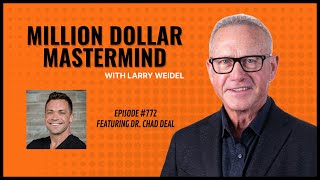
Interview (Million Dollar Mastermind, Ep. #772) with Dr. Chad Deal about using social media and entertainment to grow a medical practice. Dr. Deal explains the idea of turning patients into "fans" by showing personality and staff culture alongside educational before/after content; he emphasizes strict rules to preserve professionalism and patient safety when filming. He recounts an early controversial COVID-related video that went viral and the later shift to lighthearted skits (e.g., a Celine Dion TikTok with 40M+ views) that increased visibility and bookings. The conversation closes on systematizing operations (SOPs), hiring complementary talent (e.g., company president Rebecca McMahon), and entrepreneurial advice: plan, then take the first scary step.
Welcome to this edition of the Million Dollar Mastermind podcast. This is where we pick the brains of high achievers from all walks of life and get their hard earned real world insights on winning. I'm your host, Larry Wydell.
But those, all of your 19 people are promoted with those three people. It's not just you.
Yes, well, the individual providers, we do give them the owners of responsibility to promote themselves. We tell them all the time, people don't follow businesses, they follow people like you don't. You don't follow Nike, but you follow Michael Jordan. Right? People follow people. So if you really promote yourself and you make yourself, you know, out there and show people your personality and maybe your pets and what you like and your hobbies or what's important on your heart, and then throw in your great work, your before and afters, that's how you're going to grow. But when I go and I try to give, I even give talks on this to some other doctors you're struggling with, I'm like, like I'll pull up their Instagram and say, look, you're all commercials all the time, before and after, before and after, 4 and after, 30% off, blah blah, blah. Who wants to watch that? Who wants to watch nothing but commercials? Treat your Instagram, if it's a business, as entertainment.
Yeah.
Wow.
Now as you went into all of this thing, you're so, let's just say what did you learn about the cut, how quick did you learn about the content, entertainment? Did you study the doctor that you trained up in Massachusetts and kind of use that as a role model for starting off?
I did. In fact, I linked first with a really well known social media doctor, Dr. Miami, who's actually known as real name is Dr. Michael S. Hower. And he I think still has, I think more followers than anyone else on Instagram. I believe that he does. But he was, I think, more of the pioneer. He may not been the first, but the real pioneer to understand how smart it is. And when, if you see Dr. Miami and you look at his crazy wild skits and everything he does, you would think this guy's out of control and not a professional. Let me tell you something. That man, Orthodox Jew, wonderful husband, wonderful father, doesn't drink alcohol, is straight laced, but when he turns on the channel, you know, the skits and the funny stuff that you see. But when you go visit him, he's extremely professional, runs a tight ship, right? I mean really, really, you know, focus on giving great results or low complications. And I was like, wow, this is just a show. That's all it is. And he told me something that was really smart. He said, all right, Chad, he goes, stop wanting patience. Start wanting fans. You don't want patience, you want fans. Fans are going to be loyal to your practice. Fans will wait a long time to have surgery with you and not go to someone else. Fans are going to be less likely to have complications. They're really going to listen to you. And fans are going to be way more likely to refer you to other people. A, A patient is just going to be a patient. But if they're a fan of you and your work and your practice, it's going to be completely different.
Well, I, I know that you can relate to the fact that the magnitude of this kind of change you have to go through yourself. Because when you grow up, as you know, in a professional enterprise, and you're a professional, you try and produce the legitimate image. Like if you're in financial services, which I've spent a lifetime in financial services, you don't want to come in as like Clarabel the Clown and like, you know, where are we going to put this half a million dollar investment? You know?
Right.
You know, like you say, when they go in to see Dr. Miami in the office, you know, they're seeing a professional operation and he knows what he's doing. But it's a dichotomy there. You got really. You really gotta work that out in your own mind how to let yourself be seen as anything other than, you know, we're very protective in the professional arena, you know, protective of our image and our impression. And how did you get over that?
That's such a good question. A lot of people would never even think to ask. There is, in fact, the medical boards. Oh, they frown on.
Oh, I bet. Oh.
Or be careful. I created a list of rules that I thought would cross the line of professionalism. So, for instance, let me give you just some examples, some of my rules. I would, of course, never film anybody anywhere. In fact, no medical record anywhere. We always review the film footage nowhere where there's a medical record or anything of anyone's name, etc, in the footage, unless that person has signed a consent form for all the media, etc. So the only person they're signed. Next, we stick with more mostly strictly educational content if the patient is still asleep. So there's no dancing, there's no singing, there's no, none of that stuff. We have a patient asleep on the table. I will finish a case, tape on and everything and then explain it Looks entertaining, but I'm really explaining here's. We had to make this pocket. There was a little asymmetry, you had to do this, etc. Etc. Etc. All right, guys, she looks amazing. Let's go. Whatever. Right? Something like that. A little tagline at the end. Yeah. So I also never delay a case if. If the people that are ready to film are not ready, or I'm in clinic and the patient's asleep and they're ready, they've got the patient prepped to go and do the quick educational video. I always wake the patient up. So I will never prolong a case just so that I can get footage. Right, Right. Professional garments. I make sure all my media folks understand Cat Gal. Mask, gloves. Just like everything else, you're coming in the operating room. So all the sterility rules are really being held in place. If there's ever any use of the ors where we might be doing something colorful like dancing to a certain skit or whatever, it's always at the end of the day before a terminal cleaning crew comes in and the patients are even out of the recovery room.
Yeah.
That way there's no silliness, no fun going on unless we are completely done with the ORs for the day. And even the recovery rooms are empty. Right. And even then, we've got our professional cleaning crew come in. So it's not like we're unsterilizing anything. There's the cleaning crew that's going to come for the next day surgery. Right. So I have that and more list of all these rules. In fact, even between Instagram and Snapchat and Facebook, there are nudity guidelines that you have to follow that are completely different. Like Snapchat, you can show anything.
Yeah.
Okay. Instagram, you have to cover the buttock crease. So if, let's say you did a buttock augmentation, you can show the sides and top, but you can cover everything else. You can never show the nipple or areola. Etc. Right?
Yeah.
So every single one of them also has their guidelines to make sure your content doesn't get. Get stopped. So we had to learn all of this and make a lot of mistakes along the way, but we are big on professionalism and safety so that when the medical boards ever look at mine, they see, okay, yeah, I may be having a lot of fun, but when it comes to the patient care, that part is always strictly professional, educational, etc.
Well, Chad, we have to prove we hear these things, we get interested, maybe sold on it, but then we got to prove it. To ourselves. And so as you started your Instagram journey there, there had to be one breakthrough moment where you did a skit, you did something a little crazy, let yourself go and to prove to yourself this was okay. And so do you remember what that was?
I do, but it's not going to be what you think it is.
Okay.
All right. So the beginning of. And that matter of fact, that's probably going to make people hate me. There you go. Yeah, I'm. I'll be controversial right now. Here we go. This going to make them not like me. It was kind of the beginning. The first six months we were into Covid. My degree is in microbiology and biochemistry. And I'm looking at a lot of the data going. It's really not that bad, right? I was like, I mean, it's. Where it's going to be bad is it's going to be bad for people that are over the age of maybe 65, maybe they've got multiple you. And the number one thing was obesity, etc. That was what data was showing. And I was like, you know, the mask, I mean, that doesn't. I mean, look at what we use. Mask.
And there is no study on the mask, the system that works.
But imagine back then, this is six, right? I was.
And you're. Well, then the other thing is you're a doctor. You're, you know, you're a doctor.
So doctor having been a surgeon and wearing masks today. My degree, a 4.0 microbiology degree. Yeah, literally. So then I got on, and then if you look at one of my very first videos, I was like, wait a minute. Isn't the Institute of Virology and Wuhan. I said that, right? I said that six months into Covid. And I said, wait a minute. In that market, kind of close to that thing. So I did a video, I drew a map of China and I showed everyone where Wuhan Institute of Virology was. I did that six months in. This is long ago. I did that video. It went. I said, look, you're telling me that in all the landscape of the world, this happens to be a coronavirus research lab. This is where it was called. Discovered 20 miles away. And that this wasn't a lab leak. I said that six months and just my knowledge of microbiology and virology. And I said, I did that video. Next thing you know, it went millions of views.
Wow.
Famous actors and stuff were reposting. All these things were kind of going on. And the hate mail that I got when I did nothing but question what we were asking questions.
You were asking questions?
Yeah. I didn't even say this is for sure. I was like, my gosh, this makes you wonder. I mean, you could even make a bug. Did they make this on purpose? Did that. I mean, I don't even know. I said, you know, they have a population problem. Could it be related to that? I mean, did this accidentally leak? I was like, but I'm gonna tell you what, this is too close for me not to think this is actually a lab leak. The hate mail I got for simply asking, not knowing at the time and asking questions to the point where NPR called me to do a hit, really, really do a hit piece. They thought they were going to get me. They thought I was just a. A boob and butt doctor. Yeah, they were quickly. And I started listing off data to them on the phone and I started over why I said what I said and et cetera, et cetera. They didn't then they didn't want to do the interview.
They didn't want to know. They're not even.
Once I had data and they knew my what my background, where he was what that when I was just a boob and butt doctor who's getting famous and saying things. They were quickly wanting to do this hit piece on me. But then when they found all the rest, then they didn't publish any of that.
Amazing, amazing.
Very interesting.
That interview could have done a lot of good too if, if they publish it, you know, but absolutely amazing. But when did you get into where you said did something like silly?
So there would be these trends, you know, like maybe dance.
For those of you who are sick and tired, tired of fooling around and are dead serious about wanting to move up fast, I've got something especially for you. I've combined the best insights from over 40 years in business and making $70 million in income and compressed them into a free webinar. That's right. It's a free resource. If you want to find out exactly what the concepts are that I use in coaching million dollar earners, Register now@wloomwinning.com you'll discover the five part framework used by so many to reach their financial, personal and professional goals, you can find that link in this episode's show Notes.
Somewhere in there you had to prove yourself. Silly is okay.
Yeah, well, it was. I bring up the only. I will get to that. I only bring up that one because it was way more. That was the most negative. The most controversial by far was just being a clinician and going over data that didn't match with a political narrative.
But what's the end result of that? You lived through it, right?
I lived through it just fine. But boy, I will tell you, I learned so many lessons. I. Anyway, I, it, it actually got me to lose a little bit of faith in some of our larger medical institutions like the ni, CDC and I. And I hate to say that, but even, even the jam of the Journal of American Medical, I, I was like, my gosh, this is completely political. That's not true at all. The data is actually there that shows it. In fact, someone's telling me, you should follow the science. And I'm like, I shouldn't follow. You should stick to boobs. And I'm like, if I can't be, be somebody, both being a surgeon and the degrees I got, who's trying to look at this and give my. Anyway, I, I digress. Now, to get into the entertainment stuff, you would see these trends, tick tock, dancing trends, all this kind of fun stuff. And I said, you know, the problem is with doctors is they look unreachable, they look stuffy, they look like you can't truly have an open conversation with them. We've got to humble ourselves a little bit while maintaining professionalism and show people we're very approachable, very likable. We, we joke around like anyone else, no matter how serious the surgeries are. So I said, let's start doing some of these, you know, fun skits. And whether it was dancing or I, there's just so many you can do, right? And it took off. Boy, it, it just one or two little songs in little dance, trying to learn little silly dances that people are doing. And here they see their doctor trying this new little dance and then also doing it with the staff, so they see what the staff is like. Then I'd get some of the other surgeons who were pretty reluctant to do it with me, you know, and they started, I bet, and then boom, boom, boom, boom. And what you saw was there would be way more people go, I don't know when I'm going to get my tummy tuck done, but when I do, it's going to be with you.
Wow.
Wow, right? So it wasn't that I showed an incredible before and after in my board certifications, just the fact that our staff was likable and it looked like a fun place and a place where they could really, you know, feel, feel confident and comfortable at the same time. Then like, okay, that's where I'm going to come get my surgery done. And I thought, you've got to be kidding me. It was just being personable and approachable that made people say, look, I don't know when I'm going to get my breast augmentation or lift or tummy tuck or et cetera, but when I do, when I get my money saved up, that's where I'm going to go.
Now, how did you see your bookings? How quickly did that translate into where you got phone calls coming in and people booked?
I'm not going to say immediate, but it, it was really a logarithmic growth log rhythm. Yeah, it was just like a hockey stick type. Yeah, it really was. It wasn't like I would do a skit and the phones would light up. It wasn't like that. It was just more that for one next hit video to the next hit video. And I'll tell you one that really took off. I'll never forget, there was a trending skit with Celine Dion and it was so funny. And I say, hey, I'll use my liposuction cannula as a microphone and toss it to me across the room just like they toss a microphone and just like when they put a spotlight on a patient, but instead use my overhead surgery light. Right?
Yeah.
And then my wind blowing in the hair. Well, we have a cooling wand for after people have lasers on their face. Except to put the cooling wand in my face, I'll grab the mic, I'll belt out the Celine Dion. Of course, after all the patients are gone for the day, I hit that video. Next thing you know, 40 million plus views on was that it's a tick tock. 40 million plus views on tick tock. And next thing O E entertainment calls me up wanting the rights to the video so they can put it on their nightly show.
Wow. Wow.
You know, from a Celine Dion. And in fact, I was like, gosh, you know, I was looking about the population of America and I was like, God, I don't know how many of these views were Americans versus worldwide at this point, but I was like, gosh, that means just walking around. There's about 1 in 6 or 1 in 7 people in the United States that seen my video.
That's amazing. Absolutely amazing.
I thought, this is great. And sure enough, I walk around, they're like, aren't you that guy that did this leaned. Happened a few times.
Pretty, pretty amazing. Yeah. You know, I want to wrap this up with, you know, you've got a multi tier type approach to running your business, which really sets you in up for really amazing future growth. And I really think you stay on track now, Chad. You're going to have a chance to build a network that can do big things, can be very attractive for the monster hedge funds or to go private or something like that down the road. And I say that because of the structure and the thinking that you have put behind it. And one of the pieces that we haven't talked about, except you brought it up on, you kind of lifted the veil there when you talked about, I've got rules for my social media content to where we make sure it's in line. And that is procedures. Planning is one thing, but then when it comes into implementing and running the game plan, when it goes beyond yourself, where you've got a team, the key to a successful team is not only planning, but then having procedures in place. And like the army SOP Standard operating procedures that you've thought through, you've created yourself by doing that, you know, work. And, you know, this is the simplest, quickest, best way to get things done. And if people do it this way, it's easy for me to keep up with them because this is how I think and everything. And I, you know, you kind of gave a hint there that you are organized in all these different areas about things that you do on a repetitive basis, like, you know, washing and folding the towels. You know, it's like, you know, taking the thought process, like, how do we want this done? What are the sequences? How can I teach somebody to do this and then make sure it's done and then keep an eye on them, you know? But how much did you prioritize systematizing your. The things you want done?
I would say not enough. And I would say, actually, though you might find it a strength of mine, I find it a weakness of mine. I would say the strength has come for some great team members around me, like my company president, Rebecca McMahon. She is so good at that. And I've surrounded myself with people that I think are so good at things that I'm bad at. Yeah, I'm. I'm a little bit more of a controlled chaos guy. Right. I will see all the things moving.
Aha, aha.
Right, right. And put these into play. But finding these things and organizing and make it repetitive, these, these SOPs, as you say, so that people can follow that recip, look for success. She has been much better at that than me. Now, her background, she's a nuclear engineer and she has an mba. She came out of the corporate world. Her last job was building a help building A branch in Switzerland with General Electric. She retired at the young age of. Gosh, what was she, late 50s or something like that, I think. And then joined me to help continue this. This great growth. So we're doing more of that now because I find that as we grow with our med spas, we needed to make them more similar in so many ways. Exact same front desk, exact same smell, exact same lighting, exact same products and services, Everything same. Which made it much more attractive. If you ultimately do do some sort of PE deal, they see that this is very standardized.
Yeah.
That is most of being put in place by her because I don't think I would be good at it. Yeah, I think I could probably force myself to sit down and do it, but then I would have losses in the areas that I'm good at. I'm.
Right.
I've. I've laughed, I've said, you know, people say, like, what's. You think the number one thing you're really good at are keys to success? Outside of the me talking about just planning and I say, you know, I would say operating is the second best thing I do. It's not really the first. Even though I'm very proud of the work that I do. It's promotion, my ability to throw a party. If someone says, we want to have a great party on Friday, I can have 150, 200 people there, no problem. It's creating the energy, it's creating the vibe. It's creating this Friday. I got an idea, guys. Let's do. We'll start with a couple whites. We'll do it wine tasting like you've never had before. I gotta. If you'll bring, you know, you see, I'm already beginning to just.
Right. Yeah.
I'm gonna do a wine tasting, and I'm gonna make it big. So promotions is where I found motivating promotions. It's not necessarily marketing, but specifically promoting is what I was good at, not just personally, but professionally. And so I said, you know, if I move away from what I'm good at, what's been a key to our success, to do these things like creating all the SOPs as we grow, then I think we will falter. And I had to put those people around me that were good at it.
Yeah. And the lesson for people listening that say, I'm just not that great a promoter. I'm more of a, you know, organizer and things like that is you could just hire you, you know, promoter. You know, you hire a promoter, you know, really got that skill.
Yes, exactly. It's much more important to know what you're not good at, what you are good at.
Yeah.
And. And to. And to be humble about that and say, you know, someone is better than me at this and I need to really listen. It doesn't mean you step away, because sometimes I think the true pioneer of a company maybe sometimes steps away too much.
Right. Yeah.
You know, and they. They kind of realize, man, I really was good at that. That's what I really brought that spark into the company. We can all think of Steve Jobs and Apple. Right, Right. That person steps away. That really brought that special, you know, key element to it.
Yeah.
So I've. I've actually pulled away sometimes too much in my quest to get this right. But I will say that I'm always making mistakes. I'm never getting it right, but I'm always fighting for it to be better. And I'm enjoying the journey. I'm never hard on myself. I made that mistake. That was wrong. And Rebecca and I, we don't mind calling each other. Oh, I was right about this. Yeah. Same thing. Always right about this. So a little bit of band back and forth doesn't hurt.
Yeah. Fantastic. Well, thanks so much. You've been a lot of fun and very generous with your time. I got. I'm glad I got you on a slow afternoon in Chattanooga. And I always like to give our guests a last word. And there always seems to be one thing that needs to repeating or needs to be said that comes up at this time because I like a little extra reward for the people who've hung with us the whole time. And what would you say? People who want to, you know, they're starting out or they want to go into another phase of expansion or something and something that you'd want them to take away from this conversation.
Okay. If it's not, I have nothing to sell anyone of your audience. I've got nothing to sell. Okay. Doing this because, you know, like you said earlier, it's almost like having other kids and it.
Right.
Help people be successful. I really liked that. You have to plan. People call it setting goals. I call it planning. You have to think, okay, this is what I want. That means if I'm going to reverse engineer that and I want this before that, I'd have to have this before that. I have to have this before that. Of this, of this. And then once you're there and you've planned it out, go.
Yeah, do it.
Don't wait till you think you've got everything so perfect before you make that first move. And the first move needs to be scary. Don't say, well, I'm going to start talking to the bank. Oh, get out of here. No, take out the loan. Like, do the first big scary step. Now when you've got the plan, do it. And I think people, number one, they don't either plan enough or they get to the start line of that first big scary step and they never take it. They want to keep planning it and they want to keep having a meeting to have a meeting, to have another meeting. And later on they regret it and they never do it. And maybe someone even took their idea. And I would say that's the biggest thing I see is either lack of planning or that first scary step, not making it.
And the, the point is the world is moving fast and the, if there's a great idea you see out there, you better jump because somebody else probably sees it too. And the quicker you get in, the quicker you can start improving and make it better and build a lead over the people coming behind you.
So, absolutely.
Well, I'm excited about what you're doing. It's a lot of fun to meet you and talk to you. As I said, I've seen you on social media and I'm gonna look forward to seeing what new skits you come up with and enjoy seeing your business expand in the future. And so let's stay in touch. Let's do this again down the road.
Oh, it was. Oh, the pleasure was all mine. And honestly, I'm humbled that, that, that you paid attention to my, to my little channel and to my audience and, and spent the time to want to get to know me. Really, that's, that's a blessing.
Well, I think it's more than a little channel.
We're doing okay.
Thanks so much.
Appreciate it. Thanks for listening to the Million Dollar Mastermind. If you felt there were any valuable takeaways from this episode, please take a minute and leave us a five star review. Your feedback is important and really helps us get the word out to a wider audience. Remember, we have a valuable webinar that is absolutely free. Register for it right now@whiteallnwinning.com thanks for listening.
More from Larry









Rick Jordan on Self-Engineered Proximity, Cyber Security Moats, and Truth-Based Leadership

Fire Fast or Fail Slow: Kevin Brittingham Reveals the One Rule That Built a $100M Empire
