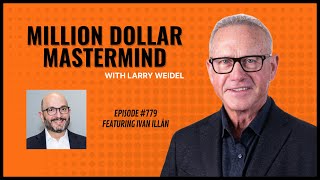
Podcast interview (Episode #779) with Ivan Illan on building resilience and a financial-advisory business in an unpredictable market. Illan describes lessons from earlier setbacks, starting his own advisory practice in 2005, embedding as a money manager with insurance-focused RIAs, growing via referrals to about $200M AUM in direct retail clients, and pivoting to market investment solutions to other RIAs; the episode includes career anecdotes (e.g., working at Nuveen) and practical advice on diversification of prospecting methods.
Questions this video answers
2005.
About 350.
About $200 million.
Nuveen.
Foreign.
Welcome to this edition of the Million Dollar Mastermind podcast. This is where we pick the brains of high achievers from all walks of life and get their hard earned real world insights on winning. I'm your host, Larry Wyd.
Those scars that you accumulate from those experiences pay dividends down the road, are very educational. Like, one thing is you learn not to put all your eggs in one basket and, you know, have lots of possibilities. Because one of the unwritten rules I learned early on is if you need a deal to come through for this to be a great year, a great month or whatever, it's not coming through okay if you need it. And so the only way is to have so many things out there that I've got so many possibilities, something's gonna come through.
Absolutely. I find that. I mean, I was just having a meeting earlier today with a team member and I was describing that exact thing, which is, we have a particular effort, we have an initiative underway. But I'm not relying on that one method on how to achieve this thing. I've got multiple methods in place going after the same destination because I don't know what's going to work. I cannot be attached to one thing working more or better than another thing to get me to the same destination.
Right. The unpredictability of life. This is my reason why I love to do these talks, Ivan, is that it dispels the easy answer type things you get from people that are interviewers or professors or something that write about winning and just follow this formula. 1, 2, 3, 4, 5, 6. It's. That's great in a particular situation, if everything worked out perfect. But things never work out perfect. You got to think on your feet. You've got to adjust. You got to have enough experience to where you can kind of coach yourself to stay on track through these things. And you got to have, you know, it helps if you have people that you can, you know, call up or talk to on the phone that know your situation, can. You can kind of get your restack your bearings if you get knocked off your, your feet. And so all of these things play into our advantage, to our advantage if we see them for what they are and we keep on moving. And so how did you move on from that? Because I'm really curious about now. You've learned some lessons, you're going to move on. You're cautious, you've got that behind you. Yet it sounds like there were other event or two down the road to where the tears came and the sleepless night.
Definitely. I mean, so this was a big lesson for me. And the lesson that I learned, that first lesson was I cannot put my fate, the fate of my income, very specifically the fate of my income, I cannot put it in the hands of someone else. I have to really own the full cycle of it. And so this really shifted my perspective on the investment banking side, which is deals can get pulled and you can work for a year on something and not get your payday because somebody somewhere decides something. And so I had all this experience working with financial advisors because they were the clients, they were my clients whom we distributed financial products to and investment products. And so I thought, I've seen a lot of these guys work and it seems like they go to lunch a lot, they play golf a lot, but I don't really see anybody really advising or maybe even knowing enough. I was training people on how to put together a portfolio and, and what is that supposed to look like? And here's how you use this product in this way for this solution. And then they would go to their clients and present that. And I thought, that's, that's great. But you know, maybe if I was a financial advisor then, then I could bring something to the marketplace that was maybe a little different than what maybe the typical financial advisor was doing at the time. And so that really set me on a course to starting my own practice, just becoming a financial advisor, starting from scratch. And ultimately that is what I did. And by, so by 2005, that's when I started this practice from scratch with nothing again, starting over with nothing.
How do you. People will wonder, you're in a professional enterprise, how do you get your prospects? How do you get started? Build that client base, how do you go through that? You know that, you know, it's like an account attorney or something. You start, you open up shop. Now what? You know, you gotta have somebody come through that door. So how did you get people coming through the door? Was that a little nerve wracking?
Well, I approached it very strategically from day one when I knew exactly because I served around 350 broker dealers and registered investment advisors around the country. So I saw the whole landscape of it at the time. And so I had this idea again. I had an idea and it was in my head and I was like, I couldn't get rid of the idea. The idea was to embed myself as an investment manager, as a money manager, embed myself with financial advisors who focus on another aspect of financial advice or financial planning. So, so I very strategically approached a insurance owned corporate ria that most of the advisors there were insurance advisors. That was their primary mode of business. And I figured, you know, these guys are doing business that they don't have to apologize for, usually because it's safety, it's guarantees, they're selling, you know, risk management product and if, but. And they have securities licenses, but they're not necessarily doing anything with it. Maybe accommodating a college savings or IRA rollover, but they're not managing it, they're just sort of allocating it elsewhere. And so I figured maybe if I embed myself in that kind of environment, I can be the guy that they can bring along. We can do joint work. We can now they'll have an extra tool and another resource, not only for the client to be taken care of, but also for them to have this other revenue stream. And so that was the idea and it was a very good idea. I built a very nice network of these advisors throughout the country over a period of 17 years. And some of them along the way ended up consolidating those assets and those practices into the firm that I have today.
When you start out by yourself, how big is your firm now? What's a good size firm for you to operate with? Yeah, we've never.
So this year is actually different for us because we're now for the first time marketing our solutions to the Marketplace. And so RIAs independent financial advisors can actually leverage our investment offerings for the benefit of their clients. So we have what I would call it more of an institutional process underway approaching RIAS having those conversations. And that was the point of sort of evolving away from that corporate ria. So yeah, our foundation is our direct retail clients. And that's about 200 million of assets under management. Some of that is non discretionary, but all of that has been just through direct client referrals and just our own direct business. And so from my standpoint, just like for the reason why I wrote the books is I like sharing information, I like sharing intelligence, I like sharing insights. And so now the big pivot is we have wonderful direct clients and we're very loyal to them. But for the future of this business, for the second half of my career, it's really about sharing with other firms, sharing with other colleagues. And so growing the business in that way is very exciting to me.
Yeah. Now how did you wind up in la? Why are you living in Los Angeles of all places?
Yeah, I mean LA, that's where Nuveen moved me back in 1998. So I, because I said I'm kind of done doing this administrative development stuff in the home office. I see you have a wholesaling position open in Southern California. I'm going to be perfect in that role. Really? You don't love Chicago? I said, I'm thinking I've been through two Chicago winters. If I do one more, I don't know if I'm going to make it on this planet. So I really pushed hard for it and they gave it to me and that's how I got out here. And Certainly in the 90s, it was a very different place than it is today. It was a lot less crowded. The weather is perennially beautiful and not too fussy. So. So I've kind of stuck out here. But I've traveled around the world and done business around the world since and. But it's home base.
Thanks for listening to the Million Dollar Mastermind. If you felt there were any valuable takeaways from this episode, please take a minute and leave us a five star review. Your feedback is important and really helps us get the word out to a wider audience. Remember, we have a valuable webinar that is absolutely free. Register for it right now at whiteallonwinning.