Episode #794 - Transform Your Passion Into Profit with Stephen Scoggins
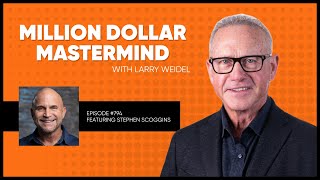
Stephen Scoggins, who runs the Unstoppable Show podcast with 120k YouTube viewers, talks about turning thought leadership into recurring revenue through masterminds and retreats. He built a lean team of four core people and emphasizes hiring slow, firing fast, and prioritizing impact over income.
Foreign.
Welcome to this edition of the Million Dollar Mastermind podcast. This is where we pick the brains of high achievers from all walks of life and get their hard earned real world insights on winning. I'm your host, Larry Wydell.
What are your other companies right now?
Well, the, the one that I exited was a roll up of four, so I'm down to house instead of seven. One is a, is a real estate business, as you can imagine, which is an investment company. The other is Scoggins International which is media events and empowering education. And recently I began working with other aspiring and developing thought leaders to help them build out the infrastructure that they need to have a sustainable brand. A lot of thought leaders that are up and comers, they got a really good presence, they're doing really well in social media, but they don't have a business yet. A lot of times they don't have a business, they never ran a business. Yeah, they're really good at teaching a concept or, or content, but they don't know how it all comes together. They don't know what automations are, they don't know what needs to be delegated or eliminated or so I began working with a guy by the name of Randy Garn in that third business where we develop thought leaders.
What is the name of that business?
I. We're still, still toying with the idea of the, of the name of the business right now.
Yeah, you and I might talk.
That's one of the reasons I made that. Utah.
You and I might brainstorm a little bit on, on that if you're, you're interested. Sure. Because I've got a fascination with that myself. Talk about your. When you wrote the book. When you wrote the book, what was motivating you there and when did you write the book?
So I wrote the Journey principles back in 2014 and it was a way for me to process my Forrest Gump of a life to that point. For any of the readers that have read the Journey Principles, it never fails that a lot of readers have one or two or three chapters that they personally identify with. I wrote it in such a way that allows for a conversation to take place with a lot of, well, questions I was asking myself, you know. So for example, a silly question was what does it take to change the essence of a man? Like how do you actually create behavioral change and a human being that has been operating on a program since the day they were born? How do you have a pattern interrupt that allows you to do that? So that was one of the core Concepts. The new book, Unstoppable Startup, will be releasing late next year. And that's designed to be a strategic life plan, a business plan, if you will, for entrepreneurs who ultimately want to build and scale a business without losing their family in the process.
Yeah, talk about your podcast. That's called the Unstoppable Show.
Yeah, I mean, so it's. So all things are unstoppable. So for anyone who knows my backstory, one of the things that I love is I love other people's stories that they just decided not to give up when everyone should have thrown in the towel at any given moment. We've been very blessed to have a lot of really cool guests on. And in that show, One of the core concepts we're looking for, strategical thought that can drive tactical action for every single listener that listens, listens, or watches the show. We just tripped over 120 some thousand folks on YouTube, countless downloads. So it's a really cool way to allow people to see their own stories within the stories of other people. Because a lot of times if you're going through a difficult circumstance, it's very easy to, to get lost in the fact that this is my story. I've got all this stuff going on. This doesn't happen to anybody else. It only happens to me. And when you can showcase countless stories of people who became incredibly successful after going through incredibly difficult things, by definition, they were unstoppable because they kept moving forward. You're able to give inspiration, hope, and tactical action steps. So that's kind of our heart by the show.
Explain that phrase. Tactical strategic. Explain that. What, what's, what's the thinking behind.
Yeah, yeah. So a strategical concept will have tactical action steps mixed in the middle. So if I say I want to increase my income by a hundred thousand dollars next year. Okay. And I can. I have a bring a guest on that can actually talk about how to actually do that. Each show should have four to five aspects, four to five tactical steps that the listener can take immediately following the show to begin to set the dominoes up in their favor. So a strategical process is what needs to happen and what time frame it needs to happen, and how does it need to happen, and more importantly, why does it need to happen? And if all of those line up, by definition, you're going to have milestones that shake out of those things that become the tactical action steps.
And give an example. Can you think of an example of a recent one that you had on?
Sure. One recent example is a guy by the name of Light Watkins. Light Watkins is a minimalist by nature. He's. He's very successful financially, but yet he travels everywhere and lives nowhere. And one of the key principles that he talks about, this tactical, is a meditative practice that allows you to basically let go of what you can't control and focus on the things that you can create movement on. A lot of us, I think J. Mar to say minor in the major things.
Yeah.
Or major in the minor.
Major in the minor.
Right. It's that. It's that concept. You're. You're focused on the wrong stuff, which is why you're not making progress.
Yeah.
And by learning to let go of what's in your way and kind of those roadblocks, rather than focus on them, you're able to put all your energy and attention into advancing yourself.
Yeah. And so how long have you done the podcast?
We are pushing our. Almost our third year now.
Yeah.
Yeah.
And so what has it done for you? I mean, is it. How many people are involved in this project? Is it primarily you and your staff, or do you have a outside firm that kind of works with you like I do with fame, you know, out.
Of a. Yeah, I. You know, we do it all internally. It's. It's. It's more of a. For us, it's more of a. Kind of a quality control thing. I'm very particular on how I like the things to be released and launched and stuff like that. And I was unable early days to find an outside partner that could come in to help us really structure it, with the exception of our producer.
Yeah.
Our producer, Bo, has been with me for three years. He's a big reason why we have some of the guests that we have on through key relationships and things that he's brought to the table. But more importantly, our entire team comes together and we position the content from a place of why do we do this? The way that serves the audience best.
Now, how many of the core team do you. You know, I know you're going through a transition. You've downsized, you offloaded. How. What. What kind of core team are you maintaining with you right now? Because I'm sure it could expand at any time as other things open up.
Yeah. So our Nucleus is only four people. Yeah. We only need.
Amazing what you can do.
I didn't 100 like I had with the other business.
Right.
The nucleus is four. We can expand for events up to 25, and then we kind of. We kind of stay in that. One of the things that I discovered this is, it's going to sound kind of crazy, but is I never wanted to build a business as large as the last one that I just exited. Right. I'm more than okay doing, doing well and doing and doing and, and making impact and making income along the way. I'm okay with that. But I'm looking for peace of mind nowadays.
Yeah.
And, and I can build a sizable thought leadership business that does quite well with a lot higher margins than construction and allows me to bless my team at a lot greater level. Cause I'm a big person of overflow. So whatever comes in, overflows out.
Well, the thing about that, Steve, is until you push the limits, you never find out where the edge is for you, that you, you know what you really want. And now that you've done that before, it's easier for you to kind of have a feel the instincts for that. And the greatest thing we deal. I love this phrase that the founder of our previous company said. He said you work to get to the point where on a daily basis you instinctively do enough of the right things to get ahead. But once you've done enough, enough is enough for that day.
That's right. Well, the reality is that you get, you can get to a place where you've invested in your team and your business so much that you get more choices. Ultimately, every entrepreneur wants greater levels of freedom, which is ironic because you have to build a sustainable empire, if you will, to have a greater level of freedom, which is kind of. So it's kind of, kind of a counterintuitive or counterproductive until you get to the place of where you'd invested in your business. You've invested in your management team, you've invested in the ERP systems and the infrastructure and all the fulfillment processes where now you can literally run your, your entire company by management Dashboard. Right. Your management dashboard gives you all the widgets, all the things that you learned along the way of what needed to be in the management dashboard. And you just get to a place where you get more lift for the effort.
Yeah.
So if I invest an hour of my time, I can get eight to 10 hours of productivity, whereas the former me would have to spend 12 hours to get one hour of productivity.
For those of you who are sick and tired of fooling around and are dead serious about wanting to move up fast, I've got something especially for you. I've combined the best interest insights from over 40 years in business and making $70 million in income and compress them into a free webinar that's right. It's a free resource. If you want to find out exactly what the concepts are that I use in coaching million dollar earners, Register now@widelonwinning.com you'll discover the five part framework used by so many to reach their financial program, personal and professional goals. You can find that link in this episode's show.
Notes.
How has your life changed from early on? How would you look at it in terms of options that you've got, opportunities that you have that, that are way beyond what you thought you were, you know, were headed your way. One thing we like to point out to people on the way up is you've got goals in mind. You think there are going to be certain rewards, but if you keep your head down, you'll find out the payoff is so much bigger and in so many more ways than your wildest dreams that you can't even think of when you're starting, you know. But how has that unfolded for you?
You know, I think it's, I think it's a lot like human nature, right? So you start an endeavor for what you need and want and then over time, as you grain in wisdom and understanding and experience, you realize what you really want to do is you want to build something that outlives you, which means it's now focused on others and not you. The people that you mentioned, John Maxwell earlier, when, before we hopped on air, awesome guy. One of the reasons he's been so uber successful is because his entire organizational structure, whether his management team or people he has on his, in his, in his, his sphere of influence are all impacted by him on a daily basis. John has made massive impact and as a result, he gets to make income via flow rather than force. So I've also gone from force to flow, right? So I used to have to force it to make it happen. I got to make it happen. I got to make it happen. And now because I'm, I'm able to position it in an act of service of helping others do different types of things. Helping business owners, helping thought leaders, you know, helping my team. Now, income comes in as a byproduct of flow. And.
When you talk, expand on that. Like if you're talking to a thought leader and they want to turn that into realize, you know, to monetize it basically. The thing is you can't, not everybody can go out and get 20, you know, 20 million followers on YouTube, you know, or, you know, like what do you do before, you know, from start to where you get the 20 many follow 20 million followers on YouTube.
Well, the. The biggest mistake I see thought leaders make. There's a massive mistake I see thought leaders make. Thought leaders try to build their entire infrastructure and organization based on another or a handful of other thought leaders. So I'll give you an example. What works for Ed Mylett, who's a friend, does not work for me. Okay. What works for ET doesn't necessarily work for me, but it's closer. Closer in alignment to what I would do. They. They've managed to monetize their. Yeah, Eric Thomas. They've managed to monetize their brands in different ways with different parts and pieces. So Ed has a lot more endorsements now and things of that nature that go on top of his speaking plus his other. His actual business endeavors. ET Is almost exclusively speaking and training. Okay, I had another thought leader I was working with and we were like, all right, well, if you're going to be a successful thought leader and build a business, you have to have two things. You have to have a reoccurring revenue model, provides cash flow. You have to have a margin maker, things that actually create profitability. And so we were breaking down the different types of products and services that could fit in either one of those buckets or so or those silos. And one that works for a lot of people is a mastermind concept. Okay. You have a thought leader, you're seen as a thought leader. You get a group of 10 or 20 or 15 people as part of a mastermind. They obviously pay to be part of the mastermind, and then you give them as much value as you can give them. Okay, That's a. What's called a one to many offer. Okay, well, in this particular case, this thought leader I brought in, I said, well, this is a concept. What do you think about it? She goes, honestly, it sounds exhausting. I'm like, really? She was like, yeah, being on like calls all the time. And I'm like, okay, well that. So that's not going to work for you. But actually, had she force fit herself into that, she would be trying to monetize in something that she wasn't passionate about. So what we did for her is we actually created a retreat model where she actually takes a group of people. She'll spend the first half of the day training and then hand off, hand off to a certain level of coaches for her and then have a night, kind of a night social and have a retreat on a beautiful destination. So she still gets to teach and exercise that muscle, but she doesn't have to do all the heavy lifting. That's where the coaches come into play. So that model ended up making her close to seven figures in year one because she was passionate about it and she was passionate about how she was serving and she was able to serve in an organic and authentic manner.
Yeah.
So a lot of thought leaders don't get to that research. A lot of thought leaders are, well, let's just do what John's doing or let's do what Dave Ramsey's doing or let's do what Ed my. Let's do it or let's do with like they're just. They're copying rather than being the number one of themselves. Right. So I'm really good on stage. I can teach on stage. I can teach on an online platform. You know, a mastermind. I could. I can't really do a mastermind that's recurring. I can do a once a week coaching call with a bunch of people. Right. Because I'm looking, I am personally looking for a time on return of. I'm sorry, return on time.
Right.
So if I invest an hour, how much lift can I get if I'm on a digital process? I got a digital concept, unstoppable startup, for example, a curriculum that people can watch at their leisure. But then on top of that, add coaching and mentorship along alongside of it. I'm spending probably 80 hours creating the curriculum, filming it all, getting it all done, but it's done. That's my reoccurring revenue model. Okay. The coaching concept and the other things like that is I only want to work with people that are serious. I don't want to work with people that are. I'm gonna, I'm gonna invest an hour. We're gonna talk through things. Going to talk about building your business and you take no action. Right. So you get to be more selective when you start building out the packages in such a way that are authentic to you. So my number one thing for anyone who's aspiring to be a thought leader is build out a monetization path with a reoccurring revenue model and a margin maker. But make sure the products or services you're offering are authentic to what you want to do and how you show up best in the service of others.
What would a margin maker be different from? Recurring revenue stream? Yeah.
So margin makers that with the retreat model, most people can't do a retreat every. Every week. You're still trading time for money. Okay. Margin makers, in a grand, in, in a roundabout way, are still trading time for money. Reoccurring revenue models are typically set on an automated sequence. Once you, you have people come into the program, they have a great experience that that program begins to build on itself and then that leads your, leads them ultimately to the margin makers where they get to spend more in depth time with you one on one or. And a coaching concept.
Yeah.
The margin makers themselves are only happening a handful of times a year where the reoccurring revenue model sequence is happening throughout the entirety of the entire year. That's probably the biggest difference between the two.
What are you, how have you, you know, we're talking about your journey and what have you learned, you know, that you could pass on to people that are on the way up, maybe they're in the middle of their big project and you know, on the other side of the mountain where you sell that, you, you retire from it, you move on from it, but you still have energy, you still have things you want to do, ideas to pursue. But again, you go from 400 people in multiple states to like four people and.
Foot said it's a lot more fun to have a smaller team.
Yeah. What, what have you, what, what are the light bulb things? What have you learned about that, that maybe you didn't, you weren't aware of going in?
I would say that I chased income over impact way too, way too much.
Yeah.
So I've reversed that, I think. And I say let's look at it this way. You can have a service based business that may not make a worldwide impact, but you're making an impact on your customer base. So how can you make the most positive impact on your customer base and the community that you're serving in? Okay, so how can your plumbing company not only serve the customer, but create a community, give back program or feed people in need or whatever, that stuff is a whole lot more fulfilling. And as a byproduct, ironically, you end up making more money along the way. So I think impact before income always, I think was number one. Number two, hire slow fire, fast, delegate and mentor often because that, that one thing had me hold on to people way too long that impeded the progress of the business, which created more frustration and a lower level of a lifestyle for me.
Yeah. Unbelievable. Well, I appreciate your time, Stephen. That's been a, you know, a lot of fun. And before we go, do you think you have one last thing you'd like to pass on to the leaders and high achievers that are listening here today?
Absolutely. I would say it this way, the word unstoppable is not is more than a word. It's a lifestyle. And to become unstoppable, all you have to do is get yourself back up one more time. Then you look, then you fall down and you'll be unstoppable.
Unbelievable. Thank you very much, Stephen. It's been a ball. And I wish you the best in your new adventures over there. And maybe I'll stop in and see your, your operation over there when I come over to ski in Salt Lake.
Come on. Anytime, my buddy.
All right. Thanks so much.
See you, buddy.
Thanks for listening to the Million Dollar Mastermind. If you felt there were any valuable takeaways from this episode, please take a minute and leave us a five star review. Your feedback is important and really helps us get the word out to a wider audience. Remember, we have a valuable webinar that is absolutely free. Register for it right now@whiteallonwinning.com thanks for listening.
More from Larry









Rick Jordan on Self-Engineered Proximity, Cyber Security Moats, and Truth-Based Leadership

Fire Fast or Fail Slow: Kevin Brittingham Reveals the One Rule That Built a $100M Empire
