Episode #798 - This Accidental Entrepreneur Reveals His Secrets To Win In The Luxury Brand Market
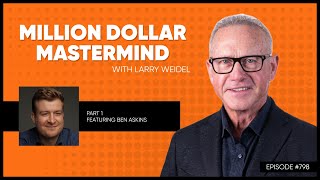
A conversational interview (Episode #798) where Ben Askins recounts his path as an "accidental entrepreneur": starting a digital marketing agency at age 20 focused on luxury and premium brands, growing it over ~9 years, and selling the business in 2021. Key themes: building credibility from zero (doing free work to create a portfolio), service-based businesses as bootstrap-friendly first ventures, psychological drivers (youthful confidence, competitiveness), and practical routines for productivity (weekly inbox clearing, avoiding morning meetings). The episode includes examples of high-end clients and reflections on discipline, networking, and work habits.
Welcome to this edition of the million Dollar Mastermind podcast. This is where we pick the brains of high achievers from all walks of life and get their hard earned real world insights on winning. I'm your host, Larry Wydell. Hello, everyone. We're talking with Ben Askins and he's kind of the leader, one of the leaders of the new generation of leaders around the world making a mark in business. So welcome, Ben.
Wow, that's quite the intro. Very, very nice to be here.
Yes, sir. And you know, you've had a lot, you've traveled a lot of roads, made a lot of progress in your early career in business and in reputation contacts, dealing with global brands. And I'm sure you picked up a lot of valuable insights about what, you know, the way the world works and the way the world doesn't work and how to be successful out there. And because, you know, this is a big company, all the way down to individuals, the principles of winning and making the right choices come down to a lot of the same principles that work consistently over time. And the quicker you can learn those things, the quicker you can start being productive yourself. So when did you get started on your entrepreneurial business leadership type adventure? What was going through your mind at a young age that sent you in this direction?
Yeah, it's really interesting. I do get asked that a lot and I'm kind of what I'd call an accidental entrepreneur in a lot of ways. So I was all set to go down the sort of more traditional job route, as it were. So at university I did work experience, found this insurance company which I quite enjoyed, did a little bit of work there, and they got offered a job at the end of college or university and I was all set to do that, moved to London and then the company was bought that I was about to join and so kind of left with nothing to do. So sort of had already moved to London. And then I met a guy called Chris who was my business partner of my first business. And he sort of said, look, I'm, you know, thinking of doing this thing. And I said, that sounds absolutely amazing. We couldn't have had less of a clue, but we decided to start a digital marketing agency. So I was 20 at the time when I started this. So we decided to start a digital marketing company that essentially provided marketing for luxury and premium brands. And so we set our store, had a tiny little office and slowly grew it over the next eight, nine years. Really.
Did your partner have experience in digital marketing?
No, neither of us did. So he had sold A few websites to make a bit of money at college and I had, I. I did Latin and Greek at university. So our experience on the digital front was absolutely diddly squat.
So how do you go from diddly whatsoever? How do you go from diddly squat, experience and track record, plus you're young. To getting deals with these global brands, you know, Jimmy Choo and Claridge's and you know, these big global brands, the Aston Martin, Omega, Mayburgh Hotel Group. How, how do you go and get your foot in the door there to do marketing for them? Seems like they would have shown you the door.
Yeah, well, I think the lucky point we had was we were so low down that the only way was up. But essentially we started off by doing things quite small. So when you have no experience, no background, no nothing, you've got to build up credentials. That's kind of step one. So for us, we were young, money wasn't an issue for us at all. So we're very fortunate there. Had no dependents, had nothing like that, very much on a student budget. And so the opportunity we had was to build our credentials. So we started off by doing work for free. So we'd go around and say, look, we'd give you, we'll do the free work for you, we'll give you a website, we'll give you marketing support, whatever it is. And in return all we ask is you give us a shout out on your socials, you give us credit on the website, et cetera, et cetera. And we use that first wave to kind of build out our initial set of clients. And then off the back of that, we started to leverage those clients to start charging people initially, which was a very exciting moment. We still remember those first paid jobs and to slowly start building out the sport from there. So every sort of raft of clients would then fund the next round or next step up from a sort of size wise. So you don't go from nothing to Aston Martin, but you start off with like small blog sites, you then start work with small businesses, then you start working with medium sized businesses and slowly you sort of build out your portfolio that way. So there was no sort of real trick to it, it was just slowly identifying who we wanted to work with and slowly sort of building up our raft of clients from there. Really?
How did you get the idea that would even work? Where did that come from?
Yeah, so, I mean, to be honest, it was our only really real option because we were young, we had no experience with no real skill set. And so we kind of had to do it that way because genuinely there's no other reason why someone would work with us. So we had to do it that way. It was our only choice. But we'd understood, you know, we worked, you know, we had a good understanding of like how people worked. We'd seen a couple of agencies in our space be sold just before we started and all of that sort of thing. And we just used that to slowly leverage it and build it out from there. And so it kind of was our only route to success really.
Yeah. So the point there is seeing a living, breathing model you would like to be yourself really gives you a head start towards patterning, you know, building those patterns because you can see it happening before your eyes and you see that it works because they're successful and it's easy to believe that this could pay off for you. Was it frightening at that time? What kind of emotions do you go to? Because there's, you know, because you went to that and you went through that to where you were start being able to build. And how long did that take by the way?
So we sold at the 2021. So it was about a nine year journey. All in. We sold Verb. It's interesting. I was never afraid in the early days. I think I was so clueless, didn't know enough to be afraid. If you ask me now I am a lot more scared in my entrepreneurial journey I am today than I was at 22. What you want to make of that? Psychologically I don't know, but I'm a lot more aware of the decisions that I make. I guess it comes, you know, you go from incompetently incompetent and things like that. And for me, I was so incompetent and so clueless, I didn't know enough to be afraid. Whereas now, you know, I'm far from the finished picture, but I have enough experience to recognize that some decisions I make do have wide reaching consequences. And um, and so I'm away way more afraid now than I was back at 22. The one big advantage we have was we're a service based business. So I always say there's a lot of young entrepreneurs say, you know, what should my first business be? I always say get in the service base because you don't need investment, you don't need funding, you don't need anything to get up and running. You can bootstrap it hard. And because if you're young, you often don't have the credentials, you don't have the appearance to kind of People trust you with money. To fund a company, you have to bootstrap it. It's very rare you get funding or certainly funding at an acceptable deal. And so I always recommend a service based, like a digital agency, like a sort of, well, any sort of service base, because that's the best way to get your foot in the door from an entrepreneurial perspective.
And one thing that you did right, that I like to point out, was you did not look for a handout or someone to come bail you out. You didn't like, stay on the dole and wait for other jobs to, you know, the economy to shift and jobs to come back. You went on the, you know, you figured out this is our only option. No one's going to bail us out or solve our problem other than ourselves. And you dove right in. What do you think caused you to have that up take charge type approach?
Yeah, I don't know. I think it goes back to, you're weirdly confident when you're young. Sometimes you really are, like, overly confident, I would say, in a lot of ways. And I think for us it was just a case of it sounded fun, it sounded interesting, it sounded exciting. And when you're young, those emotions matter, right? You know. Well, like I said, you know, go back to when we were, we had no dependence. No. Why, you know, nothing that, you know, would, you know, we were completely free in that sense. You know, we're very lucky. I think it's one of the advantages of being young when you start a business is you don't have the pressures of a mortgage and all of that sort of thing. And so I think when. So when something gets exciting, you're really happy to work hard on it. And so for us, it wasn't a sort of negative perspective. Oh, what we're going to do, our backs against the wall. It was like, no, actually, we really want to do this. And we think. I never thought we were crazy, right? No one thought, you know, how's your little business going? How's your little company or how's your little whatever. Everyone used the word little for the first two, three years of our journey. And it was only after we kind of become established that people started to recognize what we built. So I think people laughing at you is a big motivation, like wanting to prove people wrong. I remember a couple of networking events early on where agencies who are much bigger than us would sort of go, oh, you know, they treat you like the kid brother, right? Which is nice in a certain way, but it's quite patronizing. Quite quickly. And so that was always a driver for us, just being that and super, super competitive, I think, which you have to be in this sort of world, really.
Where'd you get the competitive streak?
Having three siblings and playing a lot of sport when I was younger.
I suspect playing sports at early ages are great trainers for so many things you need later in life. You know, learning to work with a team, learning how to deal with defeat, learning how to compete in a game situation with a clock running, getting behind, coming back, taking charge and that. I find that a lot of people who, they go through their formative years without being in a competitive situation of some kind, kind of at a disadvantage, you know, it's almost like prepares them to be an employee because when you're out there on your own, you got to compete. You've got to, you got to find that fight inside yourself. And it sounds like those, your networking events did you a big favor by putting you in front of people that could kind of hold you in contempt and let it be known they didn't think much of you.
Yeah, it does. And those little, those little things have an. But, you know, I still hate networking events. I mean, I don't know many people who love them, but even now, and I think it probably does go back to those few early car crashes where we would go, you know, very proud of our business and people just, just completely ignore you, basically where it's interesting, you know, that. So I still don't like networking events. So I do find it interesting how those early lessons in your career really do stay with you. So now a lot of the sort of rules and guidelines that I set myself very much come from either horrendous mistakes I've made or experiences where I felt particularly powerful, either positive or negative emotions, and basically just never want to sort of go through that again. So. Yeah, no, I totally agree with you. And I think sports, sport for me has always been outlets. I'm one of those people, you know, if I want to de. Stress my long day exercise for me has always been that, that thing for me. And I, I find running incredibly boring, if I'm being honest. So for me, team sports is the natural answer to that. So. Yeah, I totally agree. And growing up with brothers and an active family, it, you know, it stays with you for sure.
When you say rules and guidelines and I set for myself, what's the first thing of those that would come to your mind?
Yeah, so I. So the first one is every Sunday, without fail, I clear my inbox. So my inbox is my to do list. I'm very strict about what emails I respond to and what emails I get cc'd in and all that sort of thing. And that comes from the early days of the business where I completely lost control of my inbox and felt like I was drowning under messages but didn't hire quick enough and all that sort of thing. So for me, I sort of decided that every week I start Monday morning with a clean inbox. That's just what I do. It's just how I sense myself, how I get ready for the day. And I don't think I've ever missed that. I really haven't. Even if I'm on holiday, you know, whatever it might be. So that's like an obvious example of something I do every week without even thinking about it. It's just I won't be able to sleep as well as I could if I didn't do that. So it's just stuff like that which sort of get ingrained in with you where. Because a lot of people go, oh, you've got to like, be disciplined. I kind of. I agree and I disagree with that. I think discipline comes from something that's naturally ingrained with you. If you're always working on discipline, I don't think you have discipline. I think discipline, you train your body to do it, that you just almost do it without even thinking. And that's kind of always been my view about things like that.
I couldn't agree more. Because it's like you grow into these discipline behaviors automatically from an internal desire to. You see ways of making things easier for yourself or less painful yourself or to offload stress. And you wind up doing it because, you know, it's mates. You know, you realize this is going to make my life easier. And so you're not doing it because of some commitment you made to discipline or to obey the rules. You're doing it because this has got a payoff for me, you know, and I'd rather do that than not, you know, start the week under the, under the gun with a pile of emails hanging over my head, you know, and so that's a, that's a great point.
And I think it goes. I think you have to be smart about it as well. I mean, another good example is I hate morning meetings. Always have. I've never, always struggled to get going in the morning. I've always done late nights. I always have. I find it easier to work in the evenings, things a bit quieter. I get a lot of my thinking done then and So I kind of set my day up for that. You know, I try and get a lot the sort of easy tasks out in the morning and know that I do my best work after lunch. And that's not, you know, I don't know, would you call that discipline or would you sort of recognize that that's just me understanding how I like to work, what's best for my business and going through the motions like that.
I think that's one of the keys to being successful for a long time, a long run. You know, you develop an approach to life and business and projects that suit you, that you have discovered fits you and where you can be the most productive. You know, that's the whole idea. How can we get ourselves to be the most productive and have the best attitude too? You don't want to be going to these networking events that this always puts me in a foul mood, but I'm going to go to it. It's just, you know, you find the things that put you in a good mood and people put you in a good mood. The situations you design, the systems. And I think that's where a lot of good discipline kind of comes from. Thanks for listening to the Million Dollar Mastermind. If you felt there were any valuable takeaways from this episode, please take a minute. Leave us a five star review. Your feedback is important and really helps us get the word out to a wider audience. Remember, we have a valuable webinar that is absolutely free. Register for it right now@whiteallonwinning.com. thanks for listening.
More from Larry









Rick Jordan on Self-Engineered Proximity, Cyber Security Moats, and Truth-Based Leadership

Fire Fast or Fail Slow: Kevin Brittingham Reveals the One Rule That Built a $100M Empire
