Episode #801 - Trading Politics For Silicon Valley Dreams with Alan Pentz
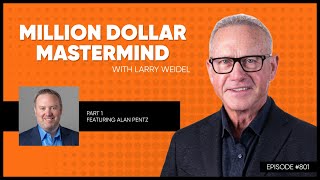
A conversational podcast interview (Million Dollar Mastermind) in which host Larry Weidel speaks with Alan Pentz about his career trajectory: early interest in politics and Capitol Hill work, an MBA pivot toward technology, the post-9/11 return to Washington D.C. and entry into government contracting, and ultimately founding his consulting firm (Corner Alliance). The episode emphasizes lessons learned about the realities of government work, transitioning into entrepreneurship, the importance of sales and client relationships in professional services, and building teams to deliver consulting work.
Welcome to this edition of the Million Dollar Mastermind podcast. This is where we pick the brains of high achievers from all walks of life and get their hard earned real world insights on winning. I'm your host, Larry Wydell.
Great this afternoon to be able to talk to Alan Pence. Hello, Alan.
Hey, how are you, Larry? Great to be here.
Where are you talking from? At the moment?
I'm just outside our nation's capital, Washington, D.C. in Chevy Chase, Maryland. In a basement in Chevy Chase, Maryland.
Well, that's all the intelligence network needs to know.
It's an undisclosed location.
Undisclosed location. So we're going to have fun talking today about your adventures inside the behind the scenes with so many of, you know, like big companies, but also the government and inside that world. And so talk to me about when you started out. It's always interesting to hear, Alan, what people started out in life, interested in and thinking they were going to do and then how they work their way into what they're actually doing. You know, sometimes.
Where do you want me to start, Larry?
Like, yeah, let's dial it, dial it back to, you know, a lot of these probably when is when it, it's formative even when you're a kid, you know, and it's good for people to hear about because everybody's got kids, you know, and so it's good to know what's going on in their minds, which a lot of times is absolutely amazing.
Yeah, yeah. I probably wanted to be a fireman or something or astronaut. It wasn't anything amazing. But I guess I can start in the professional world post college. So I say now, after seeing ChatGPT, that I was at the first revolution, which I saw in the computer lab back when we had those at college. I saw them load Mosaic, the first Internet browser, onto the computers there, followed by Netscape. So I said, this is the future. Did an email for the first time and promptly went to Washington D.C. and got involved in politics. So I completely missed it. I knew I should have done something. I should have gone to Silicon Valley. I'd be a billionaire right now, Larry. But I went to D.C. instead and I worked on Capitol Hill for several years.
And so what kind of work were you drawn to? At what stage of your life was this?
Yeah, when I just Post College at 22, 23 and I was pretty into policy and politics and I thought, you know, I was going to change the world and all that kind of stuff.
So you can make a difference.
Yeah, yeah, exactly. Find out that that was not the case. But you know. Yes. That was how it was marketed. Yes.
Well, you probably did make some, you know, everybody, you know, I think, you know, I'm sure you made an impact, you know, to some degree. But, you know, even, you know, even if you're. I learned this a long time ago when you're a CEO of, and you know this, you're a CEO now of a corporation, the bigger it is, much less a bureaucracy. Whether you're the president of it, it kind of runs its own thing. And for you to get out there and you raise your hand and we're going to do this, we're going to do that, it's like, yeah, yeah, good luck.
Yeah, exactly.
Good luck on that one. Everyone applauds and lets you go back to sleep and then they keep doing what they, they've been doing, you know, but so why were you interested? You know, how did you get interested in policy and things like that? That's, that's a different kind of interest level, which, whatever that interest was, is probably why you went to Washington rather than Silicon Valley.
Yeah, I know. I guess I was always somebody who was really interested in history. I was raised by. My father was a lawyer, but almost became a history professor. So I had that kind of in the blood, lots of debate at the family dinner table. So I think I didn't quite know what I wanted to do when I graduated from college. So my now wife moved down here and she got, she had like some kind of internship. Geez. Like, hey, there are all these legislative assistant people on Capitol Hill that I meet and they don't seem any smarter than you, so you should go get a job there. So I did.
Yeah.
Got the job. Yeah. So.
It'S pretty interesting how those things evolve. I'm out in ASPA today and actually got my first trip out the mountain. And in spite of being covered by face mask, helmets and everything, I look like I've laid out in the sun for three hours in the equator.
I heard you guys got, what aren't they getting like three feet out there? I mean, the snow sounds incredible.
You got a lot of. But it's been, you know, a week or so ago. But some more is coming this weekend. It looks like we're going to get batches of, you know, 4 inches at a time every day, which is ideal.
You know, but I would rather be there than in a undisclosed basement in Chevy Chase, Maryland, I'll tell you that much.
Well, when you got interested in politics, the policy. What about it? What about it? Did you felt like you always Got to tell you, I'm right next to the Mezzalona restaurant here in town. Everybody knows. And back when he was speaker of the. The House, Paul Ryan came by our table and, you know, loud rest. And I said. I said something to her, hey, Paul, blah, blah, blah, blah, blah, you know, and he. He came in and stood there for, like, 20 minutes talking to us. Turns out his grandmother, he grew up coming to Aspen, and his grandmother had a place here. And when he graduated from college, he was going to be a ski bump for, like, two or three years. And his mother heard that, didn't even say anything to him, but she negotiated and got him a job as an intern in Washington. So he never got. She never let the ski bump phase get. He said, I went into Washington as an intern, and I never left.
Yeah, that's right. So that's what we call it in D.C. we call it the vortex. Once you get a job in dc, you're stuck here forever because there are no other jobs like that in the rest of the country. And somehow you just get sucked in. So my advice to people moving here is get out in the first couple of years, or else it's done. You're here forever.
When you get in, it's like people joining the military or. So that's what my dad did. He got kind of warped by that, and that was the only place for him forever. But dc, it's an interesting thing that you don't know you're getting into as a kid when you go to dc, that there is a vortex. I'm sure there is. It's real?
Oh, yeah. Oh, yeah. It could be very profitable, though. So that's a good part.
Right. So what was fascinating to you about that? You know, when I read your bio and you're in consulting and marketing and all of these things, it's like.
What.
Was the fascination there? Because there's gotta be fascination that you don't find other ways. Adventures you get to get into and, you know, electricity running because of certain projects, and you get a chance to be around. And what jumped out to you?
Yeah, I mean, I think for, you know, specifically working on Capitol Hill, it's a. It's really about the intellectual interest. It's certainly not. It's certainly not for the paycheck when you're on Capitol Hill. I think my first job, I made $21,500 in, like, 1995 or something like that.
Really?
Yeah. Yeah. It's barely survival wages.
Wow.
So, yeah, it's not for the money. You Know, I think there's a lot of intellectually interesting issues. You get to learn a lot about stuff. And especially for young, you know, to be honest, I kind of, I kind of downgrade the job a bit. But you learn a lot very quickly. And as a young per, you know, the whole, the whole hill, most of the hill. And a lot of our government is run by 23 year olds. So you know, for a smart, young, ambitious person, you get to meet a lot of people at a different level than you would in probably most other jobs. And it isn't, you know, it's not a cubicle job. There's all sorts of. Although you're probably in a cubicle, but it's pretty exciting. I mean there's a bunch of stuff happening and you get to jump from issue to issue. Yeah, it's fun.
For those of you who are sick and tired of fooling around and are dead serious about wanting to move up fast, I've got something especially for you. I've combined the best insights from over 40 years in business and making $70 million in income and compress them into a free webinar. That's right. It's a free resource. If you want to find out exactly what the concepts are that I use in coaching million dollar earners, register now@wearlyllonwinning.com youm'll discover the five part framework used by so many to reach their financial, personal and professional goals. You can find that link in this episode's show Notes speak about that thing.
So much of the government is run or the world is run by 23 year olds. You know, you see that on like in the Navy, on these battleships you have these, these multibillion dollar airplanes and computer systems and then you have these 20 year old kids in charge, you know, and basically flying the jets too. So what, what, how did you see that and how, how quickly did you realize, you know, you, you could get in kind of an influential position and you know, run, run some things that would be, you know, exciting.
Yeah, I mean it's, it's a lot of fun, like I said. And there were receptions every night so you could eat free at you know like the dentist convention or whatever it was who were on Capitol Hill and Yeah, I mean I think the reason there's a lot of young people is because it's a lot of hours, you don't get paid much. Other people aren't going to put up with that but you know, and it was a great thing. For a few years I worked on both the house and the Senate side. But, you know, by the end, I had really seen the writing on the wall. It was not a place I wanted to be long term. There's, you know, I saw some lifers there and it was a pretty scary picture when you looked at them, I was like, I don't want to be that guy.
So what kind of options popped up to you and which had the most appeal?
Yeah, I mean, really, you know, the normal track is to work your way into, you know, a prominent committee with or leadership, member of the leadership, and then to make the jump to K Street, as they call it. And the lobbying, I had looked at that. I ended up at the end working for a senator named Max Baucus, who was taking over the finance committee in 2000. And, you know, that was certainly a prestigious role. You know, they cover all the tax writing and do all the health care stuff. So yeah, that would have been the path, but really that siren call of technologies was still there that I had rejected back at that computer lab. So I, I left in about 2000 to get my MBA at the University of Texas at Austin. And I wanted to leave government behind. I was done. I wanted to go out into the bright world of tech. And so, yeah, landed down in Austin and got off the Hill.
Yeah. So when did that lead to in terms of business and employment and you know, a real, other than education, a real new adventure.
Yeah. So, I mean, I went down to Austin in 2000 and if you can do the math on a two year MBA program, you realize that I graduated during maybe the worst tech recession in history. So Austin was pretty devastated in 2002. So there were no jobs in Austin and there were no jobs in tech. So I had a great time there. Love the school and Austin's such a great place. But, you know, I had to crawl back to D.C. the vortex sucked me back in and my now wife had a job up here and we came back up and it was at that time, it was post 9 11, pre Iraq war. So the, the administration was spending a lot of money on government consulting and contracting. So that was really the one job hiring in the, in the country, it felt like for MBAs and ended up working for a small company that was doing, doing what they called back then, eGov, working on some projects that, you know, to be honest, my company, my main company today still is involved in. So we, we were helping the federal government, had a lot of, was working a lot at that point on getting interoperability for public safety communications. So it's like Right. You know, post 9 11, there had been a lot of problems with police and fire. Being able to talk to each other during the towers coming down resulted in a lot of fire firefighters dying because their communication systems weren't interoperable. And. And so I ended up working on a project to try to help that. And that's morphed over the years through different permutations into a bunch of projects that my company's still involved in.
It's interesting that your year, your early years, did not yield a bumper crop of networking contacts that would have lots of jobs, you know, because that's what you would assume.
Yeah, it could. Well, if I had stayed.
Yeah.
And. But, but having left and gone to Austin to get an mba, I did, I did consider going back to the Hill, but I was like some weird person. They were like, look at an mba. They'd be like, what were you doing that for? Like, that makes no sense to us. So I was really, I had really like morphed a little bit so that I was no longer really a political person. And they didn't understand what I was doing. But I had not yet become a full fledged business person. Cause I still, most of my experience had been on the Hill. So I was sort of caught between two worlds there.
Yeah. When did you first get into a situation where you were really challenged?
Oh, well, I mean, that's all through. But you know, I'd say my journey as an entrepreneur really started when, you know, I was working at this company. And it was. It was a small government contracting company up here. It was bought by a much larger company. And then, you know, through that process, kind of lost the culture it had had. So it was really, for me, I started out owning businesses because I wanted a better place to work and still do the work I was doing. So a partner and I decided to strike out on our own about 17 years ago, I guess, and founded my main company, Corner alliance then. And it was really, you know, it wasn't some great idea. It wasn't, you know, like a hole in the market or anything like that. It was simply I wanted to work. I wanted to keep doing the work I did in the environment I wanted to. And you know, it seemed like setting up a company was the best way to do that. So I really kind of stumbled into entrepreneurship. And so that was my first real challenge was like, what do I do now that this job I had that I like was kind of changed because of the company I was working for, selling, and then kind of setting up my own thing after.
And so it seems like that was when you first started to really use your, the consulting and the other. You really started to use that mba. Maybe not the training, but the outlook and the fundamentals and different way of looking at things which you wouldn't have no reference point if you just remained a policy geek or something.
Yeah, well, I say actually, so I think an MBA is really great at teaching you how to be a mid level finance person at a Fortune 500 company. It's not real great at teaching you how to run a small business. So like I said, I started the business with a partner. We were really just government consultants who happen to own a company. But over the year we did that. We were mostly billable doing the work ourselves. We were really almost 1099s in a sense. But we, you know, over time we added a couple of people, we got a little more work. But it was really about four or five years in that I had to learn how to run a business because you know, like I say, at that point I didn't even know how to get into our bank account. Like we had a back office person doing all that and I was just billable with clients all day long. But then, you know, we weren't doing projections, we weren't looking out at, you know, we weren't doing monthly financials, nothing like that. And one day we realized, oh, you're going to lose, we're going to start losing money because like a contract had changed and we lost some of the work on it and you know, we started losing money and we started going and we started putting money on the line of credit to float people and all this stuff. So that really started what I call my journey from being a consultant who happened to own a company to being a business owner who happened to own a consulting firm. And it was really through a process that took me time. It's still going on today, probably five, 10, five years. Three. Three to five years to really learn how to run a small business and how to make it successful.
Well, the, how much of the consulting work is collaborative? You know, you said it's something I like to do. And you know, in the first company the culture changed or whatever. So how much of that is collaborative, done with teams? How much of it is done? You know, you're the long ranger running in there.
It's 100%, it's all teams. Yeah, there's very little sitting in the back office analyzing things. You know, it's, it's really a collaboration, you know, it's a Professional services gig, it's client based and it's all about, you know, working with a team and having good relationships with clients. So it's really, it's. It's not, it's not a profession for the introverted or uncommunicative.
Well, how did you get, you know, there's a couple of things I want to talk out about, but how did you get good at it? You know, when you came in, how did you get good at it? Because you're not going to start, you know, and when did you find out you really liked this work and you had to be in the process getting good talk about that.
Yeah, I mean, I think some of it was a natural ability. So, you know, I think I realized I was good at sales and, you know, professional services is not selling widgets or software, but I was really good at developing client relationships and figuring out what the client needed and building a relationship based on that and then building a, you know, really building a team to get them what they needed. So I think, I think for me, it was. The process was about me figuring out what I was actually good at. And I think for a long time, you know, I probably thought of sales when I worked on Capitol Hill as like being Willy Loman or something. Something, you know, pedaling. Pedaling stuff door to door, which now I think is really cool and people should do. But at the time I would have been like, oh, I'm not going to do that. Yeah. So I think going into consulting and, you know, getting into business, I realized, oh, yeah, I am actually good at sales. And sales is like the most important thing to be doing.
And so sales is the most important thing of consulting.
It's the most important thing of business, Larry. If there is no customer, there is no business.
But at some point you've got to do the consulting. Because the great mystery of consulting is what in the world are they doing?
They're taking your watch and telling you what time it is.
Right.
No, I mean, to be honest, a lot of consulting, particularly in the federal government, is really just outsourced intelligence.
Yeah.
So you're really just doing the job that they can't get their own employees to do. And particularly in the federal government, you have a lot of that because of the hire. There's pretty severe hiring restrictions and it's very difficult to hire people. So they usually end up. And they can't fire people. Right. So if they have a program that's going to go on for three to five years, they actually don't want to hire A lot of federal employees, because I'm. They've got them for 50. Right. So to be honest, a lot of it is outsourced labor. Just pure and simple.
How did you go through the process of realizing what, you know, what was your impression of what this consulting position was going to be involving with you? And then how long did it take for you to realize what you're telling me now is mainly going to be about sales and everything? How long did that happen and how much. How different was that from what you had? A preconception?
Yeah, I mean, I think probably during business school, I learned a lot about consulting. I mean, it's one of the top three professions. So, yeah, probably had a good idea of it. But I think when I got in, realizing that, I. I think why I was good at it is because I could understand what the client wanted when. Even though they weren't telling you in detail what they wanted. Right. So it's about this reading people understanding how to ask some questions to clarify. And I think, for me, I have a pretty good framework, thinking brain. So I'm always listening to something to try to understand the overall framework of what you're talking about. And so I can put it in context, which sounds a little, you know, it's a little abstract, but for me, I need to know, oh, what's the architecture of this that we're talking about? And then I can see where your request fits in that and figure out how to help you build to that architecture. I think there's. That's. To me, that's what great salespeople do. They don't just. They don't just ask you stupid questions. They're actually, like, trying to understand who you are and exactly what you're after and how that fits in with, you know, the organization you work in. Like, what does that mean? When your boss. How is your boss gonna act like, you know, if you buy this versus that, what's the actual. Like, are you. You know, there's a famous thing, like, are you. Are you looking for a screw or are you looking for a picture to be hung up? So what's the ultimate goal of what you're trying to do? I think that to me, the great salespeople are just people who know how to read someone get the detail of what they're trying to really say, even though they can't maybe articulate it themselves.
Thanks for listening to the Million Dollar Mastermind. If you felt there were any valuable takeaways from this episode, please take a minute. Leave us a five star review. Your feedback is important and really helps us get the word out to a wider audience. Remember, we have a valuable webinar that is absolutely free. Register for it right now@whitealawnwinning.com thanks for listening.
More from Larry









Rick Jordan on Self-Engineered Proximity, Cyber Security Moats, and Truth-Based Leadership

Fire Fast or Fail Slow: Kevin Brittingham Reveals the One Rule That Built a $100M Empire
