Episode #809 - How Every Business Travel Can Boost Your Career with Ranjeet Mudholkar
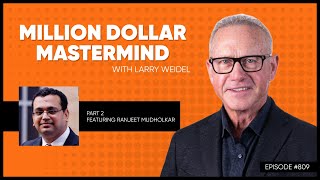
This is a podcast-style YouTube interview (Episode #809) hosted by Larry Weidel with guest Ranjeet (Ravi) Mudholkar. Ravi explains that roughly 90% of his international travel was for business purposes and that he routinely used travel to meet regulators and leaders to learn best practices. He describes formative encounters with high achievers (Dalai Lama, George W. Bush, Ratan Tata, A.P.J. Abdul Kalam, Justice Shri Krishna) and extracts common leadership traits: exceptional listening, focus, non-judgmental compassion, and the ability to motivate by unloading others' prejudices and sharing resonant success stories. Practical advice emphasized: use travel to build exposure and contacts, listen deeply, avoid judgment, help others "unload baggage," and use storytelling to motivate change.
Welcome to this edition of the Million Dollar Mastermind podcast. This is where we pick the brains of high achievers from all walks of life and get their hard earned real world insights on winning. I'm your host Larry Wydell. Now when you going back to your traveler versus tourist, were you on business when you, you know, were traveling to all those countries? Did you have or were you just trying to broaden your exposure and your experience and your contacts?
It was 90% of my travel was more as a traveler, as a business for business purposes. Say for example, even if I would have traveled to Germany or uk, I would have gone to France. But it would have always been more initially I would say has always been to the for a purpose of my business travel. Financial planning standards for the organization where I was working for has its affiliations with over 25 different countries. Ah so I would definitely. So we would have had meetings all around the globe for this for various purposes, meeting regulators, understanding the financial planning practices, the world's best practices out there. But having said this, at the same time, even if I would visit some country as a tourist or on a holiday, I would always try to, you know, kind of take out one or two days outside my personal schedule to meet the government officials and try to leverage my contacts to learn something good which would be good for myself. For example, if I would go to even country like Hong Kong, there is something an affiliation of financial planning. So what are the best practices out there? I would be happy to go there. I had been to vacation to UAE as well actually Dubai. So they're also in Dubai and Abu Dhabi. They have financial center actually bfc. So I would happy to meet the officials out there even if I'm on a personal visit. So I have always tried to leverage an opportunity to kind of understand the complexities in whatever job that I have been doing actually. So let's put it that way.
Well, when did you get excited? I mean you probably were inspired to greatness early on by your meeting with the Dalai Lama. Just that experience probably affected you in ways you were not even beyond what he told you, but what you aspired for yourself. Because you've certainly moved to the top of pretty much everything you've gotten involved in. Where did that drive come from do you think? And what do you think has made you to stand out and to move to the top in all of these different arenas where people want to follow you, they want you to speak at their event, they want you to write articles like you say how many books you've Written the foreword for in financial services and things like that. What have you done that's made you stand out and moved up to the top where people really value your endorsement and your comments and your encouragement?
Larry, there is no secret to this, but let me give you a lead here. Actually here it's not only Dalai Lama, but lot other great people I have been fortunate to meet and interact with. So even I would meet somebody for a very brief period of time, I would like to learn something from them, how I could be better. Like for example, when I was pretty young, when I met Dalai Lama, to kind of get a direction of my life. Once I got an opportunity to meet a former US President. You can see a photograph out there again with George Bush actually there. And at that time I was CEO of Financial Planning Standards Board. And he having come from a position of a great authority, being great learning of having run a country like United States for over, you know, two terms. My I had, I. When I got a time to shake hand with him, my question to him was that I'm running so and so organization called Financial Planning Standards Board where we try to help middle class and to kind of help wealth creation for people. What is your advice to me actually? So that was my question to him. He did kind of, you know, ponder over and instantly he could give a response to me in terms of how I could reach out to regulations, try to meet different government agencies, even outside India, learn from them and bring it back to your government. Now those kind of. I have always been kind of in a mood of learning and there is a switch I think mentally you will need to keep yourself on, to learn from, to be receptive to ideas and to receive new concepts actually from people. And I have constantly been doing that. I think we briefly interacted today. I'm happy to learn a lot of things from you in how I could do serve people better. It's not about you here in this world. It is about others whom you serve. If I look from that perspective and how can I help my students? How can I help to help you achieve your goals? I have always been in that mode of learning and that has helped me a lot, always consistently throughout my career.
Well, you've met a lot of high achievers, government heads, people that excelled and again around the world. What stands out, what traits stand out to you? That maybe was surprising, you know, because what I found is the closer you get to the top in any endeavor, the person who's there, they're very similar in the way they think they go about their business, their, you know, their discipline, their what they'll allow and won't allow in their life with, you know, the managing, their time, their money, their relationships and things like that. There seems to be a lot of variables with people who are mediocre and fail. They fail and they're mediocre in a lot of different ways. But the people who excel have a lot of similarities. And what did you notice about that as you over the years, being in a position of authority where you could get into these environments and talk to people one on one and get to know them?
I like this question very much, actually. And I want to confess one thing to you, Larry. Excellence and mediocrity are not traits. They are attitudes. Yeah, that's the first thing which I want to tell you. And nobody is born. I mean, of course there are some born genius, but nobody is born. You can, you know, it's your work. I have a very. I love to make a statement here, Larry, that. And I will tell. Answer your questions accordingly. That, you know, people come to me and say, oh, you know this EB1, a green card is for celebrities. Nobel laureate and Olympians. Well, I'm not an Olympian. I'm not a celebrity. So do you think I am qualified for this particular EB1, a green card? And my response to everybody has been that, well, you don't have to be a celebrity, but your work has to be celebrated.
Yeah, right.
Yeah. Okay. Now, that's the first thing. Now, having said this, if you're talking about a personality trait, about all the individuals whom I would have met and great achievers, super excellent, extraordinary in their own rights, whether it was Dalai Lama, whether it was Bush, whether it is a person like Ratan Tata, I would have got an opportunity to meet a former President of India, Dr. A.P.J. abdul Kalam, and many others. I think one of the common traits is, and I'm going very granular here, is that they are number one, they are very good listeners. That's. And when I say listen, it's not about only hearing. Okay, Larry is talking. I'm listening. I'm not talking from that perspective. So, for example, if I were, I would have spent an hour with Dalai lama or even 15 minutes with Mr. George Bush. I can promise you, Ravi, one thing, that their complete 15 minutes was devoted totally to me at that particular moment of time. So their knowledge, their wisdom, their years, hundreds of hours of efforts were convergent towards me. I had their all years for me. For me, actually, when I was listening to. When I was talking to them. And I could see that in their eyes. I could see that focus and incisiveness in their eyes. And I think it's only one quality. I would say that at the end of the day, I'm not talking about because I don't know that personally, I would not kind of interact with them on a one, on one level, but it's more from a professional setting. So whatever little I understood from that and I could grasp that they were, they, all of them are very good listeners. So when I say listeners, what you are, what I mean by that I have tried to explain. It's a convergence of their total experience being completely with you for that moment of time, and then to give, offer an input back to the person based on that convergence, which is a great quality. And I personally feel that even if we try to imbibe 1% of that into our habits, so even if you are talking to me, I'm talking to you, we are listening to each other. What is it that you are trying to say? I am trying to understand and give mutually each other to the world. And I am sure these guys would be meeting thousands and thousands of people over a period. And if they are able to focus and converge their energies for each and every interaction, what they are doing at that particular moment of time. So I can tell you my feeling at that particular moment of time whenever if Delaila is talking to me or Abdul Kalam is talking to me, I felt that for that particular moment, the time was still. They could make me feel that they are totally for them for that particular moment of time. And I feel that this is a great quality, Larry. Yeah.
And as you've dealt with a lot of CEOs of companies, I guess it's become obvious to you that the quality and energy level and attitude of the person at the top infects the whole company. And.
It'S very infectious. I would say that in that sense, what you are trying to say, it is not only, you know, kind of superficially it's doing that. It's the if you are focused like this, you produce a certain kind of a vibration. And when you are vibrating at that level of energy, it percolates down.
Yeah. And I don't know if you follow, follow American Football, but we have a celebrity out of that world called Tim Tebow. And they always used to ask him why he was so positive. And he said, well, he said, I know that when I go into the locker room, if I'm negative, that's going to be contagious. Or if I'm positive that's going to be contagious, the team's going to be a whole lot better off if I go in positive and spread the positive vibe than the negativity. And that's no more and more tricky.
True.
Than in a corporation or a business or even in a country. And when you're around people like that, it's inspiring. And talk about some people that are some experiences where we all run our course, where we're doing the same thing and things can get stale. Talk about some things in your life where you've run across some of these inspiring people and you've gotten inspired, you've gotten energized.
Okay, I think let us also start. And I want to. As you were asking me this question, I was thinking about a response. Actually. We all get de. Energized, let's put it that way. Or vibration at a low. When we are judgmental about people. Okay. Have prejudices. One of my former bosses, I would say that actually has been one of the former Supreme Court judges, actually. His name is Justice Shri Krishna. And a very accomplished jurist, I would say that. And one day I want to share with. I have spent about five years with him as my boss. There was one particular question I did ask him and I want to kind of give it to the world. Here is I asked him a question that, oh, why, you know, you interact with so many people. You have would have. As a judge, you would have penalized thousands of people, criminals. And at the end of the day, when you went home, how did you feel about it actually here? And I think his response was very profound. I must confess to you, Larry. And that was another great learning for me. His response was that, well, I may be a judge, but I am not judgmental. Now this, let's understand from where this profundity is coming from because you are not trying to be prejudiced against the situation. You have to realize that you are just playing a role. You are just playing a role to do justice. Now, we are not in that position. Nobody has given us a position to be judgmental about anybody. And that was another point here. Now this is something I would like to kind of tell say that don't be judgmental. And I think that puts us into a very compassionate mode and that gives us an ability to serve others.
When you've talked to people and been in a advisory role, what is the biggest thing that you find you can tell them that causes them to turn things around and cause them to realize changes. They need to make.
I think people love to hear stories, success stories which resonates with them. Depending on their culture, depending on their own way, they have kind of evolved themselves as a passion. I think another aspect is that how to break myths. You need to have an art of doing that successfully as a leader. Everybody have their own misconceptions. They come along which is I feel is a baggage. So if you are able to help people to unload their baggages, I think you are doing a great service to them. Actually you don't know great people or people, you don't really. If you want to help people to become the best version of themselves, you don't need to kind of, you know, teach them something. I think if you're able to unload them, help them unload their baggages, your preconceptions and prejudices, I think 50% of the job is already done and that's what I try to do. Then second is to motivate them and try to do try to offer them some kind of a success stories which would resonate with them and it works as a magic.
Thanks for listening to the Million Dollar Mastermind. If you felt there were any valuable takeaways from this episode, please take a minute and leave us a five star review. Your feet feedback is important and really helps us get the word out to a wider audience. Remember, we have a valuable webinar that is absolutely free. Register for it right now@whiteallonwinning.com thanks for listening.
More from Larry









Rick Jordan on Self-Engineered Proximity, Cyber Security Moats, and Truth-Based Leadership

Fire Fast or Fail Slow: Kevin Brittingham Reveals the One Rule That Built a $100M Empire
