[Greatest Hits] Setting Up Oneself For Success with Ari Meisel
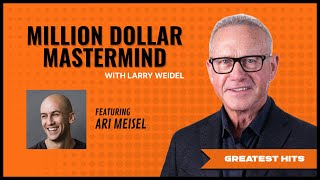
Ari Meisel started his first company at 12, graduated college early, then took on $3M in construction debt before a Crohn's disease diagnosis at 23 forced him to stop working. He experimented with biohacking, regained his health without medication, and now runs Less Doing.
Welcome to this edition of the Million Dollar Mastermind podcast. This is where we pick the brains of high achievers from all walks of life and get their hard earned real world insights on winning. I'm your host, Larry Wydell.
I'm talking today with Ari Meisel. Hello, Ari.
Hello, Larry.
Princeton, New Jersey, family of four has done all kinds of things. I mean, he's, you know, if you ever wondered about doing a TED talk, he's done that. He's appeared, keynote, guest speaker at leadership summits, he's been in mount. He's been in, featured in magazines, his number of programs. He's got his own, I guess, online programs. Is that right? Workshops, Ari, the.
Both online and then in person. Yeah.
And so he is the founder of Less Doing, and we're going to get into that. But the interesting thing is he's done, you know, he's been out there, he's got the mileage. He's got 500 episodes on his own podcast and decided to wrap that up. So he's got that experience of those contacts behind him. And with four young kids, he decided, I need to take a look at my priorities and these kids need to see their dad. And so he reorganized himself successfully and he's going to explain how he's working for 20 minutes a day. Even Tim Ferriss would be jealous of that. And by the way, Tim Ferriss also went to Princeton University, is from that area. So I don't know if there's something about Princeton that causes people to want to get their work done over with as fast as possible. But anyway, you come from a good tradition and has written over half a dozen books, the Art of Doing Less, the idea to Execution the Replaceable Founder. And that evolved out of his inspirational story of overcoming Crohn's disease. So, Ari, did I butcher that introduction sufficiently for you, or is there some semblance of setting you up for success in that intro?
They definitely opened up some discussion points, for sure.
Yeah, I'm all about setting people up for success who have success to talk about. And so starting off, let's talk about how and when did you get Crohn's disease and how devastating or how much of an impact did that make on you?
I mean, a very big impact. That was the beginning of all this in some ways. I was working in construction and real estate development and just living a very unhealthy, very stressful life. And when I was 23, I got diagnosed with Crohn's, and basically, long story short is that I went from working, like, 18 hours a day to working an hour a day, if I was lucky. And I was pretty sick for a couple years, and then I started to turn things around, and I was able to overcome the illness. And a big part of that. Sorry.
No, I. No, that was just. That was a sniff.
Oh, okay. A big part of that was figuring out how to manage stress and still get things done and not feel overwhelmed. And that one hour a day became like, my mantra, you know, what would you do if you could only work an hour a day? It's a really powerful question. You frame it the right way.
So at that point in time, what got you up to that point? Just getting, you know, normal growing up, going to school, maybe playing sports, working different things. What kind of. What area of construction were you in?
Pretty much all of them. I mean, I think my best trade was probably masonry, but I pretty much did everything. What happened was, before that, I grew up in New York City. My father is an art dealer. My mother is an artist and a real estate broker. And I started my first company when I was 12, which is a website design company. And then I started a couple others before I graduated high school. And when I graduated, I went to the University of Pennsylvania, to the Wharton School, business undergraduate, and enjoyed it, but remembered that I wanted to get back to work, basically. And so I graduated a year early with two majors and two minors and got back to work, essentially. And what that meant was I went to visit a friend in upstate New York, and he showed me these old buildings from the 1860s, and I made an offer to buy them that day, which was probably somewhat foolish, but the deal was that anybody that worked on the job had to teach me their trade. So I spent the next three years learning and doing every construction trade there is. I put myself into $3 million of debt and eventually was able to get out of that and sell the project out. But I learned everything I could about construction, about project management, about leadership, politics, legal aspects, media. I was in the news all the time. Like, it was a hell of a crash course, and it crashed my body in a lot of ways, But I still learned quite a bit.
Well, you know, I got out of school with a degree in building construction, because halfway through, I found out architecture was not worth it. And so by the time I was at the age where you got the Crohn's disease, I built 100 houses as a construction superintendent, north side of Atlanta. And I've always thought that was the greatest education I could have in terms of keeping up with moving parts, people, supplies. You've got to train the people, you've got to know what they're doing. And I've always thought that that was like a combination of multiple graduate courses just going through that process and being in charge and getting scre screamed at if it wasn't done, perfect. Because you know, it's like an assistant coach on a football team, a pro football team. Any. Anything that goes wrong, the head coach is going to be yelling at you, you know, on your unit and you're on the sidelines, you know, and so you become a manic depressive, over manage everybody just to protect yourself and survive. But you get an education that allows you to do incredible things the rest of your life because it forces you to get organized. And so can I ask you a thing about the father who has a gallery? I guess that explains your. I've never seen anyone with a fine art minor out of Wharton. So that explains your fine art minor there. Probably.
Yeah. Well, I had an art history minor actually. But yes, that definitely contributed to that. And it wasn't from Wharton. That's from the liberal arts school. That's at UPenn, which we had to take courses at. But yes, essentially that was a big part. I grew up in an art gallery.
Is your father. That's not Louis Meisel, is it?
Yes.
Okay, I'll tell you this. We have something in common. The guy who works with me and my art down here in Palm beach gets on the train and comes up from Miami three days a week. And he is in your dad's gallery, David Oliveira. He does these hyper realistic ship paintings. And so he has been in your. By the way, he was just on one of his paintings, just got on the COVID of the Irish Titanic Society or something. He sent it to me yesterday. But I've heard about. Heard about your dad in his gallery quite a bit here over the last couple of years. So it's nice to meet you.
Yeah. That's funny. Small world. Wow.
Yeah.
So you must have been at the art fair.
Yeah, yeah. The scope down at the tent down there. And so anyway, so we've got some tie ins together from the construction to the art to the. Your father and the. That. That world. But talk about why didn't you go into art? Why didn't you go in the gallery business?
Yeah, but why.
Why didn't you. Why was that not appealing to you?
Oh, sorry, that broke up. I don't know. You know, it's so. Well, it's a tricky question. So when I was Younger. It didn't really appealed to me because it was a very slow business. I feel like in some ways, you know, it was like very big deals every other month kind of a thing. And so, like, that. That aspect of it was exciting, I guess, or interesting enough. But the other thing is that, as I'm sure you're. You're well aware, you know, like, so much of the art business now is just online with people, you know, seeing something buy some. Right. So having, like, an actual gallery space feels less relevant to me than it did, you know, right back then. So if I were to get into the business, I would probably do it that way. And my. My dad still likes to have his gallery in soho. And they're. They're also. It's. I don't know. It just wasn't. I mean, at some point, I'm gonna own the gallery, so we'll see.
Oh, okay. Well, we'll have to get together down the road. But the thing is that Crohn's disease. How did Crohn's disease. What are the effects that. In terms of the impact it makes on you, in terms of shutting you down? What I did, Ari, I was going along great, and 12 hours a day of playing golf and cycling and boating and this and that and the other, and then cycling after golf. One day in the middle of Palm Beach, I hit a curb that they had put up coming in the end of the night, and you couldn't see it. And that was the end of me for about the last 15 years, pretty much, in terms of shutting me down. And that's most of what I'm doing now today as a result of that. But I found out I could reach out if you're talking to people on the phone, the Twitter, Facebook, blog posts, that's where I got into writing the books and the pot, you know, weekly conference calls, things like that. So you can keep your voice out there if you. But it forces you to be creative, and with you. You try. You did a lot of things that you wouldn't have had time for if you're in construction. So talk about how that impacted you. That with me, I couldn't. I had no energy. I couldn't get off the couch, you know, for a long period of time. You know, it was a long multi year thing of going to about 20, 30, 40 different medical specialists to get somebody who had a clue of who could get me through the next step, you know, and so today I'm not too far away. But it's tough when you go from being in charge in construction, around. Go, go, go, people. Go, go, go. Responsibilities to where you're shut down. How did it shut you down and how fast was it?
I mean, not similar to traumatic accident, but yeah, basically it just killed all my energy. So it happened pretty quick. And the thing is, is that in a lot of ways, so I was put on a lot of medicine, which in. In the long run definitely helped in that period, but in the short term made it a lot worse. I mean, there was just one of the drugs I was taking was a leukemia drug. Like, it was just really hard on my body. And so I went from, like I said, working really hard to basically like that was. It was the same thing. Like, I could barely get off the couch. You can't absorb food properly, for one thing, on your prongs. Some people get obstructive symptoms, which is what I had, which is basically like food gets stuck and then it's extremely painful. So I could. I couldn't sleep well. I couldn't move very well. And also just psychologically, it's just a total beat down, you know, that I just. Motivation wasn't there.
And so you're having to offload all these responsibilities while you're dealing, you know, figuring out how to deal with this thing. Not. And the other thing, Ari, is like, you don't know how long it's going to take. You know, it's just like you're. You're heading on this new adventure and land is not in sight in any direction, and so you're having to set things up at this point. Are you married? Do you have kids and you have the personal responsibilities like that, or are you still a single guy?
So it's interesting, actually, my wife, we started dating about a month before I got diagnosed.
Oh, okay.
So not great timing.
Not great timing. So.
But by the time we had kids, I had been healthy for a few years, so because I, you know, Crohn's is considered an incurable disease and after three years of misery, I was able to overcome it. I got off my meds after about six months and just had a colonoscopy about three months ago, and there was no signs of it at all in my body. So they always like to tell. They always like to remind me, like, you know, it's not curable. So even if you feel okay, you still might have it, but there's no signs of it, so it's good. Yeah.
Congratulations on coming back from that. And what do you attribute that to? That comeback and overcoming what they said is an incurable thing.
Data to some extent. I mean it was really my sort of introduction to biohacking and that was really where I got start in this, in the sort of like public sphere. My TED talk and all that or TEDx talk was all about biohacking. So I had all this data from all the blood testing, all the different tests I've been doing and I wasn't really doing anything with it. So I started to try to identify correlations and experiment on myself and the, the true like one of the biggest things I'd say is probably the sort of locus of control that you start to feel when you stop being a passenger of your health journey take over again. And I just started experimenting different diets, different supplements, exercise modalities and I started to get better and better and better and it kept going.
And so explain biohacking to people who are not familiar with the term.
So it's really just hacking your biology meaning if you want to figure out, well in my case the disease, but how to sleep more effectively, how to eat most optimally for your body, not what the most bad diet at the time is, which supplements actually help you and don't and which versions of the supplements might help or not. So it's really taking a very analytical approach to our health and well being.
Thanks for listening to the Million Dollar Mastermind. If you felt there were any valuable takeaways from this episode, please take a minute and leave us a five star review. Your feedback is important and really helps us get the word out to a wider audience. Remember, we have a valuable website webinar that is absolutely free. Register for it right now@whiteallowinning.com thanks for listening.
More from Larry









Rick Jordan on Self-Engineered Proximity, Cyber Security Moats, and Truth-Based Leadership

Fire Fast or Fail Slow: Kevin Brittingham Reveals the One Rule That Built a $100M Empire
