How This Former Shot Caller Inspires Millions Today
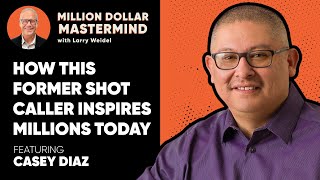
Casey Diaz grew up in gang violence, became a shot caller by 18, served time in solitary, then built a sign business for 23 years and became a national speaker. He wrote two books, launched a podcast, and now has a film adaptation of his story in development.
Questions this video answers
Okay, I Will
The Shot Collar
About 18 to 18.5 years old
Approximately 23 years
46 years old
Foreign. Welcome to this edition of the million dollar Mastermind podcast. This is where we pick the brains of high achievers from all walks of life and get their hard earned real world insights on winning. I'm your host, Larry Wyd. I'm talking with Casey Diaz this afternoon. Hello, Casey.
How you doing, Eric?
This is a return visit from Kasey, and he was in the middle of restarting his business and life after Covid. I think you had like 200 speaking engagements lined up when Covid came along, and it just completely shut you down. And I. I think you had written a book or you're getting ready to write a book, but now you've got your second book out. Is that right?
I got my second book out, yeah. And, yeah, that lockdown really threw a wrench at my whole program, but we're back on track and going all over the country.
Talk about your second book.
So we just released our second book called okay, I will. And it is a bunch of testimonies from correctional officers, prison chaplains, nurses, people that have experienced a dramatic change in a loved one who received the first book, which was the shock collar, and put it in the hands of a friend, a stranger. They read through it, and, I mean, it was just a drastic change in their life. And so we thought there was no planning. The strange thing happens when I'm a big guy that loves to plan, but then there's moments when you just don't plan and things happen and you just gotta roll with it. Right. I think all of us have that. Those moments from time to time. And this is one of those moments for us where we thought, you know, we need to interview these people that were eyewitnesses to the changes in complete prison blocks from death row to solitary confinement situations. And so we decided that it was important to interview these correctional officers, these law enforcement officers, as well as prison chaplains and nurses and gamper engine counselors and have them, by their own words, tell us what took place, what they saw, and how things changed in the. The lives of those that received our first book. So we're excited and really, it's. It's a thrill ride to. To see and to capture their side of the story.
Yeah. And I want to get into what would cause someone, you know, because business is about making a profit. You know, you're making a bigger, better, faster, newer version of something, and you're delivering good service, and you do it right.
Do it.
You're conscientious, then you can. Your business can grow. But the idea is to make an impact and a bigger and bigger impact. Now you're on the side of life. That there is a surprising number of people would be a good thing. If there's an even larger number of people who have said, I'm going to go in a different direction to make my impact, I'm going to go in the direction of helping people and standing with them and work with them on the spiritual side. The help them reorganize their life for greatness. And you, you get a chance to see a whole kind of different positive impact. But a lot of people will do this after a successful business career. You know, they might have 10, 20, 30 years and they say, this is not satisfying me the way I wanted. You know, I'm looking for more out of life. You know, the thing was when I was starting out that at college, I remember people saying, you know, I don't want to be the guy at 40 who said, I worked hard and all I did was make a bunch of money. I want to be somebody who makes money, but I want to make impact. And so a lot of people don't get a chance to address that issue or have that put in front of them before they launch out into a all consuming business career. And that realization a lot of times comes later down the road. But I hope we can get into some thinking as we get into this but. Cause that may be a change to make it. The idea of being a winner is to live the kind of life you felt you were, you were designed to live and to make a positive impact, to be improving and accomplishing things on a daily basis that are important to you to accomplish rather than being a victim, beaten down by life, kicked around and feeling sorry for yourself, you know, that that's the other side, you know, and so winners can be winning in their careers, in their lives in a lot of different ways, not just business success. And so you're someone who's having like monster success winning and impacting other people. But for people who have not heard, we can give them a little teaser about your first podcast where you get into your story. Why people should be interested and why your story is so unique is that you weren't like in a gang at a young age. You were like consumed. And you are really good at it, which means you are a real bad boy. That's where the shot collar thing came from. And so how about doing a quick review of that for the people who haven't had a chance to hear that podcast and so that they will, or maybe to remind them and so they'll have a better framework from understanding where you, what you're speaking from.
I think a recap is well needed for even new listeners. Right. Well, I did get involved in the whole gang culture at a very young age of 11 years old. And just like any gang, there is a structure, there is organization, and you move up the ranks by way of violence. That was my cup of tea. It wasn't. There's different type of gang members out on the streets in every gang. And I can only speak for the LA gang structure, but there's different grades, just like in anything. Just like in, in business, you know, there's ranks and how you move up ladder.
Minor leagues in gangs.
Exactly. Yeah. And you know, to get up into the, to the major leagues, you're going to have to catch the attention of your crowd, your oikis, your circle of influence and by way of violence. And for me, that was so easy for me to get involved in. In the violence side, you have guys that join gangs for just the purpose of meeting girls and partying and the fast money and all that stuff. But then you have the 1 or 2% that is just about violence. And then unfortunately, that's the route that I took. I started getting noticed by not just only my gang, but rival territories throughout Los Angeles where, I mean, my name was just everywhere in that era. And unfortunately, at 16, kind of like.
The star Tiger woods coming up through the ranks in golf when he was young, everybody knew about this young golfer, Tiger Woods. They knew about you in the gang world.
They did. And you know, and it's nothing that I glorify now as an adult, but it was, it's part of my story. And I have to share that, you know, because I think business in conferences, I speak all over the country and platforms, whether it's in business or a gang prevention convention, whatever the case is, I think that when you share your entire story, both the good, the bad and the horrible, and then the redemption side of that, who doesn't like to hear a redemption story? And you know that that's where I was at, man. I was a slave to what I was doing, which was sin in atrocious ways, punishing my rival gang affiliates with extreme violence. That earned me a title, I would say, in the streets and then in the prison system. I was voted in as a shot collar at a very early age of 18 and half.
Explaining shot collar.
But when you become a shot caller, it gives you great responsibility. Not everybody wants to attain that title or that figure just because you're a shot caller doesn't mean that you could just do whatever you want. You're still. You got to be careful in there. And a shot caller has the ability to move drugs to murder individuals inside and outside of prison system. So there's a lot of responses. A lot of weight goes on your shoulder. And for that responsibility to land on my shoulders at about 18 years old, 18 and a half, it's a lot. But you also, this arrogance and this pride comes upon you that you do have power that others don't have. But again, you know, just like in anything, you make one brutal mistake, it can cost you your life in there.
And the Shot Collar is the name of your first book, right?
It is, yes.
And so they talk about how you arrived at age 11 with the mentality that, this is the way I want to go. You know, events have. Their shadows are cast before events happen. This is a big event in your life, big transition. How did you wind up there? How do kids wind up to where they're just ready to go all the way to the other side?
For me, there was the violence that happened inside my home, in our apartment. For me, it was a father that didn't work, who sold drugs and loved drinking, Loved drinking his life away and was violent and would, I mean, just unleash terrible violence to my mother. Physical, emotional, verbal was his record. And, boy, did he beat my mom just like a man would beat another man. And so watching violence there, the age of eight, I would witness a triple murder. So this individual walked up to his three victims, dished out some rounds on each one of them, and then reloaded and finished the job. And he didn't run to his car. He very slowly walked to his vehicle and didn't burn tires or anything. He just drove like he was going to the supermarket. Very calculated, very cold. And you could tell now as an adult, you could tell that this was not his first walk in the park. This guy has did something similar, perhaps in the past as well.
So, Kenzie, you grew up in a world of violence that was saying you did. Probably didn't know any other world. I mean, kindness, things, like people doing nice things for each other. This was not the world you were in.
No, it wasn't. I mean, I saw witness violence at a very young age, and I had this perception that, well, this is how life is, right? Like, if you're used to pattern in your life, early in your life, and it's a repetitive pattern, well, this is how it is. This becomes the norm. And for me, that was what it appeared to be and I just ran with it. And it was easy for me to incite violence of any degree upon anybody. I mean, it was that easy.
And so you got started in a gra, Grassroots level, kind of a minor leagues type thing, improved your way, prove yourself and moved up to the ranks pretty quickly, didn't you?
I did. And again, it was just the repetitive violence that I would. Just uncontrolled rage that was within me. And it was just easy. I mean, and it sounds horrible, but. But it was very easy for me to unleash. I mean, just with a murderous heart, to unleash this kind of rage upon an individual. It was as easy as getting a cup of water. It was, it was just that easy.
Well, now you obviously did not have. How close were you to your mother? You obviously had no bond between you and your dad. How many kids were in the family? How were you the oldest at this time?
My brother wasn't born, so I was the only one that got to see that type of violence. I was very close with my mom. I still am. There's this bond of being raised by a hard working mother who tried her best with the cards that she was dealt with. And even up to this day, there's moments when I have talks with her, you know, mother, son type of deals. And she always finds herself trying to apologize to me for not doing something better. And I have to step in and say, you don't have to apologize for anything. You, this is the hand that you were dealt and you did the best what you had and it's, it's fine. You know, we came out okay now and we're, we're good.
Do you feel like there was a, when you went over there, did you feel like that was like a surrogate family for you? You know, like they, you got approval from these. Even though it was for these horrific acts, you got Pat's on the. You got approval and way to go, Casey. You're the man. You got no other place.
Absolutely.
That.
And that's what the false sense of family, that that's a gang pitches to a young gang member, a young recruit. It's that validation, right? If you don't have a father figure, a leader in your house, in your home, in the family, a counselor, and it doesn't even have to be a dad, of course. That's the, what you really want, right? A father figure who's responsible, who will direct you in the right path when that's missing a recipe for disaster for any kid. And it doesn't matter if you're in a wealthy neighborhood or in the ghetto.
Right.
With the absence of a father, the success rate of being honorable, being ethical, being moral is absent. I mean, that's how important a dad is to the family structure.
Yeah. And of course, we're speaking in generalities and there are exceptions and all, but it does speak to how seriously people ought to look at this situation. And that phrase you had under the false sense of family that the gangs preach, you know, that's just something for people to be aware of. And the importance of that mature role model, male role model in the equation for a young boy growing up. Say this is acceptable. This is not acceptable at the right time. I'll tell you something. Third grade, my father moves to. We're in Oklahoma. Halfway through the year, he gets transferred. He's Air Force. He gets transferred to France. And so he's going to go to France, find us a house. And we got me my mom and brother and sister, they're like six and eight years younger. And so we go, we move to Georgia from January to the summer. You know, I finish out third grade, I think there in Georgia. And so my grandfather. And when, you know, school year's over, then we went to, over to, to France and lived over there for a year. But I remember this one is my grandfather and I got along great. You know, he's. I was the only one there at the house at the time. You know, all of their kids had gone and none of the grandkids live nearby. And so, you know, it was me and grandmother's in there cooking with my mother in a cleaning house and working with the younger kids. But I'm out there with my grandfather and we got along great. He would do all kinds of things for us. But there was one time he got madder than hell at me. I still don't know what I did. I said something, I responded to something in a way, you know, here I am, I guess, 10, 11 years old. He just really lost it with me. He said, boy, he's. He said, if you would act like that, you go through your life and you're not going to have any friends at all. You need to change. I didn't even know what I'd done, you know, but I got. I got the message. I need to be a little bit easier to live with. Great. And you know, they have a thing and they, they replay it occasionally on the, the Nature channel with elephant. They found in elephants. There was a thing over there in Africa where the In a certain area, the elephants were running around and with their tusks they were like, what do you call it? Not t boning, but they were piercing. Killing rhinos. And they would just go in and kill them and it was just like leave them. And they were just like killing them. Killing them. Killing violence, you know, like murder. Yeah, it's just like animal murder. And what they found out was that there had been gang warfare in the area and a lot of pirating of older elephants for their tusks. And so this new generation adolescents elephants had grown up in the absence over the years without any adult male supervision. In this whole multi hundred thousand acre area, there was going reign of terror. And so one of them got the idea, they went in, in another part of Africa and brought in. They only brought in about a half a dozen mature male elephants. All they did was turn them loose. And that stopped like that.
Wow.
The mature elephants got the message out to the young rebels. Teenagers, that's not. That's not acceptable. We don't behave like that. And it stopped just like that. And so it's something to think about that kids need young boys every now and then, need a strong hand to just say no. That's. You don't need to do it all the time. Don't need to be whipping them and beating them. And it's not a punishment thing, but like laying the law down. Like you got to behave in a certain way and in the absence of that, all hell can break loose. And that's what happened in your life.
Absolutely. Yeah. And I'm a very big believer of, you know, you praise a kid when he does. He does something. Well, when they behave, when they bring back those good grades, you know, when they turn into their homework, you have to give them that pat on the back. You want to take them out and prize them. But when it's time for discipline, you have to discipline. And I think that that is something that. Not an old thing and it's not an old school thing. It's a proper thing that needs to take place in the home very early on, by the way.
It's a matter of kids about authority and respect for authority. Because it's like John Mellencamp said in one of his songs, I fought the law and the law won. And that's the way. That's the way it's going to be. You're. It's just not permissible to be going out and shooting. You know, that one guy may have gotten away with it. Go out and shoot three people sooner or later your number's going to come, someone's going to do that to you, or you're going to be in jail and it's going to run its course because society's not going to tolerate that forever. I know they're testing the balance again out in California for what I hear, but sooner or later, reason comes back into the picture and the people who are most out of line wind up in prison. And that's why you found yourself in a supermax at what age?
I was already 18 years old when I got what we called slam down. And that was meaning you were put or placed in solitary confinement 23 hours out of the 24. And even when you came out of that cell for that one hour, a state required hour of yard time, you were basically walked into a bigger cell to spend time outside of your cell by yourself. So I want to talk about, like the, the myth of. Because we're so accustomed to movies and prison movies and, and we think that certain things that take place in prison are the way that we watch it in a show, in a movie or a TV program. And it's not like that. So solitary confinement. And again, I'll speak on the California issues. It's something that a gang member has to earn. So it's not like in the movies where some potbelly correctional officer doesn't like you, and so they just place you in solitary confinement and leave you to rot and give you the worst type of food imaginable unto man. Right. That's not what happens in solitary confinement here in California, in the California Department of Corrections and in the Los Angeles County Jail, you earn that. That inmate earns that cell. And it is a coveted cell, as crazy as that sounds. It's a coveted cell because it speaks on who you are as a convict inside. So there's stages of you getting to and a structure to someone earning that 8 by 10 cell, solitary cell. So for me, again, it was easy. I didn't care about life, of human life or property. Whatever I needed to do to, to get to the next phase, I was willing to do it. And again, I think it has a lot to do with how someone, a young boy, grows up in seven years.
You had progressed up to where you joined the gig. Then you're in supermax. And so you made the big leagues, really big. And so what level, what was your reputation? What was your title? What was your, you know, your title was Shot caller. But how much power did you have? Influence? And what authority did you have when they shut you down and sent you off to supermax.
Well, I was in charge of all the hits, of all any kind of violence for the Los Angeles area, for.
The south, for the entire Los Angeles.
Area, in particularly the Rampart district, which was known. Let me paint a picture here, the Rampart district of Los Angeles. And if you were to Google and investigate the Rampart district, a lot of stories, a lot of stuff that happened in the 80s and 90s in that area to paint you a picture. If you grabbed Watts, Compton and South Central and you got all the homicides that took place in that era, they still wouldn't match up with the homicide rate of just the Rampart district.
Really.
That's just, it was incredible and bloody throughout that time.
It was just authorizing hits, people to be taken out. If I'm a full time job for you.
Well, you know, green light. Talk about in the book. Green lights are essentially a note that would be carried and co signed by me to have somebody beat to the point of almost death. Those were other responsibilities that a shot feller would have. You also had all the, the capability of all the prison shanks. First book I speak about sleeping with 13 prison shanks in my possession. So there's a lot of stuff that goes on that the public doesn't know. I look back as an adult, as a Christian and kind of just shake your head because you can't believe that that was at one time your reality. This is what your life looked like.
Well, just so people know what goes on on the other side. How much of a case would people have to make to you before you said, okay, take him out, you know, shoot him.
Well, it depends. It depends on a lot of things. Again, the shock collar doesn't just have. You're responding to other people as well and other people are involved. So it's not just a, you know, I can just sit there and go, that guy. And it's X amount. Again, that's like a movie thing. Right. There was a panel of others that needed to sit around with you and make a logical and sensible move on someone.
And so that had to be understood and interpreted by everyone else that you weren't out of control. Otherwise they take you out. That's I guess why you were in that position. They felt like they could trust you with that responsibility.
Yes, yes, absolutely.
And so baddest of the bad. And you get, you get up to shot caller status in supermax. Like you said, you had all those shanks. Yeah. So they have that respect for you there as well, isn't it interesting, Kasey, where we feel like one of the things about tragedy, about people missing out in life is they don't know what they're missing out on, that they can change and what's possible and then they don't know. The other thing is how great it would be if they did change. But a lot of people are just totally unaware the capacity for change in a human being.
I agree 100%. You know, today in the life that I live now, I fly first class and all over the country, right? For someone that had never flown before. I was 46 when I took my first airplane flight to D.C. on a white House invitation. That first flight was not first class. It was, you know, Southwest, the middle seat. I thought it was the greatest thing that ever happened to me. I was thrilled. In the second book of okay, I will there's a full story and it's quite hilarious. Funny on how my take was sitting in an airplane for the very first time at 46 years old. I thought they give you soda and peanuts for free. That's amazing, right? That was my. Because when you don't know, you don't know. And now as I go and I speak to prisons and in conferences and you're sitting in first class and by the way, that alone had to. It took a little while to get used to, as crazy as that sounds, because you know, that you feel out of place, you know, because you remember where what those days were in solitary confinement. But you're right, you don't know how great your path could be if you just do minor changes in your life structure, in your discipline. Right. I still wake up at 4 in the morning ever since 18 years old from the SHU program, from solitary confinement, that's been my. It's an internal alarm. And as I study and I look at other successful business owners and, and whatnot, I see that there's something in common in every single successful person out here and that's that they wake up early in the morning, they're notetakers, they're not headline readers. They like to study. They're readers of many types of books. And that's. And so those little tweaks, those little dial ins that could change somebody's life. And when you're there, as I am right now and I'm flying all these to these wonderful places to share my story. If you, if somebody would have told me this was going to be my life, you know, down the line, I wouldn't have believed it. But. But here I am, your podcast a million Dollar mindset. I mean, it's incredible of how your life can change just like that.
For those of you who are sick and tired of fooling around and are dead serious about wanting to move up fast, I've got something especially for you. I've combined the best insights from over 40 years in business and making $70 million in income and compressed them into a free webinar. That's right. It's a free resource. If you want to find out exactly what the concepts are that I use in coaching million dollar earners, Register now@widelonwinning.com you'll discover the five part framework used by so many to reach their financial, personal and professional goals. You can find that link in this episode's show Notes and a lot of people would not be aware of fact if they're new to this and haven't listened to the first podcast. They don't. They need to know. I need to tell them that you are an entrepreneur. You know, you got out of prison and you started a sign business and you know, from the sign business, one of our mutual friends came along and got intrigued with your story and the book came and some speaking started. But you were, you built a successful sign business in LA from scratch, am I right?
So, yeah, I did started a sign company from scratch.
The government come in and said, let US loan you 50, 100 grand to start this thing. We're going to help you get on your feet coming out of supermax. We just blurred me so terribly much. Casey.
Yeah, you're a great guy. Let's, let's just roll in the, you.
Know, pay it back whenever you feel like it. Yeah, yeah.
When you feel like it. No, I wish I would have been like that. But no, it wasn't. It was. Again, waking up early in the morning pursuing the goal that was in front of me with a vision. A lot of failures. That's another thing that, that's very common with successful, successful people. We fall a lot.
Why did you go into the sign business?
Well, that's interesting. So I was volunteering. I was volunteering at a, you know, thing.
One thing people hear. Okay. And I want to say they, they hear, follow your passion. And then you'll also hear because you got, you know, you're going to put extra time and energy and effort into whatever you're doing to be successful. You got to do above and beyond, especially early to get. And if you don't like it, you, you're going to resent putting that kind of time and energy in on the other Hand. I just heard something last week where a guy got on Instagram and he's saying, you know, billionaires speak at colleges and say every single one said, follow your dream. He said, the worst stupid advice you can give, you know, because follow your passion. You know, seems like I'm going to become a, you know, something stupid you can't make money at. But the deal is there's a balance in it. And the billionaires thing is the guy who was saying that the billionaires were wrong was not a billionaire himself either. So he didn't really have the right to say that's the worst advice you could ever get. You know, follow your passion. Well, you got to have some. You got to have an idea that you're excited about at least.
Absolutely, absolutely.
But somehow you got excited about sign painting. I mean, sign making, which is not something I would have ever gotten excited about. So what did you see in it? The money.
I saw the money.
There you go.
But I remember selling my first sign gig and it was a tattoo shop and it was just 2 inch foam that I was to cut, and I was to cut the word tattoo from a tattoo shop that I walked in. I, I just walked into this shop and the owner was there and he had a blank canvas. And the funny part is that he was also a former convict who had came out of Pelican Bay. So here's this guy and, you know, we talk and I pitch, you know, my sales thing. But it was, it was quite easy because we had a mutual background. It was, it required cutting 2 inch foam with a band saw and a jig. And I made 3, 700 bucks and I finished the project in about an hour. And I thought, I like this. I think I could do this. You know, who makes 3,700 bucks in an hour? And so that was my first taste of real success. And then my third or fourth job was a job that brought in $63,000. It just, that took me a weekend to make. In a weekend, three days, I made $63,000 decaling a fleet of vehicles for a big roofing company. And I looked at that and I went, you know, this is something I could, I'm excited about. I love making and creating. I like the look on my client's face when they see their dream, because that's what you're doing. You're fulfilling their dream and their vision board when you have that sign light up in front of the sidewalk, wherever that that may be. So, yeah, that it was exciting to me. And then eventually I would End up becoming part of the motion picture union. And so we did signs for the major part of it for motion picture films, movies, TV shows and seeing and watching Paramount trucks and Disney trucks, Warner Brothers and all these guys bringing these big giant trucks to my shop every morning at 7 in the morning, just, you know, in and out. It was exciting. I mean it really was. And, and I did that for 23 years.
23 years.
23 years.
Man, I had no idea you ran that business that long.
Yeah, 23 years. I mean it was great. You know, I was able to put my kids through a private education from kindergarten all the way through university years. My two oldest daughters, they just graduated, both became teachers. And then I have a 15 year old son, Jacob, who's still at home. It's exciting, man.
What did you do to have. You dropped that business now?
I sold it. Yes. I sold it because there's no way that I would have been juggling public speaking, writing books. There's a motion picture film coming out. It's in development right now. We're in the very late stages of it and we've been. It's. It takes a long time, a lot of patience, a lot of work, a lot of hands to making a motion picture film. And so yeah, it's a Hollywood production that has taken my story and it's going to be the shot color and it's going to be the shot collar. Yes.
Yeah. And okay, so once you're a big star and that's a big success, we got to get you, we, we're gonna go ahead and book you now. Yeah, you better do it now. Hey, I don't know, you're gonna have.
To talk to my people after that.
Because we can do it on zoom and I don't have to fly your first class anywhere to hear you speak. Here you go.
That's a smart millionaire.
Talk about how this speaking thing revved up. It took off. Here's one thing, I want to dig into that because I want people to, to be thinking about listening from a different standpoint. We have a lot of million dollar earners listen to this call. A lot of people are on their way up the line. A lot of people have influenced in a lot of different areas of life. And if you're out there, there are people in need everywhere that need to hear a voice of hope, encouragement, especially when it's real. And I would encourage people listening to this, if they haven't yet thought about it, think about, take a look at Casey. You know, read a little bit about him take a look at the. The book, the Shot Caller. And he's got a podcast, too. You got a podcast, right?
I do, yeah. The Shot Collar podcast.
And so pay a little attention and see Casey might be a great fit for some of the organizations you're in, that you could encourage them to get him to come in and speak and make an impact, because Casey makes a big impact wherever he goes. You know, this is a message of impact because it's real. And so talk about how the speaking thing started.
It was interesting because I ended up in circles that I would have never dreamed of. I got featured with Laura Ingram was one of the biggest opportunities, open doors that presented themselves to us. I did. She interviewed me on her podcast. And it was funny because the interview was. I was being driven around D.C. while I'm doing her podcast for a whole hour or driving in circles, as you know, she's interviewing me. And then that same day, within hours after that episode, her producer called. I was with PR at that time, and they called our PR guy, Joel, and he says, you know, this is. I just got off the phone with Laura's producer. She wants you live on her show, and it's prime time. And now I have to call Harper Collins to see if. Because that night we were to fly out to New York to Fox and Friends and give them an interview. So we had to cancel Fox and Friends. All the airplane flights had to be canceled because at that time, Laura Ingram was number two, you know, with millions of viewers. So it makes sense to be on her show. And from that point on. Then I got interviewed by Sean Hannity, my cuckabee, and just Adam Carolla. I've been on all these platforms, and then just the door. I mean, we. To this day, we have emails every single day with requests for me to go and speak at conventions, at business locations, in churches, you name it. So. And you're right. When the story is real, it'll have an impact, because everybody wants to hear, hear a good story of here's a mess. And now that mess has become this message of hope and redemption. And all of us, as America, as people, we like hearing redemption stories. And I think that when I hit the stage, I'm there to provide a service and to ignite and to impact and to move a crowd that perhaps some are in there and they're lethargic or they're hopeless or they keep hitting a wall and all it takes is that one good story that'll catapult them to something different in their own personal Life. And that's what I like doing. And hitting these stages from A to Z.
And like we talked about before, your schedule fills right up. And you had, I think, 200 bookings that you had to cancel because of COVID and quarantine, which. That.
Right, yeah. And it was just. I would have been working endless. You know, there was times when we did. Where I was in a vehicle going and doing more than 25 interviews per day. Per day.
How do you do 25 interviews a day?
How do you do. So some of them are, you know, 20 minutes, some of them are 30 minutes. And you're just. I would be driven to one location to another. Put it this way. There was one moment where I forgot what state we were in, because we were going from it's. It's one airplane to another black car or. And you're just moving and going. And I remember we stopped for lunch and I said, where are we at? And then we all laughed. I said, you're in Virginia, man.
Right now.
You're in Virginia. I said, oh, okay. I had no clue.
It's easy to happen around D.C. but it is. Maryland, D.C. virginia.
Yeah.
Yeah.
They're all so close. Yeah.
I figured the only way to learn the layout of that. That place, or any place, really, is to be the guy driving the car. If someone's driving you, they can. You can go 50 times and you still don't know where you are, but you still don't know where you're at.
That's right.
The one driving one time. You know, it gets programmed in your head. You know.
That's right. We love our drivers because those are the guys that take us from place to place.
Now, do you have, like, a PR person that's going with you that says.
Okay, at the moment? No, because we're preparing for this film. And this film is going to have us. Yeah. They're going to be the ones that will be booking me. And then at that point, I'm going to have to separate because of course, they're promoting the film and shows left and right. So they're already prepping me and talking to me about get ready. Because if you thought that you were busy with your book writing, this is 2.0, once the film goes up. So I'm trying to take it one step at a time. And right now, again, if. If you need. If you have, you're out there and you're a business guy who has the power and authority to pull the string and call a shot and bring me out there to stir Your crowd up, let's do it. Let's make it happen. I love doing that. I love what I do.
And a lot of this dealing with, you know, the problems of a speaking business, movie business, a book business. You know, business problems are business problems. And a lot of the ways we learn to solve problems is from the beginning. You know, when we first got out on our own and we were in charge and we called, we made decisions, and then they turned out bad, and we. Oh, I didn't know about that, you know, because you. You never know until you do something. They're like, oh, why did somebody tell me? And, well, nobody knew. Nobody knew to tell you, you know, and so what are. You know, you said you were. You were talking about when you started your. I'm really curious about what you. What's still on the top of your mind of lessons, failures that you had, disasters coming out of prison when it seemed hopeless, you know, because you got to have, you know, you got to go through a thing with yourself that you doubt yourself and you get down in yourself, especially with your background, you know, it's like, oh, everything's going to be great for me. And, you know, you know, you have these people, they go through life, it's like, I don't know, something will turn out, you know, we'll just come up with something. You know, it's just like, no, they won't usually just turn up. Are bad ones. As you go, as you were starting your business, you were getting that on your own. You're trying to find your first successes. You know, you had to feed a family, you had bills to pay. What were some of the toughest times you went through and maybe you caused, you know. Yeah.
You know, there's moments in everybody's life, man, for me, I tend to lean on biblical truth that has helped me in those moments where you either get depressed or ashamed of something that you've done or a failure. Right. Because nobody wants to. When you start a business, when you start anything that. Where there's. You have to write the vision, make it plain where it's taking so much time and you don't see the fruit right away. And you look at some of my mistakes is, I think, hanging out with the wrong people. That was one of my greatest mistakes. Even after I got out.
Even after you got out.
Even after I got out. And what do I mean by that? It's not that I returned to the gang proud, that I knew there's some people that surround your life that can't get out of small thinking.
Right, right.
Just they, they think small.
I'm glad we got to this.
Yeah, they think small, they think safety. Right, that's safety. And they're not risk takers. And just like that gentleman that you mentioned who was trying to give advice on billionaires, but he himself was not a billionaire. I remember walking into a karate studio for one of my kids when they were little and the karate guy, the instructor was quite overweight. And I looked at my wife and I said, this is not the school. And we walked away and she said, why did you say that? I said, because we walked into his studio and he's eating a big cheeseburger and he shouldn't. And she listens. She goes, really? I said, yeah, I want someone that's fit. I want somebody that's been there, done that, bought the shirt, you know, and that's an uni. That's not to shame anybody. But that's the truth. There's some people that just think smile won't take risks and they want you to partner up with their ideologies and you can't give into that. And so I had to break off. And this is even church people. These are even well intended people that you need to just separate yourself and go into a fold or a circle of go getters. And when you surround yourself with those kind of people that think big, that, you know, if what's in your mind is easy to achieve and it's anybody can do it, well, then everybody would be doing it. Yeah, but when your idea is huge, when your idea is beyond you, that's the kind of guys that I want to hang out with. The guys that go, I don't know how we're going to do it, but we're going for it. I get excited about people like that because those are risk takelists.
There are people that have the impression that everybody's in church. It's like I remember my sons when they were little, I was asking, what did you think about the people over this other church, you know, we went and visited? He said, well, he said all the people there look like they belong in the Star Wars Cantina. You know, they're like, they're all kind of weird. This and the other, you know. Yeah, yeah, you get all. In church, you get all kinds. You get people very and everything. But they're still pygmy thinkers when it comes to their own world. It's like, careful, careful, careful. I remember, you know, and it's a product. It's not necessarily, they're bad People, it's a product of their environment. But you, yeah. Gotta be smart enough to not let that environment fall on you. I remember when absolutely we went, our company trip, we went to big, I went to Hawaii the first time. We're gonna take my, you know, take my, my mother, my wife's mother, we take my boys. It was a phenomenal trip. Ten days, two weeks, something like that. And told my grandmother about it. We were down, down her place for some holiday or something before we went and I said grandmother. And she goes, well, I just hope it turns out all right. Well, since she came through the depression, you know, this is, you know, this is a woman who, when I gave her, you know, I'm so mad at myself because I didn't realize this until like 10 years later for Christmas once I gave her like six or seven hundred one dollar bills, you know, I gave her a big thick water. She never had any money for herself, but somehow she would scrounge up and every grandkid would get a dollar bill in the birthday card. She always makes sure you got a dollar. And I guess my grandfather gave it to her. So I was going to give her 600 of these so she wouldn't have to ask him for anything she took. She had never had that much money in her hand in her life. She grew up on a farm. And never dawned on me, I felt so bad, Casey, because she absolute. This is my 90 year old grandmother. She grabbed it up, she was giddy with joy. With the joy. It was just like she was on heroin or something. It was a farm, you know, we're out in the country to farm. She got that, she looked, I'm rich. And she went running around the yard, up and down the street. It must have been 20 minutes before she calmed down. But people are product of their environment.
Yeah.
And we better be smart enough to realize that we have different circumstances, different exposures. And there's no finer Christian that ever lived than my grandmother. But when it came to things about finances and stuff like this, like, whoa, whoa, whoa, whoa, you know, let's be careful. They can't, they're not going to change it. It's in their, their DNA is what their bad, their background is. And that's what's so great about you is you overcame that gang DNA, you know, that supermax DNA. But it's, you have to fight your way out of it mentally to talk yourself through it. You know, we all have to be our, ultimately we're our own best self coach. You get mentors, mentors Advisors read books and everything. But at some point, you gotta talk yourself through these things and keep yourself on track. And you had to go through that, and that had to be some tough times to where you were really dark and wondering, am I going to pull this off? That's what I'm curious about. People. I think people would love to hear.
And you know, one of the people that I surrounded myself with very early on that the person that introduced me to sign making, I remember him saying this to me. And, you know, sometimes people will speak into your life and you won't get it the first time. And it's important that they repeat it to you over and over again. And at some point, the light switch turns and the light bulb turns on. For me, I had that experience. And I remember him saying this. He said, casey, you're going to get your first $5,000 job. And then he said, don't get too excited about that because sooner they'll come and you'll have a $15,000 job. And he said, celebrate that only for a short while, but don't stay there. Then you're going to get a $30,000 job. And he kept repeating this, right? And I thought in my head, I thought, really, until I bought his idea, internalized it, and the next thing I know, I went from that $3,700 sign and kept moving. And then it became a regular thing. It just became a norm. And I would celebrate it for a little bit, but I was ready for the next thing. And I think those type of people. And you. I have friends in batches, so I have the guys that I hang out with that are entrepreneurs, successful. One of our mutual friends is a very successful millionaire. I have breakfast with him twice a week. I sit down, I make time, and so does he. But he's my mentor in the financial area and he's also my business partner. But I make sure that when he says, hey, let's go out for breakfast, I'm there. And there's a reason for that, because, listen, billionaires don't just sit around and invite people over for breakfast like that.
So you.
You honor that because you know that there could be something that you're about to learn over a meal. And I have learned so much from this man. He's much older than I am, incredibly successful. And I sit, I listen to him. He's given me advice over and over again. And he's a guy that's. He's like this man. He's unwavering. He doesn't look to the Left or to the right? This guy's, he's, he.
Casey, you go out and you speak to encourage people to help them. But one last question I have for you is from the speaking, what is something or is there something that you can think of that has transformed your life and that you have learned from either one particular experience out there that if you weren't out speaking or traveling, meeting people or meeting this particular person, or maybe it's just in general that doing that lifestyle that your life would not be the same that you've gotten from doing it because you go out there to speak and encourage them. But what have you gotten back from this that has been a big difference maker to you? I'm going to go ahead and steal the easy answer, which is my vision expanded. You know, I learned all these people are all over and they're hungry and this, you know, I got a vision of all these people around the country. So I, I'll steal the easy answer and see what else specifically, if anything you can think of that has made your life unbelievably better simply because you had the privilege of doing it?
I think I have an easy answer as well for that. And that's on this earth that we're living in. When you pass away, when you expire, you take nothing with you. And the most important thing in your life, in my life is relationships. Relationships is what you do go with when you die. And I think that for me, greatest thing that I've gained from public speaking is hearing from people that have been affected or impacted by me going there. And then the emails that follow, encouragement that is written out when somebody reaches out and says, I needed to hear that and I don't like leaving that person just there. There's been many times where, when I have invited someone to lunch, there's been many times where I've invited someone over for lunch or a simple cup of coffee and I've gotten an opportunity to make a new friend to hear their story. I think that's valuable if it's anything that I've taken away from public speaking, is that the building of new friendships, the developing of relationships from, you know, one corner of the country to the other and seeing, seeing them make those baby steps, those tweaks in their own life for something better.
Absolutely. Fantastic. Thanks so much for your time. Looking forward to hearing about all the great steps forward that are in front of you and seeing you on the big screen, but, or see the movie on the, your story on the big screen. And I'm sure They haven't bothered to ask you to act in it yet?
No, no, I. I won't do that. I. I'll let the mechanic do what the mechanic does.
Yeah. Well, do you have a favorite actor that you're pitching for for the part?
Well, everybody tends to say that I look a lot like Brad Pitt. I don't know. I don't know. I think they're lying to me, Larry. I think they're lying to me.
I don't know. I see the. I can see the resemblance. Yeah. Little faithful hair there. I always like to give the guests, if you remember, the final word to wrap this thing up and send us on down the road. For the people who've stayed with us the whole time, what would be on your mind that you'd like to send them away with?
Seek out. Always seek out something that's. That you haven't tried out yet. A new adventure that keeps you fresh, man. And also there's a moment when. Where you need to pause and just rest. You know, a lot of us that are go and go and go, we tend to. We feel guilty about resting. And resting is part of your success. Take some time to just take it easy, man. Breathe in, enjoy the fruit of your labor, and spend some quality time with friends, with family, and just kick back and close off everything that has to do with business there. You need that. Because what happens when you come back from that, from that rest? There's a new freshness, there's new ideas that flourish from that, and we all need that rest. So don't feel guilty about taking rest. You need it. I need it. And I'm telling you, man, it feels so good to come back and then hit the ground running again. That would be my advice to those that are movers and shakers of this year.
Okay, well, thank you so much, Casey. You have a great rest of the afternoon out there in Los Angeles, and I'll be looking forward to talking to you soon.
Thank you so much, Larry. Always a pleasure.
Thank you for listening to this episode of the Million Dollar Mastermind podcast. Commit to your personal and professional evolution with our free training video. It's designed not just as an educational session, but as a transformation transformative journey for those bold enough to aim for the stars. This isn't just any webinar. It's a roadmap to achieving the extraordinary. It's tailored for those who dare to dream big. And yes, it is completely free. Join us in a network of ambitious professionals ready to take their careers to new heights. Secure your spot now@whitelonwinning.com and let's unlock, unlock your potential together. Thanks for being part of this community.
More from Larry









Rick Jordan on Self-Engineered Proximity, Cyber Security Moats, and Truth-Based Leadership

Fire Fast or Fail Slow: Kevin Brittingham Reveals the One Rule That Built a $100M Empire
