Meet The Doctor Leading The Anti-Aging Revolution
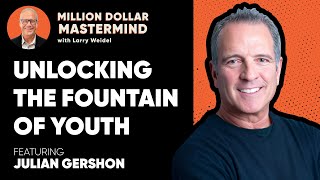
YouTube podcast interview (Million Dollar Mastermind) hosted by Larry Weidel featuring Dr. Julian R. Gershon (recorded Sept 2024). Dr. Gershon, a 71-year-old physician and long-time anti-aging/regenerative specialist now practicing in Aspen, discusses his career shift into age-management medicine, challenges running an independent clinic (regulation, insurance, overhead), and the therapies he uses: hormone optimization, adipose-derived stem cell treatments (over 700 cases historically, resumed after favorable court ruling), NAD infusions, ozone therapies, peptides and more. He describes personal experience with severe influenza in Dec (hospitalized through Christmas), resulting lung scarring that he treated with his own stem-cell infusions and gradual recovery. He is releasing a book and hosts a short-form podcast 'Beyond the Fountain of Youth' (about 26 episodes). Interview also covers mentorship, Olympic/college sports-medicine background, marketing/education efforts, and advice to patients to seek optimal (not just 'normal') care.
Questions this video answers
71
Over 700 cases
'Beyond the Fountain of Youth' (both book and podcast)
About 26 episodes
2010
Welcome to this edition of the Million Dollar Mastermind podcast. This is where we pick the brains of high achievers from all walks of life and get their hard earned real world insights on winning. I'm your host, Larry Wydell.
Hello Julian. We're here with Julian Gert, Dr. Julian Gershon.
Hi Lurie, great to see you.
Dr. Gershon, for those who don't know, since 2020 or before has been on the American's Best Physician list and national Consumer Advisory Board and is a fellow of the American Osteopathic Academy of Sports Medicine and served on their board of directors for 12 years. And that's a glutton for punishment in my book as far as sitting on meetings. I just got asked yesterday if I wanted to get be nominated to get on the board of my HOA and my immediate reaction was but there's times you want to do that. And you have a fellowship with the stem cell therapy awarded by the American Academy of Anti Aging Regenerative Medicine. You've been doing that for a long time. You're a veteran of regenerative medicine, anti aging and triple board certified family medicine, sports medicine and of course the anti aging and regenerative medicine which I learned a long time ago. Julian is pretty much like the green Berets of the medical profession coming up with a new all the new treatments and they're kind of the envy of the other doctors that are out there just practicing normal medicine and everything. And Julian has been involved in that for, since forever. And so over the course of his year of his career has been with a variety of school programs, high school, college, and he knows the business of sports health, regenerative medicine and anti aging. And he and I are in a race to 120 years old to see who gets. I think his father may beat us there. Anyway, welcome, welcome back, Julian. For those who don't know, you know, Julian was one of my early guests and back before we were doing the video and so it's good that we can kind of redo this and people get a chance to see, see what you look like and hear what's been happening over the last couple of years. It's been, it's been a wild ride over the last two years, hasn't it?
Well, it has been, yeah. We've grown rapidly and which you know, we worked out for some time and moved to a new office in Aspen, then a new location with a little more space and a lot more new toys to share with our clients. And that's been very Exciting.
Well, it is interesting, isn't it, how as you go through life, it just does not get any easier. You know, it seems like it doesn't get any simpler for some reason. But you do carry with you the great thing about thinking correctly and trying to do things the right way and figure out the right paths early in your career is you can kind of prove to yourself what works for you and you know where your percentage of success is and then you can use those things to kind of maximize your progress as you go forward because. But you still have to call shots. You still have to make decisions, don't you?
Yeah. Every day.
Yeah. Over the last couple of years, when we talked the first time you were in Aspen, you had made your mark, you'd gotten yourself established. It wasn't a great office in terms of size, but it was a very productive money making operation. And eventually you had, you were able to, you were stretching at the scenes. You had all kind of new therapies that you wanted to do and didn't have rooms to put it in. So talk about the, talk about the challenges doctors go through right now. I mean, it's almost like the government wants to put your ass out of business. It's just like, when are these races, regulation's going to end and cutting how much they're going to pay in the insurance, things like that. But it's pretty. As a veteran, you're energized, you're on the attack, you're still investing in the industry and in your career and explain the challenges of doing that. Because people would look at someone like you, with your credentials and mileage and say, piece of cake, all he's got to do is go through the motions and the money just keeps rolling in. But they don't understand the challenges that you have to overcome. All of that stuff that help you when you are dealing with government regulations and taxes and, and all of these changes give people a little perspective on that.
You know, that's an interesting topic that I spend a lot of time discussing because for me, I made the decision 20 years ago when I turned 50. I'm 71 and I feel pretty good for 71. But, you know, being a sports medicine physician for 40 years, my goal at that time, 20 years ago was to position myself in front of the baby boomers, so to speak. People like myself that were aging athletes that wanted to feel their best. But as I learned about natural hormone therapy, as two of my close friends, Bob Goldman and Ron Klatz, founded the American Academy of Anti Aging and regenerative medicine. Initially I thought they were nuts. I was like, what are these guys doing now? Well, they weren't, they were the pioneers, along with Bill Fallone of Life Extension magazine, people that really started to fight the fight used to be even to get vitamin supplements authorized. The government wanted to 86 that. And so I made the decision after having an incredibly busy career as a primary care sports medicine office, seeing 40, even 50 patients in a day, struggling to collect 40 cents on the dollar, which people don't understand, that was standard. We worked our butts off to, had a big staff to work with, insurance and Medicare, Medicaid, whatever it was. And if we got 40%, we were doing pretty well. Well, that was tough. And I was a younger guy and so I didn't mind working hard, and I still work hard and love what I do. But I wanted to find, position myself in front of a movement that I could be, you know, knowledgeable and become a, an expert in this field and have a little leeway, so to speak, a way to be able to spend quality time with patients and, and still pay the bills, be able to have a decent business. And so it was quite a paradigm shift, if you will, for me to make that move. And it was scary. And there was some months with peanut butter crackers because somebody had to pay the bills. And when you own the business, if there's that money, you're the, you're the last one to get paid. So it was tough. It was really tough. And I started from scratch, moved to Aspen in 2010 after my, my youngest two boys mother died of brain cancer. And I just said, you know, I, this is it, I'm not, it's time to move. And I was, you know, successful in Denton, Texas as a physician for the University North Texas for 20 years when I left. And it was certainly a challenge, but I wanted to be able to provide and continue learning new techniques to help myself and those patients that I care for.
And the thing is, like, even today, I mean, you're going to conferences constantly to stay current. It is a rapidly changing industry. You constantly seem to be on the move, attending conventions, talking to people, getting educated, getting new information in. And how much of a challenge is that?
Well, it's a big challenge when you're in solo practice and when you're not here, you know, the bills are still there and somebody's got to pay them, but you have to go learn. You know, I go to stem cell conferences, anti aging conferences. I'll be in San Antonio at two weekends with my, one of my favorite mentors, Dr. Neil Rouzier, who's trained thousands of physicians from, and nurse practitioners and PAs from all over the world. And just to hear what he has to say, everything he does is evidence based. He will give the pros and cons of new studies and, and point out the validity. And so it's very important. In fact, I was playing golf with one of my cardiology buddies yesterday who is finally making the turn from having said in the past, oh, testosterone less terrible for you, and it may cause a heart attack. I sent him three articles today to read because he's fascinated, you know, and the medical profession as a whole is opening up to that. We've been fighting it for 20 years.
Yeah. And it's hard to stay facts based in your profession because I've heard doctors say in the past that if they, every month they try and spend. This particular doc said he tried to spend an hour a day keeping up with new breakthroughs. And he said every, at the end of every month, I'm like so many years behind on just what came out that month. And so. But you have to pick and choose the areas that, that's, you know, when you look at a physician, don't be surprised if there's information they're not aware of because there's so many different areas that these breakthroughs are happening. Is that an accurate statement?
Oh, absolutely. And. But it's tough to keep up constantly. That's why I quarterly I'm some place at a conference, immersed for eight hours a day, where it's like, someone asked me yesterday, well, yeah, you're going to the Hyatt Hill Country. You taking your clubs? I'm like, no, I, I'm a golf fanatic. But no, I'm not taking my golf clubs because I don't want to miss any of these lectures. They're. They're great. And, and if I can just walk away with a handful of new ideas to share with my patients, then that's why I paid for it. That's why I go do what I.
So that's how you judge you. That's how, you know, because a lot, a lot of people are going to, to conferences and meetings and workshops. And I always tried to tell people, look for something, you know, go into these things. And we always had a lot of them in our business, you know, and in the sales and management and growth business always had. You're always having meetings, but they can tend to just roll together. But I said, look for something that jumps out at you that something you've heard before, maybe, but you haven't heard it like that. Or if you heard an explanation, but you've never heard it explained like that, because there's a. Levels of understanding things or a new concept. But I said, look for something big that you can. And when you leave, I always try to challenge people to have every conference they went to. Like, if we're going to refer to this thing 10 years from now, how would you remember this conference? You know, make it that memorable? That's where I got that idea. Because big ideas can make big changes in your life. So when you, when you go to these things, what are you on the outlook for?
Well, validation. Validation for what I do every day and learning and listening. For someone that's found a way to do something a little bit differently, it may work a little bit better. Something I hadn't thought of or gee, maybe I forgot on something that, that I can then bring back and put into place immediately. There is a tremendous amount of research going on every day, whether it's stem cells, hormone therapy, new applications of other things like red light therapy, ozone therapy, and all the things that we many people already understand and take for granted. But it's a complete eye opener to most folks and certainly providers in general, just trying to fine tune or hone the art of and practice of medicine.
And as a veteran, successful, recognized physician, can you tell people how important it is for them to look out out for themselves in the medical profession? You know, my son Adam, the bodybuilder, he tore his tricep and then he retort, you know, it was just about healed. And then he slipped on his, stepping into his truck, which he's done 10,000 times, and tore it again. Had to go have it reattached. So he went back in to get the stitches removed last week, and the nurses said to him, you know, except for the swelling there, I think you're. You're in good shape. They said, you know, you can. Let's go ahead and wrap that up with an ace bandage, and that'll help keep the swelling down. He said, why didn't anybody mention that to me the first damn time I came in here? He said, I've been in here six, eight times since the first surgery, and nobody's mentioned. And that's like one of seven different things. You really have to look out for yourself, don't you? As far.
Well, you do. And you just have to understand that not every provider can understand everything that's out there. It's not possible and there's changes and even the way that I fine tune and adjust hormones with people, they all say, well this doctor told me this and that this was bad for me. And I have to say you have a duty to yourself to research things. They haven't seen the same articles I have perhaps and, and haven't applied it in the same way or done it personally. I do everything that I practice and preach myself. And when I understand the benefits firsthand.
You need to feel free to ask questions. And if you have an older or a, have a relative that maybe is not in the best shape, it's good to have someone along with you. You know, if they're going through a crisis type situation, to have someone along who is healthy, is thinking clear and kind of look out for them. Because it's easy for people to get the wrong medication, to get shuffled through the system, to be ignored. And it just helps if you speak up for yourself because it's almost like the so many professions right now, like law enforcement, they can't find people who want to be cops. That's with that all of the things that have gone from defunding to the political things to the abuse and they were, I just heard that on the radio 45 minutes ago. And the medical profession has been under attack. I mean the government, health care and things that the onslaught that the medical practices, hospitals and doctor offices have been under it, it's not the same as it was in the past. It seems to me maybe it is for you. Maybe it's easy to get people.
Well, it's just. I'm not sure how to answer that. I think for physicians it is, it's extremely difficult and because of the overhead, the never ending regulations, government, someone trying to define and establish healthcare, when they should leave the healthcare providers to do that.
Yeah, but in spite of this stuff, you've stayed on the attack. You open your new office, you've got some new machines, you've got some new therapies. What is that? Let's just say for just for funsies kind of shift gear. What's the therapy that you've added in over the last year to that you've seen giving you the best boost to feeling like you're making a difference with people and seeing the turnaround.
Well, it never ceases to amaze me when I see new clients and whether they're in their 40s, 50s, some in their 60s, that their family doctors told them for well, your testosterone's fine, but they feel terrible. They can't get off the couch it's, let's say it's 400 or even 500. Well that's in the normal range. I saw what someone recently was 350. Well, that's normal. Well, no, optimal is a thousand. It's where you were in your 20s when nothing hurt, you felt great, and, and doing small things, just helping to replenish those levels by whichever means we use, from self injections to lozenges, pellet therapy, it's a game changer for, for everyone that I see. And even those that are really fit, they recover faster, they have less inflammation. So, so that has been the foundation for a long time. It's what I call the baking the cake, then we ice the cake. And there's a lot of things from growth hormone therapy, from high dose EBO2 ozone blood purification, which I know you're familiar with, to increasing NAD plus levels to NAD infusions. There's a lot of tools that we use. The number one thing that I, that I've done for 12 years, I was one of the first in the United States doing fat adipose derived stem cell therapy. And I've done, you know, over 700 cases during that time. I stopped a few years ago when the government was trying to say we were creating a drug. When I took your fat cells and put them in a centrifuge, I created a drug. Well, I didn't know I was that smart. But they wanted $5 million for a biologics license and that wasn't going to happen. There's, you know, not my world. And so fortunately, about a year and a half, almost two years ago in November, they lost a big court case in California where Cell Surgical Network won. The federal judge there said the right thing. He said they're your cells, you can do anything with them you want. And so now we've, we've resumed doing that kind of therapy. We have a big machine in the office that helps us in an automated way to process and isolate those stem cells from adipose tissue in about an hour. It's called the time machine, you know, 2.0 from cell surgical Network. And we've had great results with that. And then we can treat patients within about an hour, hour and a half of simple minimally invasive fat harvest, using a local anesthetic to also taking a portion of those fat cells and sending them to a banking facility. We use American cell technology and they're excellent. So they're available for you for the rest of your life. And I've had patients even in their 50s and 60s that done a few 70 year olds and said, well, I'm old, my cells aren't that good. Well, I said, you know what the reality is your bone marrow derived cells aren't as good and certainly the numbers are different from when we were an infant to now, but they turn over faster. Adipose cells don't turn over as fast. And so as a general rule, they're about half of whatever your chronologic age is. And when they can, our culture expanded and reproduced over time. They're a 100% pure culture of mesenchymal stem cells. And so they're highly effective for many things. And I've done hundreds of joint injections. We use them for aesthetics, for hair growth. That has been very exciting to be able to reintroduce that to my patient base and offer that to new clients as well.
So what we're talking about is people hear about stem cells but they wonder are they safe? And this or the other. But this is a way you're using stem cells out of your own body. And then you can also, I guess this is separate, you can just do that by itself one time, spin them up and inject them back in. You don't have to bank them, right?
You don't have to bank them. In fact, I just saw a woman about 20 minutes ago that was my first patient zero patient one in 2011. She was here just for a follow up doing we do hormone pellets and, and other things. And so she's stuck with me all this time. She was told in 2011 to have both knees replaced. She came to me and said I really don't want a knee replacement. What can we do? We harvested her cells at that time and it's now 13 years later, she is still pain free in both knees. We did it once now just real.
Quickly because we don't want to complicate, just to let people know they can call you if they want to get more information or look at your website. But one thing that is an option is when you're doing this, there's fat cells are drawn that a certain portion of those can be banked and put in a bank. There are companies that you use that you've used for years and they're there for life. It's all you got to do is make. They can regenerate these things forever and you're not having to pay for anything other than you can call and say send me so many stem cells. We won't get into the numbers and all, but you know, you have the, you know, the doctor call for you at you say my knee, I'm starting to get, feel something in my neck or one thing and another elbows and I like to get, get some of my stem cells out of my bank. You can do this every other month pretty much the rest of your life. Because they can regenerate these things from that first initial batch you sent. There's no limit to how many can be regenerated. Is that correct?
That's, that's true. And it's, it's very cost effective. After the initial banking it's like 250 bucks a year to have them stay there and be preserved. And then when any time you want them depending on the number of cells. And we would decide that together it's 60 to 70% less expensive than the initial treatment. And so yeah it gets, it becomes an easy decision. 20 billion cells, US $1,000. And so it's great.
For those of you who are sick and tired of fooling around and are dead serious about wanting to move up fast, I've got something especially for you. I've combined the best insights from over 40 years in business and making $70 million in income and compressed them into a free webinar.
That's right.
It's a free resource. If you want to find out exactly what the concepts are that I use in coaching million dollar earners, Register now@widelonwinning.com you'll discover the five part framework used by so many to reach their financial, personal and professional goals. You can find that link in this episode's show.
Notes. One of these things in life is that you really know it. You really know your business. Like in my, when I wrote my book Zero Winner, I just wrote a bunch of principles down that I wind up using pretty much all of them at some time or another, pretty much every day, all the time and stuff I'm talking about and using all the time. Same thing with you and your health program. But the advantage that happens is when, when tragedy rears up its head and strikes out of the blue unexpectedly. When you have this knowledge and these resources, you can spring into action and do yourself a lot of good. But I'm bringing this up to say no one is immune and you don't have to talk about this, but you got hit by a health baseball in the back of the head last Christmas just by making a simple trip. Do you mind sharing that experience with it? Because people would feel like this doctor, he's healthy the rest of life, he'll live to 150. But no. No.
Well, I'll tell you, it's. Yeah, thank God my dad's 99 going on 100. I have some pretty good genetics, but. Yeah. I was at an anti aging convention in Vegas early last December, and my wife and I went to see you, too, at the Sphere. And I don't want to say anything bad about the Sphere. It was a great experience. So whether it happened there or around the thousands of people at this conference, we both came home on a Saturday, and by Monday night we were sick and we tested positive for influenza A. I haven't had the flu in 40 years. I had it once when I was a young guy, and it. I was so hypoxic, so delirious, my wife had to send me to the hospital by ambulance. And she has a video of this. And it's not funny. I mean, I was rambling out of my head and I was in the hospital till Christmas Day, and it took me all winter. I am still winning Masters level ski races, and I only got to ski three days last week or last year. I went out the weekend before the World cup race in Aspen. I was scheduled to be a volunteer and help slip the course and take care of things, and. Which I did. But I kind of regretted it. I was so short of breath, and until this August, and after using multiple of my own stem cell infusions to help restore my lungs, it was miserable. So. And I am sure without that therapy, I don't know where I'd be right now.
It was tough because what happened was it scarred your lungs.
Absolutely.
And you were just telling recently, telling me you just now got back to where you can walk down and get the mail from. Your mail into the driveway?
Yeah. I mean, I live on the side of a mountain, so it's. My driveway's a couple hundred yards long and it's pretty steep, and I'd have to stop two or three times walking up the hill. And I couldn't even carry a case of water for my truck into the house, which is 10 steps. And it was tough, but, hey, I'm back.
Yeah. And so. But it gives you a different. It gives you a different awareness about the efficacy of these things when you go through that yourself, doesn't it?
Oh, absolutely. And I've treated some pretty sick patients with their own stem cells and seen dramatic improvements and met with really similar or worse pulmonary conditions than I had. So it's. It's very rewarding. I'm grateful that I have available because I play golf three, four times. A week. I do a lot of things and I. The season ski passes just came in today. I've got a few days so I don't plan on not being on the slopes this winter.
Thanks for the reminder. I've got to call my office. Keep asking.
That's right, you have to renew your chamber of commerce membership so you can get the discount.
Yeah, I'm looking up at the hill now.
And so we talked about all these different things ensuring and I think I mentioned to you that I'm just finishing my first book.
Yeah, tell us about that.
Well, it's called beyond the Fountain of Youth and which is also the name of my podcast and I cover in short form a number every topic that I can think of. And so on YouTube you just put my name in. And there are some things there excuse the first ones. I was a little rusty getting started with things but we're getting there and we try. And particularly in the book, I wanted to stay away from a medical journal with double referenced everything and just share my perspective and my experiences. Although while talking about science that all the things that are out there and I talk specifically about different issues, how your doctor may respond and how he may not. This is a lot of interest in what we do. And more and more physicians are becoming well versed through our anti aging Academy, through Dr. Roussier's trainings with WorldLink Medical. There are many avenues for them to expand their knowledge base as well. But I tried to make it read like a conversation and so I'm about three chapters away from having the final edits and hopefully they'll be out on our website and available in the next four to six weeks.
So what does that. What was that experience or what has this experience been like for you? That's different. Has it been a positive experience? And if so, why?
As far as my. The writing of this book, writing, the.
Experience of writing it, going through the whole process.
Well, it's been. It was a mind blowing, daunting task at first. I'm like I'm not a writer and I'm a clinician. I love talking to patients. I love just digging into the facts and then explaining based on the things I know and what I've learned, how this relates to you. It's one thing for it to be important to me, but if it doesn't mean anything to the patient, it doesn't mean anything. This is all about the you, so to speak. And so as we got started and we did it and with the company that I chose in a interview Style, format, and I agreed on an outline and then they dug in in a very expert way and asked me the right questions to get what was stored up there out on paper. And so when I, I got teared up when I looked at it the first, first time. And I'm doing that now, excuse me, but it's, but it really feels good and I think that it's going to help a lot of people.
Well, there's a lot of, a lot of professionals, a lot of entrepreneurs, a lot of people out there that have a lot of experience, that had amazingly interesting lives, that have insights that a lot of people would know. But you know, the interesting thing about doing these podcasts, Julian, and you'll, you'll find this, I'm sure, is that a lot of the times the people who get the most out of it are the people around you who hear you talk about things that you never talk about when you're in the office, you're in the business, you're going because you're doing other st things, you got projects you got, and you're not talking about sitting back, talking about life and attitudes that have served you well. But one, why did you give in to write the book?
Well, it's just something I wanted to do for a long time. And you know, I, I talked with an author guy named Jeffrey Gittamer 15 years ago who talked to me about, hey, you just got to sit down and do a little bit at a time every day or every week and just it will find itself. And I understood that and it was just, I just never got started until I finally learned of a particular company and approached them and said, all right, I need help. I want to do this. Here's my ideas. What can we do? And they were excited.
They find you or you find them?
I found them. And then interestingly, as we got started, they've published a couple other docs that are buddies of mine from the anti aging and regenerative world. A friend that's doing a new, brand new book on peptides, which is the buzzword for everything, and we use a lot of peptides in practice and I talk about it in the book as well.
Along with that, you've got the podcast and are they hand in glove? Are they just same people working with you on both?
It's another company that at my conference last year, just prior to getting the flu, I had met them and, and said, all right, I've put this off long enough. And even I really wanted to do it, particularly after I did a podcast with you a year or two ago. And. But I didn't. You know, it's like, all right, I don't have the setup or, well, now I have a microphone.
Right.
And a green screen and. And of learning this. And so they just coached me through it, and they said, here, let's write down these different topics. What do you want to talk about? And then we'll find things to ask you. And. And it's been. Yeah, it hasn't always been easy.
Yeah.
Pretty hard to come up with an answer on the fly. But it's. It's been productive and a lot of fun.
Now, this format up till now, I forget, is it you sharing things from that world of health on different subjects? You talking to the camera or you interviewing other people?
It's just me talking to you via camera on testosterone therapy for men or women, what is age management, stem cell therapy, what's concierge medicine? And how do I pick someone to help me? And so, yeah, a lot of different topics. Health, nutrition, vitamin therapy, a lot of things.
And how long are your episodes?
They're three to five minutes, maybe a few or ten. They're fairly short. And it's just. I try to encapsulate information on a given topic so that you can stick with it and find something useful out of it.
Well, the great thing about that is the fact that in the title, if it's you talking, get that in the title, people can go down through the list and see the things that they're interested in and get specific information very fast from someone who knows what he's talking about. And if they have a question, I'm sure they can follow up with you. But it. I really like that for, like, people who would listen to this podcast, because they're obviously people in a hurry. People on the move don't have short attention spans and short, short blocks of time. So it's nice to know. And the name of the podcast again.
Is beyond the Fountain of Youth.
Beyond the Fountain of Youth. And how many episodes are you up to now?
I think we have 26 right now.
Good for you. And so you're putting them out how often?
Four to five. A month?
Yeah, very good. And so now let's talk about. What have you learned about marketing? You go to these conferences, I'm sure marketing has got to be a subject with all the noises and all of the static out there in the world to the right to get your message out there to people in the right way. That's got to be a topic that comes up with these conferences or am I wrong?
Well, yes and no. Not in the beginning. You know, 20 years ago it was just me working hard, telling my story, talking to patients and their family and friends and, and then websites and then we went through a series of different companies to develop and, and make sure that really that our websites had all the latest technology and it changes all the time. That world is beyond, beyond my, my scope. So we have a company we use for that now that does all of my Facebook posts and Instagram and which those are a couple times a week we have new information and new Facebook posts under our business name, Aspen Institute for Anti Aging Regenerative Medicine. You can find us and on Instagram it's just Julian R. Gershon. But we put out a lot of things and we are marketing. It's just taken a life of its own. You can't spend everything on, on in the budget on marketing. But we want to share this with as many as people, as many people as possible and to really make a difference in their lives.
Now when it comes to things, if you're going to write, if you were going to share with people what really drives you to stay on the attack and to keep moving forward and to keep trying new things, where do you think that comes from?
I had a hell of a mentor, my father, who's 99 and we're going to celebrate his hundredth birthday on Thanksgiving Day this year. Practice for 62 years and I worked with him in the early years of my practice back in 88s until I moved to Texas. And he's one of the old school in family practice, anesthesiology. He worked in surgery every day, every morning, saw 50 patients from 1 to 6, was home on time for dinner, went back to the the hospital to make pre op rounds. He delivered probably half of the people in Clare, Michigan in my hometown, 3,000. And when I post something or picture him on Facebook, there's hundreds of likes and messages because my dad was just a real loved guy who worked hard to serve his patients. And that was my role model and I tried to do that and share that with my five kids and seven and a half grandkids now, new one on the way. And so it's just been a passion to be the best person I can be and help as many people as I possibly can with the things that I learned.
When you're thinking about your kids and of course you're like Tiger woods was talking about his, his son Charlie said they were saying you have a lot of father, son talks and, you know, pass on to him a lot of things you've learned. And he said he doesn't listen to me on anything except golf.
Well, I don't want to speak out of line because they may hear this or see this, they probably agree with you, but you just, all you can do is your best and.
Yeah, but when you have your, your kids and when you have people that look to you for leadership, I know you try and set a certain kind of example in turn, and you know that you have a lot of eyes on you. If you look back in your life, what do you think? Were there forks in the road? Do you look back in your life and see that there were forks in your. In the road where you could have gone, made a wrong turn or gone in another direction and things would have turned out all differently?
Well, I can't say I haven't been. Been down a lot of wrong turns or dead ends. So I tried everything. But, you know, my sports medicine career, that's all I wanted to do. And I've been to the Olympics a couple times and taken care of multiple Olympic teams. I had 20 years as a Division 1 team physician for the University of North Texas. I've been to more hundreds of high school football games than I could ever relate to you. And just being there to be available, you know, that's how I learned from my father to be successful. He said, you show up and you be consistent and persistent for a long enough period of time until, as my buddy Jeff Olson's book the Slight Edge says, until the compounded effect takes you, it carries you to where you want to be. It's not what I did today or that one bad decision or one good decision. It's that compounded effect over time. And so I just try to live my life that way.
I've heard that said, like you want. This is the opposite of quitting. You want to stay with whatever it is you're doing to give time for your efforts to compound and grow because it always, everything always seems like it's taken longer than it should. And what was the. How did you get, you know, selected for, to go to the Olympics and what was that experience like?
Oh, it was awesome. You know, I. Well, I was active. I was on the board of my National Academy, American Osipathic Academy, Academy of sports medicine for 12 years. Showed up at meetings all the time and had tours. When we did, gosh, back in the 80s, I had a meeting in Colorado Spring Zoo, and they took all the sports medicine guys and we got to Go do a walk through and a walk around. And I just started reaching out to people and writing letters and sending my resume CV at the time and and was fortunate enough to be selected as a volunteer team position at the US Olympic Training center and Colorado Springs back in the early 90s, 92 or 93. And then through that I started working with USA Boxing, USA Judo and then was selected by them to go with them as a team doc at the Olympics in Atlanta. My passion, I grew up ski racing. I didn't quite make it with the alpine team, but I got to go to El Colorado, Chile outside of Santiago for a couple weeks in the summer of 2007 as team doctor for the on the hill with the freestyle ski team. And we get to wear the jacket and be part of things. And it was. Yeah, it's a thrill. It was the highlight of my career. The Olympic experiences were great. And then one of the hardest things now is to watch a college football game. I've never set the stands. I've been on the sidelines my whole life and. And North Texas is a great place and I love being. Having been part of the mean green and still follow them. So that was a big change in 2010 when I moved here was to walk away from that and change the direction of my career strictly into anti aging and regenerative medicine.
Did you learn anything at all from being that close to so many different coaches at different levels in the heat of battle, did you or were you just coldly concentrated on the hilt side of it or can you pick up, you know.
Yeah, I loved being on the sidelines and I was always somewhere near the coach and I've been blessed to. I was team doctor for GA Moore for 20 years. He was the number one winningest coach in the history of Texas high school football. He's still alive. We're Facebook friends. He's since retired. But I can just tell you those guys and someone like Johnny Jones who went from North Texas to LSU is now back in Texas a former All American basketball player, Daryl Dickey, who I loved some great coaches. Their ability to get more out of someone than they thought they had in them. Yeah, was amazing. I mean, it just, it was like being around Olympic athletes. Those athletes aren't necessarily more talented than you or I or anybody else, but they work so hard day in, day out until they hone that skill and they are the best in the world and win the Olympics. And I was just blessed to be able to be around coaches and leaders of that caliber that people still talk about. And it's changed, I can tell you. You go back to a little pilot Point, Texas, and there's nobody there that has been around in the last 30 years or more that wasn't impacted by that coach, by G.A. moore. I mean, he, he directed those young men in their lives to go on and be successful following the principles that it took to be successful in athletics.
And if you were to describe how they were able to affect that, make that happen, not only get people to get them to stay with the training, do it at that intensity level, and then come to the game and at the moment of truth, be able to deliver again and again. The peak, not peak performance. That's, that's. You use, you use peak performance in your literature. Because I know that, that, that there's some background behind. It's not just words you picked out of.
Well, it's, it's a gift. They have a gift and they were, you know, it's, they knew when to get on someone and when not to, when to build them up and when to back off. And they were just masters at human motivation and getting these young men, including my sons, to, to perform at a level they wanted to, they aspired to, but maybe they didn't believe they could, and they put the belief and, and it was just an amazing honor to be around those guys.
And the great thing about achieving greatness is, in whatever arena of life, and you've had a chance to see it through athletics and medicine and everything, is the fact that it does inspire other people to greatness. Don't you believe?
Oh, absolutely. And what's the ripple effect? Those kids, their lives were changed forever. Whether they were on the first team or sat the bench some they were in the environment, they heard it. And they use those tools to go on and create a happy family, to provide for your wife and kids. And, and there's obviously not just about men. There's tremendous female athletes and, and people around that were part of that support system for every individual athlete.
As people got get to know you better through your book and through your podcast and everything. I think what's going to come out, Doc, is your, your relationships. Because in the world, when you're growing up, people, kids and people hear things like mentorship and coaches and things one thing and another, but relationships, I mean, you've got a incredible wealth and network of relationships in so many different fields all over the country. It's kind of amazing. And you strengthen those, when you strengthen, expand those, when you continue to be in the game, going to conferences but none of that would do you any good if you weren't on the attack with your own practice as well. Would you say that's the case there? Yeah.
Just is part of the environment of learning and bettering yourself and constantly being around people that you can either support or that you can learn something from.
Yeah. And right from the beginning, starting with your dad and coaches and everything growing up, that gave you that foundation because I know you got, you've had as tough things happen in life, throw you things that anyone could, you know, a lot of bullets you love to have dodged, but they hit you anyway. But you've had that strength. And what do you do when you get hit with the worst fireball type thing like that? What do you do?
Well, that's a great, great topic and thing to talk about because it's. I. I would have never accepted failure in my life. No. Just means not right now. And. And to find another way to succeed, to do something. I've been broke. I've had a lot of things happen. I had a spouse die of brain cancer and two boys to take care of. And along with a host of issues with family and business, business failures. I mean it hasn't been easy. But I spent a lot of time reading Personal Development. As I mentioned, my friend, my buddy Jeff Olson used to have a tv, a private TV network that was strictly personal development. So I still desk I read Jim Rohn how to Lead an Inspired Life. I'm always reading it on my ibooks and sending my boys quotes. They get sick of it. But I'm like, there's a wealth of success in the books and books, tapes, podcasts, things like yours that people just have to make an effort to access. And it just takes a little bit read one chapter of a good book a day. And I mean a novel and steamy romance thing. I mean how does it see sales? You'd be shocked at how many people sales have never read a sales book.
Right.
And so it's one thing to learn science and help, but you know, I also learn personal development because that is really the difference maker in making yourself more attractive to others. You can't go force anything. It's stuck in your head down somebody's throat. They have to want what you have to give them.
Yeah, yeah. And you have to make it easy for yourself, have the resources around you. You know, they know where to find on YouTube, the right people make it easy to find on Instagram, you know, people to follow on Instagram or our books. I've got books by my spiritual growth books, by my bed that I've been reading since I was in my 20s, but now I'll just read. Because you forget everything. Maybe I'm. I'm just particularly forgetful, but sometimes I'll only read like two sentences or one sentence, like. Yep, I got it. Okay. Reset.
Yeah. And I'll tell you what really sets my foundation is my spiritual background.
Yeah.
I read every day. I don't preach to anyone. Everyone's allowed their own perspective on life and life after death and spirituality, but it affects everything I do, and it affects health and wellness. You have to be grounded and well rounded, whether it's well read, with authors close to your maker, to your higher power, whatever that is to you. And, and I have studied a lot of religions in, in my lifetime, and, and I'm in a comfortable place where I feel that I have a pretty powerful team, so to speak.
Well, I don't think it's too confrontational to say to people that obviously things are not here by accident, but you're not here by accident. It's not too much to accept the fact that there's a plan behind this and there's a plan for you, and it's not too much to consider the thing that maybe I should get in line with that plan rather than fight it. I'm probably going to have more, more success if I go along with a program that was. I was supposed to go with maybe the abilities and the interests I have. Maybe that has something to do with what I'm supposed to do with my life. That's not too much to challenge people with, I don't think.
Julian, I would agree with you.
Yeah. Now as you go, when you think I real. We'll let you go. But when you look at that book, I will tell you that before I started my podcast, I had 20 years of trying to figure out how to do podcasting. 20 frigging years. I even sent one of my secretaries through a course. A school sent her away. Learn how to do it, get it all. That didn't work either. And so I, I can relate. But sometimes if you keep it on your mind, there's a reason it's on your mind. And so how do you feel about those 20, 20 something things? I mean, you feel good about having that, those blocks of information down on the podcast, having done that now?
Yeah, I feel. Feels great. When I. When you watch yourself for the first time, it's like, yeah, that was pretty good. I. I didn't know because it just comes out. I Just start talking and it's like, wow, that wasn't too bad. You did okay. You know, it feels pretty good.
Yeah. It's kind of like sometimes if you're. You're speaking at a conviction. I've been things where I've spoken somewhere and I almost said, like, that's pretty good. I've never heard myself say that before. Is someone writing this down? Because at Subcon, you know, our minds are putting stuff together all the time. So it's, it's interesting when it comes out, and it's great when you have a format for it to come out. And when you looked at that book, you got a little bit emotional about the book. What about the book gets you emotional that you're, you're gonna, gonna feel great about having that done?
I think. Well, one, just a sense of completion. All right, I did something and I think someone's gonna want to look, read this, learn this, or hear hear from me in this format. And I, I sent it to Bill Falloon and with Life Extension, and he just wrote the forward to my book. I don't know if I can talk about it without getting choked up. I mean, I literally cried when I read it. It's short, but it's so concise and it's so in tune with how I wanted this to come out. And so, yeah, it's just satisfying, but it's just real satisfying to feel like you reached a milestone that's been on your goal list for 40 years.
Right. And the thing is that, Julian, we're supposed to do things, we get these ideas, but they're nothing until you put it out there. And you never. When, when I did the podcast, it's kind of like, honey, we both thought, every time I go down, and it's been 20 years since I've been down there, but anyway, go down to South America and try to do some wing shooting. You go out in the morning, say, I hope I just get one bird. I just hope I don't humiliate myself. And then, of course, a few minutes later, you're, you're off to the races. But like, you start a podcast, you say, will anybody listen when anybody buy the book? But anybody. Will anybody come to my business? I open my business, I come up with a new product or something like that. You always have that. You know, it's the same thing if you're musician. Anybody going to buy my record. But until you get it out there, you, you'll never know. You gotta go. And it's like, I've. I'VE heard this before, that there are two rules of success. Has to do with the, like the Olympics. It's like you've got to pay full price, and you got to pay that price in advance. And you want to win the gold medal, you got to be prepared. And so there's no, there's no discount on, on greatness. There's no discount price on, you got to pay full price, got to do it in advance. And that's pretty much the way it is all through life if you want to succeed and have a life you could be proud of. And so you're just such a great example of that, continuing to fight. I'm going to give you the last word for everybody listening who stayed with us and what do you think we ought to send people away with?
Well, don't take your health for granted, you know, and there's a lot more than I preached for a long time as a sports medicine position for diet, exercise, spiritual awakenings. But go get tested, seek out an expert, because, as I say, nobody's immune to the effects of aging. And I don't care if you're 30 or 60. I see I have dozens of guys in their 30s that haven't felt up to par, that things aren't quite right, that somebody said you're normal. Well, there's a difference between normal and optimal. And so find someone that can help guide you down that path.
Yeah. And if you want to do something great with your life, you're probably going to be asking a lot out of your body, a lot out of your mind, a lot. You're going to put yourself through a lot. So you better take care of your tool. That's your first tool. And so great advice. Thanks so much and wish you the best with the podcast and the book. And I'm sure we'll be coming back together and talking about how all that's turned out down the road.
Awesome. Thank you and enjoy your podcast. Thanks.
Thanks so much.
All right, buddy. Bye. Bye.
Thank you for listening to this episode.
Of the Million Dollar Mastermind podcast.
Commit to your personal and professional evolution with our free training video. It's designed not just as an educational session, but as a transformative, formative journey.
For those bold enough to aim for the stars.
This isn't just any webinar. It's a roadmap to achieving the extraordinary. It's tailored for those who dare to dream big. And yes, it is completely free. Join us in a network of ambitious professionals ready to take their careers to a new heights. Secure your spot now@whitelonwinning.com and let's un unlock your potential together. Thanks for being part of this community.
More from Larry









Rick Jordan on Self-Engineered Proximity, Cyber Security Moats, and Truth-Based Leadership

Fire Fast or Fail Slow: Kevin Brittingham Reveals the One Rule That Built a $100M Empire
