Part 1 - ADHD, Dentistry, and Beer with Dr. Ty Eriks
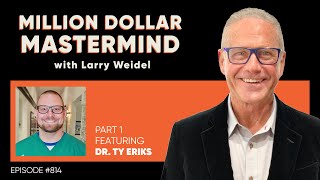
Dr. Ty Eriks, a dentist and craft brewery owner in South Florida, talks about growing up with ADHD, his path through University of Washington and Boston University dental school, and how a Brazilian classmate's homebrewing sparked a second career. He bought his first dental practice in 2016 and now runs a 5,500 sq ft brewery alongside multiple dental offices.
Questions this video answers
Morningside Academy in Seattle.
University of Washington.
Neurobiology.
Boston University (dental school in Boston).
2016.
Foreign.
Welcome to this edition of the Million Dollar Mastermind podcast. This is where we pick the brains of high achievers from all walks of life and get their hard earned real world insights on winning. I'm your host, Larry Wydell.
We're talking with Dr. Ty Ehren.
Yes, sir, Mr. Wydell, great to see you.
Yes, sir. Don't for many things. I've known him mainly as my dentist.
Yeah, it's been a couple of years. I mean, we're probably looking at five years or something here, Larry.
Yeah, at least. And from that, the conversations have, you know, he's been into my art studio. I think he came to the grand opening or something like that back and.
Yep. Went to the West Palm Beach. Yeah.
And so anyway, over the years, you know, we've, we've talked and it finally dawned on me. I found out that he had a jewelry and then I found out the whole other side of his life.
Yeah, I'll show you guys here. Yeah, we'll kind of go around here where you can see everything. Oh, and then there's Ashley. Hi, Ashley.
Now watch the square footage there.
About 5,500 square feet.
5,500. That's substantial. And the thing is that to tell people the story, what I thought was, would be fun for us to get into is, you know, a lot of people have multiple interests, but you're just going to have to, you know, guys listening, you're going to have to put up with a little background noise because we're in a brewery.
Yeah, indeed.
There's going to be conversations.
I was trying to tell people to keep a little bit quiet because we're not quite opening yet, but it's getting there.
Yeah. So there's going to be conversation. But will hang with us. You'll be glad you did. But the thing is, with Ty, what was exciting for me to hear about is that what I thought he could share is the vantage point of not only having two double interests, equally strong interests like that, but excelling, you know, knocking it out of the park in both arenas. So the thing is, there is a myth, you know, most people want to do something great with their life. They never do. And that's what I wrote my book about. You know, if they do it once, they, they don't keep repeating. But then there's people like Ty that go out there and are able to be successful over and over again because of their thinking, their approach to life, and they just do the right things. They set things up for success. And even if you fall in Your face. Eventually you don't fall in your face as much. You learn from it and you start to get successful. And then you find yourself moving up to the top of the whatever world you're in. And so being able to knock it out of the park in a profession, which is a big thing. It is highly competitive, and I'll let you talk about that.
Sure.
But you did it even at school. You started to get recognized with awards in school, with football in school. Yeah. Inducted into the Dental Honor Society even while you're in college. And then get out there and get your other passion that you kind of started even while you're in school. So we got a lot of stories to talk about, but then you turn that into this incredible business and the popularity is just growing.
Yes, it is.
And so you say you've knocked it out of the park in two areas. One of the biggest, fastest growing craft beer operations. That might not be the right way to say it, but he'll correct me. It's in South Florida, you know, all the way up into Disney World and lots of outlets. And anyway, the message today, folks, is that you can do it big in more than one profession and at one interest. And if you do, you can keep them going. You can grow both.
You can and.
Because it's always fun to do things. Well.
Yeah, no, it is. And it's also fun to keep yourself interested in multiple avenues that fill your life. You know, it's really important.
Let's do this, Ty. And then also, I know your wife is incredibly successful herself in real estate. And, you know, we've talked about getting her on the program as well. And so she's probably a little better.
Spoken than I am, too, so more fun to listen to it.
Unfortunately, it's taking us this long just to get tied and then we'll go to work.
I know she's much more. Much more regimented in her schedule, too, so it might be a little easier to get her as well. So.
Anyway, Ty, tell us. I know about your experience up in Boston in college and that we're going to get to that. But before you got there, Todd, before you got there, in your formative years of absorbing and thinking about the future and sports and coaches and teachers and, you know, you're absorbing things. You know, you're getting your principles down, you're getting your role models, you know, what you like, you don't like. When did you start getting ideas about your future? And how far back do you think that went?
First of all, I think it starts really Early, I mean, I was very blessed to have great parents that, you know, taught me to do things the right way. Work hard, earn everything you get. No, nothing is ever handed to you. It started there and then I had some challenges with school when I was younger. I got diagnosed with ADHD when I was younger like a lot of kids and learned how to work through it without taking medicines and not saying that that's the norm. It just won't work for me. Use my energy to do other things and stay focused and control the energy so that things got done in a controlled and detailed manner. So that took a long time.
Talk about that thing. Because most people are parents, have kids and you, you don't really realize the impact of how you treat them, how you say. But it goes better if you got a plan and you got kind of a general idea about what I'm going to be telling them. And I definitely am going to be telling them these things and. But how did they communicate that to you, that you got to work hard, you got to earn everything?
Well, I start from the beginning. You know, I never got handouts. My first car, you know, my dad helped me set up a car washing business when I was in high school. Like things like that, that obviously didn't pay for everything, but at least I had to work towards it. I think that really set the precedence for just making sure that you were working hard and going in the direction that you want to go in to accomplish the goals that you want to accomplish. So that really started it. Honestly, without that foundation, it would have been a lot tougher to do this. But with that and I obviously school became very important because I realized that without that you couldn't fulfill the other dreams that you have for your life. So I spent a lot of my time, or most of my time on school and sports. I played college football as well. I played University of Washington. I played five years, Red children one year and letter for four years, played defensive line and fullback for the time that was there. And even then I'd spent a ton of time out off the field in school. I majored in neurobiology in college and there was maybe 25 people accepted into that major a year. So I was trying to set myself up because I knew I wanted to go into healthcare. Wasn't quite sure at that point in time what avenue of healthcare I wanted to go in, but I knew I wanted to go into health care. And the reason why I knew that is because my family is ton of health care providers in my family, nurses to medical surgeons and my dad was a periodontist, so obviously all his friends and my uncle's friends, my mom's friends were all in healthcare. So I knew I wanted.
For those of you who are sick and tired of fooling around and are dead serious about wanting to move up to faz, I've got something especially for you. I've combined the best insights from over 40 years in business and making $70 million in income and compressed them into a free webinar. That's right. It's a free resource. If you want to find out exactly what the concepts are that I use in coaching million dollar earners, Register now@widelonwinning.com you'll discover the five possible heart framework used by so many to reach their financial, personal and professional goals. You can find that link in this episode's show.
Notes how did the thing come up about you find you got the adhd ADHD Y and how do you get to the conclusion as a kid or maybe your parents, how do you I'm going to work hard, I'm going to have a lot of activities and I'm going to work my way through it.
Rather than take the drugs probably definitely more My mother, my mom was on the psychiatric side of being a nurse practitioner, so she had dealt with a lot of this stuff on with her patients. And so she knew and we tried things initially and it just didn't work for my personality and that kind of thing. So she went the other route and, you know, obviously stayed in sports a lot, got the energy out. But she put me in a summer program which really, in, you know, in my mind, I think major change in my life and the trajectory of my life. Did a summer program at a, at a school called Morningside Academy in Seattle. And they specialize with kids with ADD and adhd. And what they do is they make school competitive, which it is anyway. But you know, a lot of the kids don't realize that at that point in time and life's competitive, school is competitive and how you succeed in that obviously directly affects how you do in life. Right. And your opportunities that arise. So everything from, you know, reading comprehension to, you know, times tables to anything, you know, they make it a competition with your classmates. And that really changed my my mental outlook on school to every single day be competitive and look around the room and say, hey, I'm gonna be the, I'm gonna be the best in this room every day that I arrive and didn't really click, I don't think until maybe seventh or eighth Grade kind of thing. So it was a struggle for me in school for a long time until that point in time. And then it just clicked. And you know what? I put the time in. Probably had to put three times the amount of work as most kids hadn't put in, but. And that was the way it always has been in my life, even through dental school. So. But I'm fine with that. At the end of the day, isn't.
It amazing how you can take, you know, like, with me, I never wanted to be in business because growing up back, my mother used to harass me. It's like, larry, you got to stop criticizing everybody you meet, you know, behind their back. Everybody that shows up and whatever job they have is like. I couldn't imagine doing that, you know, can you imagine having. She said, I'm sick of it, you know, she said, yes. Sooner or later, you gotta find something you like. You're gonna have to do something.
Right.
I never could visualize Ty, you know, but I played sports all year long, and somehow nobody ever told me, and I was not smart enough to figure out that business is sports, business is competition.
Yeah.
And it's amazing. It's amazing how your attitude can flip. Like you said overnight when you say, oh, I can beat these people, you know, it's like, this is something for me to have fun with, you know, and I get beat. And somewhere along the line, all of us, when you're on the entrepreneurial thing, you've got to get the point where you realize, I can put the energy in and I can get the results back. This is going to be worth it.
Oh, yeah, for sure.
It's all tied in there together, but it is amazing. I don't know that I've ever heard of a educational program where they did that, but thank goodness they did for you. Yeah.
Again, my mom. My mom found. I don't know how she found. So happened to be in Seattle, where I'm born and raised. So my mom was the one that found that school, and I don't do her avenues of working in Seattle and the greater Seattle area. She found. She found that program. So. And she thought, obviously, you know, we're looking at avenues to make this whole thing click and start going in the right direction. And it did. So, yeah. Very thankful for that.
Yeah. It's amazing. In fact, if you're having. Having problems with your kids or even employees or people in a team that you're supervising, if you could get some competition going, find a way to get the competitive angle involved, you're probably going to see things start to work out to your advantage. Now, how did you go from Seattle and then, you know, University of Washington, you wind up in Boston all the way across the country. How did, how did that go?
So after playing college sports again, I knew I wanted to go into healthcare. I graduated with a neurobiology degree. I just wasn't sure what avenue I wanted to go. So I thought dentistry wasn't quite sure. So I took a year off of school. I ended up assisting my father for about a year and a half and realized that that profession I wanted to go into. So I, one of my dad's old dental assistants again went to. Not again. But she went to dental school in Boston three years before this time.
Right.
And so I asked her about her experience and of course my dad shared his experience being going to dental school in the Washington and obviously hers was much better. So. So I applied there and I'd never lived out of Seattle at that point in time. So I wanted to try something different, completely different. So I applied. And the story is kind of long, I'll try to make it short. But I was also with my wife at that point in time. We're not married at that point in time, but she was applying for law school. So we were trying to apply for schools in the same cities and it just kind of wasn't working out. So no, I'd get into a school. I mean, mind you, we all had, we Both had basically 4.0 in, in college. So we thought that it would be a cakewalk, you know, to get into the school.
Get it wherever you want.
Yeah, yeah, wherever. It's all whatever, it's easy. So I ended up getting to Boston University. Well, she got into Boston University, but she also got into Duke with a full ride scholarship for law school. I did not get into North Carolina. I got into University of Pacific and she did not get into Stanford. So we were kind of like looking at the, these schools, like, okay, well it looks like we're going to have a long distance relationship and do the best we can, you know, at that point, 24 years old or whatever. And I would say probably three days before we had to give our final deposits to go to school. Boston University gave her a three quarter scholarship for law school. And so it all kind of happened the way it was supposed to happen. But that's how Boston became a big part of our lives for four years.
Boston's a big craft beer town. How did you get going on the beer side of it?
Well, that's exactly where it started. So it actually didn't start out out in the. The city of Boston. One of my dental school classmates from Brazil actually started making beer with his father, who was a chemistry professor. Still is a chemistry professor in South Brazil. And everybody that got, you know, A's in his class got a chance to make a beer with the professor at the end of the semester and learn how it all worked and. And all that. So he, semester after semester after semester, got to learn how to make beer. So, of course, us being four students in Boston and not able to go out and, you know, restaurants and bars, that kind of thing, he goes, hey, now I know how to make beer. Let's give it a go. And I'm like, all right, we'll try it. So we did. And, you know, the first couple matches were palatable. They weren't great, you know, but you get better and better as you do with, you know, as long as you put your effort towards it and all that and figure out what went wrong, how to make it better and all that. And we ended up doing it for all four years we were there and started with making small batches for ourselves, and then we made batches for, you know, tackle parties and things like that, where it became actually something that we got to do for a little bit of money. So it was. It was good. It was fun. So that's how it started.
Now, how did you start? So you moved to South Florida.
Yep.
To start your business. Let's just do a little bragging. How well has your dental practice done?
Great. It's done very, very well. I bought it in 2016, and from that time, I have grown substantially in Boynton beach and also expanded to Fort Lauderdale off of Los Angeles. So we got a couple practices now, and the one on Los Olas I did with Dr. Pike, who was my periodontist in Boynton. I've been working with him for probably since 2013. Even before I bought my dental practice, I was working with him in Fort Lauderdale. He comes up and does a surgery day of surgery every week, my Boynton office. And then this opportunity arose down here, and we decided to do the expansion together down here in Los Alas. So it's been very good to us. I really can't complain about that. But, you know, again with morals of growing up just doing the right thing by everybody. It grows on itself. You know, it grows on its own people. People send people. And that's how the whole business has really grown for me.
Your business, your brewery is down. Down that way. Too, right?
Yeah, I also live down here, too.
Yeah. Oh, I didn't know you lived in. Okay.
Yeah, I live between Fort Lauderdale and Pompano Beach. Kind of Lauderdale by the sea area.
Yeah. Okay. All right. Thank you for listening to part one of this episode of the Million Dollar Mastermind podcast. Commit to your personal and professional evolution with our free training video. It's designed not just as an educational session, but as a transformative journey for those bold enough to aim for the stars. This isn't just any webinar. It's a roadmap to achieving the extraordinary. It's tailored for those who dare to dream big. And yes, it's is completely free. Join us in a network of ambitious professionals ready to take their careers to new heights. Secure your spot now@whitelonwinning.com and let's unlock your potential together. Thanks for being part of this community.
More from Larry









Rick Jordan on Self-Engineered Proximity, Cyber Security Moats, and Truth-Based Leadership

Fire Fast or Fail Slow: Kevin Brittingham Reveals the One Rule That Built a $100M Empire
