Part 1 - From Bad Swag To Brilliant Gifts with Millie Tadewaldt
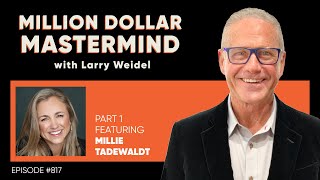
Millie Tadewaldt, founder of Brilliant, went from self-taught coding at 13 through Harvard Law and BCG to fixing corporate gifting. The $25-30 billion swag industry mostly ships junk. She built Brilliant to replace wasteful branded merchandise with things people actually want.
Questions this video answers
2015
About $25–$30 billion (US)
Age 13
About $180,000
Santa Barbara, California (moved there almost two years ago)
Foreign.
Welcome to this edition of the Million Dollar Mastermind podcast. This is where we pick the brains of high achievers from all walks of life and get their hard earned real world insights on winning. I'm your host, Larry Wydell.
I'm here talking with Millie Tadwal. Hello, Millie.
Hey, Larry, how's it going?
Where in the world are you today?
I am in beautiful Santa Barbara, California.
Barbara?
Yeah.
My brother lives about hour north of there and actually I hope to be driving through there in the next month or so. Beautiful part of the country. How long have you been there?
Is. We moved here almost two years ago. We were in Chicago before that and have lived in San Francisco and Boston and just been enjoying seeing all the great places in America.
Of course you're not going to be able to enjoy all the great weather in Santa Barbara that you have in Chicago, but.
That's right.
Maybe you can put up with it.
Yeah. Well, teaches you to appreciate even the foggy days here when everyone freaks out and wears their down coats unnecessarily.
Yeah. And so talk about why are you in Santa Barbara? What brought you to Santa Barbara?
We looked at all kinds of places, all over and we decided that it was an ideal place to live. Great weather, close to major cities. My mom lives here. Seemed like a great place to raise our little kids. And my company Brilliant has been all remote since I founded it in 2015 so we could really live anywhere.
Yeah. Plus you're close to Harry and Megan, so.
That's right.
You know, you've got dinner guests for Friday night, you know, so we're working.
On getting them over here.
Yeah. Well, let's talk about Brilliant. You know, how did you get that idea for Brilliant? What is it? And how big is this, this thing gotten?
Yeah, for sure. So in my, in my varied career previous to starting Brilliant, I had had a few opportunities to buy swag branded merch in those roles. So company T shirts, pens, gifts. And what struck me when I bought that stuff was how bad that experience was. I was in my mid-20s in my first role where I bought some company T shirts and I was an expert e commerce shopper, as many mid-20s women were then and probably still are today. And the way you had to buy company T shirts at my company was you had to call up this guy and he would make an appointment and he'd come out to the office with a rolling suitcase of samples and there was a lot of like paperwork and forms and he wouldn't let me keep the samples to try them on. And I just had to trust that it was going to work out okay. And it felt really bad. So that was one bad experience. And then a few years later, I had a really good experience giving a couple gifts at work. And what I found was giving the right gift to someone in the right moment really transformed that relationship. So those two experiences stuck with me when I found myself kind of ready to start a company. And that was the inspiration.
Well, talk about how big a business merchandise is and gifting per se, you know, it's huge.
It is actually sort of hard to measure because so much of retail is gifting and yet you can't really segment that out. In the US they talk about the promotional products industry, which is like literally kind of swag tchotchkes, that type of stuff being about a 25 to $30 billion industry that's in the US alone. So that's a pretty big industry. But then when you sort of take a step back, you can look at the industry globally. You can look at, you know, all merchandise, materials, marketing, all those different categories in addition to retail when it is purchased in a business context. And that ends up being an even bigger market. Kind of, kind of hard to estimate.
Our company, financial company, we're getting ready to have a convention this summer and there will be awards by the tractor trailer load that be about 60,000 people there. And it seems like the whole thing is passing out awards and recognition. But how do you get into, how do you go in that business and build something significant other than, you know, you're going to open up a local trophy and embroidery and T shirt shop on the downtown or something? How do, how do you go into it from a.
Like you did well, Larry, I didn't mean to stumble into the swag industry. What I set out to create when I started brilliant in 2015 was your corporate gifting assistant in a way. So the idea was our customers would come along and they would say what kind of gift they wanted to give, in what context. I want to give a gift to my client and he's about 45 years old and he's into I don't know if this is cliche golf and barbecue. And also he loves playing the ukulele and he lives in Seattle. And I want to spend about $100. And the idea was that the platform would recommend three gift ideas. You would be like, yay, I love these. And I'm picking this one. And that would make that gift giving experience really simple, yet feel personal. So that was the concept I started with.
How do you make money doing that? I mean, how much, you know, profit can you make on a $100 gift where you. Three options and then you have to deliver. You know, you have to order it and have someone deliver. Well, I guess they drop ship it or something like that.
Yeah, the thought in 2015 was you could drop ship it or you could come up with a matrix of all the possible options and you could eventually develop stock of the most popular ones, and then you could control things like packaging and the card. But. But, yeah, great question. I wasn't sure I was playing around in the space. And so I went out and found some people in my network and asked them to try this thing I had built that did that, and it really didn't do much. You would fill out that form. I made the form really pretty, and then it would say, standby, you'll get some recommendations in one hour. And so I would get the email and I would go scrambling at my desk trying to come up with three gift opt four people within an hour, because that was the time frame we'd given. And I did that a few times and it seemed like it was working. But yeah, your question was. Was always there looming large in my mind. But what happened on about gift number four was people started asking to put their logos on the gift. What I realized then was, well, this would really solve the inventory problem because no one would expect me to be stocking their logos on the gift. And, oh, look, it looks like whenever you order logos on things, you have to buy like, 200 of them. So I stumbled my way into the promotional products industry. I found myself in early 2016 at a trade show in Las Vegas. It's the industry trade show. About 10,000 people descend on Mandalay Bay, and there are aisles and aisles of swag, and a lot of it is really bad or poorly merchandised or sort of, like, presented in a way that is uninspiring.
And tell me what Bad. Let's elaborate on bad.
Yeah, bad. So many flavors of bad in this space, right? You're giving someone something that they didn't ask for, and it. It has a. You have an ulterior motive, right? You're trying to get them to do something for your business. You're trying to make money in some kind of way because you're at work here. You're not just doing this for the love. So you're giving them something that they didn't ask for. And if they don't actually love that thing, what are the odds they're going to Keep it. So to me, bad is a piece of junk that goes straight in the trash. Plastic garbage. A bad pen, a tchotchke, a scratchy T shirt that doesn't fit right, a sweatshirt with your logo printed on it poorly. Basically anything. We say we'd rather sell you no swag than sell you bad swag. But what we're really aiming to do is give people their new favorite thing. So maybe you didn't realize you needed a new water bottle, but this company gave you a water bottle and all of a sudden it is your favorite water bottle and now you have an upgraded opinion of their brand. You have positive emotions. Whatever they're trying to get you to do, you're some percent more likely to do it. And you're going to be looking at their logo for the next X days while you enjoy that water bottle and have good thoughts about them. The alternative is I gave you some weird stuffed animal with my logo on it and you don't want a stuffed animal. And maybe you give it to your kids or maybe you chuck it in the thrift store bin. We call that bad brand karma. That doesn't. That doesn't do anything good for anybody. And bad for the planet too.
For those of you who are sick and tired of fooling around and are dead serious about wanting to move up to fast, I've got something especially for you. I've combined the best insights from over 40 years in business and making $70 million in income and compressed them into a free webinar. That's right, it's a free resource. If you want to find out exactly what the concepts are that I use in coaching million dollar earners, Register now@widelonwinning.com you'll discover the five part heart framework used by so many to reach their financial, personal and professional goals. You can find that link in this episode's show Notes.
How did you get in there? And approach this from a unique standpoint.
So my, my background since not quite childhood but when I was a teenager I. I learned to code. I grew up in a small town and I stumbled on the Internet and taught myself how to code. So I was a self taught software engineer from the age of 13.
You were a young female nerd.
I know. I still am a young female nerd. Right?
Good Lord. 13 years old, small town and teaching herself code.
Racked up some weird dial up bills, all kinds of hijinks, nerdy hijinks. So I always had this lens of what can technology do to make everyday things better. And so I walked around with that lens from when I was 13 on, and I still do. And there's always a way I like to layer technology onto every problem I encounter because I'm still a young female nerd, so slightly. Yes. Less young, maybe more nerdy.
Oh, you're still young. You're still young.
Thank you. Yeah, go on, go on.
You're still young.
So I went off to college and I was a design major in college. And that ended up being a pretty fun combination of caring about aesthetics and caring about how things look and incorporating technology with that to make experiences better.
How does that filter or that framework that perspective.
Yeah.
Influence. Give me an idea of how that would influence you as you went, you know, as you go through life and you. You encounter situations.
Yeah. So I went on to be a management consultant at the Boston Consulting Group after I went to law school and.
Why did you go to law school?
Oh, it's a great question. I got into Harvard. I had to go.
You got into Harvard and you had to go to law school?
Yeah, it seemed. It seemed like it would be a good adventure and it was.
Was Alan Dershowitz one of your professors?
He was. He actually took us on a trip to Israel.
Really?
Yeah.
You're such an educated young lady. Good lord.
Yeah, sort of.
Yeah.
Yeah.
But you did, unlike most people from Harvard that I know, you actually are doing something with it, so.
Oh, my. My friends are all pretty accomplished too. It's been a. I'm just kidding. The network there has been incredible.
I kid the Harvard students, the Harvard graduates. So anyway, anyway, talk about, you know, this gave you a platform. What that. Let's just talk about that. Coming through that. Why? What in the world were you doing at Harvard from this small town, little coding, 13 year old winds up at Harvard.
Yeah.
You just wanted more challenge, I guess. What?
I mean, I had never thought I would go to grad school. I went to college and graduated quickly and started a freelance web application development firm. I couldn't find a. Couldn't find a job that paid very well, but I had a few freelance clients and I turned that into a business and I started building web applications for them. And that was a pretty good living. It also gave me some free time. And one day in my free time, I stumbled upon a page on the Internet. Still. Still a nerd. That was a practice LSAT test. So I took it and I plugged it into this page that said, you know, with this GPA and this LSAT test, here's what school you could go to. And it Said Harvard. So I thought that sounded like a good idea. So I took 24 full length practice LSAT tests to ensure that I would get a very good score and got a near perfect score and near perfect score.
Wealth did you have, in addition to being this young wonder kid, did you have wealthy parents who would not gag at the idea of you going to Harvard or did you get a scholarship?
I paid, paid my way and got a scholarship. What my parents were have given me lots of wealth in other ways, but certainly not paying for my grad school tuition.
So you paid your way through with your.
I saved up from my, from my business after college and also got a lot of loans. I think I graduated with about $180,000 in student loans.
There's a secret right there.
Yeah, there you go. I don't know, you got to do the math on that.
Well, that's, that's the motivation, isn't it? Isn't it? Is it, Is it motivation or is it depressing? What does it do? That mentality?
It never really bothered me. The interest rate was about 3% and it would stay 3% for the entire duration of the loan. And at the time I paid it off, it probably wasn't the like objectively rational choice to pay it off because an interest rate loan is a pretty good deal. But it felt shockingly good to have that just go away one day. So I don't know, there's always some emotion wrapped up in the sort of economically rational actor mindset that we try to hold in our brains as business people.
Well, I mean, you know, just the release of the pressure and yeah, while you're just such a young girl too, to have that paid off, it's just incredible.
Yeah. I think I was, I was in my late 20s when I paid it off, so that was exciting.
Yeah. And so did you pay that off from your. What business paid that off, would you say?
Well, so after, after law school I went to bcg and one of the things that lured me to law school initially was you would look at sort of what's the average first year lawyer salary and looked pretty good. I figured that would be the worst case scenario. And if I had to do that, that would be an upgrade. And if I thought of something better, that would be cool too. It's sort of a risk, a calculated risk. In going to law school, I wasn't sure I wanted to be a lawyer. And when I got there, I learned about management consulting and I realized I didn't want to be a lawyer. And management consulting Seemed like it would be a really good way to kind of transform my law degree into an MBA and go get involved in the business world and be treated like somebody who'd gotten an mba yet I also had the. I think the legal education that I got at Harvard and that you get at any top law school is incredible. Like, I would highly recommend it. The blend of kind of logic and history and policy and politics, that whole combination is just like an incredible education. And I also cross registered at Harvard Business School and MIT Sloan when I was there. So I got to see a lot of that business education too. But I would just highly recommend it. If you're a nerd and you want to go learn a bunch of cool stuff in one place, law school is a great place for that.
What about the business world had an appeal to you?
Well, I guess I'll start with what didn't appeal to me about being a lawyer. Because the flip side is what was appealing in the business world. So being a lawyer, it felt like you'd always be someone's agent. So you'd be making recommendations and you'd be helping guide them. But at the end of the day, it wouldn't be your choice and it wouldn't be your bet. And for me, I realized I liked, I liked some risk and I liked making bets and I liked winning. To go back to your point earlier that this is about winning, I like winning. I'm competitive by nature. I can't suppress that aspect of my personality. It's a sickness in some ways. But I like winning. And it feels like when you're someone's agent, it's not really your win. So I started to understand that it would take a long time if I took a path as a lawyer to move from agent to principal. And I knew I wanted to be principal sooner than that. So I didn't think I'd be principal at Boston Consulting Group because of course you're definitely an ultimate agent as a management consultant. But I think that would give me a lot of good exposure to the business world. And again, things I hadn't seen. I grew up in a small town. Law school was super eye opening. Just the kinds of different kinds of people I got to see. And you know, I went to Israel with Alan Dershowitz. That was nothing that had ever been on my radar in my childhood. So I loved seeing all the different sites. And I knew going on to, to kind of top three management consulting world would give me a similarly new vantage point on the world.
Yeah, your independent streak kind of Doomed you from the beginning that you weren't going to last long in the management consultant world that you, you, you were not going to put up with dumbbells. Not paying attention to your advice for long.
Well, the whole, the whole premise of it is a little tough, especially in your first couple of years. You know, I, I rolled into BCG. My first day of work was September 15, 2008. I don't know if you remember what happened on that day, but that was the day Lehman Brothers went under. And all the case interviews in the world didn't prepare me for how my job was going to change. So instead of doing cool competitive pricing exercises and exploring new markets for my clients, I was doing a lot of what they call delayering. You heard of that? Yeah. Means layoffs and firing people and figuring out how to cut costs. Because that was the beginning of our, or, I don't know, the sort of public beginning of our most recent recession. Getting in there. It ended up being a pretty different experience than what I'd been expecting. But again, got got to see a ton of stuff, you know, traveled all over to the clients of the world's largest milk solids producer and interviewed them about what's the, what's the experience like working with your sales rep from this milk solids company? And another project that was incredible was I got to work for Chicago Public Schools trying to identify the kids most likely to be involved in a violent incident in high school, in public high school. And from there trying to figure out an intervention plan to prevent that, which was morbid task on a lot of levels, but also pretty inspiring because when you think about it, you talk about like a 10% improvement in the business world. It's like, whoop, do I saved you 10% on your logistics costs. But a 10% improvement in kids getting shot in high school is like, hey, we stopped 20 kids from getting shot. So 10% actually becomes really meaningful. So a whole array of different things I got to see in that role, and that was incredible.
Thank you for listening to part one.
Of this episode of the Million Dollar Mastermind podcast.
Commit to your personal and professional evolution with our free training video. It's designed not just as an educational.
Session, but as a transformative journey for those bold enough to aim for the stars.
This isn't just any webinar. It's a roadmap to achieving the extraordinary. It's tailored for those who dare to dream big.
And yes, it is completely free.
Join us in a network of ambitious professionals ready to take their careers to a new heights. Secure your spot now@whitelonwinning.com and let's unlock your potential together. Thanks for being part of this community.
More from Larry









Rick Jordan on Self-Engineered Proximity, Cyber Security Moats, and Truth-Based Leadership

Fire Fast or Fail Slow: Kevin Brittingham Reveals the One Rule That Built a $100M Empire
