Part 1 - How Gurpreet Singh Escaped The Desk Job Trap
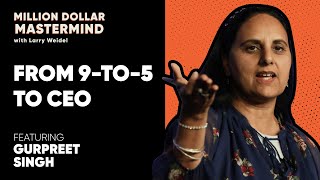
Gurpreet Singh immigrated from India at age 3 and discovered programming at 12. He built habits like waking early and learning during his commute, then escaped a desk job managing 39 phone lines to start in financial services.
Welcome to this edition of the Million Dollar Mastermind podcast. This is where we pick the brains of high achievers from all walks of life and get their hard earned real world insights on winning. I'm your host, Larry Wydell. Hello, Gurpreet Singh. Thanks for joining us.
Thank you for having me.
And you got an exciting story for people that are locked in jobs behind a desk and wanting to get out behind the desk. And you see people doing, having a business of their own and you just feel like you got more potential than your current career, your current opportunity, your current job offers you, but you don't, you don't feel like you're in a box and you're in a routine. You're successful at it, you've got obligations. And so a lot of questions about how you make the transition. Which industry would you go to? That's issue that we want to provide some light on and show people that it's compounded if you're female. It's compounded if you have a different background. Like an Indian. Is it an Indian background? Is that what you're. And so we'll get into that story about all of that compounds and ups the complexity factor. But you're living proof that this can happen. You can do it because you went from the comp five years of being a computer programmer to where now you have built a regional powerhouse organization in financial services in the most competitive marketplace in the country up in the northeast and with 20 offices, 1,000 people, and you're on the verge of a huge growth surge and unlimited market opportunity. And so you position yourself very, very well, great fundamentals and foundation in place. But where you've come so far is astounding. So we're going to dig into that and see if we can let people pick up some answers that they can put in their toolbox of ideas to use when they run into some of these kinds of problems. So talk about at what stage of your life were you, did you get into computer programming that job and what led you to it? Because I would imagine that was probably, you were probably pretty excited to get that job.
Yeah, absolutely. When I was 12 years old, they started a program in my junior high school where they introduced computers and computer programming. And they said, listen, you can come early 7am and we'll be teaching you these skills. So that's what I signed up for. And as I went through junior high school and high school, I went to business high school and they taught me, they kept continuing to teach me these things and then that's what I decided to go into in college.
And why did you like that? Why did that stick out to you rather than sports or music or art or something like that?
Well, it stuck out to me because I didn't want to deal with a lot of people. So this was behind the desk. You're doing your programming, and you're working very little with people. You're working programs. And at that time, I was not a people person, and I didn't want to interact with a lot of people. So that was the perfect fit for me.
And the idea of developing skills. I just think it's a good thing for kids to be, you know, a thought to have in their mind is a growing up of, like, developing skills that you can use throughout your life. Because even if you're, you know, not in that, you can go to the top and develop skills in one area, you makes it easier to develop skills in another area, become super proficient at it. It's kind of like when you're learning a musical instrument, they want you to learn. Get to the point. Because what your. Your tendency is like, hey, I like this song. You go in to see this week, you see your guitar teacher, whatever. How does that work? And then you kind of get to where you can play that. The next week, it's another song. You never really learned to play anything. So what they want you do is to get to where as soon as possible, get where you can play one song at a performance level. Because then you have it in your mind like, this is. This is playing a song. And it's the same thing with developing a skill. Seem like. And so you're developing a skill at a young age and probably feeling pretty good about yourself, about the things you're learning.
Yeah, absolutely. And the skill that I developed actually was getting up early and going to school early and habits that have stuck with me. The work ethic. Yeah, the work ethic skill. And also, if you want something, go for it. And being that I'm from an immigrant family, my parents migrated from India, we saw them work hard, and that was just part of our DNA. It's, if you want something, go get it, work hard, show up early and make it happen.
And so talk about an immigrant family. How long by the time you were 12 years old, you're in high school. How long had they been here? Were you involved in that immigration experience?
Yeah, well, I came here when I was 3, and I was born in India, and I came here when I was three years old. So I didn't learn how to speak English until I was six, because I never went to school till I was six, and that's when I learned English was my second language.
Yeah. And how did that impact you growing up? Do you think it made an impact on you one way or the other?
I mean, it made an impact is when I went to school, it opened up a new world, a new language, because I was only familiar with what I was learning at home, which was my own native language. So that opened up a whole new world of possibilities.
I guess one way of looking at it, Gertrude, is when in your young life, did you. Did it dawn on you, you have to learn a new language at 6? And. But when did you really. Where did the impact of being an immigrant impact you and that this was part of your reality?
Well, I think it impacted me because, as I said, my parents worked hard. They came here for a better life. So there was no mentality of, oh, somebody's going to give you something, or you're here to just wait for things to happen. It's make things happen. You came across all this time for a better life for your family. That's where my parents, my father, my mother, my sisters. That's the mentality. So the mentality was go after everything you can get your hands on, because that's where the opportunity is.
Yeah. And so as you're going through skill, I mean, through school, by the time you're 12 years old, you get the opportunity to get involved in the coding and class, and that basically forced you to now get up early, develop some discipline. And that stayed with you. I mean, so you were doing this all the way through high school?
Yes, through high school. And then I went to junior high school there. And then I decided to go to high school further away because there was a business school that I applied for. So my friends all went to the local school. They're like, oh, you're going to take the train and you're going to take the bus and you're going to go to Manhattan, because that's the big city. Right. And you're going to go to school there every day. And I said, yeah, because I'm going to be able to learn so much more. And it was fabulous because it was a business school and they taught us skills that I use. I mean, up until today, did that.
Give put you in a lead position in terms of getting employment as you graduated from that school, or what happened after that high school, that business school?
Right. Well, during high school, at that time, there was internships with payment. We got to go to work. So I worked for places like Manufacturers Hanover, which is now Chase. I've got to work in the financial industry. I actually worked for a company where I was in charge of, like, 39 phone lines. So that was a learning experience in itself because I had to manage all this and the phone calls would go crazy, and I was like, oh, my God, this is overwhelming. But then I learned a lot because the people I worked with, they were specialists in different parts of the world because it was a international company. They created dental supplies and they. They had dentists all over the world that created this product. So I was able to talk to these people as they would come into the main. Like the main hub, which was in Queens. Well, it's kind of Long Island City near Manhattan. And I was able to talk to them and they were able to bring all these ideas and their heritage and where they came from. And I was like, wow, this is opportunity as it at its best.
And what particularly did you learn at a young age about managing 39 phone lines? Just what would you learn to see, like, you just, like, running from the lions? I don't know.
Well, what I learned was that you had to pay attention, you had to focus. There was no, you can't just go on coffee break because if you walk away, the lines are ringing and these are orders coming in. These are millions of dollars of orders coming in on the phone line. So if I was able to not do the job well, that was losses for the company. So I was actually able to focus. Because at that time, you didn't have phones, you didn't bring your phone to work. You were able to. I had to show up at 8am, prepare everything, and leave there at 6pm because that's what the phone lines were open, and I had to transfer these lines to other people. So it might have seemed like an easy job, but it really taught me about focus.
Yeah. Now, as you graduated from school, did you go to college in the city or. Or where?
Yeah, well, I went to St. John's University, which was in New York. And that was another great experience because I actually met, which I didn't know, my future mentors or people that I listened to, like Dr. Wayne Dyer used to teach there, and. And I used to listen to him. And I was like, oh, my God, I can't believe it that I missed him in the college. But after college, I started learning these things and he was right there, and I missed that opportunity, but I was able to connect the two. And then the second thing I Would say I would learned in the college is again, we didn't just go to college. That college required us to have six months. Every six months we had a different internship at the college. So we would work with different departments. We would work. One year I worked with the alumni department. And then that blew my mind even more because I would have to. I would see all these checks come in as donations. And here I was. I was like, I wasn't wealthy, I was poor, I was broke. But I was able to see this. And I was like, wait a minute, there's a lot of money out there. I just have to figure out how to attract it.
Yeah, that's a big breakthrough in all of our lives to realize everybody's not poor out there.
No matter.
Everybody I know might be poor or might be starving, but there's a lot of money. There's a lot of people that have a lot of money. And I remember where that hit me was our first convention. We went over to Hawaii. And I'd always been under the impression that these were the exclusive places and you had to be. Very few people could go, well, there's zillions of people there and a lot of them were young, younger than me, and they were bringing their whole families. I'm thinking, you know, the light bulb finally went on, that there's a lot of opportunity, there's a lot of success out there in the world. And that's what we're trying to put the light bulb on here. Because there's things people do to create that success for themselves. It doesn't fall out of the sky. They're not taking their families over to on these luxury vacations because everybody won the lottery or everybody just inherited from a rich uncle. Now most of them made their own money. And almost always in the United States, you find already in the world of the billionaires, of the millionaires, most of them made their money money. It wasn't inherited, in other words. And so as you're coming up, you get out of St. John's you're still thinking the career path is coding. And why do you think you didn't think. The thought didn't come into your mind while you're looking at all these big checks coming in the alumni office and how to get my hands, how can I get position myself to where the that can happen to me. Why do you think that light bulb didn't go on at that time?
I would say it's one thing called belief in yourself. See, a lot of people, they're seeing the external world. And they're saying, oh, it's okay for this person. And I'm happy for this person, I'm happy for that person. But because they have lack of confidence and belief in themselves, they never feel that they're good enough to attract it. So. So I think what I shifted in those years after that was I was able to connect to a self development program which taught me how to believe in me that I'm worth it, that it's okay that these other people have it and I'm not mad they have it. I'm not being a victim. I'm not saying, oh, poor little me, I don't have it. And they have it and they got it easy. No, it was digging into the habits of successful people and say, if I duplicate this, then the universe is going to give it to me too.
Yeah, well, now you go out and the main thing is you're. You're getting mentally stronger. You're developing your social skills, you're developing your technical skills, and you go out and you get a pretty good job in Cody. Who was that with? And why was that a great job?
Because the first job I ever had was in New Jersey and It was about $80,000 and it was pretty decent. But. But I realized I had to spend so much time traveling there every morning and every evening to what, get a paycheck so I can build someone else's life where I can be building my own future and owning something versus just loaning it.
And how much were you traveling then?
It was two hours in the morning, two hours in the evening. That was four hours of my time. And that's when I started using those two hours to what? Develop myself, to read and listen. And they had those players, those CD players, and they had the books. I would carry the books with me. So I would sit on the train and I. It was almost like traveling and having a university on the train. And I would finish chapter after chapter, and in the evening I would finish the rest of the chapters. But then I would do the same thing every day until it just becomes where you say, well, there's something better out there.
Yeah, I've heard people say that they use their car like that. It's like every time they get in their car, class begins. You can cover a lot of class material when you're in the, in the car. If you get established that habit, that routine, and set yourself up to have that material already there when you get in. And so as you're going along, what other skills did you do? Did you develop any other skills on the job that are useful to you later once you got out of college?
Yeah, I believe I did. I was able to interact with people more. I was able to become a team player more. I was able to do different projects as a team versus an individual. And I was able to communicate better. Because if you don't communicate better, well, to either other people or yourself, you're blocking what you really want. And once you communicate it and you have a clear, concise mental picture now, the world is what out there for you to take.
Thank you for listening to part one of this episode of the Million Dollar Mastermind Podcast. Commit to your purpose personal and professional evolution with our free training video. It's designed not just as an educational session, but as a transformative journey for those bold enough to aim for the stars. This isn't just any webinar. It's a roadmap to achieving the extraordinary. It's tailored for those who dare to dream big. And yes, it is completely free. Join us and a network of ambitious professionals ready to take their careers to a new heights. Secure your spot now@whitelonwinning.com and let's unlock your potential together. Thanks for being part of this community.
More from Larry









Rick Jordan on Self-Engineered Proximity, Cyber Security Moats, and Truth-Based Leadership

Fire Fast or Fail Slow: Kevin Brittingham Reveals the One Rule That Built a $100M Empire
