Part 1 - How To 10X Your Business Growth
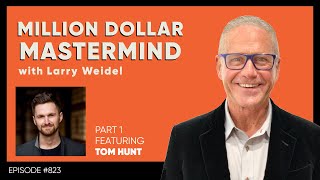
Tom Hunt, CEO of the podcast production company Fame, talks with Larry Weidel about scaling from solo founder to leading a fast-growing business. He covers LinkedIn organic content as a tool for both marketing and hiring, plus the leadership moves that got him there.
Foreign.
Welcome to this edition of the million Dollar Mastermind podcast. This is where we pick the brains of high achievers from all walks of life and get their hard earned real world insights on winning. I'm your host, Larry Wydell. Hello, everybody. We got an exciting hour in front of us here talking to the the main man at fame and fame changed our changed my life on the podcasting side. And they're the ones that produce it and organize and take all the pain out of podcasting for Larry Wydell. And so, Tom, I'm having you back on as a return guest because we're going to dig in deeper. So welcome Tom Hunt.
I have an honor to be invited back. Am I have you had guests on twice before?
I have early on a couple of my closer friend, you know, closest friends and where I knew there was tons of things we just didn't get into with them. But you know, I've been listening to your podcast and I would encourage everybody who's running a business or interested in running a business to to dial into your podcast. Confessions of a B2B marketer, I guess is how you came up with that name. I don't know, but it's easy to remember. And so the B2B business to business and pretty clever, I might say, Tom, because as you're starting your business, you pick the brains of other people that have done it well and implement the ideas that fit you. Which is how I built my business, Tom, by the way. You know, it's just like, you know, I somehow early on in my career, Tom, people I read in a book or someone told me, you know, it's like you, you beat 50% of the people by working hard. You beat another 40% by having a method to your madness, you know, a management philosophy, a structure, a rhythm. And you do that by watching the top people, you know, how do the top people do it? Picking up trends from them. So I was always interviewing on every Monday morning pretty much my entire career for decades, I've interviewed the top people in our financial services business about because I also had the heard the thing that ideas don't care who use them and ideas are a dime a dozen and the people who use them are priceless. And so if you someone's beating me, I had the audacity to think that it wasn't because they were better than me. I took the approach. It was they knew something I didn't know, you know, because I didn't mind working, but I hated to work on something that wasn't Going to pay off. And so maybe they knew how to phrase something, explain something, visualize something, communicate something, structure something in a way that I didn't. And because nobody could know everything and nobody can figure everything out the best way at the same time, you know, and so you, if people surge ahead of you, they're, you know, they're doing something you're not doing. You know, they've got a different thought in their head. And so I, I applaud you doing that and the results are showing up and, and that's just not me and you chit chatting here. This is something for everybody to pick up and think about adding to their business because what it's done, I mean your hard work has. I, I know a little bit about your story, but as you were interviewing recently, recent podcasts with Alan Pence, I heard, you know, I was hearing your story in there with his story. You know, as you start as just doing it all your, you know, one man paper hanger, doing it all yourself and you work your way up. But this has paid off for you. I mean things have paid off. You are fast growing. You're running a fast growing operation. Why don't you tell people some of those that growth.
Yeah. So the company started on $0 revenue. This was in December 2019, so four and a half years ago. So as of May, our monthly recurring revenue is $314,000. So we've gone from zero to 340,000 and then just to times that by 12. So coming up on 3.8 million in annual recurring revenue in his four and a half years. Fully bootstrapped. And I'm a solo founder.
Solo founder. And so how, what is that multiple when you say four and a half years, what is that that multiple from? Basically from nothing, you know, so that's.
Yeah, from nothing.
Yeah.
I would say the growth percentage wise was much bigger in the early years because the numbers are much lower. But I would say that there was two big jumps and I'm going to get a graph out so I can remind myself exactly when they were. There's two big jumps. One was in the last quarter and we can talk about why I think that was. And then the other one was in. So the, the big jump was Q3 of 2024 this year. So for us that was basically March to April, March to make our quarters are messed up. And then Q1 of 2023. So that would have been September of 2023. So they were the big up levels in terms of growth.
Now as you let's Dial it back. When you started this thing, what gave you the audacity to think, I can bootstrap this thing? You know, I've got an idea. Why did you think this would be a good idea?
I think so the company started. I was working as the head of marketing at a soccer company and we started a podcast. And I think we got a bit lucky in that the. The eleventh guest on the show turned out like, basically we got chatting with our CEO and then bought our software for the whole sales team. It's like a 50,000 pound deal and we probably spent about £5,000 on the podcast. And so that's like a 9.10x ROI. And so that big delta in like profitability on that campaign for me was like that set off alarm bells, like there could be potential profit here.
Yeah.
And so that gave me the initial belief and then so very fortunately they agreed to be the first client of Fame. I left and then they became a client. And then I think the reinforcing belief probably came from like the first five clients where we're maybe not able to replicate the full 90, 10x ROI, but we were definitely getting close. And so it was really the fact that we were able to bring on clients and then make them happy that gave me the belief.
Now, were you in your previous business career? Were you primarily sales? Were you management? Had you run teams? What was your experience level?
First four years of my career, I was project management. Learning about management probably a bit and then learning about how to write emails and stuff. So being organized basically, then the following. So that takes up 2014 and 2014 to basically 2018. When I started Fame, I was more marketing. So it's no surprise that Fame is really a marketing platform. People, service business. Right. Because I have that thumb understanding of managing people, then I have some understanding of marketing.
And your role now has. You've gone through quite a shift in the changing of your role and your daily activity and responsibilities. Talk about that. You know, we. I know on your podcast Alan went through in detail. Now the only thing I can say about Alan is, you know, it's easier to understand if you're in that business, you know, like, you know, level three, level four, level five of this and that and the other. But, you know, if you're not in that world, it's just mumbo jumbo. You select more complicated, you know, people just, you know, you, you know that some of those terms are not easily understood or picked up on by people who are not actually in the game. Because what he was talking about his thing is that most people, people never got past, you know, a million dollars in revenue. And that's pretty much, you know, a solo practitioner, you know, just doing everything yourself. And like only 4% ever even go beyond that. So it's, it's, you know, when it's important to. A lot of times, remind yourself when you're, you're dealing with these other levels and other systems. It's not many people can relate to that. If you're listening, you need to realize that will make real sense to you when you get there. And it hurt. It does help you to hear that in advance, which they will hear on your podcast and all. It's just don't worry about things you hear on Tom's podcast or even on this one that don't make sense to you at this stage. Just kind of tuck that away because there will be a time when you, you know, your vantage point in terms of growth reaches you say, okay, now I get that. You know, and so the exposure is good. It's good to have it, have it internalized. But as you have gone through these steps and I see that, you know, you've had to make decisions, you know, decisions, projects, effort, you know, expenditures of effort give. Create results. Results don't just come in because, you know, hey, you know, I grew another bumper crop of, you know, oats this year. It's like I didn't even plan anything. You know, look at that field, you know, and you've got, you've got to plant before you can harvest. So talk about how you've gone on the attack with your energy and effort and focus and, you know, how that's turned into results.
So going back to the question you asked just now about how the role has changed, and then I'll come into what I'm actually doing and how that's impacting results is, you know, I mentioned we have the two big jumps of growth. 1 20, 23, 1 20, 3, 24. I think the 1 in 20 came because I was doing less stuff, less stuff inside the company.
Yeah.
And I kind of stood back, had these three people, head of growth operations and account management, that were responsible really for 90% of the day to day running the company. Instead of me being responsible for client happiness, me being responsible for growth, me being responsible for ops, it's just I'm not good enough to be good at all three. And so I've stepped out. And then we have these three people who are all just focused on doing that one thing. And I'm just there to coach and be a consultant. And I think that's had a big impact because now they're doing a better job than I was. But then we add on to that the fact that I now can have like 80% of my time to invest in new things that could lead to growth. So I'm happy to share. Probably the biggest lever, I think has been LinkedIn organic content. I happy to share more about that, like the impact it's had and what I've invested into that.
Yeah, well, let's go ahead and dive into it because I remember that from a earlier podcast that I listened to that because you and I were talking about using social media here several months ago, and there was a debate between Twitter and LinkedIn and it seemed like LinkedIn won the argument. The argument that went on after I got out of the conversation. But it. By the way.
But anyway, yeah, LinkedIn is. I mean, I'm trying to get Twitter to work as well. It's just not working. But LinkedIn is working better. What I've essentially done is probably taken about half my time and have just invested that into seeing into maximizing the amount of impressions I can get organically. So it's not paid by creating content and then engaging with other people's content.
Two things, new content and engaging with other people's content.
Exactly right. And so let's say five months, 50% of my time. So 2.5%, 2.5 months of my time has been invested on this. So like a decent expense for the company. But the output is that we now get anywhere between 10 and I think in June it's going to be 20 million impressions on posts that I from my personal profile. And the output of that is that we are getting more people coming inbound that want to start a podcast. And actually the bigger impact of that is that we've roughly 10x the amount of people that want to come work for us. Really the reason for that is to make LinkedIn organic work, you want to have three things. You want to be talking about something that you are passionate about. You want to be talking about something that you're doing every day, so you're continually learning. But then you also want it to be a topic that aligns with how you make money. Now I actually only have two. I'm talking or. Or the post I get the most impressions, like the workplace culture, remote work posts. So I'm, I'm doing that every day. I'm basically responsible for the culture and leadership of fame. I'm passionate about it. But it isn't what we sell. We sell podcasts. And so that's why it's having a big, big impact on hiring versus getting customers, because it's not aligned with what we sell. But that's fine. I'm trying to work out how to talk about more about what we actually sell in order to generate more leads for. That can come later.
Yeah, I was going to ask you that because as people listen to this, they're going to say they're going to reach the point, well, I'm interested now in LinkedIn, you know, to get my. Raise my profile and then, and I'll probably have you speak about that, that you, if you're. You've got a business, you need to raise your profile and you need to. The tendency for us is to hide behind the business is out there and, you know, to try and be oz behind the curtain. But not that doesn't seem to win. You got to come out from behind the curtain and expose people to who you. You are as a person where they feel like they get to know you. I'm going to have you speak, go ahead and speak to that and then we'll. I'll ask you the other stuff.
Yeah, I think this, the role of CEO is to promote the business to three people. Well, actually four people. I think customers, employees, potential employees, partners and investor shareholders. And simply just being known is very valuable. And I think that's the job of the CEO. Everybody has like a group of people they have influence over. And if somebody reads a LinkedIn post and they agree with it, they align with it and they remember you, you are going to be the podcast agency that they refer to when their friend asks them for it. And so I think every theo should be focused on getting just more exposure to those four groups of people.
Thank you for listening to part one of this episode of the Million Dooll Mastermind podcast. Commit to your personal and professional evolution with our free training video. It's designed not just as an educational session, but as a transformative journey for those bold enough to aim for the stars. This isn't just any webinar. It's a roadmap to achieving the extraordinary. It's tailored for those who dare to dream big. And yes, it is completely free. Join us in a network of ambitious professionals ready to take their careers to new heights. Secure your spot now@whitelonwinning.com and let's unlock your potential together. Thanks for being part of this community.
More from Larry









Rick Jordan on Self-Engineered Proximity, Cyber Security Moats, and Truth-Based Leadership

Fire Fast or Fail Slow: Kevin Brittingham Reveals the One Rule That Built a $100M Empire
