Part 1 - Overcoming Challenges In Tech And Space
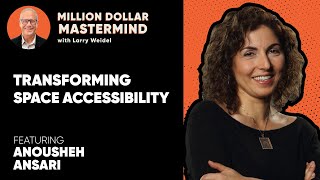
Anousheh Ansari talks about building a VoIP company, leading 50 engineers, and becoming the first Iranian-born woman in space. She flew to the International Space Station in 2006 after training in Star City, and explains how the XPRIZE and reusable rockets opened commercial space to regular people.
Welcome to this edition of the Million Dollar Mastermind podcast. This is where we pick the brains of high achievers from all walks of life and get their hard earned real world insights on winning. I'm your host, Larry Wydell.
Hello everybody. Let's have some fun this afternoon talking to Anusha and. Sorry. And Anusha's just told me she's in Maryland right now. She's based out of Dallas. And so, Anusha, what I like about in reading your bio, you're someone who obviously came up with a certain unique passion and you made certain things happen in your life and that's what I want to hear about. So as you were growing up, what motivated you? What did you get excited about? And how early in your life did that light bulb go on? That this is something that really captivates me.
I was very young, probably around six or seven years old, and my curiosity really got me interested in space. I was born in Iran, grew up in Iran. And summer nights we would sleep outside and I had this opportunity to look at this beautiful night skies and my imagination and curiosity drew me to try to learn more about what are those beautiful shiny objects up there and wanting to actually go to space. And that's what interested me in math and science and physics and astronomy and has been a driving force in my life and this desire to go to space and explore space and just to.
Tell everybody, give them an overview to what their appetite is. You didn't go to the moon, but you did everything but talk about that. You have been in space.
Yes.
And you didn't do like William Shatner, where they shot you up like a monkey in a seat and you go up and you come back down. No offense, William, but you were up there for quite a while. Talk about that.
Sure. I was actually inspired by Star Trek. I was a Trekkie and watched Star Trek growing up and wanting to actually explored the universe onboard Starship Enterprise. I didn't get to do that, but I did fly to International Space station and spent 11 days in space and performed some experiments for European Space Agency and was able to really understand what astronauts talk about when they talk about the overview effect. And this profound experience that I had shaped a lot of what I'm doing right now.
So what's that like you're sitting in now? You have to be, you're the elite of the elite to be able to get to where you're sitting in that rocket ship, that space capsule, getting on the launch pad, getting ready to go off. What, what did you go through to get to that point.
So my life actually has been a very interesting zigzag way of getting to what I wanted to do. I started off kind of, I came to United States, studied engineering and computer science and actually became a tech entrepreneur first and built a few successful products and companies. And once I sold the company, I decided that I want to go back to my original passion, which was space. And that's when I went back to school, studied astronomy and became involved with XPRIZE foundation, the organization that I'm the CEO of right now. And at that time, this is in 2000, late 1990s, 2000, and the X Prize Foundations that was started by Peter Diamandis. The goal was to try to create a way for everyone to access space and reduce the cost of access space and make it accessible. And we did it through a competition. And this competition was a way to ask the people around the world to go build a spaceship to go to 100 km, which is the edge of space, and do it twice within two weeks, which meant that it's a reusable rocket. So this prize and this competition was something that drew me and started my career in space. And I, my family and I sponsored the prize and that was my entry into the space program, if you would, several years later. And a lot of successes through seeing how these small companies were able to build their spaceships. And hundred millions of dollars were spent actually to win this 10 million. So this leverage model was an amazing achievement of this model. And the prize was won by a US company. And design, which was Spaceship 1, was licensed by Richard Branson, became Virgin Galactic. And at the anniversary of this competition is when I got the opportunity to go train and fly to International Space Station with the Russian Soyuz. At that time, the shuttle program was not flying to the space station, so only Soyuz was flying to International Space.
Station, which is the Russian.
The Russians.
The Soyuz.
Yes, the Soyuz, exactly. So that's how I ended up about training for a year in Star City outside of Moscow and flew on, on a mission in 2006. Star City.
Star City, yes. Now, the thing is that as a way of perspective, the reusable rocket was a radical idea at that time, way back to now with Musk and everybody there that, you know, it's acceptable. They proved they could do it, but that was really a stretch of the imagination that could even happen. So you guys ran a competition to help do that. Let's dial back before that. How did you and how quick in your career did you decide, I'm going To be an entrepreneur. I'm going to start my own company. Because here's what. One thing I want to bring out, Anusha, is the fact that the incredible injustice Iran is doing to the world by keeping their females under wraps and in the house because you're one, you know, you're one female from Iran. And look what you've accomplished in your life. Impacted businesses, industry, inspired people all over the world. And you're one, one female out of Iran. And so this just shows the devastating impact of a repressive political regime in terms of starving the world. Putin's go there killing off all of his men, you know, starting the war. So they're never going to be able to make their contribution. They're going to be dead. And so now the same thing kind of happens when you stifle half of the population. But it's be amazing to see what could happen if these bright minds were unleashed. So you're, you know, you're a champion, you're a message, you're a beacon and I want to appreciate you for that. And hopefully that will change, you know, somehow, hopefully that will change and these women can be unleashed because it's no telling what could good could come from that. And also I appreciate you mentioning Star Trek, because that'll get me back for sure in William Shatner's good graces. If he listens to this, he won't walk away. He will walk away with the fact that I impugned his trip into space.
No.
So anyway, the thing is that what you come up. And now you graduated from school, how early did you decide? I'm going to get a business of my own. I'm going to start. I've got ideas. And what was your main products that you came up with? This business, of course.
So it was about four years after I started working in, in the industry that I decided that I wanted to start a company. I did that with my husband. So I had a good partner in crime in that. But one thing that I think people should appreciate is this is right around 1993 timeframe. So entrepreneurship and venture capitalism and the Silicon Valley didn't exist as it exists today. So it was still very difficult for startups to really get the funding they needed and create big companies. And especially as a female CEO in the tech industry, the news for getting the product done and funding the company was narrow. So a lot of the work we did and the way we built the company was through bootstrapping and just using our stock option from our work and our savings and credit cards and whatever means we had at our disposal to build the company. It was a learning experience because I was an engineer but I wasn't a businessman. I never went to business school. So it was really learning the business. And the way I would look at the product was putting myself in the shoes of the customer. So it was very customer focused and customer centric. We started with doing a lot of consulting. So through the consulting work we understood the needs of the customer basically. And then based on that learning, we built products which was for the telecommunication industry. This was in the early days of Internet. So a lot of products that would use the Internet, that would be mobile centric. And one of the biggest product that we built that was ultimately the biggest success we had was the software that enabled voiceover IP if you remember back then.
Oh really? VoIP? Really?
Yes. It's a soft switch. I remember when I started my career we would pay like $2 per minute for long distance international calls and now it's free. And the reason for that is this transition from analog to digital and voiceover it and demonetizing basically long distance and international calls. So our software was one of the enabler and dad.
For those of you who are sick and tired of fooling around and are dead serious about wanting to move up fast, I've got something especially for you. I've combined the best insights from over 40 years in business and making $70 million in income and compressed them into a free webinar. That's right. It's a free resource. If you want to find out exactly what the concepts are that I use in coaching million dollar earners. Register now@widelonwinning.com you'll discover the five part framework used by so many to reach their financial, personal and professional goals. You can find that link in this episode's show notes.
And how, how did you, did you guys write the software? Did you hire software engineers to do it?
Well, we had a team who built the software. So we had about 50 software engineers building different products with one major one was the soft switch product.
Wow. And so what would you say the first big lesson that still sticks in your mind that you learned about business, the business side of it. What would you say pass on to people that are starting their own businesses now, but they don't maybe don't have a business degree, haven't really run any businesses before. What would you say is the first thing that hit you that you learned and it stayed with you?
So looking back, I would say one of the most important thing is sort of rigor and passion. Because if you're not passionate enough and believe enough in what you're building and your business, it's a really difficult road and journey to build a successful business. It's not a short term thing, it's something that you need to be committed to long term. And you will have many failures, you will have many obstacles. Unless you have that strong belief and rigor in your work and passion for what you're building, the product you're building, you will give up. And a lot of businesses, if the founder is not dedicated enough to what they're building and they're not passionate, then the first two or three obstacles they would give up and move on to.
The next thing would you say is this is something that when you got into the business world, you realize the complexity of it, the demands of it, the harshness of it. And that's when you realized if you don't really have the burning desire to be, to do this and to do great at it, you're going to get washed. Right. It's just going to crush you. Would that be what it is? Is this something that you had to come to a decision about with your own commitment?
Absolutely. I think I see sometimes young people say I want to start a business and they the reason for wanting to start a business is not the right reasons. They don't want to solve a problem, they don't want to build something, they want to make money. Well, there are other ways to make money and it will be much easier. So the reason for someone to start a business is to really a problem that they want to solve or a product that they really believe in. Building. It's about building things and building things is difficult and it requires time and energy and effort. So you have to have that dedication and be able to sustain the time and the obstacles that you need to overcome.
How long did it take before this started to become satisfying to you where you felt like this is tough, you got to have a passion for it. But I really, really feel like we're making an impact and we're adding value out there in the world and I feel good about what we're doing. How long did that take?
It didn't take that long actually. I'm as an engineer, I like building things. So that whole process of building is satisfying. So building the team, starting to put things together and of course the first test that you do that is successful, that's one milestones and it gives you satisfaction and drive to go to the next one, the next Milestone that gives you a lot of satisfaction is the first sale that you make, the first customer, and the deployment of that. So throughout the journey, you find things that gives you energy and drive to continue on and measure your success along the way. So within the first year, I would say it was already satisfying to me to be in business.
It's important to celebrate those early successes, even though they may be small, because you had to really fight for them. And so it's not. You don't belittle those things. You celebrate them.
Absolutely.
And I remember when I went to North Carolina to start a. In 1979 to start a sales organization. After the end of the first year, I think we had a handful of people and I gave out my most valuable person. I had three people. I had the most valuable person award, but my, the award was this like 5 by 7 piece of wood plaque. And I said, you know, you're the most valuable person, but we're small now, but you are the most valuable person. These awards will get bigger as we go.
Absolutely. But it's important, but we still celebrate.
It even though it's small. And so. But going up to, you know, like, well, we have 50 people. It's a big deal. Getting up to where you got 50 software engineers working for you. I don't know if there's anything. I think managing 50 cats are 50 monkeys and making them line up and parade in formation would be easier than working with 50 software engineers. In my case, they seem to be the weirdest type people to communicate with. What was that like?
Well, I had the fortune of being an engineer myself, so I could speak their language. I think most important thing with working with software engineers is to gain their respect so they would actually follow your direction and listen. So being able to speak their language, understand their work, and speak intelligently about what I'm asking them to build it, it was a big part of it. The second thing that I sort of practiced throughout my career as an entrepreneur is because I've worked in the industry myself, so I was an employee at some point. I always try to look at it through that lens. It's like what things did I appreciate as an employee, what things I didn't like as an employee about the company or management that I was working with and tried to avoid those and try to build an environment where the team felt like they're being listened to and they felt like they are part of the company. They all own shares in the company. So they knew that the success of the organization will lead into success for them individually as well. So I think that all helped put the team together and bring them together.
And the other, you know, in addition, like attitude, allowing them a chance to get some skin in the game. The idea of breaking down what their jobs are very clearly, piece by piece and how that contributes to the whole allows them to relax and just throw everything into that one piece of the puzzle that they're responsible for. And that's an ongoing, hour by hour, minute by minute thing. I mean it's very intensive.
Is, is it's not something that you do once and then it will be on autopilot. You have to continuously tend to it, pay attention, course correct, adjust, because you make certain assumption and you start to start building something that will take maybe two years to build or three years to build the market. Things change, technologies change, customers demand and needs change. So you continuously have to reevaluate what you're building and make sure that there is still a market fit. And you may have to be course correcting and making small adjustments along the way. So communicating those in a timely fashion and a clear and simple manner, getting the buy in from the team who's been building something and now you tell them, oh, you need to slightly move to the right, getting them convinced that's the right thing. So that's all continuous management and operational challenges that you face day to day.
Well, it's important that people realize that if you're growing, you never are on autopilot. Autopilot. It's easy to go autopilot on your plane when you're going into the earth and you're just going to crash the plane, just put it on autopilot and relax and enjoy the ride. But if you're building something, everything's always new. You're, you're evaluating your systems, your market, your products, your people, your procedures. And you're constantly tweaking. And there's. Because you're going in, it's really like going into space, you're going into the unknown. Don't you think, when you're creating something like that?
Absolutely. That's a great analogy. And on top of that, if you're successful, actually you will be copied. There will be competition out there and you need to always continue to stay ahead of the game. And that requires always looking into the future and anticipating what's next and trying to stay at least one step, if not too ahead of the competition.
Thank you for listening to part one of this episode of the Million Dollar Mastermind podcast.
Commit to your explore personal and professional.
Evolution with our free training video. It's designed not just as an educational session, but as a transformative journey for those bold enough to aim for the stars. This isn't just any webinar. It's a roadmap to achieving the extraordinary. It's tailored for those who dare to dream big.
And yes, it is completely free.
Join us in a network of ambitious professionals ready to take their careers to a new height. Secure your spot now@whitelawnwinning.com and let's unlock your potential together. Thanks for being part of this community.
More from Larry









Rick Jordan on Self-Engineered Proximity, Cyber Security Moats, and Truth-Based Leadership

Fire Fast or Fail Slow: Kevin Brittingham Reveals the One Rule That Built a $100M Empire
