Part 1 - Rich Dad Advice Meets Cowboy Wisdom
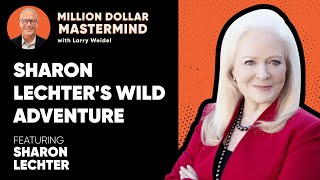
Sharon Lecter, co-author of the Rich Dad series, spent 32 years in Scottsdale and now runs a 300-acre working cattle ranch near Young, Arizona with an off-grid lodge. She was one of the first women in public accounting at Coopers & Lybrand and later served as a financial literacy advisor to two U.S. presidents.
Welcome to this edition of the Million Dollar Mastermind podcast. This is where we pick the brains of high achievers from all walks of life and get their hard earned real world insights on winning. I'm your host, Larry Wydell. I'm talking with Sharon Lecter from I think Phoenix, Arizona. That area, is that right?
That's correct. Scottsdale? You bet.
Oh, Scottsdale, yeah. And northern Scottsdale. I used to go out there all the time. Well, for a lot of reasons. But anyway, a fun place. What I remember about that place, I bought more jackets and heavy sweaters out there because I never took anything out of that. I thought I'm going out there where it's hot.
From Phoenix you can get to the mountains and snow ski in a couple of hours. You just never know what the weather is going to be like. But.
Right, but in the desert, kind of gets cold in the evening at night. You don't expect that if you're not from that area. And I never remembered it. So I would fall into that trap every time. How long have you lived in Scottsdale?
32 years.
Really? You've got to be one of the veterans now.
I was like, we're natives of course it was very, a very different town back then, but we love it here. It's an easy place to live.
Why did you choose that place?
Well, we had been in Wisconsin. My husband was, is a well known intellectual property attorney and bec kind of established a model for creating intellectual property practices within large firms. And so he was recruited down here to do that for a firm in Phoenix. So that's what actually brought us here. And at the time Phoenix was considered little Silicon Valley. Very inconducive to research and development. And since he's a, his background is a patent attorney and licensing, it was a perfect opportunity for him.
So you have seen that place absolutely explode. And what area of town do you live in?
Well, we lived for the first 31 years in paradise Valley, right by Scottsdale Lincoln, if you're familiar with the area and loved it. It was beautiful home. We loved where we were. And then a year ago we moved a little further east in Scottsdale. Out on Shea puts us about a half an hour closer to our ranch. We also own a ranch in Young Arizona that's about two and a half hours away.
How big is that?
We have 300 acres that are deeded and 42,000 acres of grazing rights and in the Tonto National Forest. So. Wow.
Wow, that's impressive. It take a while to fly over that even in a Helicopter, I think.
Yep. We run black Angus cattle there. So it's a working cattle ranch. And then we also have a hospitality side. So it's a guest ranch. People can come stay. We have a big beautiful lodge and it's. Go to cherrycreeklodge.com you can see a.
Little bit more about the Cherokee Lodge.com so the public. You bring the public in.
Yes, we have. You can go online to cherrycreeklodge.com and you can rent a room. You can rent the whole place. We have weddings, retreats. Is a little piece of heaven. It was totally off the grid, all solar power, our own water. So it's really a little piece of heaven.
Now did you get that going by as a long pent up desire to have your own place out in the country or to get into cattle? You know, cattle is a big thing and a lot of entanglements. This after a life of travel and go, go, go. That's a big project you bid off for yourself. And so why'd you do that?
Well, we've been. Mike. Mike and I have been married for 43 years and he always wanted a survival property. So we were out looking for 10 acres somewhere. And now 18 years ago we found this place and we both fell in love with the history. And the history is the place of one of the deadliest feuds in American history. And the Pleasant Valley War. If you remember old western, you saw the battles between the cattle ranchers and the sheep herders. That was from this property. Yeah, the big corporate cattle guys against the little guys. That was this particular war. And so we love the history, wanted to maintain that. And so we actually bought it the day we saw it. And it was a whole lot more than what we were looking for. We were looking for 10 acres somewhere. We end up at 300 acres and 45,000 acres of grazing rights. And so we became ranchers overnight because of that. And my family background was in farming. My parents both were raised on farms, but my husband was a city boy, so it was kind of interesting. And he's now Cowboy Mike. He loves it out there. We've owned it for, like I said, for 18 years. And because of what I teach, financial response, I said, we've got this large piece of property now, we need to make it an asset. Yeah. So we became ranchers and we built the lodge and we use it as an income producing hospitality. Yeah.
And the one thing you don't want for Christmas is anyone to give you any sheep. I guess the die has been cast in favor of the ranchers.
Yes, the cattle.
So in terms of anybody interested in restarting that war, they're going to have.
Oh it is. The feud is still alive and well. People who live up there. It's the Tewksbury's versus the Grahams. We bought the Tewksbury ranch and in fact our ranch manager lives on property that was owned by the Graham. So it's just, it's a comical because we can keep the feud alive and well.
Wow. Wow. Let's let people behind the scenes. You are a high level financial mentor. Mentor and working with brands like Disney and Time Warner. I'm going to read off some of the bullet points here. You have co authored and I want to hear about this, the international bestseller Rich Dad, Poor dad, which I've heard about for the last zillion years because I come from the financial services industry as well and has released 14 other books in the Rich dad series. You've collaborated with the inventor of the first electronic talking book and turned that into a multimillion dollar international market. And you have centered your career out impacting others to improve their financial IQ and served under two US Presidents as an advisor on the topic of financial literacy. And you've covered the whole spectrum there from George Bush to Obama. And so everybody's interested in financial literacy. And so how in the world did you get into this situation with your young self starting out in life?
Well, thanks for the question, Larry. I think we don't know what we don't know and we all sometimes we don't know what we do know.
Yeah.
I was raised in a very lower middle class home. We lived in an old tiny house between my mom's beauty shop and my dad's used car lot. And we had rental properties that I had to help scrub out the bathrooms between tenants at the age of 10. So I've been a real estate investor since I was 10 and I hated it. I had my friend's parents were CEOs, military officers. I swore I'd never be an entrepreneur. I was going to be a sophisticated professional. And so I was the first generation one of my family, first generation to go to college. I was the only woman in my accounting classes. I was one of the very first women hired in public accounting by Coopers and Lybrand. At the time there were the big eight and started my career in Atlanta. I thought I was hot stuff. Very upwardly moving in my career. One of the few women learning tons. And in that position I learned how companies did things right and probably more importantly how companies did things wrong. And in that journey I started realizing, realizing that some basic understanding of things that I understood the power of assets, income producing assets people didn't get. People were chasing money, chasing salary. And at the ripe old age of 25, my parents looked a whole lot smarter to me. And I realized that I'd been given this gift of financial education that most people didn't get. And that was. I actually had a call from a client inviting me to go with him. He was getting a company out of bankruptcy. And I. So I went back to my condo and did the old pros and cons because this was before PCs or cell phones. A yellow legal pad, right. And it didn't help me a bit because I could argue both sides because I was very successful in my career, but not in control of my life. And I had this opportunity and my hand kind of took off and wrote across, why not do something different? Why not take the road less traveled? Why not solve a problem, serve a need? Why not go where you've never been before? And so I made the decision to leave public accounting.
If you're looking down the road at that moment in your life, I don't know if you verbalized it, but probably at least subconsciously you felt like you were going to be doing more of the same, that you'd learned quite a bit. And the excitement was in learning things you didn't know and also being able to move yourself up, being more in control of moving up yourself. I know, I, the idea of freedom being my own boss was worth more than just about anything to me coming up. And it's funny how that'll take over. You come from the inside out as you get established and you get a confidence in your ability to perform in the real world and you get, you know, you had the advantage of being in situations where you had responsibility. You came up with solutions, you earned respect. And that's like, okay, I can do this. And so it's still a gut wrenching thing in a sense to walk away from those things, security and things to the unknown. Many times, unless you're, you're terrorized where you are. But you know, if you're not terrorizing, you're making up, you're going from good foundation to something that could be even better. It's it. You got to think about it a little bit, don't you?
Oh, it was, I mean, my parents thought I was crazy, but it was. For me, it was. It comes back to that question, why not? And I, that's still a Mantra of mine today. Why not do something about it? Something gets me mad. I started a new company. It's one of those things. It's just been a part of my DNA. And it was probably still, to this day, the worst business decision of my life. I got up to New Hampshire, where the company was. And ended up finding all kinds of corruption. So I was, like 26 years old. Afraid I was going to lose my newly minted CPA license. And I was terrified, not knowing what to do. So I knew I had to leave. And I actually went away for a couple of days. To try and center myself. To figure out what my next step was. And when I came back, that company, as I mentioned, was in bankruptcy. So there was quite a bit of litigation. I wasn't part of that. So they waited for me to get back for them to do discovery in this lawsuit. And that's when I met Michael Lecter. He was there. He was on the other side of the lawsuit. He was doing discovery. And was selected to come into my office to do theirs. So we literally met when he was in my chair going through my desk drawer. So we comically tell people we met when he was going through my drawers. Which was a true statement. And it was love at first sight. And that was 43 and a half years ago.
So, well, congratulations. And on all fronts. So when you. Let's just say before that, up to the time you decided to move out on your own. Had you been burned? I mean, had you gotten responsibility and dropped the ball. And had some comeuppance, let's say, in your early career in the CPA firm? Or is it just a matter of doing the work they gave you every day? And did you have some bad or unfortunate learning experiences. Or how did the progression go when you got into the cpa?
Well, I mean, there were things that happened that I share with people that. But I really like to add more to it. Because I was a woman in a field that was primarily male oriented. So. And many of my audit clients were in little tiny towns in Georgia. So I tell the story. I did one that was a calcite mine. And that's the white powder on chewing gum, right? So I was in charge of that audit. And I went in, and the guy was big, heavy, behind his desk with his big stogie. And he saw me and he says, I don't need no secretary. And I don't need my windows washed. So I don't know why you're here. And so I tell people, at that point in time, you can make a decision. Do I combat or do I just confront? And so, you know, and I said, well, it's a good thing, Harry, because I don't do windows and I'm a lousy secretary. But if you want to maintain that loan with your bank, you and I are going to become good friends. And so a lot of it is learning to have backbone and not combative, but be strong in your position. And we ended up becoming great friends. And then one of the reasons I made the decision to leave public accounting was that I was in this group of people that were hired, the only female and my. I got a wonderful raise. And they said, you've, you really deserve to be a manager. We're giving you the money of the manager, but we can't give you the title because it's going to upset the guys that started with you. And so that was really like a trigger. And it's not me being mad about sexual discrimination. It was just simply I had earned it, but I wasn't in control of getting what I deserved. And so that was a trigger. And then it was like the week after is when I get a call from a client where I said, okay, I'm tired of not being in control of my life. I am a lousy employee and I need to be in a position where I can control my destiny.
Yeah. And of course you have magnificently with. Did your. I'm curious, did your parents always make great financial decisions when they were buying those houses and accumulating those rental properties? Or did you live through some tough times or some reversals there too? Because the real estate market is always. Is always a crapshoot change all the time.
So yeah, we had some tough times. My. I have a sister, four years older and she went to a private college in Georgia. Was very expensive. So I remember my parents concerned about with some weeks we had vegetable dinners all week because they were conservative. But my father was just a brilliant money manager and we had multiple rental properties. He owned orange groves. He always believed in cash flow. We would sit at the dinner table and talk about assets, cash flow appreciation really. And some of his orange groves are now where SeaWorld is. Right. So he was a man before his time and he was not at all. He didn't want to build an empire. He just wanted to build a foundation for his family. And he did. He bought a piece of property that was the last undeveloped part of Winter Park, Florida, if you're at all familiar with Florida. And so when he passed, we had this 30 acre piece right in the middle of the largest, most desirable area in Central Florida. And he was always looking to leave a legacy for my sister and I.
So pretty good decision. Thank you for listening to part one of this episode of the Million Dollar Mastermind podcast. Commit to your personal and professional evolution with our free training video. It's designed not just as an educational session, but as a transformative journey for those bold enough to aim for the stars. This isn't just any webinar, it's a roadmap to achieving the extraordinary. It's tailored for those who dare to dream big. And yes, it is completely free. Join us in a network of ambitious professionals ready to take their careers to a new heights. Secure your spot now@White ElonWinning.com and let's unlock your potential together. Thanks for being part of this community.
More from Larry









Rick Jordan on Self-Engineered Proximity, Cyber Security Moats, and Truth-Based Leadership

Fire Fast or Fail Slow: Kevin Brittingham Reveals the One Rule That Built a $100M Empire
