Part 1 - The Battles Doctors Face To Keep You Younger, Longer
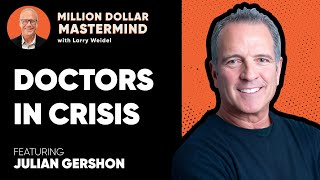
Dr. Julian Gershon discusses the regulatory and business hurdles private doctors face offering anti-aging treatments like stem cell therapy, hormone optimization, and NAD infusions. He explains why staying current matters and shares how these therapies work in practice.
Welcome to this edition of the Million Dollar Mastermind podcast. This is where we pick the brains of high achievers from all walks of life and get their hard earned real world insights on winning. I'm your host, Larry Wydell.
Hello Julian. We're here with Julian Gert. Dr. Julian Gershon.
Hi Larry. Great to see you.
Dr. Gershon, for those who don't know, since 2020 or before, has been on the American's Best Physician list and national Consumer Advisory Board and is a fellow of the American Osteopathic Academy of Sports Medicine and served on their board of directors for 12 years. And that's a glutton for punishment in my book as far as sitting on meetings. I just got asked yesterday if I wanted to get be nominated to get on the board of my hoa and my immediate reaction was but there's times you want to do that. And you have a fellowship with the stem cell therapy awarded by the American Academy of Anti Aging Regenerative Medicine. You've been doing that for a long time. You're a veteran of regenerative medicine, anti aging and triple board certified family medicine, sports medicine and of course the anti aging and regenerative medicine which I learned a long time ago. Julian is pretty much like the Green Berets of the medical profession coming up with a new all the new treatments and they're kind of the envy of the other doctors that are out there just practicing normal medicine and everything. And Julian has been involved in that for, since forever. And so over the course of his year of his career has been with a variety of school programs, high school, college, and he knows the business of sports health, regenerative medicine and anti aging. And he and I are in a race to 120 years old to see who gets I think his father may beat us there. Anyway, welcome, welcome back, Julian. For those who don't know, you know, Julian was one of my early guests and back before we were doing the video and so it's good that we can kind of redo this and people get a chance to see, see what you look like and hear what's been happening over the last couple of years. It's been, it's been a wild ride over the last two years, haven't it?
Well, it has been. Yeah. We've grown rapidly and which you know, we worked out for some time and moved to a new office in Aspen, then a new location with a little more space and a lot more new toys to share with our clients and that's been very exciting.
Well, it is interesting, isn't it, how as you go through life, it just does not get any easier. You know, it seems like it doesn't get any simpler for some reason. But you do carry with you the great thing about thinking correctly and trying to do things the right way and figure out the right paths early in your career is you can kind of prove to yourself what works for you and you know where your percentage of success is and then you can use those things to kind of maximize your progress as you go forward because. But you still have to call shots. You still have to make decisions, don't you?
Yeah. Every day.
Yeah. Over the last couple of years when we talked the first time you were in Aspen, you had made your mark, you'd gotten yourself established. It wasn't a great office in terms of size, but it was a very productive money making operation. And eventually you had, you were able to, you were stretching at the scenes, you had all kind of new therapies that you wanted to do and didn't have rooms to put it in. So talk about the, talk about the challenges doctors go through right now. I mean, it's almost like the government wants to put your ass out of business. It's just like when are these regulation's going to end and cutting what, how much they're going to pay and the insurance, things like that. But it is pretty. As a veteran, you're energized, you're on the attack, you're still investing in the industry and in your career and explain the challenges of doing that. Because people would look at someone like you, with your credentials and mileage and say piece of cake, all he's got to do is go through the motions and the money just keeps rolling in. But they don't understand the challenges that you have to overcome. All of that stuff that help you when you are dealing with government regulations and taxes and, and all of these changes give people a little perspective on that.
You know, that's an interesting topic that I spend a lot of time discussing because for me, I made the decision for 20 years ago when I turned 50. I'm 71 and I feel pretty good for 71. But you know, being a sports medicine physician for 40 years, my goal at that time, 20 years ago was to position myself in front of the baby boomers, so to speak. People like myself that were aging athletes that wanted to feel their best. But as I learned about natural hormone therapy, as two of my close friends, Bob Goldman and Ron Klatz, founded the American Academy of Anti Aging and Regenerative medicine. Initially I thought they were nuts. I was like, what are these guys doing now? Well, they weren't, they were the pioneers, along with Bill Fallone of Life Extension magazine, people that really started to fight the fight. Used to be even to get vitamin supplements authorized. The government wanted to 86 that. And so I made the decision after having an incredibly busy career as a primary care sports medicine office, seeing 40, even 50 patients in a day, struggling to collect 40 cents on the dollar, which people don't understand, that's, that was standard. We worked our butts off to, had a big staff to work with, insurance and Medicare, Medicaid, whatever it was. And if we got 40%, we were doing pretty well. Well, that was tough. And I was a younger guy and so I didn't mind working hard and I still work hard and love what I do. But I wanted to find, position myself in front of a booblet that I could be, you know, knowledgeable and become an expert in this field and have a little leeway, so to speak, a way to be able to spend quality time with patients and, and still pay the bills, be able to have a decent business. And so it was quite a paradigm shift, if you will, for me so to make that move. And it was scary. And there were some months with peanut butter crackers because somebody had to pay the bills. And when you own the business, if there's that money, you're the, you're the last one to get paid. So it was tough, it was really tough. And I started from scratch, moved to Aspen in 2010 after my, my youngest two boys mother died of brain cancer. And I just said, you know, I, this is it, I'm not, it's time to move. And I was, you know, successful in Denton, Texas as a physician for the University of North Texas for 20 years when I left. And it was certainly a challenge, but I wanted to be able to provide and continue learning new techniques to help myself and those patients that I care for.
For those of you who are sick and tired of fooling around and are dead serious about wanting to move up fast, I've got something especially for you. I've combined the best insights from over 40 years in business and making $70 million in income and compressed them into a free webinar. That's right, it's a free resource. If you want to find out exactly what the concepts are that I use in coaching million dollar earners, Register now@widelonwinning.com you'll discover the five part framework used by so Many to reach their financial, personal and professional goals. You can find that link in this episode's show notes.
And the thing is, like, even today day, I mean, you're going to conferences constantly to stay current. It is a rapidly changing industry. You constantly seem to be on the move, attending conventions, talking to people, getting educated, getting new information in. And how much of a challenge is that?
Well, it's a big challenge when you're in solo practice and when you're not here, you know, the, the bills are still there and somebody's got to pay them, but you have to go learn. You know, I, I go to stem cell conferences, anti aging conferences. I'll be in San Antonio at two weekends with my, one of my favorite mentors, Dr. Neil Rosier, who's trained thousands of physicians from nurse practitioners and PAs from all over the world. And just to hear what he has to say, everything he does is evidence based. He will give the pros and cons of new studies and, and point out the validity. And so it, it's very important. In fact, I was playing golf with one of my cardiology buddies yesterday who is finally making the turn from having said in the past, oh, testosterone, that's terrible for you and it may cause a heart attack, to I sent him three articles today to read because he's fascinated, you know, and the medical profession as a whole is opening up to that. We've been fighting it for 20 years.
Yeah. And it's hard to stay facts based in your profession because I've heard doctors say in the past that if they, every month they try and spend. This particular doc said he tried to spend an hour a day keeping up with new breakthroughs. And he said, he said every, at the end of every month, I'm like so many years behind of just what came out that month. And so, but you have to pick and choose the areas that, that's, you know, when you look at a physician, don't be surprised if there's information they're not aware of because there's so many different areas that these breakthroughs are happening. Is that an accurate statement?
Oh, absolutely. And, but it's tough to keep up constantly. That's why I quarterly I'm some place at a conference, immersed for eight hours a day where it's like someone asked me yesterday, well, yeah, you're going to the Hyatt Hill Country. You taking your clubs? I'm like, no, I, I'm a golf fanatic. But no, I'm not taking my golf clubs because I don't want to Miss any of these lectures, they're, they're great. And, and if I can just walk away with a handful of new ideas to share with my patience, then that's why I paid for it. That's why I go do what I do.
That's how you judge. That's how, you know, because a lot of people are going to conferences and meetings and workshops. And I always tried to tell people, look for something, you know, go into these things. And we always had a lot of them in our business, you know, and in the sales and management and growth business. Always had. You're always having meetings, but they can tend to just roll together. But I said look for something that jumps out at you. That something you've heard before maybe, but you haven't heard it like that. Or if you heard an explanation, but you've never heard it explained like that, because there's a. Levels of understanding things or a new concept. But I said look for something big that you can. And when you leave, I always try to challenge people to have like every conference they went to. Like, if we're going to refer to this thing 10 years from now, how would you remember this conference, you know, make it that memorable. That's where I got that idea. Because big ideas can make big changes in your life. So when you, when you go to these things, what are you on the outlook for?
Well, validation. Validation for what I do every day and learning and listening. For someone that's found a way to do something a little bit differently, that may work a little bit better. Something I hadn't thought of or gee, maybe I forgot on something that, that I can then bring back and put into place immediately. There is a tremendous amount of research going on every day, whether it's stem cells, hormone therapy, new applications of other things like red light therapy, ozone therapy, and all things that we many people already understand and take for granted. But that it's a complete eye opener to most folks and certainly providers in general, just trying to fine tune or hone the art and practice of medicine.
And as a veteran, successful, recognized physician, can you tell people how important it is for them to look out for themselves in the medical profession? You know, my son Adam, the bodybuilder, he tore his tricep and then he retort, you know, it was just about healed. And then he slipped on his. Stepping into his truck, which he's done 10,000 times, and tore it again, had to go have it reattached. So he went back in to get the stitches removed last week. And the nurses said to him, you know, except for the swelling there, I think you're in good shape. They said, you know, you can, let's go ahead and wrap that up with an ACE bandage and that'll help keep the swelling down. He said, why didn't anybody mention that to me the first damn time I came in here? He said, I've been in here six, eight times since the first surgery and nobody's mentioned. And that's like one of seven different things. You really have to look out for yourself, don't you? As far.
Well, you do. And, and you just have to understand that not every provider can understand everything that's out there. It's not possible. And there's changes and even the way that I fine tune and adjust hormones with people, they all say, well, this doctor told me this and that this was bad for me. And, and I, I have to say you have a, a duty to yourself to research things. They haven't seen the same articles I have perhaps and, and haven't applied it in the same way or done it personally. I, I, I do everything that I practice and preach myself. And when I understand the benefits firsthand.
You need to feel free to ask questions. And if you have an older or a, have a relative that maybe is not in the best shape, it's good to have someone along with you. You know, if they're in going through a crisis type situation. To have someone along who is healthy, is thinking clear and kind of look out for them. Because it's easy for people to get the wrong medication, to get shuffled through the system, to be ignored. And it just helps if you speak up for yourself because it's, it's almost like the, so many professions right now, like law enforcement, they can't find people who want to be cops. That's with that all of the things that have gone from defunding to the political things to the abuse and they were, I just heard that on the radio 45 minutes ago. And the medical profession has been under attack. I mean the government, health care and things that, the onslaught that the medical practices, hospitals and doctor offices and have been under it, it's not the same as it was in the past. It seems to me maybe it is for you. Maybe it's easy to get people.
Well, it's just, I'm not sure how to answer that. I think for physicians it is, it's extremely difficult and because of the overhead, the never ending regulations, government, someone trying to define and establish health care when they should leave healthcare providers to do that.
Yeah, but in spite of this stuff, you've stayed on the attack. You're open your new office, you've got some new machines, you've got some new therapies. What is that? Let's just say for just for funsies kind of shift gear. What's the therapy that you've added in over the last year to that you've seen giving you the best boost to feeling like you're making a difference with people and seeing the turnaround?
Well, it never ceases to amaze me when I see new clients and whether they're in their 40s, 50s, some in their 60s, that their family doctors told them what are your testosterone's fine, but they feel terrible, they can't get off the couch. It's, let's say it's 400 or even 500. Well that's in the normal range. I saw what someone recently was 350. Well that's normal. Well no, optimal is a thousand. It's where you were in your 20s when nothing hurt, you felt great and doing small things, just helping to replenish those levels by whichever means we use from self injections to lozenges, pellet therapy, it's a game changer for everyone that I see. And even those that are really fit, they recover faster, they have less inflammation. So, so that has been the foundation for a long time. It's what I call baking the cake. Then we ice the cake and there's a lot of things from growth hormone therapy, from high dose EBO2 ozone blood purification, which I know you're familiar with, to increasing NAD plus levels to NAD infusions. There's a lot of tools that we use. The number one thing that I, that I've done for 12 years, I was one of the first in the United States doing fat adipose derived stem cell therapy. And I've done you know, over 700 cases during that time. I stopped a few years ago when the government was trying to say we were creating a drug. When I took your fat cells and put them in a centrifuge, I created a drug. Well, I didn't know I was that smart. But they wanted $5 million for a biologics license and that wasn't going to happen. There's, you know, not my world. And so fortunately, about a year and a half, almost two years ago, in November, they lost a big court case in California where Cell Surgical Network won. The federal judge there said the right thing. He said they're your cells, you can do anything with them you want. And so now We've resumed doing that kind of therapy. We have a big machine in the office that helps us in an automated way to process and isolate those stem cells from adipose tissue in about an hour. It's called The Time Machine 2.0 from Cell Surgical Network. And we've had great results with that. And then we can treat patients within about an hour, hour and a half of simple minimally invasive fat harvest using a local anesthetic to also taking a portion of those fat cells and sending them to a banking facility. We use American cell technology and they're excellent. So they're available for you for the rest of your life. And I've had patients even in their 50s and 60s that done a few 70 year olds and said, well I'm old, I cells aren't that good. Well, I said, you know what the, the reality is, your bone marrow derived cells aren't as good and certainly the numbers are different from when we were an infant to now, but they turn over faster. Adipose cells don't turn over as fast. And so as a general rule they're about half of whatever your chronologic age is. And when they can are culture expanded and reproduced over time, they're a 100% pure culture of mesenchymal stem cells. And so they're highly effective for many things. And I've done hundreds of joint injections. We use them for esthetics, for hair growth. That has been very exciting to be able to reintroduce that to my patient base and offer that to new clients as well.
So what we're talking about is people hear about stem cells but they wonder are they safe this the other. But this is a way you're, you're using stem cells out of your own body and then you can also, I guess this is separate, you can just do that by itself one time, spin them up and inject them back in. You don't have to bank them, right?
You don't have to bank them. I, in fact I just saw a woman about 20 minutes ago that was my first patient zero, patient one in 2011. She was here just for a follow up doing we do hormone pellets and, and other things. And so she's stuck with me all this time. She was told in 2011 to have both knees replaced. She came to me and said I really don't want a knee replacement. What can we do? We harvested her cells at that time and it's now 13 years later, she is still pain free in both knees. And we did it once now just.
Real quickly because we don't want to complicate just to let people know they can call you if they want to get more information or look at your website. But one thing that is an option is when you're doing this, those fat cells are drawn that a certain portion of those can be banked and put in a bank. There are companies that you use that you've used for years and they're there for life. It's all you've got to do is make. They can regenerate these things forever. And you're not having to pay for anything other than you can call and say, send me so many stem cells. We won't get into the numbers and all, but you know, you have the, you know the doctor call for you at you say, my knee, I'm starting to get, feel something in my neck or one thing and another elbows and I like to get, get some of my stem cells out of my bank. You can do this every other month pretty much the rest of your life. Because they can regenerate these things from that first initial batch you sent. There's no limit to how many can be regenerated. Is that correct?
That's, that's true. And it's, it's very cost effective. After the initial banking, it's like 250 bucks a year to have them stay there and be preserved. And then when any time you want them, depending on the number of cells. And we would decide that together, it's 60 to 70% less expensive than the initial treatment. And so yeah, it gets, it becomes an easy decision. 20 billion cells, you cost $1,000. And so it's great.
Thank you for listening to part one.
Of this episode of the Million Dollar Mastermind podcast.
Commit to your personal and professional evolution with our free training video.
It's designed not just as an educational.
Session, but as a transformative journey for.
Those bold enough to aim for the stars.
This isn't just any webinar. It's a roadmap to achieving the extraordinary. It's tailored for those who dare to dream big. And yes, it is completely free. Join us in a network of ambitious.
Professionals ready to take their careers to a new height.
Secure your spot now@whitelonwinning.com and let's unlock your potential together. Thanks for, for being part of this community.
More from Larry









Rick Jordan on Self-Engineered Proximity, Cyber Security Moats, and Truth-Based Leadership

Fire Fast or Fail Slow: Kevin Brittingham Reveals the One Rule That Built a $100M Empire
