Part 1 - Why 900 Publishers Said No To Seth Godin
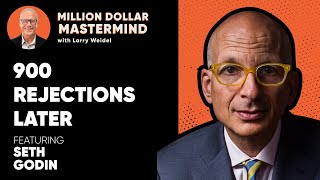
Podcast interview (Million Dollar Mastermind) between host Larry Weidel and author Seth Godin. Seth describes his long author career (noting the 38th anniversary of his first book and the 25th anniversary of Permission Marketing), his philosophy of self-learning and empathy, and a formative period when he received roughly 900 rejection letters before changing approach by collaborating with John Boswell on a commercially viable proposal. He recounts working as a book packager (including test-prep books and young-adult novel series for Scholastic that sold about a million copies) and contrasts writing to prove cleverness versus serving reader/editor needs.
Questions this video answers
Approximately 900 rejection letters.
The 38th anniversary of his first book (as of the interview month).
The 25th anniversary of Permission Marketing (as of the interview month).
About one million copies.
Welcome to this edition of the Million Dollar Mastermind podcast. This is where we pick the brains of high achievers from all walks of life and get their hard earned real world insights on winning. I'm your host, Larry Wydell. Hello, everybody. We're talking with Seth Godin. Is that correct, Seth?
God, it is if you want it to be. I'm glad to be here, Larry.
Or go din. And anyway, Seth, I bought my first Seth book, I don't know, 15 years ago, 20 years ago. I didn't have time to go and see the oldest one, but I did show him on my Kindle the scroll of books that I have from him over the years. So what a chance I've looked at the face you see in front of you has been in his books. And on there, it's like he confronts you with those glasses and that stare and challenges you to look at the world from a fresh point of view. And so I'm curious where that came from and curious what informs all that. But so we're going to have some fun because, Seth, you have 20, you know, out of the, the Bible says out of the abundance of the heart, the mouth speaketh. And I think it's out of the abundance of the heart and the brain, the writers speak. And you have what, over 20 bestsellers? I looked at different websites that has different amounts from 21 to 20 to 27 to 29. But anyway, in 39, translating to 39 different languages, is that approximately correct?
Well, this month is the 38th anniversary of my first book. I'm not that old. I don't know how that happened. And the 25th anniversary of permission marketing. The thing about the book business is there's not often a connection between how good your book is and how many copies you sell. Selling a bunch of books might be the result of being in the right place at the right time or the effort you put into getting it to people. So what I keep track of is did a book I wrote bring an idea to someone who didn't even read the book is when I run into somebody who said, blah, blah, blah, purple cow, blah, blah, blah, and I say, oh, did you like my book? And they said, there's a book. That's how I know I accomplished something. Because what we're trying to do is teach. And I'm not trying to corner the market or sell more books. I'm trying to help people ask better questions.
Absolutely. And what that triggers in me is the idea that we all have to be the ones that are talking strongest to ourselves. And that information better be accurate. And so if you're not sure of something, ask a question and get sure about it so that you can proceed with confidence. You can stand on some concrete, or at least it's concrete to you. And so how did you learn the importance of that? So?
Well, you know, I think all learning is self learning. All motivation is self motivation. I grew up with Zig Ziglar. Zig and I spent a lot of time together in the car. And the tapes didn't change, but I did. And understanding that we can feed ourselves on purpose ideas that we can then make our own inspired me. It got me through some very tough kids and inspired me to contribute in that way.
How did you get into find yourself in the situation where you were spending time in the car with Zig Ziglar?
I was spending time in the car with Zig Ziglar in my driveway. Larry. I worked from home. I had no employees. When I got there 18th, no of the morning, I would go outside, get into my old Miata, put the engine on, and then listen to Zig for another half hour. Because it was that or give up. I was introduced to Zig by my dad. He listened to some pretty wacky people. But Zig caught on with me. I was lucky enough to publish one of his books, share a stage with him, and work with him toward the end of his life. But his stories and me learning how to deal with the stinking thinking, give myself that checkup from the neck up, it taught me that I could teach myself things.
What led you to the point where you said, I need a fresh approach to how I'm thinking? What led you to the point to where you realized the way I'm thinking is not working for me, I need some fresh insight, and therefore I come. Cause it's a big thing to get up in the morning and do get out and go. I mean, that's a commitment. And there has to be need, drives, effort, right? And so where did that need come from?
Well, I would say the people who are listening to this podcast already have it. That's why they're listening to this podcast. Other people who are complacent aren't. You know, my new book, this is Strategy, is about four things. And one of those things is empathy, which is realizing that we can't force other people to agree with us. We can't force other people to think we're right. And I was a book packager. I got so my first book the first day, and then I got 900 rejection letters in a row.
Could you repeat that, Seth? I want to make sure we hear.
That, yeah, 900 times someone in book publishing bought a stamp 900 letter and mailed me a letter that said, we read your proposal. We don't like it.
And James Patterson, when he started writing, he brags about the fact that he got like 39 publishing houses turned him down, and then the one that accepted it then became the book of the year. But I mean, you're in a league of your own for rejection. Congratulations.
Thank you. Yeah, I worked hard at that. What I realized is I was writing books to show how clever I was. I was writing books to prove I was right and met a guy named John Boswell. Boswell and I worked on a proposal together. And he explained to me that it didn't matter if a reader was going to like it if I couldn't get an editor to like it first, because if the editor didn't like, wasn't going to get to the reader. And understanding that an editor has a different agenda, a different way of seeing the world, a different set of priorities than me or the reader helped me understand if you can't get through the door to the end goal, there is no end goal. And I learned how to make books that they wanted to buy. And that was a very big transition. I ended up selling a book a month for 10 years after that as a book packager, worked with Jay Levinson. I did the Stanley Kaplan test prep books and things like that because I understood the genre that what we do when we bring an idea to people is we're there to be of service. We are not there to get them to realize we are right.
And so. And we're talking nonfiction.
There was a series of 30 novels that I did for young adults. I discovered that my Cousin, who was 13, had never read a book for fun in his life. He was just playing Nintendo games all the time. So I got the rights to Nintendo games and turned them into novels. And we sold about a million of those because people at Scholastic had a problem, which is kids like my cousin weren't reading books. They needed to solve that problem. I had a scarce resource, the rights to these books. I had a stable full of writers who could make one of these books in about six days. And we did 10 or 12 books for Scholastic. Then I did another series with Walter Dean Myers for kids who are left out of traditional young adult fiction. People of color, immigrants, people who weren't the typical blond haired kid in a Sweet Valley High book. And it was Just one of the privileges in my life to be able to bring Walter's ideas to people. So yeah, I did a little fiction, but fiction is, it's trickier because you have. You don't have a foundation of truth to lean against. You have to invent your own. And I find that thrilling. I'm just not prepared to do enough work to be good at it.
Yo. Well, if you've got a stable of writers, you can turn it over to that. That takes a lot of the stress out of it. I'd like to get to that. But let me ask you this. How far on your journey of 900 rejections were you when you heard from. Was it John Boswell who told you, let's go at it from another angle? How far in that 900 were you when you were talking 900? You were at the 900?
Yeah. I mean, just to be clear, just to be clear, I write every single word of all of my books. I haven't had a stable of writers in 20 years. I just want to say that out loud.
Okay. Now, has it always been that way or was that just for the fiction or where you had the stable of writers? Yeah, yeah, that was for fiction. Yeah. And so, well, you were asking questions. What I'd like to point out to you and congratulate you on is something you did incredibly right, was you were still asking questions and still knocking on doors. You were operating off the assumption. I heard this idea early in my career. Thank goodness I'm here today because of certain phrases assert concepts that I heard somebody had the decency to tell me early in my career. But one of them was that great ideas don't care who have them, they don't care who use them. And if you can get a great idea that you see somebody else using, you can do this, you can use the same idea and have similar or even greater success. So now you're operating under the assumption, I don't know if you were just. There was no other career options for you. So I've heard of single minded people, but this kind of defied. There's one actor in Hollywood right now, I forget, he's one of the guys who's in the superhero movies and everything. I can't mark somebody. But anyway, he went on like 850 auditions before he made his breakthrough and now he's making $20 million a picture. But that's about the only one I've heard that's knocked on as many doors as you. And so you're knocking on doors, but you're asking questions. How did you find John? And what you know to narrow it down to where you're still digging for answers.
Okay, so it's something A lot of people listen to this are in sales. And I think it's important to understand that the job of the people I was pitching books to was to have people pitch books to them.
Yeah.
I was not hustling people or hassling people. I saw that they had a problem. They have to acquire books. If people like me don't show up, they don't have any books to acquire. And what happened is the rejections kept getting better. They kept getting more encouraging. They kept. Because it wasn't 900. Different people, same people often would reject me, but they say, oh, now you're starting to. This is closer to what we can deal with. And so it's like somebody who's lost. If you're just as lost an hour into it, you're never going to get yourself found. But as you're slowly finding your way through the map, you're learning something. And so the idea that I came up with that ended up breaking the cycle was to take Cliff Notes and rewrite them and put them all in one book so a kid could get 30 cliff notes for the price of two. And it's a great idea, but one of the people I worked with said, there's someone who can make this idea better. You should call John, because John was someone who you might call a competitor. But I don't believe I have competitors. I believe I have colleagues I haven't met yet. And so John heard my idea, and he said, yeah, I'll take half of it and I'll make it better. And he did. And three different people wanted to publish it because he knew what it needed to rhyme with. People don't want to buy something they've never bought before. They want to buy something that's a lot like the thing they already are pleased to be buying.
Thank you for listening to part one of this episode of the Million Dollar Mastermind podcast. Commit to your personal and professional evolution with our free training video. It's designed not just as an educational session, but as a transformative journey for those bold enough to aim for the star. This isn't just any webinar. It's a roadmap to achieving the extraordinary. It's tailored for those who dare to dream big. And, yes, it is completely free. Join us in a network of ambitious professionals ready to take their careers to a new heights. Secure your spot now@whitelonwinning.com and let's unlock your potential together. Thanks for being part of this community.
More from Larry









Rick Jordan on Self-Engineered Proximity, Cyber Security Moats, and Truth-Based Leadership

Fire Fast or Fail Slow: Kevin Brittingham Reveals the One Rule That Built a $100M Empire
