Part 2 - From Government Housing To CEO
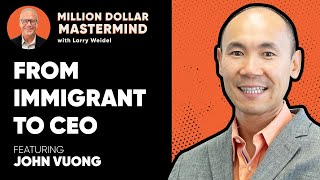
This is a transcript of Part 2 of a YouTube podcast episode (Million Dollar Mastermind) hosted by Larry Weidel interviewing John. John recounts growing up as the fourth child of Vietnamese immigrants in government housing near Toronto, relying on community support, working many entry-level jobs, and developing discipline through sports and education. The conversation emphasizes hard work, asking questions, following intrinsic interests, leadership aspirations (John wanted to be CEO), and practical advice from the host about finding one’s fit and pursuing potential.
Foreign.
Welcome to this edition of the Million Dollar Mastermind podcast. This is where we pick the brains of high achievers from all walks of life and get their hard earned real world insights on winning. I'm your host, Larry Wydell. And when you started though as a kid would were you always wanting your own business when you started? You're in Canada now. We're in Canada.
I'm in Toronto, Canada.
Uh huh. I've never heard of it. No, just kidding.
So I grew up an hour outside of Toronto and my upbringing was. I'm the fourth child of immigrant family from Vietnam. They escaped the war and so we came from pretty much leaving a country of war and my parents didn't know English and I was born two weeks later and basically just started in government housing. Didn't really have much growing up so foundationally all I knew was we had each other, we had a family, we had dinner together and we had shelter in government housing. We got a lot of support from food banks and Salvation army and stuff that actually helped us get ourself on the ground. So I know what it feels like when people are starting from nothing and therefore that's how I take on any project. Knowing and having good perspective in every aspect of where people's situation and life events are. In business.
Yeah, in every area of life. The people that do it all the time have their little terms they use and acronyms, sop, things like SEO. If you get in the army there's a million of them. But it's real easy on the entry level into any industry to feel like an outsider because you just don't know. It's not the language, you don't know the jargon, you don't know these abbreviations, you don't know what they're meaning. I had a degree in building construction from Georgia Tech. I started architecture then switched what once I found out you had to be weren't going to make any money until you're 35 years old in architecture. I said I got to make money quicker than that. So I switched into building construction. I had a degree from a first class institution, Georgia Tech, Bachelor of science in building construction. And I didn't know anything about construction and I went out on the job site and was hired by a guy to be the field superintendent. And they were taught we'd walk through a house and he would order the doors and the windows. We need six three by six, three six by four six casings for this and we need a three zero panel here and a case. All of this Crown molding here. And I didn't know what anything was and nothing stuck in my head. And two days later, I was like an old pro. Because you learn to ask questions and then you. What you learn is it's not all that hard because most things in life is just people working in one area or another and they've worked away to where they know how it goes. And then depending on your motivation, you can get familiar and the questions you ask, you can move up pretty quick. You beat half of the people just by working hard. And we notice that in our business, when we have staff people come on, if they're a hard worker, it doesn't take them a whole long much time before all of a sudden they're making contributions to the team and they're making life easier for us. But now, as you came up and grew up and started to think beyond food, shelter, clothing, the next meal, what was going on in your mind with your friends, your family, community? What were the conversations? What was the outlook for the future like at home?
My parents really grounded us. They basically made sure that we studied hard, get a good education, and really focused on school, good education. Outside of that, I had a lot of friends from sports. There's different crowds, right? People that were very disciplined in terms of hard work, putting in the time and effort and get excelling in sports realm. And then there's other ones that were really about fast money, get quick rich, try to do some underground activities to earn money so that they can buy nice clothes, buy nice cars, whatever, and drop off. So it was more about which crowd did I want to gravitate towards? And I stuck with what my parents told me, stay in school and also with my friends that stayed in sports. So that really helped me guide me through the next stage of my life, which was post education as well as my career.
Did you have any grandiose vision for the future, whatever, but. Or were you focused? I'm thinking like, how would have I answered this question back when I was that age, when I was growing up, I was focused. Like you said, the family was solid, hardworking, and I was focused on doing well in the situation I was in. And I wasn't a genius by any means, but if you go to small schools, you can look like a genius. You know, I wound always was at the top of the class president, the school, and this and the other. But that was mainly because of the size. Schools I went to were small. There weren't a lot of possibilities there. And who should we get? Oh, let's Get Larry. That's how I explain that. But when it came even to going to school, I didn't have this vision of I want to make hundreds of millions of dollars. I didn't even know you could make hundreds of millions of dollars. I was out in Long island and the Hamptons when I graduated from high school. It's a good thing all the hedge funders had not come out there. And I heard that you could get make billions of dollars by the hedge funds. Or I might have gone to Wall street, but the possibilities were like, do something you love. I was always chasing something I loved and that I could. After two years of the architecture, I put the idea, well, also something you love that you can make money on sometime before you die. And so that's why I said, I got to get out of, yeah, I got to get my degree, I'm not going to quit, but I got to get something where I can make money faster. But I didn't really have a vision of I want to be a concert pianist, I want to be the greatest anything. It was just a matter of I want to make a mark, I want to build up a thing. And the main thing that drove me, I've said on this podcast before, was I wanted my own freedom and I didn't want to be low paid because I did those labor jobs growing up in high school and I learned that the lowest paid person usually gets treated the worst and is paid the worst. And I said, whatever I've got to do to not be on the bottom of whatever it is I'm doing, where I can be closer to the top, I'm going to do that. And so did you have any formative type of ideas happening in your mind? Playing in sports allows you to, if you've got good coaching, especially playing in sports, can cause a lot of these things to form in your mind. The kind of person you want to be on a team, do you just want to be on the team and maybe score some points and be the occasional hero? Or do you want to be the main guy or go higher, to a higher level or something like that? Talk about that.
Yeah. In the sports realm, I always wanted to be a captain. So I wanted to lead by example and be the best I can in terms of what I wanted to be when I was growing up, I definitely wanted to be the top, like CEO. I wanted to drive that nice car, it was an Audi at the time. And live in a big mansion and have a private jet because I saw that on TV as well as magazines. That's how I live my life. I was surrounded by people that wasn't doing that. So I was always imagining what it would be like having all those things. And throughout my early years, I had 20, 30 different jobs, just like yourself, from factory laborers to working in restaurants, working as a fryer. You name it, I've done it. And these are things that you kind of live to really understand what it means by being treated like crap and getting paid like nothing, because that's what they do there. So you just have to understand what situation you're at and where you're at in your life and what you don't want in your life. So moving up in life was a big thing for me and my family, and I wanted the best for myself and my parents, and family was really out to guide me properly. And with sports, it's all about making sure that you have the proper training, the proper mental focus, the proper repetition, the hard work, the discipline. All these things, I think, molded me to become really good at sales. I was listening to Zig Ziglar's Brian Tracy, all the going to conferences on sales, even though I wasn't hardcore sales, but I wanted to be the best my first year of sales.
Yeah.
And therefore I started getting better and learning as much as I can and just being admired by other successful salespeople. Yeah.
And the point here with everybody is not that everybody has to have their own company and be the leader and be in charge, but the deal is behind this podcast and behind everything I do is to help people reach the potential of what's important to them. What do they think they're supposed to do? What do you feel most energized by thinking about or seeing? You know, where do you want to see yourself? That you want it bad enough that you'd be willing to work like a dog to make it happen. And that could be the head of something, the head of a company, head of a charity, head of a volunteer organization, a foundation. I could be, heaven forbid, a politician or something, but I can't relate to that. But whatever it is that's in you, you gotta realize that was put in you for a purpose. And already at a young age, you're seeing that. That probably wasn't an accident that you had those your mind set on being the captain of the team or this, that and the other, because your mindset was forming early on about what you were destined to be. Don't you believe I now that I.
Reflect and I look back? Definitely, because I've always wanted better I was always curious to live a life that I was not living in right now. So watching these TV shows, looking at these magazines and all these things, I just wanted a car. I wanted my own house. Like, not huge goals, huge aspirations. But then I wanted to travel. I never flew in my life. So for me, it was like just these little baby steps to eventually mold my way to what I am today.
Yeah. And the thing that I would say, and I'm going to wrap up this episode, is that if I had to say anything to anybody, is pay attention to these things going on inside your mind about where you are today, where you're thinking about, don't let people hold you back because you can't take a dog and make it into a cow or a cat, because a dog's a dog. A leader's a leader, someone who is a great support person. They don't want the spotlight. It's like in football or did you play, what, soccer or whatever. The thing is, like, a goalie's a goalie. A quarterback is a quarterback. In football, if you take the greatest quarterback, Tom Brady in the NFL and you stick him at center, he's going to get destroyed. First of all, he'll be lifetime injured on the first play. That would be the end to him. So the thing is, you've got your first job in reaching fulfillment in your life is get yourself in the right place or get yourself moving towards the right place. And the way you do that is to override what other people are telling you, what you think life, society would say is right for you. But go down deep into the mare of your bones and say, what do I inside feel like is right for me? And follow that, because you're never going to be anything but who you are. Do you have kids yet?
Yes, I do.
Isn't it funny how kids, when kids are born, they are the way they are. Some are neat, some are a mess. And you're never going to change. You can modify it for a period of time, but they're going to be the way they're going to be. And the ones that naturally you're smiling and looking the positive, they're just going to be that way. And then the others are a little bit reserved and held back. They're going to be that way. So our job is to help people reach their potential. I think everybody can be smiling, regardless of what their personality type is, if they are on track or they have arrived at the place they're supposed to be in life. I want to get into how you made that transition from launching out of your preparation phase. There's a preparation phase phase for all of us. But the deal is try and get some preparation and the things in line with what you want to do. And if you're not really sure what that is, get a good widespread foundation that gives you the options to move in different areas. As I'm saying this, I wanted to make this point, John, for those of you all that are older and have kids growing up, realize they're going through these things too, and this is the kind of counsel you should be giving them. Rather than saying, I'm an attorney, my son's going to be an attorney, I'm a artist, my son's going to be an artist, or that type thing. You got to let them become what they're supposed to become, and that will be what they're most interested in. Thank you for listening to part two of this episode of the million Dollar Mastermind podcast. Timing is everything. You may feel that now is the time to get moving forward so you can do something even greater with your life. Now, if that sounds like you, I've got a free training video to show you how that transformation can take place. Getting interest reduced to how the cycle of success works has been a major transforming event for so many current million dollar earners. And that's exactly what this video is all about. And yes, it's completely free. Join us at the video@widelawinning.com and thanks for being part of our community.
More from Larry









Rick Jordan on Self-Engineered Proximity, Cyber Security Moats, and Truth-Based Leadership

Fire Fast or Fail Slow: Kevin Brittingham Reveals the One Rule That Built a $100M Empire
