Part 2 - How Being Uncomfortable Becomes Your Greatest Ally
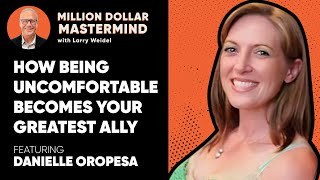
Danielle overcame her fear of public speaking by taking on small challenges like school events and year-end awards, building confidence through repetition. Larry and Danielle argue that discomfort is where growth happens: lean into it, take action, and momentum carries you through setbacks.
Welcome to this edition of the Million Dollar Mastermind podcast. This is where we pick the brains of high achievers from all walks of life and get their hard earned real world insights on winning. I'm your host, Larry Wydell.
The thing is that in terms of your expansion, you get your work, but people don't understand that are not successful. And people who are successful, we almost get defensive about staying on the attack and keeping our foot to the accelerator for growth. But the thing is what I don't understand, you got a lot of people counting on you to perform. The bigger you get, the more people you can help. Like you say, but the rich will always be damned to hell by the people who are not successful. Because there are some people that lie, cheat and steal their way there, but they usually blow up and they don't have what you do is. And that's why on this call, I vet it as closely as possible to get people who have been successful for over long periods of time because they have fundamentals and principles. You don't have to have a million of them, but you got to have a few of them to keep yourself on track and keep yourself doing the right things under all kind of situations. Some are opportunities presented to you. The other thing are disasters that drop out of the sky in your lap. But it's the same you that's got to deal with all of those kind of things. And so you want to build that in your team because sooner or later the disasters are coming. And the bigger you are, the more street and the more momentum you have in the business, the more likely you are to be able to keep rolling through those things right and come out the other side as quick as possible. And the faster you can get through disasters, the less likely you're going to be scarred by them. But when you limp along, it's like every little speed bump on the highway. If you're going five miles an hour, two miles an hour, that little speed bump might be enough to make you stop. I might not have enough momentum to get over it, but when you grow and you have your momentum, there's challenges for that. But would you say the challenges of growth are not put you under stress, you got more things to do, you got different situations to do, you're always doing something new that you've never done before because you've had success. But would you say, how would you explain the comparison of having to deal with choosing to deal with the problems of growth than the problems of boredom and failure and sliding back and losing momentum and Letting the good life kind of slip away from you because you took it for granted. Explain that to people or how you look at that.
I would say being able to always be working towards something and having bigger vision to move towards and move forward, you never feel. Feel bored. You never feel. And maybe it is uncomfortable at times. Actually, for me, speaking was very, very uncomfortable. When Omer and I first got married, that was kind of the one thing I said to him was, you're good at speaking. I do not like to speak. I don't want to speak. Please don't ask me to speak. I'll do anything else, but I don't want to speak. And I was really petrified to speak in any. Even in a small setting. But little by little, it's like I had to realize in order for me to grow and get better and in order for us to grow and get better as a couple and as a team and grow our business, I needed to do some stuff that I was uncomfortable with and get comfortable with certain things, some of those kind of things. So actually, now I enjoy speaking, which is funny. Now you put me. When we've spoken at the convention, I get mad at Omar because he won't give me more time out of his time. I want more time on the stage.
He's hogging the time slot. That's right.
That's right. But, yeah, I don't know.
I guess 50,000 people want to hear from me, not you. Omar, shut up.
Look at their faces.
Can't you tell? They want to hear from me.
That's right. I believe I'm very blessed because I grew up in a house where people were always working towards something. And then now my adult life and.
Well, let's look at it this way. Let's look at it this way, Danielle. The thing is, things you're afraid of have a power over it. It's kind of like a kryptonite, the things you're no good at. I'm no good at the computer or I'm no good at those fancy phones, those smartphones. And it's amazing. It wasn't that many years ago that Oprah didn't know how to do email. Let's be honest. Raise your hand if you can. Remember that Oprah learning email. I'm the one who taught Art Williams how to do email and on his iPad and you know what I'm saying? And the groove text and this, that and the other. And he want ahead of me. I said, no, you hold it. Now take and move it over there. But the thing is, Oprah and art are very fast learners. Millionaires are pretty fast learners. And so you don't have to, but they still need to be taught. We all need to be taught. But when you have a weakness, usually it appears to be a scarier thing than in your mind than it really is. But when you get through that, don't you feel more empowered now? I mean, that fear of speaking doesn't have the power over you. It's not like a weakness that you have. That's not a kryptonite to you anymore, right? Right.
Yeah, definitely. Definitely. When you overcome something, you feel that.
And how did you get yourself to do it step by step? How did you just got drawn into it where situations came up and you were talking and speaking more and you didn't even realize it. It just kind of naturally happened or.
What I would say there were two different times, and I don't remember which came first, but one time we were. I had pretty much for a couple of years, would not speak. Omar was getting asked to do schools at different places, different. You know, we would fly to the. So I would. I'll do like the little personal stuff, one on one kind of talks and stuff, you know, but not, please don't put me on stage. And so one time we went and did a school for Christian David. And the night before the actual school, we were eating dinner. And so he said to me, you're speaking, right? And I said, no, I don't speak. He went through this whole thing about how you have a story that people need to hear and you've grown up in the business and you can talk about what it was like to grow up with goals and dreams and positive influences. And he said, you have so much to share. And he said, so it's a shame not to share it. When I went back to the room, I was like, oh, man, I guess I have to do it now. So I said to Omar, okay, tell Christian I'll talk tomorrow. And I wrote down some stuff I prepared. And when I spoke, I felt really good about what I spoke about. I felt really. I did a good job. And I shared information that was really valuable and that really started to give me confidence. And then we had. I think this came next. Then we had like our year end awards. And so I said to Omar, okay, I'm ready to speak. He's like, how much time do you want? I was like, I don't know, don't time me. Just let me talk. And I talked and I did a great job. I Was very prepared. And then a lot of people came up to me afterwards and said, oh, it's so great to hear from you and hear your views and you get to learn more about you. And then little by little, when.
It's important to note that when you were having the walk on the beach with Omar, he already had built a great organization and yet a great income. More than most people will ever. The average person would make a couple hundred thousand dollars a year in a business of their own. It would seem like he already had the dream life. But the thing is, you wanted to hammer down. It was not fulfilling from what I'm hearing, because you were around. I mean, you go to the office and you'd see him and you'd have lunch and you, you had things going on. But it's something different than when you turn a business into an adventure. You start, it becomes like. To me, it becomes like sports winning a championship. When I grew up, I thought business was sitting in an office shuffling papers. I just couldn't imagine why people would do that. Because I grew up playing sports. Not any good at it, but playing. That's what I did. Outside. We're playing whatever the sport of the season is. And the idea of being in an office shuffling paper. But it was a big light bulb for me when I found out no, business is sports. It's competition. You're putting teams together, you're in a different environment and there's championships to win, there's breakthroughs to make, there's adventures going on, and they're going on all over the world. It's like sports, athletic competition on a global scale. If you want to do that type thing, so what about yourself would you say, how would you explain to people the thrill? It's kind of like, are you doing the business? You're not doing the business for money, Al, but you're doing it for the thrill of breakthroughs and to meet people you could never meet otherwise, have experiences you otherwise could never have, and really stretch your life out to way beyond. The thing about a comfort zone is that's what you can see, that's acceptable to you. You can make that happen. You don't have to extend yourself. I can go out and do that. It's like going to the gym and I can lift five pound dumbbells, no problem. I got this. I can see myself. But when you want to stretch yourself, you're not going to grow your muscles that way. In fact, you're going to. You can go to the gym and atrophy, have Your muscles shrivel up on you and you're doing all these workouts with these little tiny weights. But if you want to be strong and you want to keep your mind engaged in it, you've got to be going for something you haven't done before. It's something about the way life is. And the sooner you get past the point of people making you feel bad about it because they're wrong, not you. You hear this all the time. Have you started playing golf out there? Oh, you have?
Yes, I have.
Here's what you go through. You get out there, you get a score, you start getting your handicap. Start keeping up with your handicap. And then it's like people will say, good Lord, you got a handicap down in single digits now. Are you shooting par? How good do you want to get? You know you're never going to be a pro. Why do you keep practicing and doing this, that and the other? Well, what they don't understand is it's fun to improve. It's fun to do things you've never done before, even in a game like golf. And if you're shooting free throws, it's just like, I'm shooting 100 free throws. How many out of 100 can I make? How many a row can I make? It takes it from work. The thing about it is, it takes it from work, just going through the motion of doing it to where it becomes fun, it becomes sport, it becomes an adventure. It's you against yourself and you're challenging yourself to see if you're good enough to move to that level. And basically that gives you more freedom and more confidence when you do break through to those levels. Just like you getting past the speaking issues.
Thank you for listening to part two of of this episode of the Million Dollar Mastermind podcast. Timing is everything. You may feel that now is the time to get moving forward so you can do something even greater with your life. Now, if that sounds like you, I've got a free training video to show you how that transformation can take place. Getting introduced to how the cycle of success works has been a major transforming event for so many current million dollar earners. And that's exactly what this video is all about. And yes, it's completely free. Join us at the video@winning.com and thanks for being part of our community.
More from Larry









Rick Jordan on Self-Engineered Proximity, Cyber Security Moats, and Truth-Based Leadership

Fire Fast or Fail Slow: Kevin Brittingham Reveals the One Rule That Built a $100M Empire
