Part 2 - Resilience And Innovation In Commercial Space
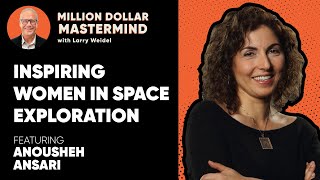
This is a transcript of Part 2 of a Million Dollar Mastermind podcast episode (YouTube) in which host Larry Weidel interviews Anousheh Ansari about her entrepreneurial path and her experience as a private astronaut on the International Space Station. Ansari recounts founding a company in 1993, selling it in 2000 and staying two more years with the acquirer before shifting focus to space. She describes long-term ambition to go to space, nine months of training (initially as a backup), becoming the primary crew three weeks before launch, a Soyuz launch from Kazakhstan, a two-day transit to dock with the ISS, and nine days aboard the station (six people on station during her stay). The conversation also covers astronaut selection numbers, training elements (Russian language, centrifuge, vomit-comet, quarantine), onboard life and experiments, international teamwork on the ISS, outreach via blogging from space, and commercial space topics (Starship size/reusability, projected cost-to-orbit reductions and a cited ~$10 trillion commercial market projection).
Questions this video answers
1993
Sold in 2000; stayed about two years with the acquiring company (Sonus Networks).
About nine months (trained as a backup for nine months to a year).
Three weeks before the scheduled flight the primary crew member developed a medical condition and she took the primary seat.
Nine days
Welcome to this edition of the million Dollar Mastermind podcast. This is where we pick the brains of high achievers from all walks of life and get their hard earned real world insights on winning. I'm your host, Larry Wydell.
So how long did you stay and did now did you evolve from company to company to company? Did it expand your company to whether you're running two or three companies at the same. How did and how long were you in the entrepreneur phase?
So we started in 1993, as I said, with consulting and then started building multiple products within the same company. And then as the products matured, we sold out the product lines and in 2000 is when we sold our company and I continued with the company as part of Sonus Network, which was the acquirer of of our company and stayed with them for another two years and ran the division that was basically my company now inside there. And then that's when I left and went back and decided that, okay, now I want to go and pursue space. I still worked on other ideas and in a new company that we built, but my focus shifted to space around that time and went to space station around the same time.
Now was your focus at this time to be involved in space exploration or how long did you have it in the back of your mind that I want to go? It's one thing to work on this stuff, but I want to be there?
Oh, I wanted to go since I was 7 years old. I knew that the first opportunity I would get, I would say yes. And it really, if you look at what happened to me, I, when I went to train, I was a backup. I wasn't supposed to be part of the primary crew. So I just said yes and I wanted to go and just be with astronauts who were training and learn the ropes by myself. And as part of that whole backup training, three weeks before the flight crew member who was supposed to fly, the primary crew member actually developed a medical condition so he couldn't fly. So I got my chance to fly because I said yes to the opportunity. I went and trained for nine months as if I was going to space, not knowing that it will happen or not. And because I was there and I took that chance, the opportunity came in and it took me a millisecond to say yes, I'm happy to take the primary seat. And three weeks later I was strapped on top of a rocket going to International Space Station.
That's like training for the Olympics, but you don't know if you'll make the team. You still got to Train for months and years. And then it comes down to the trials or a few months before. There's only so many spaces on the team. And then if you don't make it, a lot of times it's not your fault. It was a fluke or this injury. But so a lot of things have to fall into place. How many people were would you say? How many people were competing that you have to overcome to get in there? Is this something that thousands of people apply for or is it just a few people because they don't know how to apply or don't even know what's going on?
Well, for the NASA astronauts, usually every few years they have a open call for astronauts to apply. And they get several thousand, I would say probably two to 3,000 applicants, qualified applicants. And they go through a down selection, which takes over a year. And only a few, probably about 10 to 15 people, sometimes only get selected out of thousands of people. So it's quite difficult to get into the program. And the program has changed over the years. You know, the right stuff at the beginning of the space program were mostly people from military and test pilots. Nowadays they're looking for scientists and people with multiple degrees because it's more of an exploration and building maybe a permanent base on the moon. People who understand different aspects of sciences to be able to build a permanent station. So it's a different type of application that they looking for.
Well, and it's good news for people that have more of a science and technology bent and ability, but they would never. They're not motivated to go in the military or they're too far down the road and they would otherwise just say, I wouldn't have a chance. But now in this new era, especially with what you're saying, that's something for people who have that interest to think about.
Absolutely. And also on top of that, now you have a very vibrant commercial space program with many companies. I mean, the reports estimate that the commercial space marketplace in the next 10 years will grow to be about $10 trillion. And this is not just launching launch systems, but you have a lot of new satellites for Earth observation. There's opportunities in the future for manufacturing in space, using solar energy, for providing sustainable energy sources here on Earth. So there's a lot of activities and businesses that are being built in space that will benefit humanity here on Earth. And that's also an opportunity for people who want to be involved in the space industry, but not in the government space programs to participate.
Yeah, more countries are getting involved in it. The United States Is we've had, I don't know how many years now that I guess last four, six, seven, eight years we've had. Trump started the Space Force as a whole nother department inside the government for space, which before it was just NASA. And so, in fact, my brother, I was out in Lompoc. I was out in Santa Maria, and on the other side of the hill is Lompoc, where they have Vandenberg Air Force Base and the space facilities out there. And they're launching those rockets fairly regularly. It's like over the other side of the hill. But it's going to be something that more people are aware of because they're relaunching these things everywhere. Do you know this? I'm curious. It was like yesterday they launched that big, supposedly the biggest thing, heaviest object, let's say biggest object that was ever lifted off of the Earth. The Musk. SpaceX. Yeah, Starship. So talk about how big is. Do you know how big that is in comparison to like an ocean liner or something or office building or something like that? How big is the biggest thing to ever been launched in space? You know, that put you on the spot.
Sure. I don't know if I will have an accurate comparison, but I can tell you it's the largest. Not because of just the size. The size is bigger than the Apollo capsule. So the biggest launch system we had were the Apollo capsule, which were built for, for taking the rocket launching for moon missions, and the starship is built to launch for Mars mission. So it's, I would say, probably five to ten times bigger or heavier than the Apollo systems. But the most important part of the starship, which is very exciting, is it's reusable. So it's not only biggest or heaviest, it's reusable, which means the cost of access to space is going to come down. And I think what Elon had talked about in the past is once it's fully operational, it will be about $250 per kg, which is compared to about $25,000 per kg when we launched XPRIZE Competition. So as you can see, this big cost reduction in taking things to space will allow us to build these businesses in space to launch new satellite Constellation like he's building Starlink. But there will be a lot of other means of getting intelligence about our environment, about how our atmosphere is changing, about how our planet is changing. And that will allow us to predict things better, to be able to deal with adverse weather conditions, to decide how we want to build our agricultural plants across the world. So it will, the intelligence will get from space will help us really build better and more safer life for humans and other species on Earth. That's I think it's the biggest part of starship and what it will allow us to do.
We use the word, you hear the word pioneer, but you're like a real pioneer in this arena. How significant was it for you, a female from Iran to be to go into space and spend nine days on the space station? How unique and how special was that from a pioneering standpoint?
It was pretty significant on several fronts. One was I was the first self funded women to fly to space. But on top of that, because I was from Iran and Middle east, it became a very sort of inspiring story for a lot of women. As you said, women in Middle east and Iran, they don't have a lot of opportunity. And a lot of young girls grow up being told that there are certain things that women should not do or cannot do. So my story and the fact that I was able to do the things I accomplished gives hope and it gives inspiration to a lot of young women around the world to really go for big dreams and try to achieve them. So that's to me that was the biggest achievement that I could think of that it was helping millions of other women across the globe to do things. And the reason I know this was because I started writing the first blog from space and millions of people started reading it. There were about 20 million readers two months after I came back. And the young people who were reading would write back and say when I read your story, it gave me hope because I wanted to do this thing always in my life and I thought it's not possible. But now seeing what you've done, I have hope that I can do the same. So seeing that with young people around the globe was really made me happy that I was able to share my story and inspire others to go after them.
For those of you who are sick and tired of fooling around and are dead serious about wanting to move up fast, I've got something especially for you. I've combined the best insights from most 40 years in business and making $70 million in income and compress them into a free webinar. That's right, it's a free resource. If you want to find out exactly what the concepts are that I use in coaching million dollar earners, Register now@widelonwinning.com youm'll discover the five part framework used by so many to reach their financial, personal and professional goals. You can find that link in this episode's show notes.
Now talk about you're up there, let's just say. So you get in the seat, you fought your way into the seat and you're thrill, your heart's pumping. And how many people were launched up with you? How many went up?
There were two other crewmates, one Russian and one Spanish American crewmate, Michael Zopez Alegria. And they. We were sort of strapped in this tiny capsules, the three of us.
Uh huh.
And what was that? The experience of doing that yourself. You're at that point, you're, where did you launch from? Where did you launch from?
We launched from Kazakhstan. That's where Soyuz launches take place. And back then it took two days to get to the space station. So you would get to space, but then you would have to orbit until you would sort of get into a position that you could dock safely with the space station. That took two days. So it was not a very comfortable place to be in this tiny, you know, capsule for two days. But it was worth it because then I got to spend nine days on the space station. And there were three other crewmates, one from Germany, one Russian and one American on station when we arrived. There were six of us for the nine days I was on station.
So during that two days, could you move around in the capsule or did you have to like stay in the seat, the whole thing or what?
I mean, you know, you're fortunately, when you're in space, you're weightless, so we could get out of the seat where you would float. We didn't have a lot of space to move, but there is enough space for the three of us to sort of be standing or floating around. And there are two parts to the capsule, so we could split off and two people could be in bottom piece and then one person on top and we would exchange location physically.
What do they prepare you for, by the way? Do you have to learn Russian? I mean, is all the training in Russian?
Yes, that was the hardest part of the training, trying to learn a whole new language in six months or less. So we had to learn Russian. You do a lot of physical training, not because that you need to get stronger, but to build stamina. You learn a lot about emergency situations, so you do simulations of different emergencies and how to do repairs and fix things. You do zero gravity training through what they call the vomit comet with the parabolic flights. You do centrifuge tests to understand does.
The body get, does the body get where it can adapt to that, where you might Your vomiting reflex type thing gets under control, you learn how to control that or it adjusts or yeah, you.
So there's a couple of things. One is you train for it, so you build more resilience against motion sickness. But also you can take medication, of course, like when you go on a cruise, you take medication. And the rest of the training is really the duration of the training. The nine months to 12 months that you train, your body builds more and more resilience against adverse effect. But I also learned that our body adjusts really well. So when you're in space, the first two days you're, you know, you get back pain, lower back pain, headache, because your spine is stretching so you come taller, the fluid shifts in your body so your sinuses are inflamed, you get headache. But all of this after the first two to three days, the these side effects go away and you adjust and then you go back through the adjustment back to the gravity well of our planet when you come back from space. But that was a big learning. Our body can really is resilient and can adjust to different environments quickly.
Yeah, so you get into it's high adventure. You finally get on the space station. You're up there with how many people did you say? Once everybody got up there, there were.
Six of us together.
Six of you. And are you interacting with each other all the time? Everybody. So what's that like? You got a little, you've got a little community up there.
It is a little community, an international community. And we speak different languages, different backgrounds and personalities. So it was a little microcosm of what could be like if we all got along well. And when you're on space station, you understand that your survival depends on how well you work together as a team. And that's I think, a big part of it. And you know that if you don't like someone or if you get upset with someone, you can't just open the door and shut them out. So it is something you have to learn how to work well together. And that's why we all become friends, friend afterwards and we stay in touch. So I'm in touch with my crewmates and visit them from time to time if I'm in their neighborhood. And it's something we can learn on how international collaboration and cooperation can lead to building big things. I mean, the International Space Station is a collaboration between 16 countries. They all came together, built different pieces of this amazing laboratory in orbit and they assembled it in space. It's not like we put it together to make sure, it works here on Earth. We actually assembled it in space. So if we can do things like that, I'm sure we can collaborate and build amazing things here on our own planet as well.
How big inside is your space you had to move around in?
So the Soyuz is pretty small, but the space station is the size of like a football field. And it has different modules. Yeah, it has.
Really.
Yeah, it has different modules. That's huge. It is. There's. Inside. These are like the length is this football field, but your. It's a cylinder. It's these cylinders put together like pieces of the puzzle. And you have the Russian segment, you have the US Segment, you have Japanese modules, you have European Space Agency modules. And there are experiments running inside the space station. So there's a lot of equipment. So the space for people to live, it's limited, but it's more of a tiny laboratory orbiting our planet.
Well, when you get up there, do you have one common area where everybody stay in their own separate worlds, or you have common areas where they're eating and sleeping and interacting? And then you go the separate areas for the research and the projects.
The research and projects are spread around. So depending on what project you work, your workstations may be different. But usually during the meals, especially dinner time, we all come together and we have a meal together, which is a great moment every day for people to share stories, to get to know each other and talk about their experiences. So it's not all talking about science and work. It's really more of sharing our personal stories and lives together. And that's what brings us together. We don't have. We don't have to cook meal, but you have to heat up. So someone takes the task of being the host that day and heating up the food for everyone. And great conversation takes place around the mealtime.
Well, what language did you speak up there?
So there are two official languages. It's Russian and English. When you're up on the space station, and depending on the number of crew that leans toward one side or the other, then mostly that language is spoken. I was more comfortable speaking English, but I learned enough that I would understand Russian. So with my Russian crewmates, I would speak English, they would respond in Russian, and we understood each other. So it's a multilingual space.
Yeah. Your particular. How much can you get done in nine days? Your particular assignment, do you remember exactly what you accomplished? Because you're supposed to accomplish things up there. And what was your assignment?
Sure. There were four experiments I was doing with European space Agency two had to do with how being in space changes human body and doing different measurements from muscle systems or pain resistance. There were also an experiment around bacterial life form and taking samples every day of different parts of the body and the station to understand microbial life form transfer, transference and growth rates and also radiation effects. So taking blood sample for effects of radiation. And I did, I had several experiments I was doing with schools because one part of my mission was to come communicate this experience with people on Earth. So I did talks with different schools across the globe and letting the students ask, question and share this experience with them.
While you were up there?
While I was there.
While you were up there.
Yes, yes.
I need to do a podcast from the space station.
You should. That would be fun.
Live from the space station.
That would be fun. I can tell you the students loved it. The fact that they were talking to someone in space was just mind boggling for them. So it was great.
Sure.
Now, did they prepare you for like, when you go to foreign countries and everything? A lot of times you'll have your orientation, your cultural orientation before you go, don't say this. In this country, they don't do this. They don't tip or they don't bow or they do, you know, they address people with how you address them and greet them. Did they do that? Like before you go, like now, when you get to the space station, don't do this, don't say this. Or do they, they give you training on how to get along with the other crew members before you go?
No, honestly, you don't get training on it, but you train with your crew. So at least the people you're flying with, you have some, you establish some relationship before you go to space, so that's good. And then they do a lot of psychological tests on you to make sure that you're someone who will collaborate, follow instruction. So the simulation tests that we did, for example, some of them are full day simulation. So you're in your suit, you're inside the mockup of a space station. Different things change, different things break, you have to go repair. So they try to really test your endurance and your ability to follow instruction and collaborate with your crew members to fix a situation. So you're put to test, but not a lecture on how to get along.
When you got to the space station, how long did it take you to get comfortable around the other people and feel like, okay, the awkwardness is over and now I'm into the routine.
I would say immediately because as I said, we train together so you already know your crewmates, and before you fly, you. You spend three weeks in quarantine. And when you're in quarantine, you primarily just interact with your crewmates because you can interact with the outside world.
So I'd forgotten about that. I think I'd heard about that, but I'd forgotten about it. Three weeks of quarantine before you go.
Yes. So we got to be really close friends and shared a lot of stories before. Before our flight.
Wow. I'd like to thank you for listening to part two of this episode of the Million Dollar Mastermind podcast.
Timing is everything. You may feel that now is the.
Time to get moving forward so you can do something even greater with your life. Now, if that sounds like you, I've got a free training video to show you how that transformation can take place. Getting introduced to how the cycle of success. Success works has been a major transforming event for so many current million dollar earners. And that's exactly what this video is all about. And yes, it's completely free. Join us at the video@widelonwinning.com and thanks for being part of our community.
More from Larry









Rick Jordan on Self-Engineered Proximity, Cyber Security Moats, and Truth-Based Leadership

Fire Fast or Fail Slow: Kevin Brittingham Reveals the One Rule That Built a $100M Empire
