Part 2 - The Surprising Key To Seth Godin's Success
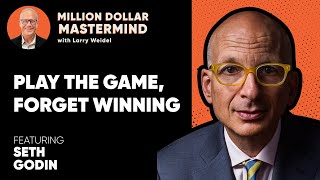
Seth Godin explains how he treats situations as games with players, rules, and outcomes to find underused strategies. He credits middle-school status dynamics for shaping his approach, emphasizes storytelling as the most effective teaching tool, and contrasts short-term winning with an infinite-game mindset.
Welcome to this edition of the Million Dollar Mastermind podcast. This is where we pick the brains of high achievers from all walks of life and get their hard earned real world insights on winning. I'm your host, Larry Wydell. Now, how did you develop your. And I'm sure you won't take offense of this and because I think it's part of the reason for your success is you have a unique take on a lot of the things going on in life, in business and people, humanity with the tribes. And you're kind of this outside observer and you have it come at a different angle. Where does that come from, do you think? Or what gives you that? It's like you're sitting in a different place than everybody else is sitting from. And you, you like see something and you speak to it, everybody goes, oh yeah, that's it, that's it. So where does that come from?
Well, first, it's hard for me to imagine taking offense at that. That's my job.
Yeah.
And I wasn't born with it. It's just a choice. Anyone can do it.
And so how did you develop it yourself? Did you say, like when I'm writing, if I'm going to write a lot of books, I've got to have something unique or distinctive or useful to say. And did this come from your knowledge of what these editors were looking for inside the company or something?
No.
Or what?
It has nothing to do with writing books. I only write books because I have no choice. It has to do with being an engineer and a game designer. That what I write about in this strategy is that a game is any situation with players, rules and outcomes. And so getting on a plane when there's a storm from Atlanta to JFK is a game because you can decide to switch airports, you can decide to rent a car, you can decide to find 10 other people and charter something, you can decide to get on a train. These are moves that you can make in a game. So if you think about the games that are all around us, you realize that there are strategies available that other people aren't using. And that's what I do. I noticed that I've been doing that since I was 12, but I chose to do that because I can't dunk a basketball and I can't beat someone in an arm wrestling match and I'm too lazy to out study them. But what I am willing to do is lean into the liminal space of what happens if this strategy gets used instead. And because I'm a teacher, once I See a strategy that could be used, I try to tell other people about it.
Now, when you say you're a teacher, talk about that. Where did that come from? I mean, were you a teacher before you started writing books?
Oh, yeah, for decades before I started writing books. I think being a teacher is also a choice. It says the most generous thing for me to do is share my strategy, not hoard my strategy. And great salespeople, in my experience are teachers that if a salesperson shows up and says, I gotta remember, this brokerage firm came to me and said, you have to sign an NDA. We have a secret way for you to make money and not pay taxes. And I said to them, number one, I'm not signing an NDA because if it's a secret, there's probably something wrong with it. And number two, I like paying taxes. So no. And it turns out that like dozens of the people who did sign the NDA went to jail. Because if someone's hoarding things and not teaching, then they're afraid of something. But if you see something and can generously outline to other people a better way for the game to be played, you earn trust and the world gets better because other people are doing things better.
When in your career growing up did you discover, I'm not going to be able to dunk a basketball, I'm not. Was that a goal? Was athletics success a goal growing up?
I think almost everyone we know carries middle school around with them. I don't know if you do. I hope you don't, but you probably do. Middle school is a horrible place filled with horrible people. And what happens in middle school is challenges of status and affiliation. Mostly status, but the affiliation of who's sitting at the lunch table with you, who are you better than? What's the hierarchy and status and affiliation stick with us for the rest of our lives. And it was pretty clear to me in seventh grade that what was commonly allocated in status was not going to come my way because I did not have a head start in the traditional measures of status among 12 year olds. And if you talk to a lot of successful people who became successful as adults, they had the similar experience that if you're easily popular when you're 12, it's easy to get stuck in being easily popular going forward, but if you're not, then you might be spending time looking for a different game to be played with different people.
And how did this dawn on you? How clear was this? Was there an experience that came along that crystallized this? Because it sounds like a Detached view of. I'm watching Seth go through middle school and things are not clicking here and so he needs to think other ways. So how did you get this detached you boy? Was that an adult input or friends or.
I think that, I think a lot of us carry around middle school trauma. I don't think my middle school trauma is any worse than most people's. And if you're not going to internalize it and make it part of yourself, then you have to look at it from a distance because I'm not 12 anymore. So I can see that 12 year old kid. It's not me, it's that 12 year old kid. The other thing I talk about a lot in the strategy book is time. And like you and I are both present in this moment. Tomorrow this will be a memory. Yesterday it's something we were looking forward to, but we're still us. So our strategy needs to say I am here today. Where do I hope to be in the future and who am I taking with me when I go? And too often people in business get hung up on making their quota or closing the sale or winning. And I just don't. I'm not comfortable with winning because the infinite game is about playing. It's not about winning, but the goal isn't to end the game. So keep playing the game.
Yeah. And so I won't go there. But anyway, I, you and I are on the same page. And the idea is that I tell people I was never going to be a professional athlete due to my lack of speed and lack of height. Although I played all sports, I was never going. I never got a nibble in terms of a college scholarship. But I was a big hero in high school. And the way you do that, Seth, is you go to very small schools. You always get to start because there's nobody else around. But the thing is, the one thing I learned is that winning is better than losing. I like the taste of coming out on top, trying something and then have it turn out right rather than getting egg on your, your face. And it's better to be accepted if you submit a book offer than turn down 900 times. But you know that the way you went through that is very instructive and I've never thought about it. But in my learning how to sell early in my sales career, I went through a similar process where you're not making sales but you're getting more and more positive feedback. People would say, not for me, but I can really tell you're going to be great at this. That's really not going to help me buy groceries for my wife and kids that are at home. But anyway, thank you. And so it does. You're smart to pay attention to those signals on the way up. Either you're getting those or you know, you're getting. It's like in anything, you're getting closer, you're getting further away. And as you came up, one thing I hear, I'll just say I hear from you. Even in middle school you had an attitude inside you that I want to accomplish something some way, somehow. I don't want to be the guy ignored over the wallflower over in the lunchroom in middle school and go through life in my parents basement and nobody knows I live. I want to be somebody that accomplishes something positive in society where you know and you get those good feelings from impacting in a positive way. Somehow you came up the ladder with that. And was that, did you have a big family or family of accomplishment from your parents or sometimes people say they're hard workers or something, you know.
Yeah, I definitely won the parent lottery. I'm not sure it pays to go into it because we don't get to pick our parents. I'm really pleased that I ended up with who I ended up with. The question that's more interesting to me is, well, now what are you going to do?
Right?
And now what are you going to do in a world where everyone has a microphone, everyone has a camera, everyone has the ability to connect with anybody else out of 3 billion people on the planet. We live in a world where since I was born, we have invented 7 billion jobs. And the question is, what will we do with these tools, this leverage, this privilege? And it's super easy to get stuck on. I didn't have parents like Seth or to get stuck on. I grew up with the wrong middle school or whatever. Yeah, that happened. But now what are you going to do about it? The magic of this moment in time is even though the media tries to make us distraught and to believe that there's no opportunity left, there's more change happening right now than has ever happened in the history of the world. And for me to be able to sit with Claude AI, have a conversation with a trillion dollar artificial intelligence device for $20 a month, knows how to understand and write and has read every book ever written, like, how dare we go back to watching Netflix? What an opportunity to find a new way to make things better.
And the point that's not going to happen if you are feeling sorry for yourself or you feel like you don't have a disadvantage. But what you find, Seth, is where I would take issue with is like, if you won the parent lottery, big damn deal. Because there's millions, hundreds of millions of people who won the parent lottery and turned into drug addict losers. Narcissistic, like, where did this come from? And so the thing is, that's just because you have the parents and you have on the other hand, people who came up with nothing. All the parents were killed or they were one of the amazing guys, and I don't comment on these guys much, but a guy like a LeBron James in basketball who's never been picked up drunk anywhere, out with other women, any kind of rumor of anything. He's raised a. And his father was in jail, his parents were drug addicts, this, that the other. And he's got all the pressure of this athletic ability, which is enough to crumble anybody. Lynn Bias elected in Maryland. He was the number one draft pick by the Boston Celtics and he celebrated by going and overdosing on cocaine. He never made it through the night. There are people like the LeBron James, which I don't agree with everything he does, but I mean they're just heroic and somehow they rise above. And so what people need to realize there's enough things going for you out there, tools where you don't need. As you know, people have done this in the past without all these advantages and now the kind of things, it seems like you have a compulsion to wake people up to possibilities. Would that be fair to say?
Yes.
And part of that, how does that transformation come from people? How do you ignite that and what do you find works because you write books and then you have people respond back to you like, thank you for doing this, thank you for doing that. You know, it's going in that direction. And I heard this. What have you distilled from that feedback of putting out transformative type ideas over your career? And then hear people come back to you who have gone through those transformations, what comes to you as kind of trigger points? And I'm sure it's different with everybody, but are there things that come up more often than not and things that we could learn from and use? Because in a leadership position you're always trying to help people through these situations. You're always ask for your advice and there are people that are looking for answers and, and the more you can kind of zero in on the thing, that'll probably trigger the positive turnaround, the better. And so have you noticed anything from the feedback you've gotten from your books.
So what you're talking about is pedagogy. Pedagogy is the science of learning. Learning about how people learn.
Yeah.
And I have discovered two things. One, I've never met anybody who says, I read all the graphs and charts and tables. And you have proven your point. I have changed my mind. People change their approach because they read a story, because they internalize a story. And the second thing is the single best way to get people to take action is not for them to come to the conclusion they were wrong. It's for them to come to the conclusion that they were right all along. They were just doing it wrong. So not trying to change where someone seeks to go, but turning on lights to help them get there. And those two things, a story that turns on lights and helps people get to what they've always wanted. That's my pedagogy. That is what I do over and over again.
So give me an example of how you've done that in a recent book or in recent books or your current book.
So there are plenty of people who want certain metrics of conventional success. More sales, more income, more profit, more revenue. And they're surrounded by people who are hustling or spamming or just manipulating folks. And if I can tell them a story of how someone earned permission, built an email asset, was able to contact those people over time and take them on a journey, and then the outcome of that is the business did really well. Someone doesn't have to say, oh, I want my business to do well. Yeah, because they've already said that, right? Saying, oh, that's the express lane. I'm going to get out of this bumper to bumper traffic following all the bottom feeders and I'm going to do this other thing. It might be hard, but yeah, I see the journey now.
Yeah. Well, you have backed your way into why I do this podcast, tapping in the stories of the people. Because everybody's story is different. It's like, how do you put a rock band together? Unless it's a boy band or a girl band and there's a machine. Or how you come up with a rock band and you. They're all amazingly unique. Different stories, but they're informative because you may not be able to copy the whole thing, but you can copy steps. And you might be stuck at the same point this band was stuck at at certain points along the way. And their idea may not resonate with you, but it may trigger an idea or an alternate approach that you hadn't thought of yet. And so that's really what I try and do on here is what I found is that if there's a. One of the shortcuts to success is being around people that have had more success than you have in life and just being exposed to them and listening and seeing like greatness is caught and not taught. You're around it, it can kind of get in your head and it's like, oh yeah. But it's. If you go to them and say you're wrong on this, they're not going to listen to you. But if they hear something over there, they can tell themselves I was wrong on that or I need to look at this a different way and this is more to my advantage. I wasn't thinking, I wasn't thinking about it that way. And I've had many of my friends that were more successful than me 30 years ago and they did things that I knew they did them. I couldn't get myself to do what they did. Now, 30 years later, they explained to me what their thinking was and I said, I wish I'd known that because I would have probably double timed what you were doing because I could see why it would pay off for me. But the stories wake up the emotion and allow people to things changes to happen, molecular changes to happen that would not happen. And then when they do, people are able to slide more into where their mind and body wants to be. They're able to go through this difficult adjustment like, okay, now I can do it. I'm comfortable with it. I'd like to thank you for listening to part two of this episode of the Million Dollar Mastermind podcast. Timing is everything. You may feel that now is the time to get moving forward so you can do something even greater with your life. Now, if that sounds like you, I've got a free training video to show you how that transformation can take place. Getting introduced to how the cycle of success works has been a major transforming event for so many current million dollar earners. And that's exactly what this video is all about. And yes, it's completely free. Join us at the video@widelawnwinning.com and thanks for being part of our community.
Taking.
More from Larry









Rick Jordan on Self-Engineered Proximity, Cyber Security Moats, and Truth-Based Leadership

Fire Fast or Fail Slow: Kevin Brittingham Reveals the One Rule That Built a $100M Empire
