Part 2 - Turning Financial And Family Challenges Into Entrepreneurial Success
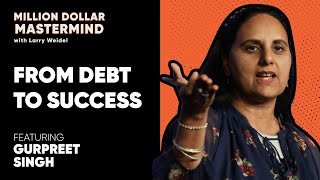
Podcast interview (Million Dollar Mastermind, host Larry Weidel) with guest Gurpreet discussing her transition from programming/employee work to entrepreneurship. Topics include self-coaching, immigrant work ethic, mentorship, reading/listening/writing as daily disciplines, overcoming financial debt ($40,000) and personal obstacles (people skills, language, gender), and the timeline of change (about two years to financial transition). The episode emphasizes deliberate practice, asking questions, mentorship, and rapid income replacement when starting a business.
Welcome to this edition of the million Dollar Mastermind podcast. This is where we pick the brains of high achievers from all walks of life and get their hard earned real world insights on winning. I'm your host, Larry Wydell. Now, were you on a management trajectory when you left that and started your own business? Were you pretty much still programming or what? When you say you're a part of the team and everything, what, what were you doing inside the team?
Well, basically you're setting different programs. But I don't think I was on a management trajectory because the people I worked there worked there for 30, 40 years and they had no intention of retiring because they would have to get out of the way for me to have management. So I, I really realized that this is going to be a long shot because these people, they are not going anywhere.
How scary was it and what are the first steps you had to put yourself through to? How did you evaluate opportunities and how did you make the decision to branch out and go in another direction?
Well, the decisions are very simple. You use common sense. You observe, you look at other people's lives if they're in your field, and then 20, 30, 40 years from now, this is where they live life looks like then your life will probably be the same. But you have to step out of that box and you have to say, listen, I don't want this kind of life and I don't want that same end in mind. So it was almost like when you start learning these things or you start learning the habits and the laws of the universe, it becomes common sense, like, oh, okay, this makes sense. So if something makes sense, you have to move on because if you stay where you are, then you're really hurting yourself.
How long did it take you to find something that appealed to you as an alternative career path?
I would say as I was working in the field for five years with the programming right after, when the opportunity came along, I believe even though I didn't accept excel in the opportunities right away, but I did have an awakening that these are some of the things I need to position myself. I need to believe in myself more. I need to learn those proper skills in the new field, which is doable. And then I need to understand that what's out there is available for other people, but it's available for me too. And I'm just willing. Am I willing? I was asking myself this question when I was struggling with people skills. I was asking myself this question daily. I said, listen, self, do you want to be financially or wealthy in the future. Yes, you do. Then you need to get over yourself and you need to go ahead and become a better people person. That's it. It's a conversation. That's it. It's over. If you want this, then you need to do this. So it was more common sense than anything else.
Yeah. That's a principle that I first put in my book and then I since put in my course that we. Ultimately, the higher you go, you've got to become your own best self coach. You can learn from other people, but only you know you and only you are there right when you're facing these challenges. And you can either you can take forever to try and find someone else that would give you your answer, or you could dig it out and find it out for yourself. And a lot of these answers you wind up using over and over the rest of your life because these. These roadblocks are recurring. It seems like they're recurring as you go down the road. They show up at different levels of success. But as you went in and what was your financial obligations at the time you made the transition? Did you have a lot of obligations on you, or was it easy for you to make the transition because you're giving up a steady income?
Well, I had obligations. I had $40,000 in debt, and I had to bet on myself, and I had to bet on realizing I was a young. At that time, I was transitioning into marriage, being a young, a future young mother because my child came right away after we got married. And there was a lot of. You had to do a lot of kind of soul searching and say, okay, what do I want? Do I want something better or do I want to stay the same? Right. If I want something better, then I need to be better. If I'm better, I'm going to attract better, which means better opportunities, better money. Then the future for my family is better, too. But it all starts with me, because a lot of people say, oh, I love my family, I love this, I love that. But they're not willing to make the changes to themselves because nothing is automatic. Success is not automatic. It has to be a daily grind.
Was it your goal to as quickly as possible replace the income that you had left behind? Did you put yourself on the clock? Was it kind of a race? One principle that I talk about all the time is when you're in business for yourself, you don't work, you race. The sooner you get there, you're smart enough to know the sooner you get to the next target in front of you, the quicker you're going to start enjoying the benefits and you don't want to drag it out because you got less time to enjoy, so you want to get there fast. And so did you have that kind of thinking or were you. Did you have any idea of a target in mind?
Yeah, absolutely. And it all brought me back to the again, being an immigrant and having that immigrant work ethic and wanting it and taking it right, Being in that place of remembering coming from another place and saying, okay, am I better? Did I do something better? Can I do something better for my family? So it was almost like going back to that space of where you come from and what you're willing to fight for. So that's what kept me focused on working 60, 70, 80 hours a week. Because I said, wait a minute, if I did it for someone else, I'm doing it for myself.
Now you're in the process of overcoming those feelings of inferiority and disadvantage. You know, I'm disadvantaged for this, I'm disadvantaged for that. I'm an immigrant child of immigrant parents, second language. I'm not a people person. I'm female, and I, you know that. Did you see people along the way that you met that gave in to those kind of feelings and kind of sold themselves short?
Yeah, absolutely, all the time. And the ones that I saw bail out the fastest were the people that, quote, unquote, call themselves smart because they, they were logical. Right. So I was not a logical person. I backed everything from emotion, and I knew that emotion would drive me and that the logic was going to be there. But I needed to do that emotional side. Because the E and emotion is the energy that drives you. Right. Because logic is someone that needs proof. I don't need proof. I just need the emotion and the energy to know that I can move forward. And once I had that, I wasn't stuck on, oh, when will it happen? Is it going to happen? Yes, it's going to happen. When it's going to happen? Well, the universe knows when it's going to happen, and I know eventually it's going to happen. So let me continue the journey.
How long did it take you to when you start getting your first successes and where you prove to yourself, like, I can make this, I can make this go. This is going to work?
Yeah. Well, it took me two years initially to make any type of transition financially, but the two years I made the transition realizing that I had to work on myself. So that work that I was doing on myself would cause me to have the financial growth. But if I Didn't do this work on myself, quite honestly. The game was going to. Game was going to be over. It was going to be over and I knew that I couldn't give in. So I had to keep working on myself.
How would you explain to people how did you view that, what that meant working on yourself, continuing to move forward, continue to do what was in front of you, staying on track where the results were not coming in yet or not, and keeping, keeping the faith that if I keep doing what I'm supposed to do, eventually things are going to start coming my way. What would you say is how you kept improving?
Right. So working on myself is very simple. And I tell this to people all the time. It's reading, listening and writing. It's being able to have those new thoughts by reading and then we learn by listening. Right. So these are the three most powerful things we learn in a classroom. Right. That's why we have teachers and we have, we're become students. Right. So I became a student of life. And once I realized that I was capable of reading, I was capable of listening and I was capable of writing. This is what's required for success and I could duplicate that within myself daily. And if I do this, it's going to take my life to the next level.
Another thing is you're seeking out answers to questions that you have. You just don't let these questions stop you. I would always say to people, they came to visit, they're in for a meeting or something and they happen to jump in the car and they're riding with me over to next location or whatever. And I said, I'm not surprised by your lack of success, but I am surprised that you have me in the car with you probably the one time in your life and you're not asking me questions. What is going on in your mind? You've got me right here. And if you didn't have questions, you'd be doing a whole lot more than you're doing right now. And what I did, this thing really preps you. Going through this process preps you. You program yourself to take the mystery out of the magic or of how you actually become successful and get it down into step by step things that you can teach to other people. And that allows you, once you get your business going, to develop and train your management, but also develop the train management where you can expand and open other offices, which I know that's what you did. And I went through the same thing myself because I had mentors that I grew up in an office I don't know, when you, you're in financial services, you have the thing where you can go just open your own office right off the bat. As a, any professional coming out of medicine or accounting or cpa, you can go out there and open an office, put at your shingle and then just start to build that way or what. The more common approach is to start in someone else's office as again an apprenticeship, a mentorship type program, a trainee program, and then once you learn the ropes, earn the right to get promoted out and get your own operation and turn yourself loose. And if you're good enough, then you can, in other words, not just run a McDonald's but get your own McDonald's type thing. And if you're really good and you're really motivated to do it, then you can start taking people in that work inside your operation and train them and spin them off to their operation. And you've done that 20 times. And a lot of that you're seeing the fruits of you taking the time to learn this stuff, write it down, get these specific answers to specific situations. And you were really programming yourself for really the rest of your life to have growth the rest of your life. And that's a great thing. When I came in Gurpreet, I would ask questions. I was surround, I was the dumbest guy in the room. Everybody else was a charismatic natural salesperson. I had no sales, I had to learn it. I told people that it would have been easier for me. I always thought sales was a magic process. It was like a magic trick because I would watch people make sales and I had no clue how they did it. I'd listen to them talk, they'd show things to people. And then at the end people would give them a check or fill out a form. And I thought, how did this happen? It happened right in front of my eyes. What just happened? And so I had to step by step ask questions. And I got a little tape recorder, a little cheap tape recorder. Cassettes, 29 cent cassettes. And I would take the tape recorder and I would ask the question, listen to them answer it. You know, take 10 or 15 minutes, I'd go in the other room, I'd transcribe it longhand, I'd make it a long outline out of that, then a short outline, then a one word outline. By that time I knew it and that was me writing it down. But it's kind of like I put myself through the same process. I on anything I needed to learn, any presentation, I needed to know anything. That I needed to train someone else on or whatever. I'd go in and do that same process, ask it, write it down, make an outline. I'd wind up memorizing it just by doing it from long to short. And most of the time I never had to look at the outlines ever again because it was in my. I kind of made it part of my DNA. And so that helped me in training. I found, Gurpreet, that the harder it is for you to learn something, the better a trainer you are because you have to break it down into the real small pieces so it makes sense to you. But that makes that elevates you in terms of being able to explain it to other people. Have you found the same thing?
Yeah, absolutely. And I love what you said. And you use the keyword mentor. And that's what every morning when I speak to my mentor and I remember the quote from Walt Whitman, be curious, not judgmental. I'm very curious. I'm a very curious person. I ask a lot of questions. So if you're in front of me and you have your success, I will ask you everything because I know from that I'll get the understanding and put that pieces of the puzzle together. And every time the puzzle unfolds now, I get a new breakthrough.
I'd like to thank you for listening to part two of this episode of the million dollar Mastermind podcast. Timing is everything. You may feel that now is the time to get moving forward so you can do something even greater with your life. Now, if that sounds like you, I've got a free training video to show you how that transformation can take place. Getting introduced to how the cycle of success works has been a major transforming event for so many current million dollar earners. And that's exactly what this video is all about. And yes, it's completely free. Join us at the video@wearlyllonwinning.com and thanks for being part of our community. It.
More from Larry









Rick Jordan on Self-Engineered Proximity, Cyber Security Moats, and Truth-Based Leadership

Fire Fast or Fail Slow: Kevin Brittingham Reveals the One Rule That Built a $100M Empire
