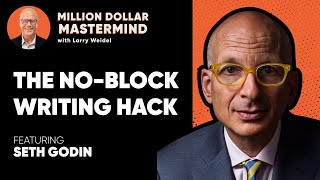
This is a transcript excerpt of Part 3 of a Million Dollar Mastermind podcast episode (YouTube) featuring an interview between host Larry Weidel and Seth Godin. Major points in this chunk: Seth explains his disciplined daily writing practice (he says his blog has not missed a day in ~8,000 days), argues against writer's block by advocating doing bad writing to produce good work, recounts Isaac Asimov publishing 400 books and his morning writing routine, discusses consciously choosing media (blogs vs. video/TikTok/YouTube) and refusing to be an unpaid employee of platforms, and recommends subscribing to many blogs and avoiding social media to preserve time for deep thinking. The episode release date is given as October 22 (podcast/video drops then).
Questions this video answers
October 22nd (episode will drop in October; Seth: "that's when it comes out, October 22nd").
About 8,000 days (he says, "I haven't missed a day in 8,000 days").
400 books (Seth: "Isaac published 400 books.")
Welcome to this edition of the Million Dollar Mastermind podcast. This is where we pick the brains of high achievers from all walks of life and get their hard earned real world insights on winning. I'm your host, Larry Wydell. How do you slide in? You made a statement. I write books because I have to. All right. And I'm sure it's. You get, like, the book you just wrote, your most recent book, is it out now or is there one that's just out or it's just coming.
So this podcast will be dropping in October, and that's when it comes out, October 22nd.
Okay. How long have you had that concept in your mind that this, I need to write a book on this? And how did you go about that coming up to priority status in your life, in your thinking? Talk about that, if you don't mind.
Well, the big transition for me was going from writing books for a living, which I did years and years ago, to writing books when I felt like there was a tool that other people needed and I wanted to offer it to them. So I used to look at the world and say, where's the next book? Where's their book? And now sometimes the world shows up and says, here's a book. You have to bring it to people. And that's different. What often happens is I just write every single day. My blog is I haven't missed a day in 8,000 days. And sometimes I just keep writing. And if that happens, I'm trying to talk myself into making it a blog post because that makes life much easier. But if I can't, now, it's a book.
Now, Jerry Seinfeld's advice to comedians is, write every day. And of course they say, you're kidding. He says, no, I still write every day. He said, take out a calendar and write. And every day that you write, draw a red line through and never have an interruption in the red line. And that's what you've done for 9,000 days in terms of writing blogs now and you writing every word yourself. It's not going through.
I don't. This is. You're looking at my entire team. It's just me.
It's nice to meet the team. And when you sit down to write, people have this question. I paint, and it's a similar type thing. It's like every day I do photography and I paint in addition to other things. But it's just like every day it's like, get out a pen and put a mark down and get started.
Go.
And then see what comes out. And so when you sit down, what do you do?
So I worked with Isaac Asimov at the end of his career. It was the beginning of my career. Isaac published 400 books. And I said to him, how do you do that? How do you publish 400 books? And he took me over to this manual typewriter and he said, every morning I sit down at this typewriter at 6:30 and I type. It doesn't have to be good or I have to type. And after a few minutes, the part of my brain that can't tolerate bad writing starts forcing good writing to slip in. And writer's block is a myth. There's no such thing. And the way I know that is if I say to you, show me your bad writing, people say, well, I don't have any. Well, that's what you really have. You have a block because you don't want to do any bad writing. Go do some bad writing and bring it back to me. You do enough bad writing, the good writing will happen. So for me, I know there's going to be a blog post tomorrow, not because it's my best post ever, but because it's Saturday. And so I go to bed knowing that there's going to be writing.
Now why did you choose when the videos come on the scene? When we started we had to write because that was, that was our only option. And before video came along, I mean I could do video interviews, I did conference calls.
That was the.
Because there was no zoom and also there was no cell phones. So you had to get people at certain times around phones and have your conference calls. And that was how you ran organizations. But when you videos come along, they need the video conference and tech comes into our lives. Now I'm sure you've had people come, Seth, you've got to do a video thing. Whether blog you've got just get in front and read your thing and put it on YouTube. It'll have much bigger exposure. I'm sure you've had people come to you and try and twist your arm to shift over to a video rather than just writing a blog every day like blogs are old. Seth, why are you doing that? Let's use the new technology. And so I'm sure you get lectured and urged those kind of urges. Except in your world they may not want to mess with you. But how does or you keep your staff of one before you keep those voices out. But how have you stayed true to your original premise there? And why did you stay true to that purpose?
Well, I think you need as a creator of any kind to pick your media. And so I saw Twitter early and I decided I could be mediocrely pretty good at Twitter, and. But if I did that, I'd have to do less of something else. And I didn't want to be a wandering generality. I have dozens of videos on YouTube. I pioneered online education with video, and there's stuff on Udemy. And I built the alt MBA into thousands and thousands of students. So when I pick a new medium, I lean into it for what I think it's good at. But I don't work for TikTok and I don't work for YouTube. I'm not an unpaid employee. My job is not to feed their algorithm the way they want me to feed it. My job is not to show up because they need content. My job is to bring messages to people in a format where I think they're going to work and help people get to where they want to go. And choosing what to say no to is at least as important as choosing what to say yes to.
In fact, that's a concept that was stated, I read 20 or 30 years ago. They said the value of an executive is the ability to say no. Because when you're in a leadership position, everyone's bringing you all these ideas, and it's a matter of, do you have, you know, the financial or personnel resources to execute? And we know the good is the enemy of the best. And so if you're just chasing good ideas, the best never gets done. And you've been smart enough to. To realize you only have 24 hours in a day. Let me tell you a story. When I started in management and I had to do training, I was in Atlanta, Georgia, and Fred Herman, who wrote all of the. He had retired, and he wrote all of the training for the Dale Carnegie courses. He was the guy. And he had retired, and he was. Somehow I found out about him up in Rome, Georgia. So I called him, went up and sat in his backyard, now that I remember. No, I don't think he offered me anything to drink because I don't think he wanted us to stay long. But he was very, very kind, and he told me a story. The one thing I remember by the story, he said, when he was like in the 1920s or 30s, and his name was up there and popular, the radio stick came to him and they said, we'll give you $100,000 a year. Back when $100,000 was a lot of money, and we'll give you $100,000 A year for five minutes. Five minutes a day. And he said no. And they were staggered. He said, why five minutes? 100 grand. He said, well, he says some days I only have five good minutes and I'm sure not going to give them to you.
Brilliant. Speaking of minutes, we have to wrap this up. Larry, though I would stay all day if I could. I appreciate the time that you put in showing up episode after episode after episode. I hope that your listeners appreciate how much work it is.
Well, I appreciate you taking the time and I know your schedule is insanely packed with a lot of powerful things. Let me ask you one last thing, if I might, before you go. How do you keep yourself do where is your input come from? Does it come from reading people that you talk with regularly in terms of staying up with the trends of what's happening out there? What do you and what do you advise is the best use of time for people that are busy but need to stay fresh and informed and have fresh perspectives? What would you say to that?
I would say you should get off Facebook, LinkedIn and Twitter. You should subscribe to 50 blogs. They're free. You should read blogs like Boing Boing or blogs like Every, which is about AI. You should read consistent and persistent generous voices that talk about things you don't know about. And if you see something you don't understand, stop what you're doing until you understand how it could be that if there's people, there's 200 people waiting in line to buy an $80t shirt at the Supreme Store. Don't just walk by, say, why are all these people in line to buy an $80 T shirt? Develop a theory that too much of our time is spent accepting what a crowd is telling us as opposed to making assertions about what is possible. And that's a habit. And because I don't watch much TV or do social media or go to meetings, I have seven hours every day that most people don't have. I got time to do the kind of thing you're talking about.
Thank you very much, Seth. It's been a pleasure. Hopefully we'll be able to do this again and I can't wait for the new book to be out. See you later. Goodbye.
Looking forward.
Thank you for listening to the final part of this episode of the Million Dollar Mastermind podcast. Great ideas. Don't care who use them. If you're motivated to move up in a big way. Right now, I've created a free training video to remove the mystery on how to set yourself up for big success. This is the information that has changed so many of our lives and it can have the same impact on you. And the video is completely free. You'll find it@widelonwinning.com join us over there. And thanks for being part of our community.