Part 3 - The Anti-Risk Formula: Test Don't Guess Framework For Business
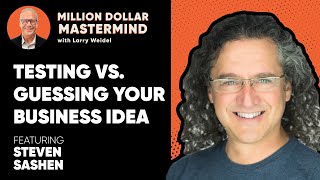
Stephen and Larry discuss testing business ideas cheaply through real ads and landing pages rather than guessing. They cover cash flow management, designing tests to disprove your assumptions, and setting explicit metrics like revenue per visitor. They also touch on AI for ads, exit planning, and how a liquidity event changed their lives.
Questions this video answers
December 2020
February 2020
widelonwinning.com
$70 million in income
Welcome to this edition of the Million Dollar Mastermind podcast. This is where we pick the brains of high achievers from all walks of life and get their hard earned real world insights on winning. I'm your host, Larry Wydell.
Now, would that be like with you and your wife from a business thing? Let's, let's just focus on the last couple of years.
Okay.
If possible, on a business standpoint, what do you think are the biggest things that you've learned? That you're grateful that you know no. Now that anything stick out from a business standpoint and how you run your business, how you think about things.
I. Well, this is going to sound stupid because it's just business 101, but cash flow is king. So my natural inclination is to just worry about money coming in, not the ratio of money coming into money going out and what that allows you to do. So now I pay more attention to that than I have in the past. That's one big thing. The other biggest thing, it's not that I've learned it, but I've. And I won't even say that I've mastered it, but I deploy it more often than I ever imagined. And that is people ask me for my opinion about things all the time.
Yeah.
I say, I don't give a shit what my opinion is. Let's test it and find out. Let's do a real test and see what the world says. What we're saying here, we could be in an echo chamber. We have no idea. And so it's something that I've actually tried to instill in every team that we have. And it's a hard one because people, frankly, are afraid of testing something in advance and finding out that they're wrong, which is ironic because it's less expensive to do that than put it out in the world and find out you were wrong. But what happens for many people when they put it out in the world and they find out they're wrong is they'll rewrite history and go, see, I knew that. It's like, no, you didn't. So we're also having people write down their predictions about certain things to see, not to, because we want to punish them if they're wrong, but just so we can help them learn what to do to minimize the risk of that moving forward.
Well, it's very helpful to get. Make them specific. Just like commit, what do you think it's going to be? And then let's test it.
And the testing, I mean, we were actually in a meeting earlier today with an advertising person who said, well, we can do a focus group on. I don't want a focus group. I'm going to test it in the real world. I'm going to run. So this is an ad that had like five different colors. We had arguments about the colors. I went, I don't give a shit what the colors are. Let's just do a thousand variations, put them all in Facebook and see which one people click on. Then we know. Why are we trying to guess what people are going to do? Let's put someone in an EEG helmet and watch their brain waves. Look at their galvanic skin response, which measures stress. Check their heart rate and do eye tracking to see if they're actually paying attention to this shit. It's like, why are we trying to guess when. When there are tools that let us figure it out. Look, Tim Ferriss's book, the four Hour Workweek. The way he came up with that title is he ran a bunch of AdWords ads with different titles as the headlines and he looked to see which one got the most clicks. That's how he decided on the title. I have another friend, a guy named Marlon Sanders. He's a very an OG copywriter and he used to send emails to his list saying, I'm working on, I'm looking to do one of 10 different ebooks. Which one do you think I should write? And he had already written the E book. It was just one ebook. He was just testing 10 different titles.
Yeah.
So find out what real people. When people ask me for advice because they're starting a business, I go find the cheapest and fastest way to see if people that you've never met will give you their money. In the old days, in direct response days, when the way people would pay, you'd have a full page ad in a magazine and the way people paid is they sent in a coupon with a check. Right. And so people would run a full page ad for a product that didn't exist yet, trying to see how much money the ad would pull. And if it didn't work as well, they'd either try the ad differently or and then make the product if the ad eventually pulled enough cash or they just scrap the whole thing and it only cost them a couple of grand instead of like committing to a whole development project. So you can do the same thing now in the Internet, even cheaper.
When you get with your teams, I'm sure you have to train them on how to do the testing. It's not something since they're Reluctant to do it. They're not thinking in terms of testing. So how do you get them going on the concept of testing and give them ideas to where, like, okay, we've got it now. We're off to the races.
It's a really good question right now. The answer is that I'm still the one who has to make sure that the test is designed correctly. It's a very hard one. And this is something that actually I've done in other contexts. I've done this with studies that people are doing about our shoes or about biomechanics or kinesiology or human performance. I've done this with studies that people were developing. I was a cognitive psych major when I was at Duke University, and. And I was doing a bunch of primary research. Oh, you learned how to.
Yeah, yeah. I was in green, I was in greens. I raised my family and did my first stage, my business in Greensboro.
Right down the road. Down the street.
Yeah.
A fine place. Well, so for whatever reason, I'm good at thinking of edge cases. So most people, what they do, they come up with an idea and they look for ways to prove that their idea is true. And when I'm like looking to test something, the question is, what can I check to prove if I'm wrong? I just want to see if I'm wrong. And so what do you design to do that? So weird. There's a upside down way of answering that question. Like, if I'm looking to hire a copywriter, I'll say to them, Okay, I want five headlines for an AdWords ad. I'm going to give you the first one. I need you to give me the other four. And the first one I'll give them is the greatest shoe I've ever worn. Now, if they don't come back with out of the next four, with at least one of them being something like, my wife says, don't wear these shoes or she'll divorce me. Something that is, like, completely counterintuitive. The exact opposite of what people are thinking. I'm just good at thinking of those weird things that people could do that you wouldn't expect. In part because I'm really good at figuring out loopholes and taking advantage of them. The computer that I'm using for this, I won as part of a massive multiplayer online trivia game when not only was I pretty good at winning in general, but then I figured out there were a couple rules that I could use to exploit them. And when I did that, I made 10 grand in a weekend. And and so then people figured out ways to exploit my exploits and fell apart. But I made 10 grand in a weekend, bought this computer, bought my wife an iPad, bought a bunch of stuff. So I'm good at thinking of these sort of alternate histories. And that's a very unusual skill set, even among professional researchers. It's just a quick aside. I met a guy who. He used to run what he called the consciousness lab, or he did a bunch of research on meditation at the National Institutes of Mental Health. And when I first met him, that was a world I had been involved in. I said, just as a test. I said, most of the meditation studies are horrible. And without missing a beat, he goes, oh, yeah, the controls are bad. And a lot of the methodology is just trying to prove that they were right instead of looking to see if they're right. And I went, oh, my God, I can be your friend. So. And he used to bring me into a class that he taught, a graduate class where all of his students had designed a testing methodology for something they were curious about and actually did the test. And I would come in and. And pick apart their methodology and what was really fun, because they were students and they were young, they were excited to learn. Oh, I didn't even think of that.
Right.
If it was their job, they'd be defensive and annoyed and. Right. Yeah, yeah, yeah.
So you think of a test. What's the best place? Where do you get your feedback? Where do you stick it out there in the public to where you get feedback? Does it take.
Depends on what we're testing. Social media or it depends on what we're testing. If we're testing an ad, you do it on the platform that you're running the ad. And. But the question becomes, what are you looking for? What are your goals? Some people, all they care about is does it generate more revenue, even if they lose money in the process. Some people, all they want to see is clicks because they have a boss who said, I need to see more clicks. And they go, okay, well, here's more clicks. Some people, you're looking at revenue per visitor, or you're looking at the average order value, or you're looking. I mean, there's a lot of things that you want to look at. So you need to start at the end about, what do I need to see? And then what platform am I doing this on? And what's the. What kind of content am I putting on that platform? Is it an ad? Is it a social post? Is it a. Whatever it could be? And then you just Gotta think about all the variables that might make a difference and within the platform, how to deploy those. So a company that I know, they had a tree stump and they put it on a Roomba just to have it spin around in a circle. And they put their product, they had like 20 different products, they put a different product on the top of the tree trunk and, or tree stump and they had a green screen so they could put in whatever background they wanted. And they tested like 5,000 variations of which product and what background. And out of all those, they found one that just crushed it in terms of sales. And then they spent like $5 million on that ad over the course of a year. So, but they knew they started with, all right, we need to be selling more of this product. So all we care about is selling more and we're not doing it at a discount. So it's like, so the ad has to perform and be enticing enough to get people to the website. And we're going to leave the website alone so that there's no variables there. Or if you can drive it to a landing page, you can change the landing page. So you need to just know what all the variables are and test them. Basically, I'm going to say one at a time, but I just mean one variable. So this is a stupid example. Like if you're testing the color of a button, you can test 50 different colors. That's one test. So you're testing 50 variables, but one thing, which is the button color. So you don't want to test the. I mean, now you can do massive multivariate split testing where you're testing like 50 different things at one time and there's a thousand variations of each of those 50 things. There's whatever that is, something factorial. There's millions and millions of combinations. But because there's so many combinations, you know that it's going to be stupid at first and then hopefully eventually start weeding out the stupid ones and then getting smart and then getting smart enough to fill the hole that you just dug being stupid, and then pile up enough on top of that to pay for that hole and then make the profit you need. I'll give you this one. Everyone is really gung ho about AI for advertising performance max on Google, Advantage plus and Facebook. And they say, well, that's going to be better than what you're doing because it's their AI. Well, no. So first things first. Again, in any sort of AI or, or machine learning AI, ML, AI, there's a learning phase and the question is, what's it learning on? So if it's learning on sales, actual transactions, and how many transactions does it need in what period of time to learn something? And then you've dug a hole of finance and time and the question is it going to again fill the hole and then pile on top of that hole and then give me what I need? It may optimize your ad, but its optimization might not be good enough. It might not give you the return on the ad spend that you need. So it's going to do the best it can do. But that might not be good enough. And people forget that part. They think, oh, AI is going to be smarter than me. And it'll be. It'll give me everything I need. No, it's going to do exactly what it's designed to do, which may not fit your goals. And FYI, when we're running ads on any of the meta platforms, we've been doing this so long that we know if we spend $50 on an ad and it doesn't make a sale, it's out. Yeah, our learning phase is $50 worth of spend because we know it'll never catch up. Now I'll give away this one. If we do have an ad that's crushing it, where it's making 50 sales a day, for example, then we can give that to the AI because the learning phase is one day and then we'll see can it outperform what we're doing or not?
No.
So cool. Anyway, play with that one.
For those of you who are sick and tired of fooling around and are dead serious about wanting to move up fast, I've got something especially for you. I've combined the best insights from over 40 years in business and making $70 million in income and compress them into a free webinar.
That's right.
It's a free resource. If you want to find out exactly what the concepts are that I use in coaching million dollar earners, Register now@widelonwinning.com you'll discover the five part framework used by so many to reach their financial, personal and professional professional goals. You can find that link in this episode's show Notes.
Talk about. I want to circle back to this. It seems like I'm following the same ground, but I really wanted to hear you elaborate a little bit more on what you tossed off as an obvious thing. The cash flow.
Cash flow.
And talk about how that clicked for you and how that you're using that now, how that affects the way you.
Well, it clicked for me, because I was beaten over the head with it by people saying, yeah, we don't have the money to do that right now because we just had to pay all these bills that we had to pay a year in advance for something. And so I just got told, yeah. And then simultaneously, if we had a product launch sale or a holiday sale, that crushed it. I knew that's when I was going to ask for money afterwards. So basically, I know there are certain times in my personal life, certain times where I can ask my wife a certain question, certain times where it's not a good time. So it's just the same thing. I've just learned to watch what's going on in the balance sheet to know when it's a good time to ask for more money and when it's a time to shut up about my 50th idea that day.
Yeah. All right. Now, personally, let me circle back to something you said about when your mother passed and you had a light bulb experience there about, let's think a little bit different about life. What kind of changes has that. Or have you implemented those yet? Well, down the road or.
I'm practicing, I'm getting better. Okay, so there are a couple of. I'll give you the first one.
Let me interrupt you for a minute. When I went through those stages in my life, I found when I was full bore and then it came in there like, you stay like this, you're gonna blow up or you're gonna have a heart attack or something like that. You've got to make changes. I would find that it would take me 18 months to shift gears, but I would shift gears.
No, that's probably not too far off for probably anyone, unless they're just going off the deep end and crazy shit. But. So we took a private equity investment back in December of 2020, and in De Risking Lane, and I took a little bit of money off the table and I called her a couple weeks after we'd done that. I said, I think the money is going to my head. She goes, why do you say that? I said, well, I'm in the grocery store and I just bought apples that are $3 a pound. So it's the most I'd ever spend per pound on an apple. Food is actually the biggest place where I've noticed the change. So we take our dog to doggy daycare twice a week because he has to burn off some steam and hang out with other dogs. There's a grocery store across the street that makes very good sushi. There's a sushi place across the street that makes better sushi, 50% more expensive. It's better, I just go get it. I don't look at what it costs. I know that's not true when there's stuff that's 25% off. I'll check and see if I think it went bad. I'm still looking for a deal. I mean, when my wife needed a new car, I negotiated the crap out of that because I love doing that. But for things like food, I just don't, I don't pay attention to the right side of the menu. But I also don't have exorbitant taste, so I'm not, I don't buy super expensive stuff. We don't drink wine, I don't eat steak. So it's all within reason. The biggest thing that I've done is when my wife and I are taking any sort of vacation, even if it's like a three day weekend, I let her book the hotel or the Airbnb and I don't ask what it cost. Yeah, that's the biggest one and the only other one I did. I, I've been, I've always, I've been an athlete my whole life, but I've gotten much more serious about lifting, for sprinting and for vanity, frankly in the last year. And I said, I think I need to upgrade my gym. And Lena said, well, here's how much money I spent on clothing this year, so you need to catch up. So I've said for years, anyone who says money can't buy happiness has never driven my cars. I don't buy expensive cars, but I buy cars that every time I look at them I go, God, that's beautiful. And every time I drive it I go, I love driving this car. And that's the way I'm kind of doing it. It's like I'm trying to see how much I think I'm really going to enjoy this based on some kind of experience. And if it's, and if it's really going to contribute to my happiness on a daily basis, I'll do it. And I'm not going to think about the money up to a point. There's a certain point where I'll go, I'll say to Lena, actually we bought some art for our house. I've never done that before, but we did that together. I found a piece that I loved and she's not crazy about it. I go, it'll go in my office. And she said, oh well then you didn't need my permission. I go, sure I did. It was $700. I wouldn't have spent $700 without telling you and getting you to be okay with it. But you know, this is a piece of art that I love. And so that's the. I'm basically starting to use. I'm doing two things, starting to use that as my kind of guide post of is this something that I'm really going to love? Love and it's not Maria Kondo I'm not throwing. I don't throw away stuff that doesn't spark joy because I don't really keep a lot of stuff. I don't collect things. But the other thing I'm doing is I'm thinking about the things that I won't be able to do in five or 10 years and I'm trying to prioritize them. I'm trying to look at anything where for whatever reason I might not be able to do it when I'm 72, 75, 80, whatever, and see if I can move that forward and find a way to do it.
Let's talk about that for a minute with you're a lifelong gymnast and track athlete off and on and talk about the advantages of that from your health as opposed to being in golf. Or you could do, you know, you haven't started your pickleball phase yet, but oh no.
So I've had two claims to fame in my life. The first is I'd never crocs. The second is I never played pickleball and I had to play pickleball a couple weeks ago.
I get it.
And so a jumbo ping pong mini tennis. It's interesting, it's easy to. I can see the appeal. It's easy to get pretty competent. And the intermittent reinforcement quotient is high. It's like, oh, if I'd only done that little thing. But the people who are serious, they are way too serious about it. I have no interest in that. So it was entertaining. But I can't give you an answer because I've never done those other things. This is all I've ever been interested in. I will say that.
So why should someone say, and you know, you see this on Instagram or YouTube, the 70 year old racers. Now some of them are out there, you know, they're all stiff and everything. But then you'll see some that are like striding out like they're 20 years old. And so what is the effect? What do you.
No, no, you got it upside down.
Okay.
So when I was at the World Masters Track and Field Championships. This was the one 15 years ago. I hung out with all the 80 plus people and I asked them all the same question. I said, nature or nurture? And every one of them had the same answer. They said it's genetics that I'm here at all. It's training that I'm beating that guy today. And so a lot of it I think is just luck of the draw. And I one of my things that I enjoy, I have a video on my 61st birthday. I didn't get to do it on my 62nd. I did a standing backflip on the ground and I've shown that to my multi time Olympic friends who were in their 30s and 40s and they all just went, screw you man. I said, no, now you got a goal baby, come on, catch up. So I enjoy it. I like that I'm doing well, I was gonna say I like that I'm doing these things because I enjoy doing them first and foremost.
Right.
But at the same time, I'm at an age now that I just transitioned into recently where the 30 year olds refer to me as an inspiration to which I flip them the bird, I go, I can be an inspiration when I'm over 70, not when I'm in my 60s. I'm still trying to beat you, so I know I won't. I'll Never beat a 35 year old. Yeah.
But the, the advantage of we'll talk about you are gone away from fitness, from running for 30 years and you came back.
Well, no. What. So yeah, what happened was so sprinter and gymnast and then only gymnast and then I blew out my knee tumbling when I was 32 and I spent the next 13 years looking for something that I enjoyed doing. I tried a lot of things. I was doing circus arts like Chinese pole and trapeze things which was fun. But I'm never going to be in the circus and that stuff's hard and very painful. I was a competitive jump roper. That was pretty fun. I don't know why I stopped doing that one, but there's a handful of things. In fact, I was still jumping rope when someone told me that there was a whole masters track and field circuit. And I just went, what? And that just seemed like the thing to do. So it's just kind of, I kept trying to find something and then here's where I landed so far. Yeah.
Because you already that with something that you had an affinity for earlier in your life.
And so sprinters are born, not made.
Is that right?
So absolutely There's a guy. Names fall out of my head now. Ralph Mann. He was a silver medalist in the 400 meter hurdles in Munich, if I'm remembering correctly. Biomechanical engineer. And he has a great book on sprinting. He says there's eight things that make a sprinter. Seven of them are genetic, and the eighth is how well you maximize your genetics. And it's totally true. I mean, if you want to find a good sprinter, you just find the kid who's the fastest in his fifth grade class.
Yeah, pretty. Pretty interesting. I just had another thought roll through my head from the pickleball thing. Pickleball is real big in these Lifetime gyms, like, around the country. And so in Palm Beach, I was in there, and I noticed up on the tv, there are your shoes.
We are a sponsor of Lifetime. So, yeah, here's the thing with pickleball. I just realized this. I'm an individual sport athlete. I don't like it when my winning or losing is dependent on other people. I mean, I'm okay if I have a direct competitor, but if there's other people on my team. And here's the fun thing about track and field. As a master's athlete, it's really stupid. I mean, we're working really hard for something that's very difficult with no real reward. Why are we this competitive? But we're all old enough to know that we're all this competitive, doing all these stupid things for no really good reason. So everyone I've ever met on the track, I completely adore. It's kind of like we have a secret hand. She's like, you're more on, too. Join the club. Let's have fun. And at the beginning of races, I mean, I'm five' five, 143 pounds. Okay. Other people show up, and they are way bigger, weigh everything, more than I am. And it's not uncommon. There'll be some big guy who looks at me as like, hey, have a good race, man. And I said, whoa, whoa, slow down. Get to the end. Stay healthy, have fun. There's no prize money. There's no rewards. No one's going to. You're not going to get laid because of this. And by the way, I totally want to kick your ass. So we're old enough that we can enjoy just the. The fun and the silliness of this whole thing.
Yeah, they say that it's always great to have an exit plan, and it's hard for entrepreneurs to think about in terms of exit plans, especially if you're Enjoying what you're doing and you're consumed by it.
But I call those people idiots. Seriously, if you don't have an exit plan from the day you start, it's going to be problematic. Now, that doesn't mean you can execute. Look, to be candid, we tried selling this company in February of 2020, and if you remember correctly, someone got the flu or something around then, and everything got a little wacky. And so, you know, I know what I'm good at. I know what I'm not good at. We knew what our financial goals were as well, and so we were very clear about what our plan was. But as I say about any sort of business acquisition, beauty is or valuation is in the eye of the beholder of the checkbook. I can want to sell as much as I want, but if there's not somebody on the other end with a checkbook, it doesn't matter what I want. And people have been moving the goalposts on us every year for like a dozen years when we were at a million. Call us when you're at 5. When we're at 5. Call us when you're at 10. When we're 10. Call us when you're at 20. When we're 20. I mean, every year it kept moving and still has. So we're not constantly for sale. People say, hey, I'm looking to buy a business like yours. Are you for sale? I go, no, unless the price is right. And they go, oh, well, then what's the right price? I go, well, first of all, do you really want to do business with someone stupid enough to answer that question? I would never give you the first number. Secondly, I'm going to give you the same answer the Supreme Court gave in the 1980s when they were asked to define porn. I'll know it when I see it.
Yeah.
So if you want to make me an offer, I'll give you all the info you need. You can make me an offer. Otherwise, we're running this company on parallel paths that at some point somebody might make us an offer, and at some point, nobody will make us an offer because we don't have control over that. So we're going to keep going, but we want to be ready in case someone does show up. We want to be able to show them this is a valuable and viable and rare opportunity that you're going to want to take advantage of.
Absolutely. And what did you learn? There was a. Try to remember nine years. I mean, you've had big success before, and you had a period of Time before you started this that you were, you were out, it seemed like, yeah, we were retired.
Yeah.
What was that like?
Awesome. How awesome?
How old were you when you retired?
Well, from 2000 to 2009, so 38 to 48. And we had done some very clever real estate investing with a partner by 2006. When my last friend said, hey, I'm getting into real estate, we called our partner and went, start selling everything now, by the way, I don't know why this is still the motion we use for a phone to be. Anyway, I didn't do this one at least. So, yeah, it was great. I mean, for both Lena and me, we just pursued things that we found interesting and the bar was raised very high for people would call. It's like, well, if you spend an extra two hours a day doing this, you can make an extra ten grand a month. I went, I don't need ten grand a month. And no, we weren't living on a lot of money. It was just enough that we didn't have to work.
Yeah.
And we lived again pretty modestly. So. But the decision to do that took five seconds. It was like, oh, we could either do this and still be having to get a job or we could live comfortably and not have to work. And it's like, that's how long that took. So I, you know, many people say, if you're going to exit, you have to know what you're going to do next. Not my experience. I mean, things showed up and things that we didn't expect showed up. And that's what I imagine would happen at some point in the future if someone ever buys us out.
Yeah. Well, fantastic. I appreciate the time. I was really excited. But you had the time to get back on again. Because I knew it would be a wild ride.
I do what I can.
Also, I'm looking forward to seeing the new crop of shoes and congratulations on all the progress and all the good you're doing.
Well, thanks. That's very kind.
I always like to give my guests the last word. And so what would you say is maybe we haven't covered yet. That you want to give us a parting thought for entrepreneurs, leaders that people are.
Oh, I probably said this the last time because this is what I always say if someone asks me about advice for entrepreneurs other than test your idea as quickly and cheaply as possible, is get a government job with a pension. Because I'm at an age where I have friends who are retiring with. From their government jobs with pensions and they don't even know how to spend all the money. My brother in law is about to do the same thing and it's like, holy crap, man, that's going to be a hell of a lifestyle. Because if my suggesting that you could do something where you might find a job that you find satisfying, where you get benefits and vacations and insurance, that'd be really cool. Because look, if you are a real entrepreneur, there's nothing I could say that would talk you out of your statistically stupid idea anyway. So just the only thing I would say is know that the only thing you control is risk. And if you use that as your kind of mantra and be constantly looking for what could go wrong. I'm a total optimist. But at the same time I'm always looking for what could go wrong because that's the part that sneaks up behind you if you're not paying attention. And you can pay attention to that more. You can learn to be on the lookout for what your competition's doing. What's happening in the macroeconomic world. If tariffs get raised on us, that could put us out of business. We're very well aware of that. So what are we going to do? You got to anyway, so get a government job with a pension unless you know you have no choice.
All right, thanks so much, Stephen and say hello to Lena for us. And look forward to. I gotta come by sometime when I'm in Broomfield.
Absolutely. Look forward to it.
Have a great Halloween the rest of the evening.
Thanks. Be well. Take care.
Take care. Thank you for listening to the final part of this episode of the Million Dollar Mastermind podcast. Great ideas, don't care who use them.
If you're motivated to move up in a big way.
Right now, I've created a free training video to remove the mystery on how.
To set yourself up for big success. This is the information that has changed so many of our lives and it can have the same impact on you. And the video is completely free. You'll find it at YD Bell on winning dot com.
Join us over there and thanks for being part of our community.
More from Larry









Rick Jordan on Self-Engineered Proximity, Cyber Security Moats, and Truth-Based Leadership

Fire Fast or Fail Slow: Kevin Brittingham Reveals the One Rule That Built a $100M Empire
