What Seth Godin Learned After 900 Rejections
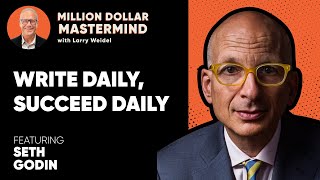
Seth Godin talks about getting roughly 900 publishing rejections and what that taught him about writing and serving readers. He explains his approach to daily writing discipline, story-driven persuasion, and choosing the right format for your work.
Questions this video answers
October 22nd.
Welcome to this edition of the Million Dollar Mastermind podcast. This is where we pick the brains of high achievers from all walks of life and get their hard earned real world insights on winning. I'm your host, Larry Wydell. Hello, everybody. We're talking with Seth Godin. Is that correct, Seth?
It is if you want it to be. I'm glad to be here, Larry.
Or go din. And anyway, Seth, I bought my first Seth book, I don't know, 15 years ago, 20 years ago. I didn't have time to go and see the oldest one, but I did show him on my Kindle the scroll of books that I have from him over the years. So what a chance I've looked at the face you see in front of you has been in his books. And on there it's like he confronts you with those glasses of that stare and challenges you to look at the world from a fresh point of view. And so I'm curious where that came from and curious what informs all that. But so we're going to have some fun because, Seth, you have 20, you know, out of the, the Bible says out of the abundance of the heart, the mouth speaketh. And I think it's out of the abundance of the heart and the brain, the writers speak. And you have what, over 20 bestsellers? I looked at different websites that has different amounts from 21 to 20 to 27 to 29. But anyway, in 39 translated into 39 different languages. Is that approximately correct?
Well, this month is the 38th anniversary of my first book. I'm not that old. I don't know how that happened. And the 25th anniversary of permission marketing. The thing about the book business is there's not often a connection between how good your book is and how many copies you sell. Selling a bunch of books might be the result of being in the right place at the right time or the effort you put into getting it to people. So what I keep track of is did a book I wrote bring an idea to someone who didn't even read the book is when I run into somebody who said, blah, blah, blah, purple cow, blah, blah, blah, and I say, oh, did you like my book? And they said, there's a book. That's how I know I accomplished something. Because what we're trying to do is teach. And I'm not trying to corner the market or sell more books. I'm trying to help people ask better questions.
Absolutely. And what that triggers in me is the idea that we all have to be the ones that are talking strongest to ourselves. And that information better be accurate. And so if you're not sure of something, ask a question and get sure about it so that you can proceed with confidence. You can stand on some concrete, or at least it's concrete to you. And so how did you learn the importance of that?
So? Well, you know, I think all learning is self learning. All motivation is self motivation. I grew up with Zig Ziglar. Zig and I spent a lot of time together in the car. And the tapes didn't change, but I did. And understanding that we can feed ourselves on purpose ideas that we can then make our own inspired me. It got me through some very tough kids and inspired me to contribute in that way.
How did you get into find yourself in the situation where you were spending time in the car with Zig Ziglar?
I was spending time in the car with Zig Ziglar in my driveway. Larry. I worked from home. I had no employees. When I got there 18th no of the morning, I would go outside, get into my old Miata, put the engine on, and then listen to Zig for another half hour. Because it was that or give up. I was introduced to Zig by my dad. He listened to some pretty wacky people. But Zig caught on with me. I was lucky enough to publish one of his books, share a stage with him, and work with him toward the end of his life. But his stories and me learning how to deal with the stinking thinking, give myself that checkup from the neck up, it taught me that I could teach myself things.
What led you to the point where you said, I need a fresh approach to how I'm thinking? What led you to the point to where you realized the way I'm thinking is not working for me. I need some fresh insight, and therefore I can. Cause it's a big thing to get up in the morning and do get out and go. I mean, that's a commitment. And there has to be need, drives, effort, right? And so where did that need come from?
Well, I would say the people who are listening to this podcast already have it. That's why they're listening to this podcast. Other people who are complacent aren't. You know, my new book, this is Strategy, is about four things. And one of those things is empathy, which is realizing that we can't force other people to agree with us. We can't force other people to think we're right. And I was a book packager. I got so my first book the first day, and then I got 900 rejection letters in a row.
Could you repeat that, Seth? I want to make sure we hear.
That, yeah, 900 times someone in book publishing bought a stamp 900 letter and mailed me a letter that said, we read your proposal. We don't like it.
James Patterson, when he started writing, he brags about the fact that he got like 39 publishing houses turned him down. And then the one that accepted it then became the book of the year. But I mean, you're in a league of your own for rejection. Congratulations.
Thank you. Yeah, I worked hard at that. What I realized is I was writing books to show how clever I was. I was writing books to prove I was right and met a guy named John Boswell. Boswell and I worked on a proposal together. And he explained to me that it didn't matter if a reader was going to like it if I couldn't get an editor to like it first, because if the editor didn't like, wasn't going to get to the reader. And understanding that an editor has a different agenda, a different way of seeing the world, a different set of priorities than me or the reader helped me understand if you can't get through the door to the end goal, there is no end goal. And I learned how to make books that they wanted to buy. And that was a very big transition. I ended up selling a book a month for 10 years after that as a book packager, worked with Jay Levinson. I did the Stanley Kaplan test prep books and things like that because I understood the genre that what we do when we bring an idea to people is we are there to be of service. We are not there to get them to realize we are right.
And so, and we're talking nonfiction.
There was a series of 30 novels that I did for young adults. I discovered that my Cousin, who was 13, had never read a book for fun in his life. He was just playing Nintendo games all the time. So I got the rights to Nintendo games and turned them into novels. And we sold about a million of those because people at Scholastic had a problem, which is kids like my cousin weren't reading books. They needed to solve that problem. I had a scarce resource, the rights to these books. I had a stable full of writers who could make one of these books in about six days. And we did 10 or 12 books for Scholastic. Then I did another series with Walter Dean Myers for kids who are left out of traditional young adult fiction. People of color, immigrants, people who weren't the typical blond haired kid in a Sweet Valley High book. And it was just one of the privileges in my life to be able to bring Walter's ideas to people. So yeah, I did a little fiction, but fiction is, it's trickier because you don't have a foundation of truth to lean against. You have to invent your own. And I find that thrilling. I'm just not prepared to do enough work to be good at it.
Yeah, well, if you've got a stable of writers, you can turn it over to that. That takes a lot of the stress out of it. I'd like to get to that. But let me ask you this. How far on your journey of 900 rejections were you when you heard from. Was it John Boswell who told you, let's go at it from another angle? How far in that 900 were you when you were talking 900? You were at the 900?
Yeah, I mean, just to be clear, just to be clear, I write every single word of all of my books. I haven't had a stable of writers in 20 years. I just want to say that out loud.
Okay? Now, has it always been that way or was that just for the fiction or where you had the stable of writers or. Yeah, yeah, that was for fiction. Yeah. And so, well, you were asking questions. What I'd like to point out to you and congratulate you on is something you did incredibly right, was you were still asking questions and still knocking on doors. You were operating off the assumption. I heard this idea early in my career. Thank goodness I'm here today because of certain phrases and certain concepts that I heard somebody had the decency to tell me early in my career. But one of them was that great ideas don't care who have them, they don't care who use them. And if you can get a great idea that you see somebody else using, you could do this. You can use the same idea and have similar or even greater success. So now you're operating under the assumption. I don't know if you were just. There was no other career options for you. So I've heard of single minded people, but this kind of defied. There's one actor in Hollywood right now, I forget, he's one of the guys who's in the superhero movies and everything. I can't mark somebody. But anyway, he went on like 850 auditions before he made his breakthrough and now he's making $20 million a picture. But that's about the only one I've heard that's knocked on as many doors as you. And so you're knocking on doors, but you're Asking questions, how did you find John? And what you know to narrow it down to where you're still digging for answers.
Okay, so it's something a lot of people listen to this are in sales. And I think it's important to understand that the job of the people I was pitching books to was to have people pitch books to them. I was not hustling people or hassling people. I saw that they had a problem. They have to acquire books. If people like me don't show up, they don't have any books to acquire. And what happened is the rejections kept getting better. They kept getting more encouraging. They kept. Because it wasn't 900 different people, same people often would reject me. But they say, oh, now you're starting to. This is closer to what we can deal with. And so it's like somebody who's lost. If you're just as lost an hour into it, you're never going to get yourself found. But as you're slowly finding your way through the map, you're learning something. And so the idea that I came up with that ended up breaking the cycle was to take Cliff Notes and rewrite them and put them all in one book. So a kid should get 30 cliff notes for the price of two. And it's a great idea. But one of the people I worked with said, there's someone who can make this idea better. You should call John, because John was someone you might call a competitor. But I don't believe I have competitors. I believe I have colleagues I haven't met yet. And so John heard my idea and he said, yeah, I'll take half of it and I'll make it better. And he did. And three different people wanted to publish it. Because he knew what it needed to rhyme with. People don't want to buy something they've never bought before. They want to buy something that's a lot like the thing they already are pleased to be buying.
For those of you who are sick and tired of fooling around and are dead serious about wanting to move up fast, I've got something especially for you. I've combined the best insights from over 40 years in business and making $70 million in income and compressed them into a free webinar. That's right, it's a free resource. If you want to find out exactly what the concepts are that I use in coaching million dollar earners, Register now@wydellonwinning.com you'll discover the five part framework used by so many to reach their financial, personal and professional goals. You can find that link in this episode's show notes. Now, how did you develop your. And I'm sure you won't take offense to this because I think it's part of the reason for your success is you have a unique take on a lot of the things going on in life, in business and people, humanity with the tribes. And you're kind of this outside observer and. And you have it come at a different angle. Where does that come from, do you think? Or what gives you that? It's like you're sitting in a different place than everybody else is sitting from. And you, you like see something and you speak to it. Everybody goes, oh yeah, that's it, that's it. So where does that come from?
Well, first, it's hard for me to imagine taking offense at that. That's my job.
Yeah.
And I wasn't born with it. It's just a choice. Anyone can do it.
And so how did you develop it yourself? Did you say, like when I'm writing, if I'm going to write a lot of books, I've got to have something unique or distinctive or useful to say. And is that, did this come from your knowledge of what these editors were looking for inside the company or something? Are. Are. No, this has nothing for what.
It has nothing to do with writing books. I only write books because I have no choice. It has to do with being an engineer and a game designer. That what I write about in this strategy is that a game is any situation with players, rules and outcomes. And so getting on a plane when there's a storm from Atlanta to JFK is a game because you can decide to switch airports, you can decide to rent a car, you can decide to find 10 other people in charter or something, you can decide to get on a train. These are moves that you can make in a game. So if you think about the games that are all around us, you realize that there are strategies available that other people aren't using. And that's what I do. I notice that I've been doing that since I was 12, but I chose to do that because I can't dunk a basketball and I can't beat someone in an arm wrestling match and I'm too lazy to out study them. But what I am willing to do is lean into the liminal space of what happens if this strategy gets used instead. And because I'm a teacher, once I see a strategy that could be used, I try to tell other people about it.
Now when you say you're a teacher, talk about that where did that come from? I mean, were you a teacher before you started writing books?
Oh, yeah, for decades before I started writing books. I think being a teacher is also a choice. It says the most generous thing for me to do is share my strategy, not hoard my strategy. And great salespeople, in my experience are teachers that if a salesperson shows up and says, I gotta remember this brokerage firm came to me and said, you have to sign an NDA. We have a secret way for you to make money and not pay taxes. And I said to them, number one, I'm not signing an NDA because if it's a secret, there's probably something wrong with it. And number two, I like paying taxes. So no. And it turns out that like dozens of the people who did sign the NDA went to jail because if someone's hoarding things and not teaching, then they're afraid of something. But if you see something and can generously outline to other people a better way for the game to be played, you earn trust and the world gets better because other people are doing things better.
When in your career growing up did you discover I'm not going to be able to dunk a basketball? I'm not. Was that a goal? Was athletics success a goal growing up?
I think almost everyone we know can carries middle school around with them. I don't know if you do. I hope you don't, but you probably do. Middle school is a horrible place filled with horrible people. And what happens in middle school is challenges of status and affiliation. Mostly status, but the affiliation of who's sitting at the lunch table with you, who are you better than? What's the hierarchy and status and affiliation stick with us for the rest of our lives. And it was pretty clear to me in seventh grade that what was commonly allocated in status was not going to come my way because I did not have a head start in the traditional measures of status among 12 year olds. And if you talk to a lot of successful people who became successful as adults, they had the similar experience that if you're easily popular when you're 12, it's easy to get stuck in being easily popular going forward, but if you're not, then you're might be spending time looking for a different game to be played with different people.
And how did this dawn on you? How clear was this? That was there an experience that came along that crystallized this? Because it sounds like a detached view of I'm watching Seth go through middle school and things are not clicking here. He's not. And so he needs to think other ways. So how did you get this detached you boy? Was that an adult input or friends or.
No, I think that, I think a lot of us carry around middle school trauma. I don't think my middle school trauma is any worse than most people's. And if you're not going to internalize it and make it part of yourself, then you have to look at it from a distance because I'm not 12 anymore. So I can see that 12 year old kid. It's not me, it's that 12 year old kid. The other thing I talk about a lot in the strategy book is time. And like you and I are both present in this moment. Tomorrow this will be a memory. Yesterday it's something we were looking forward to, but we're still us. So our strategy needs to say I am here today. Where do I hope to be in the future and who am I taking with me when I go? And too often people in business get hung up on making their quota or closing the sale or winning and I just don't. I'm not comfortable with winning because the infinite game is about playing. It's not about winning. The goal isn't to end the game. So keep playing the game, you know.
And so I won't go there. But anyway, I, you and I are on the same page. And the idea is that I tell people I was never going to be a professional athlete due to my lack of speed and lack of height. Although I played all sports, I was never going, never. I never got a nibble in terms of a college scholarship, but I was a big hero in high school. And the way you do that, Seth, is you go to very small schools. You always get to start because there's nobody else around. But the thing is, the one thing I learned is that winning is better than losing. I like the taste of coming out on top, trying something and then have it turn out right rather than getting egg on your, your face. And it's better to be accepted if you submit a book offer then turn down 900 times. But you know that the way you went through that is very instructive. And I've never thought about it, but in my learning how to sell early in my sales career, I went through a similar process where you're not making sales but you're getting more and more positive feedback. People would say not for me, but I can really tell you're going to be great at this. I'm thinking that's really not going to help me buy groceries for my wife. Wife and kids that are at home. But anyway, thank you. And so it does. You're smart to pay attention to those signals on the way up. Either you're getting those or you know, you're getting. It's like in anything, you're getting closer, you're getting further away. And as you came up, one thing I, I hear, I'll just say I hear from you. Even in middle school, you had an attitude inside you that I want to accomplish something some way, somehow. I don't want to be the guy ignored over the wallflower over in the lunchroom in middle school and go through life in my parents basement and nobody knows I live. I want to be somebody that accomplishes something positive in society where, you know and you get those good feelings from impacting in a positive way. Somehow you came up the ladder with that. And was that, did you have a big family or family of accomplishment from your parents or sometimes people say they're hard workers or something, you know.
Yeah, I definitely won the parent lottery. I'm not sure it pays to go into it because we don't get to pick our parents. I'm really pleased that I ended up with who I ended up with. The question that's more interesting to me is now what are you going to do?
Right?
And now what are you going to do in a world where everyone has a microphone, everyone has a camera, everyone has the ability to connect with anybody else out of 3 billion people on the planet. We live in a world where since I was born, we have invented 7 billion jobs. And the question is, what will we do with these tools, this leverage, this privilege? And it's super easy to get stuck on. I didn't have parents like Seth or to get stuck on. I grew up with the wrong middle school or whatever. Yeah, that happened. But now what are you going to do about it? The magic of this moment in time is even though the media tries to make us distraught and to believe that there's no opportunity left, there's more change happening right now than has ever happened in the history of the world. And for me to be able to sit with Claude AI, have a conversation with a trillion dollar artificial intelligence device for $20 a month, knows how to understand and write and has read every book ever written, like, how dare we go back to watching Netflix. What an opportunity to find a new way to make things better.
And the point that's not going to happen if you are feeling sorry for yourself or you feel like you don't have a disadvantage. But what you find Seth Is where I would take issue with is like, if you won the parent lottery, big damn deal. Because there's millions, hundreds of millions of people who won the parent lottery and turned into drug addict losers. Narcissistic. So, like, where did this come from? And so the thing is, that's just because you have the parents and you have, on the other hand, people who came up with nothing. All the parents were killed or they were one of the amazing guys, and I don't comment on these guys much, but a guy like a LeBron James in basketball who's never been picked up drunk anywhere, out with other women, any kind of rumor of anything. He's raised a. And his father was in jail, his parents were drug addicts, this, that and the other. And he's got all the pressure of this athletic ability, which is enough to crumble anybody. Lynn Bias, elected in Maryland. He was the number one draft pick by the Boston Celtics. And he celebrated by going and overdosing on cocaine. He never made it through the night. There are people like the LeBron James, which I don't agree with everything he does, but I mean, they're just heroic and somehow they rise above. And so what people need to realize there's enough things going for you out there, tools where you don't need. As you know, people have done this in the past without all these advantages, and now the kind of things, it seems like you have a compulsion to wake people up to possibilities. Would that be fair to say?
Yes.
And part of that, how does that transformation come from people? How do you ignite that? And what do you find works because you write books? And then you have people respond back to you like, thank you for doing this. Thank you for doing that. I was going in that direction and I heard this. What have you distilled from that feedback of putting out transformative type ideas over your career? And then hear people come back to you who have gone through those transformations. What comes to you as kind of trigger points? And I'm sure it's different with everybody, but are there things that come up more often than not and things that we could learn from and use? Because in a leadership position, you're always trying to help people through these situations. You're always asked for your advice and there are people that are looking for answers. And the more you can kind of zero in on the thing that'll probably trigger the positive turnaround, the better. And so have you noticed anything from the feedback you've gotten from your books?
So what you're talking about is pedagogy Pedagogy is the science of learning, learning about how people learn. And I have discovered two things. One, I've never met anybody who says, I read all the graphs and charts and tables and you have proven your point. I have changed my mind. People change their approach because they read a story, because they internalize a story. The second thing is the single best way to get people to take action is not for them to come to the conclusion they were wrong. It's for them to come to the conclusion that they were right all along. They were just doing it wrong. So not trying to change where someone seeks to go, but turning on lights to help them get there. And those two things, a story that turns on lights and helps people get to what they've always wanted. That's my pedagogy. That is what I do over and over again.
So give me an example of how you've done that in a recent book or in recent books or your current book.
So there are plenty of people who want certain metrics of conventional success. More sales, more income, more profit, more revenue. And they're surrounded by people who are hustling or spamming or just manipulating folks. And if I can tell them a story of how someone earned permission, built an email asset, was able to contact those people over time and take them on a journey, and then the outcome of that is the business did really well. Someone doesn't have to say, oh, I want my business to do well. Yeah, because they've already said that, right? Saying, oh, that's the express lane. I'm going to get out of this bumper to bumper traffic, following all the bottom feeders and I'm going to do this other thing. It might be hard, but yeah, I see the journey now.
Yeah, well, you have backed your way into why I do this podcast, tapping in the stories of the people. Because everybody's story is different. It's like, how do you put a rock band together? Unless it's a boy band or a girl band and there's a machine or rock. How you come up with a rock band and you use. They're all amazingly unique, different stories, but they're informative because you may not be able to copy the whole thing, but you can copy steps and you might be stuck at the same point this band was stuck at at certain points along the way and their idea may not resonate with you, but it may trigger an idea or an alternate approach that you hadn't thought of yet. And so that's really what I try and do on Here is what I found is that if there's a. One of the shortcuts to success is being around people that have had more success than you have in life and, and just being exposed to them and listening and seeing like greatness is caught and not taught. You're around it, it can kind of get in your head and it's like, oh, yeah. But it's. If you go to them and say you're wrong on this, they're not going to listen to you. But if they hear something over there, they can tell themselves, I was wrong on that, or, I need to look at this a different way and this is more to my advantage. I wasn't thinking, I wasn't thinking about it that way. And I've. I've had many of my friends that were more successful than me 30 years ago, and they did things that I knew they did them. I couldn't get myself to do what they did. Now, 30 years later, they explained to me what their thinking was. And I said, I wish I'd known that because I would have probably doubled off, double timed what you were doing, because I could see why it would pay off for me. But the stories wake up the emotion and allow people to things, changes to happen, molecular changes to happen that would not happen. And then when they do, people are able to slide more into where their mind and body wants to be. They're able to go through this difficult adjustment, like, okay, now I can do it. I'm comfortable with it. How do you slide in? You made a statement. I write books because I have to. All right. And I'm sure it's. You get like the book you just wrote, your most recent book, is it out now or is there one that's just out or it's just coming.
So this podcast will be dropping in October and that's when it comes out, October 22nd.
Okay. How long have you had that concept in your mind that this, I need to write a book on this? And how did you go about that coming up to priority status in your life, in your thinking? Talk about that, if you don't mind.
Well, the big transition for me was going from writing books for a living, which I did years and years ago, to writing books when I felt like there was a tool that other people needed and I wanted to offer to them. So I used to look at the world and say, where's the next book? Where's their book? And now sometimes the world shows up and says, here's a book. You have to bring it to people. And that's different. What often happens is I just write every single day. My blog is. I haven't missed a day in 8,000 days. And sometimes I just keep writing. And if that happens, I'm trying to talk myself into making it a blog post because that makes life much easier. But if I can't, now, it's a book.
Now. Jerry Seinfeld's advice to comedians is, write every day. And of course they say, you're kidding. He says, no, I still write every day. He said, take out a calendar and write. And every day that you write, draw a red line through and never have an interruption in the red line. And that's what you've done for 9,000 days. In terms of writing blogs now and you writing every word yourself, it's not going through.
I don't. This is. You're looking at my entire team. It's just me.
It's nice to meet the team. And when you sit down to write, people have this question. I paint, and it's a similar type thing. It's like every day I do photography and I paint in addition to other things. But it's just like every day, it's like, get out a pen and put a mark down and get started. Go. And then see what comes out. And so when you sit down, what do you do?
So I worked with Isaac Asimov at the end of his career. It was the beginning of my career. Isaac published 400 books. And I said to him, how do you do that? How do you publish 400 books? And he took me over to this manual typewriter, and he said, every morning I sit down at this typewriter at 6:30 and I type. It doesn't have to be good or I have to type. And after a few minutes, the part of my brain that can't tolerate bad writing starts forcing good writing to slip in. And writer's block is a myth. There's no such thing. And the way I know that is if I say to you, show me your bad writing, people say, well, I don't have any. Well, that's what you really have then.
You have a block.
Because you don't want to do any bad writing, Go do some bad writing and bring it back to me. You do enough bad writing, the good writing will happen. So for me, I know there's going to be a blog post tomorrow, not because it's my best post ever, but because it's Saturday. And so I go to bed knowing that there's going to be writing.
Now, why did you choose? When the videos Come on the scene. When we started, we had to write because that was. That was our only option. And before video came along, I could do video interviews. I did conference calls.
That was the only.
Because there was no zoom. And also there was no cell phones. So you had to get people at certain times around phones and have your conference calls. And that was how you ran organizations. But when you videos come along, they need the video conference and tech comes into our lives. Now I'm sure you've had people come, Seth, you've got to do a video thing. Whether blog you've got just get in front and read your thing and put it on YouTube. It'll have much bigger exposure. I'm sure you've had people come to you and try and twist your arm to shift over to a video rather than just writing a blog every day like blogs are old. Seth, why are you doing that? Let's use the new technology. And so I'm sure you get lectured and urge those kind of urges, except in your world they may not want to mess with you, but how does or you keep your staff of one before you keep those voices out. But how have you stayed true to your original premise there? And why did you stay true to that purpose?
Well, I think you need as a creator of any kind to pick your media. And so I saw Twitter early and I decided I could be mediocrely pretty good at Twitter, but if I did that, I'd have to do less of something else. And I didn't want to be a wandering generality. I have dozens of videos on YouTube. I pioneered online education with video and there's stuff on Udemy. And I built the alt MBA into thousands and thousands of students. So when I pick a new medium, I lean into it for what I think it's good at. But I don't work for TikTok and I don't work for YouTube. I'm not an unpaid employee. My job is not to feed their algorithm the way they want me to feed it. My job is not to show up because they need content. My job is to bring messages to people in a format where I think they're going to work and help people get to where they want to go. And choosing what to say no to is at least as important as choosing what to say yes to.
In fact, that's a concept that was stated I read 20 or 30 years ago. They said the value of an executive is the ability to say no. Because when you're in a leadership position, everyone's bringing you all these Ideas. And it's a matter of do you have the financial or personnel resources to execute? And we know the good is the enemy of the best. And so if you're just chasing good ideas, the best never gets done. And you've been smart enough to realize you only have 24 hours in a day. Let me tell you a story. When I started in management and I had to do training, I was in Atlanta, Georgia, and Fred Herman, who wrote all of the. He had retired, and he wrote all of the training for the Dale Carnegie courses. He was the guy. And he had retired, and he was. Somehow I found out about him up in Rome, Georgia. So I called him, went up and sat in his backyard, now that I remember. No, I don't think he offered me anything to drink because I don't think he wanted us to stay long. But he was very, very kind. And he told me a story. The one thing I remember by the story, he said when he was like in the 1920s or 30s and his name was up there and popular, the radio stick came to him and they said, we'll give you $100,000 a year. Back when $100,000 was a lot of money, and we'll give you $100,000 A year for five minutes, five minutes a day. And he said, no. And they said they were staggered. He said, why five minutes? 100 grand. He said, well, he said, some days I only have five good minutes, and I'm sure not going to give them to you.
Brilliant. Speaking of minutes, we have to wrap this up. Larry, though I would stay all day if I could. I appreciate the time that you put in, showing up episode after episode after episode. I hope that your listeners appreciate how much work it is.
Well, I appreciate you taking the time, and I know your schedule is insanely packed with a lot of powerful things. Let me ask you one last thing, if I might, before you go. How do you keep yourself? Where does your input come from? Does it come from reading people that you talk with regularly in terms of staying up with the trends of what's happening out there? What do you and what do you advise as the best use of time for people that are busy but need to stay fresh and informed and have fresh perspectives? What would you say to that?
I would say you should get off Facebook, LinkedIn and Twitter. You should subscribe to 50 blogs. They're free. You should read blogs like Boing Boing or blogs like Every, which is about AI. You should read consistent and persistent, generous voices that talk about things you don't know about. And if you see something you don't understand, stop what you're doing until you understand how it could be that if there's people, there's 200 people waiting in line to buy an 80t shirt at the Supreme Store. Don't just walk by, say, why are all these people in line to buy an $80 T shirt? Develop a theory that too much of our time is spent accepting what a crowd is telling us as opposed to making assertions about what is possible. And that's a habit. And because I don't watch much TV or do social media or go to meetings, I have seven hours every day that most people don't have. I got time to do the kind of thing you're talking about.
Thank you very much, Seth. It's been a pleasure. Hopefully we'll be able to do this again, and I can't wait for the new book to be out. See you later. Goodbye.
Looking forward.
Thank you for listening to this episode of the Million Dollar Mastermind podcast. Commit to your personal and professional evolution without our free training video. It's designed not just as an educational session, but as a transformative journey for those bold enough to aim for the stars. This isn't just any webinar. It's a roadmap to achieving the extraordinary. It's tailored for those who dare to dream big. And yes, it is completely free. Join us in a network of ambitious professionals than rather ready to take their careers to a new height. Secure your spot now@whitelonwinning.com and let's unlock your potential together. Thanks for being part of this community.
More from Larry









Rick Jordan on Self-Engineered Proximity, Cyber Security Moats, and Truth-Based Leadership

Fire Fast or Fail Slow: Kevin Brittingham Reveals the One Rule That Built a $100M Empire
