Why 80% of High Achievers Burn Out and How Sebastien Page Avoided It
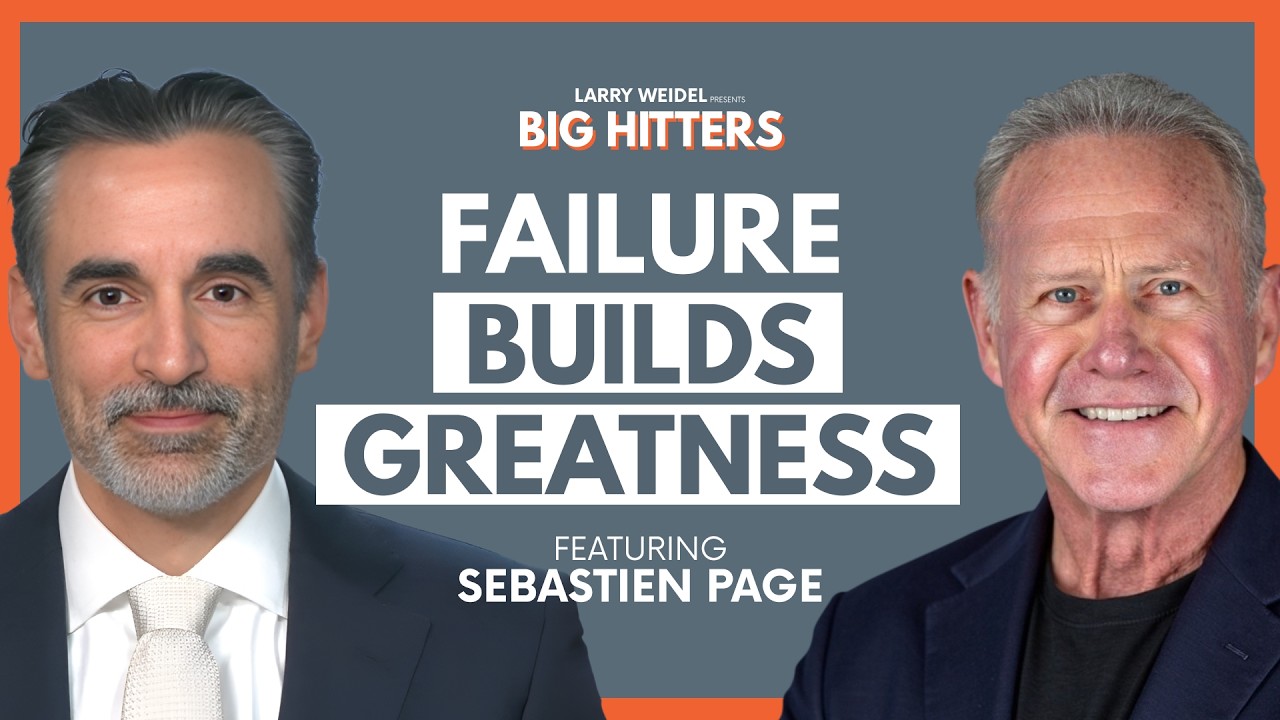
In this episode of the Big Hitters podcast, host Larry Weidel interviews Sebastian Page, a veteran money‑manager, researcher, and author of The Psychology of Leadership. The conversation moves from Page’s impressive finance résumé—multiple award‑winning research papers, growing T. Rowe Price’s multi‑asset AUM, and his recent book—to his personal journey confronting stress and burnout. Page explains how he turned to sports and positive psychology after realizing he was “stressed about being stressed,” discovering that resilience stems from learning to lose, not just winning. He shares the concept of “goal‑induced blindness,” illustrated by his own near‑death hospital stay and Simone Biles’s Olympic withdrawal, showing how hyper‑focus on career goals can eclipse health. The dialogue explores feedback methods, contrasting Tom Landry’s shift from highlighting mistakes to showcasing highlights, and discusses the importance of distinguishing luck from skill, emphasizing process over outcomes. Page reflects on his evolving superpower—from communication to listening—as a leader, and how perfectionism in preparation can backfire. He uses analogies from sports (Federer’s point‑percentage, Everest climbing, stop‑loss decisions) to illustrate decision‑making under uncertainty and the need to know when to quit. The episode concludes with leadership takeaways: long‑term vision, setting goals, leading by example, and simple advice—work hard and be nice—while promoting his book and Substack.
Chapters
We all love to win, but if you don't learn to lose, you're gonna struggle. So Federer said, the best in the world are not the best in the world because they never lose. In fact, they lose repeatedly, but they've learned to deal with it.
Welcome to Big Hitters. I'm Larry Weidel, and this show is for people who are done playing small. Each week we break down what it actually takes to win at a high level, the decisions, the discipline, the adjustments that separate those who almost do it from those who do it. No theory, no fluff, just straight talk from someone who spent 50 years building winners. If you're serious about momentum, you're in the right place. Let's get into it. Hello everyone, we are talking to Sebastian Page. Hello Sebastian.
Hey Larry, I'm fired up for this. I've been looking forward to it.
Well, tell me why.
Because I love talking to interesting people like you, and I've listened to a few of your prior shows and Super interesting stuff.
Gee, I mean, I'm, I'm, I'm even more fired up than, than I started here. Thanks for the nice words. And yeah, I just got off a call. It's amazing in the world where there's the bulk of people are looking to get by and survive. And when they get around high achievers, they want to drag them down. Then when you get around people like yourself, and you can talk on the same level from an energy standpoint, not a matter of necessarily intelligence or anything, but just drive and fun and expectation and that attitude of abundance and looking to explore the world and find the treasures out there. It's, it's a different kind of mentality. And it is fun to have friends like that. And it's one of the highlights of my life to be able to, be able to talk to people like yourself, but especially you, because Larry Weidel, introduce yourself. I mean, you know, I've got a little bit of experience in financial services, so these numbers mean more to me than other people, but global. We look for people that have numbers by their names, you know, that, 'cause you know, people can relate to achievements, you know, who have been able to do things, accomplish things most people have not been able to do. And to be able to say, Uh, the global multi-asset trading platform market reached $4.8 billion in 2024. It's projected to grow to $13.2 billion by 2033. And, you know, the fact that you grew T. Rowe Price multi-assets, uh, under assets under management, or which we call AUM, from, uh, $200 billion to over $500 billion, that had to be, you know, The experiences, the worlds, the groups of people, the probably countries or something involved in that. It's quite an experience. And I'm really excited about being able to tap into the things that you saw, you learned, you realized from those situations in terms of particularly about Fundamentals of Winning. How you set yourself up for success. Because the, the, the great thing about principles of, of success is that they're very similar for companies, you know, individuals, companies, countries. And you see, when you see things going right, it's exciting. But when you see things going wrong, it just drives you nuts. And so you've had a chance to see real-world experience. So let me point out another— I'm doing too much talking here, but I want to be— people know you won awards. What impressed me was you won awards for papers in the top journals. 4 from Portfolio Management in 2003, 2010, 2011, and '22. 2 from Financial Analyst Journal, uh, 2010, 2014. You've written a book, 2020. But then you go out there and you've applied the knowledge applied that and seen incredible success from that, which almost nobody, when they get into writing, actually goes out and applies it. You know, that's the thing about the media. They're not accountable for their stuff. But you got out there and put these ideas and this thinking and these point of views that you've come up with to the test and got amazing results. So congratulations.
Thank you, Larry Weidel. 25 years in the rough and tumble world of money management.. And here we are. You pointed out I've won research paper awards. I am a research nerd. I've studied markets from a mathematical perspective. So what am I doing here talking about leadership and psychology? At some point a few years ago, Larry, I was stressed at work and I realized that I was also stressed about being stressed. That was not good. I kept telling myself, you've been doing this for decades. Why are you not calmer? Why are you not handling the pressure better? I started exploring sports psychology, self-improvement, and I just got into, as a nerd, a rabbit hole, if you will, of all the research in positive psychology. It's amazing, Larry. We think of psychology. As treating clinical depression and anxiety.
Right, right, right.
About half the research published in psychology for years, if not decades, is on the positive side. What makes people resilient? What makes people thrive? So I ended up writing the book The Psychology of Leadership that launched last year. And so I'm not a psychologist. I'm someone who Works in money management and got interested in self-improvement and wrote the book to improve myself and to help others.
Yeah. And the thing is that explain to people like, how did you, let, let's go like behind the scenes and go back before the 25 years. How did you get on that track right from the beginning? And what, how did your, you know, your worldview, how did that get started, you know, your approach to things and the way you looked at things and things that interested you, you know?
Yeah. So how do I end up being a research nerd in money management? Well, first of all, my father was a finance professor. Now I wanna say he never pushed me towards business or finance, but he had a lot of passion and he would invite his friends, other academics for dinner. And I would be there, 13, 14, no idea what they're talking about, but it sounds super interesting. So you could say finance is in my DNA, but also I'm gonna be really honest. I was young looking at career paths and it was interesting. I was interested in making money, you know, and that's a good way if you can manage risk well to do well in life. Now if you look at surveys, Larry Weidel, people, when they are asked what's your goal in life, 80% of respondents say, I wanna be rich, and 50% say, I wanna be famous. What I've discovered though, over time, is that these aren't really, these are great goals to have, but they're not the fundamental goals you should have. You should have broader goals that are geared towards positive psychology.
Yeah. And basically related to things that, uh, excite you or interest you that you can pour your, your energy into and get good enough to be able to make the, uh, the money and have the financial independence. But you're You remind me of a point that I spent the bulk of my life, and even now today, in a financial services company organization. And the thing is that it was started by an ex-football coach, and he was very successful as a football coach. And he would go in and he talked about having faculty meetings in the high school and all the The teachers, the English, the math teachers, they would say, "The whole school's delirious with joy about your football team and excited, but all they wanna talk about is the next game and the winning streak and all that." And he said, "We just can't get 'em excited about English or math." And he said, "That's because you don't make it exciting." And people get, you can't go in there and do a boring, presentation and approach it just like trying to teach all the concepts. And you got to get them excited about the concepts. And it sounds like inadvertently your father and his friends got you excited about finance at an early stage, inadvertently, just by their own enthusiasm and you being around. It actually turned out to be a privilege.
And you know what? It's important to understand the meaning of what you do. And what we do in money management is work really hard to give people better financial futures. It's not like we're not curing cancers, but I go every day, I try to make money for clients that need to pay bills, send their kids to college, build better retirements for themselves. It's a meaningful job. Larry, the analogy I like to use is the famous analogy of the three bricklayers. Have you heard that one, Larry?
Let me, let me hear it.
Okay, so an architect walks to 3 bricklayers. They're doing the exact same job. He asked the first bricklayer, what are you doing? And the bricklayer says, I'm laying bricks. It's hot outside. I'm tired. I hate it. Architect walks to the second bricklayer. Second bricklayer says, I'm a wall builder. I'm building this wall. And that bricklayer has a little bit more energy, to your point about having energy and enthusiasm for what you do. Then he walks to the third bricklayer who is fired up, who says, I am a cathedral builder. I'm building this out— amazing cathedral, an ode to the Almighty. The three of them are doing the exact same job. They're just approaching it differently.
Absolutely. And it's, it's how you view what you're doing cannot help but impact the energy and enthusiasm you put into it. I mean, you know, it starts at the beginning. And if you're in a company That's probably one of the bigger things when you got into leadership. That was probably something you covered in your leader leadership book, that a job, the, the leader has got to be able to project that vision and that excitement about what the company's all about on a high level to the people working there if it's going to be an outstanding company.
It also makes you more resilient. You're going to be more long-term focused if you have in mind the meaning behind what you do. You know, Larry, you said earlier it's about winning, and winning is awesome, but when you start studying sports psychology and top athletes, you'll realize that sports psychologists are actually obsessed not with winning. It's not about winning, it's about losing. It's about what you do when you lose. How you learn from your setbacks. I love what Roger Federer said to the students at Dartmouth in a famous commencement address. It's all over the internet for our audience if you've never heard that speech. At one point he said, look, I was a top tennis player, maybe of all time. I don't think he put it that way, but he said, I've played 1,500 matches and I've won 80% of them. But then he asked the students, What percentage of the points that I've played do you think I won?
Right.
And that's a bit of a trick question because Federer lost almost half the points he ever played. He only had a small edge, 54%. He won 54% of the points he played, but it's what he said next that's super important. And again, you can be obsessed with winning. That's okay. We all love to win. But if you don't learn to lose, you're going to struggle. So Federer said, the best in the world are not the best in the world because they never lose. In fact, they lose repeatedly, but they've learned to deal with it. And then he looked at the students and he said, what you have to do in your life is adapt and grow. And if you're only going to learn to adapt and grow by losing, losing, getting it wrong in financial markets, losing in sports, just facing setbacks. I know it sounds a little bit trite and somewhat motivational, but there's a lot of science behind this, and it's a mindset that surprisingly few people have. You can take it to an extreme. I was talking to a sports psychologist once, Larry Weidel, and you tell me if you think that way. He actually cherishes his losses. So that sports psychologist, his name is Dr. Daniel Zimmer. He lives in Maryland where I am, and he's also a pro athlete. He's got over 40— 4-0— national titles in the sport of handball. This is where you whack the ball with your hands. Okay, so he's one of the top players for his age group in the, in the country. And for him, when he loses a game, He gets excited. This, this is the mindset pushed to an extreme. It's not realistic, really, but I'm, I'm telling you about this extreme vision of sports psychology, which by the way, could also be life psychology, that you've lost something in your life. Something did not go your way. It's an opportunity. It's hard to put in practice, to be, to be honest. It's hard to do.
Well, Nick Saban, the— I don't know if he's still, you know, the winningest coach in football, at least at Alabama, when all their championships and all that, top football, college football coach said, when you get beat, he said, don't lose the lesson. You know, it's one thing to get beat, but you don't want to get double beat by missing the point of how you got beat. And, you know, the most famous example of that is when they started the expansion in the NFL. And the Dallas Cowboys became an expansion team and they brought in Tom Landry, who was a defensive coach for the New York Giants who had won championships. And he went down there in the first 2 years. I think they were like 1-17, I think something like that. Or maybe the first year, like 1 game, 17 losses. And he said, and then they went on and for the next 17, 18 years they had not only winning records, but they made the playoffs and did very well. But they said, wasn't it depressing for you to be during that first year where you kept getting, you know, you went from the Giants where you won all the time, then you went down there and you got beat all the time. But during that first year, had to be depressing. He said, not really. He said, what we did was, and this is in line with what you're saying, he said, we started off the season with a game plan to win. And then we played the first game and then we went in and then the other team taught us a lesson. We found out We found out what we didn't know. So we went back and fixed it, made a new game plan. We went back and then we played the next team and then they taught us some lessons. Then we went back and took those lessons and improved. And he said, by the end of the, he said, by the second year, we were the ones teaching lessons because they had learned the lessons. You know, they just, they didn't just get beat, They got beat and they learned the lessons and adjusted. So what I would, the only thing I would add on to what you said earlier is, you know, you take the lesson, you realize and you accept it, but then you improve. You know, it's the idea is like what that clearly shows you is your blind spot. Usually it reveals a blind spot that you would have plugged, put something in place where they didn't get you, but because you didn't, It got you. And so it's like, okay, we're going to plug that hole. And so what— this is a transformation, Sebastian, of how you go from starting something and you're terrible at it to where years down the road people say, Sebastian, what a genius that Sebastian is. And, you know, they don't realize Sebastian became a genius by making a million mistakes and learning from them. You know what I'm saying? And so it's— I'm sure people right now today just— I'm sure you hear that quite frequently, you know, like, you know, how, how smart you are, you know, you know, they're just jealous. But you had to go through quite a process to learn that, I would imagine.
And I see it in business. We're talking about sports. The leaders that are able to learn from their failures end up performing better over time. I've seen leaders get really harsh feedback, take it on, improve themselves, and keep climbing the ladder. So it's not just sports, it's a complete mindset. Again, it sounds easier in theory than in practice. We also have to be careful. It's interesting about Tom Landry, cuz I read about this dynasty of the Dallas Cowboys in the '70s as well. It's been studied in different areas. Of psychology. This idea that you learn from your setbacks has to be very personal, and you have to self-build, build the skills for yourself. You know, in sports we give a lot of feedback and we receive a lot of feedback. In business it's the same, but people hate feedback. Here's an interesting anecdote about Tom Landry and the Dallas Cowboys. Earlier in this dynasty, He was showing players their mistakes in the video room. Have you heard that story, Larry?
I think I have, yes.
So he's showing them their mistakes, and he realized at some point that the negative feedback was not working.
Right.
He realized that the players were rehearsing their mistakes. It was making them anxious, and essentially their mental image was stuck on their mistakes. So he flipped it to the highlights, not the lowlights. And then in the video room, he would show, here's the best play you made, and here's what went right. And that worked much, much better in terms of learning the feedback process. So here I am saying something a little bit different, right? I'm saying you have to learn from your losses and your setbacks, but The caveat, or the other side of it, is when it gets to feedback, whether in the workplace or in sports or in other ways, positive feedback is actually underestimated compared to negative feedback. So there's nuance here, and I think it's interesting to explore that a little bit.
Well, and the thing is, that's, that's the, uh, intrigue of leadership and how you're able to apply those principles in, you know, in operation while the bullets are flying, you know. And the thing is that, you know, you hear the thing of catch them doing something right. You know, when you catch them doing something right and you notice that in particular. And the thing about resilience of like you and I kind of talk, we're both nerds and studying behavior and everything is like the thing about resilience. What I think— interesting your opinion of this— why I think some people are more resilient than others, the people that are not resilient, take the defeat and it's crushed. It's like, oh, you know, and they go into the spiral of either I'm not good enough, you know, self-flagellation, you know, I should have done this, I'm not good. Or they go in victimhood. The world's against me. Yeah, this doesn't happen to other people. When am I going to get a break? You know, like that. Who's ever heard of, you know, it's like the story of the guy I used to live up in Greensboro, North Carolina for about 28 years. And one Friday at 5 o'clock, a small plane came out of the sky and had an engine failure or something and crashed into this car on their way home from work. And the, the guy they were interviewing, the guy who was in the car, and he said, Ben, you're really lucky you only got a broken arm. And, you know, the plane came out of the sky and you You know, most people would think you'd get killed. And he said, lucky? You call that luck? He said, there's 100,000 cars in this town and it hit me.
Two ways. Two ways to look at the same situation.
Right. But I think what makes the resilient person resilient is they don't get hung up on poor pitiful me or I'm not good enough. They look at that and said, Why did that happen? And then what adjustment can I make? And they're, they're resilient because they want to bounce back, because that's what resilience is, a bounce-back ability. But they're, they're focusing on their ability to bounce back. And I think that's the advantage, Sebastian, of making sure people that are in training, in process, in development are well aware that they do have strengths, you know, 'cause they're very aware of their negative things. But to be able to give them that positive feedback where they, when things go wrong, it's not like everything's wrong. It's just like, I'm doing a lot of things right, but I still got beat here. Okay, let me fix that. And so I think that attitude of how you respond to the defeat is actually at the root of how resilient people are. But then you see a, described as grit, determination, toughness, or whatever. I think that's the— I think that's right where the, the, the point is that how they look at what happened to them and what they're thinking about, what the response is gonna be like, what are they gonna do next? By the way, if you're still listening right now, you're different. You don't just consume content, you're actively looking for an edge. And that's who I built the Big Hitter community looking for. Not people chasing motivation, people chasing momentum. Not theory, proximity. Proximity to operators who are actually in the arena making real decisions and winning at a high level. Inside Big Hitter, you get conversations we don't have in the podcast, direct access to people who build what you're trying to build in a room that holds you to a higher standard every single week. This isn't a hype group. It's not networking for the sake of networking. Where serious people go to sharpen their thinking and compress their timeline. If you're done just listening and you're ready to be in the room where it actually happens, head to joinbighitters.com or click the link in the show notes. The right room changes everything. I'll see you inside.
Well, well said. Also, I'll give you a trick to learn from your losses. Learn to separate between luck and skill. Here's the thing. When things go our way, we tend to think we're good, right? And in sports, the athlete doesn't really control everything about the performance. They don't control their opponent, the weather, the ref. In money management, we don't control what the markets are going to do. So did we win or lose because of luck? Or because of skill and developing the ability to look back and say, okay, I just got unlucky, or okay, I could have prepared better. I didn't follow my process. Differentiating between the two is super important. And we all have as human beings a tendency when things go well to think we're good, when things go badly to think we're unlucky. One of my mentors once told me there are only two types of investors, those who are talented and those who are unlucky. But that does not work if you want to learn from your setbacks. The best example I can give for this is really simple, Larry. Let's say you and I go out to dinner and we are having such a great time that we decide to drink a little too much wine. I make the decision to drive home. Bad decision. I make it home safely. Good outcome. I should in no way conclude that driving home after drinking too much wine was a good decision, right?
Right, right.
So it was a bad decision with a good outcome. I should know the difference. However, let's say you take an Uber, right? And the Uber crashes, right? That's a bad outcome, but you actually made the right decision. So when things go your way or they don't go your way, did you follow your process? Did you— was it luck? Was it skill? And from there you can learn a lot. You know, there's a concept of mastery in sports psychology. You really care about getting better at what you do, at your process. You should care even more than you care about the outcome.
Well, that's why— and that's why you hear people like that, that win all the time, more often than not emphasize process. You know, that's what Saban is talk about like, stay, you know, stay in your groove. You know, that's why Belichick, you know, Bill Belichick was like, do your job, you know, keep your mind on what you're supposed to do. You stay in your lane and the outcome will take care of itself. Dean Smith, who was the great basketball coach at North Carolina, was the same way. You know, he said, don't care about the ones and losses. You got to stay in your routine, you know, stay in your pattern, stay in your rhythm. And let's talk about you real quick. What did you do right growing up? What set— what did you have going for you as strengths coming out of high school, moving into college, moving into the business world? What kind of personal strengths did you have that set you on a winning track?
At some point, I realized that maybe my superpower was communication because I was a nerd and I was starting my career. But I had this ability to simplify complicated concepts for clients and customers. That propelled me in my career. However, last few years, Larry, as I've climbed the ladder, I've realized for high top-level leadership, it's the opposite. The skill you need is listening, not talking. How good are you at listening? And we were talking about resilience and setbacks. Are you confident enough as a leader to look your team in the eye and say, I got it wrong, or say, I don't know? It's very counterintuitive how top-level leadership works. If you are good at listening, that becomes the superpower cuz you end up making wiser decisions. If you listen to your team, because at those levels you got people who are smarter than you working for you.
Well, let's talk about that process. When did you realize and how did you realize that you were good at communication?
Early, I think. And I don't know if I was born with it. I cared about it a lot. I would get anxious before making presentations in school. And this level of activation or stress was actually good for me. There's research that shows that you don't wanna be too stressed 'cause you're gonna burn out, but up to a point, stress increases your performance. So I would use it, that fuel, to prepare and to be on, to have my mind focused on the task of making a clear presentation. There's no specific moment, Larry Weidel, but I would say my first presentation in the industry, I rehearsed in my room, I was nervous. There's about 300 people in the room. I was on a panel. I was in my early 20s. The people sitting next to me were big hitters, you know, big hitters. And, uh, I was very intimidated. But you know what? When it came to my turn to speak, I got in a state of flow and I was on. And when the ratings came back, cuz oftentimes you make presentations at industry events and people collect feedback and ratings. It was my first one. I got the highest score and I was so happy and I realized I have something here I can use to further my career.
Let's unpack that. How did you prepare yourself going in? You did not know how you're gonna do. There was plenty of intimidation factors there. How did you get yourself up and going in that? What did you, what did you say to yourself? Because, you know, it's one of my things that I tell people is, that your most important coach is yourself. And the most important time to coach yourself correctly is in the early days. You know, you want to be telling yourself the right things. And what did you do? How did you collect yourself and get yourself to get up there and, and knock it out of the park like that?
I'll tell you the basic answer that is going to sound obvious, but then I'll give you the other side. So the basic answer is I knew my stuff. I rehearsed. I rehearsed how I wanted to deliver it, how I wanted it to sound. And again, because I was a bit anxious about it, that motivated me to prepare. So that's the obvious stuff. You want to give a good presentation, be ready, and be mindful of how you're going to sound on stage. So rehearse. But This actually backfired ultimately in my career because I have to do live national television talking about our investment views. It's high pressure, Larry. You don't know what they're gonna ask. They're gonna challenge your thinking. All your colleagues are gonna watch. All your competitors are gonna watch. It's nerve-wracking, right? So I would over-prepare. There is a problem with perfectionism and over-preparing. And then I would have a tendency to freeze or just try to go to where I wanted to go because I'd prepare for that.
Yo.
So now I've actually scaled back my perfectionism with respect to presentations or broadcast media. I'd rather not over-rehearse, over-prepare. To be clear though, you got to know your stuff.
Gotta know your stuff.
You gotta know your stuff, but you gotta let go of perfectionism in a lot of settings, including when you don't really know where it's going to go.
What was your next— you know, you come out, you get in, you know, in the business, you take on responsibility. Where was the next biggest challenge in your career and your professional growth that you, you came into? This is going to be tough. This is, I wasn't expecting this. You know, I took everything I had to kind of overcome this. If I, if I ask this, what comes to your mind?
The great financial crisis was pretty hard to go through if you're in money management for anybody in our industry. But to me it was a lot of ups and downs and learning, you know, okay, I'm starting to show that I can communicate well. There's demands on my time. I'm in demand. I feel important. I get phone calls from salespeople saying, we need you in Japan within 24 hours, right? So the next challenge, Larry, was not to fall into goal-induced blindness. Goal-induced blindness is a concept I define in my book, The Psychology of Leadership. This is when you're so focused on your goal that you lose sight of anything that's non-goal related. So in my case, my goal was career success, and non-directly goal related was my own health. I was working nonstop, traveling nonstop. I was exhausted. I ended up getting a mysterious infection and spending a week in the hospital. I'm convinced because I wasn't sleeping enough. And I almost died at the end of the week. The doctor said, look, uh, if we didn't have these antibiotics, which are pretty new, you probably wouldn't have made it. I didn't have any lasting damage from this, but it was a near-death experience in about year 4 or 5 of my career. And that's when I had to step back and say, okay, I'm gonna be successful, but I gotta also take care of myself, get enough sleep, and try to get on track where my performance at work can be sustainable. Goal-induced blindness is, I think, underestimated for a lot of high achievers. I'll just tell you one more thing, Larry, about this. Simone Biles famously walked out of the Tokyo Olympics. You remember that? 2021?
Absolutely.
She was overtrained. She was overworked. She was suffering from anxiety. And she wasn't— she was losing the sense of where she was in the air. They called the twisties, I guess, in gymnastics. And she was criticized a little bit for walking out for mental health reasons. And by the way, no way do I equate myself, my performance to Simone Biles. I just like to use it as an example. What she did next, she was tweeting, so she was pretty public about it. She adjusted her training to be more reasonable. She took time off. She would tweet, "Hey, I slept well last night." She would tweet, "Hey, I went to church today. I went to, you know, I watched Netflix and on a Sunday. So when I talk about this, I like to say Simone Biles became a better gymnast by watching Netflix on Sundays because then she came back in 2023 and won 3 gold medals, 1 silver, and became the most decorated gymnast of all time. Simone Biles was suffering from goal-induced blindness, took care of it. Became a better gymnast by watching Netflix on Sundays. That was the next challenge for me, Larry. I started my career. I was on a rocket ship. Things were going well, but I had a serious case of goal-induced blindness that I had to learn to deal with.
Well, and that, you know, the thing about that is we all have to find our own limits. But you don't need to go through life afraid of burnout, afraid of this, afraid of that, because most people are going to fail because they never lock in on a goal and go for it, you know, and you're no matter what you get in, if you're going to be great at it, you're going to have some sleepless nights and you're going to have times when you're going around the clock. The deal is just be aware. You know what I like? This, this is, is like a trap to be aware of. And if you like, no one probably ever told you that was something to have on your radar screen. That probably was never mentioned to you.
No, that's like I think, Larry, you're so right to put the caveat there that, hey, you gotta work hard, you gotta give maximum effort, you gotta want it, you gotta make sacrifices. It's important to say that. I like to use the Mount Everest climbers as an analogy because Mount Everest is actually documented in the literature about the side effects of goals. If you wanna climb Everest, If you want to reach the summit, you have a 4% chance of dying. That might not sound like a lot to a lot of people, but I don't know that I would do it with a 4% chance of dying. It's extremely difficult. It's an extreme effort, and you got to have the mindset to put up an extreme effort to reach the summit of Everest. There is someone, Larry Weidel, who has over 30 summits. The world record, last time I checked, was about 33. What does he do better than others? He knows when to quit. He's an expert at quitting. He knows exactly when the limit is, and that's the time to turn back. Now, to be clear, a lot of deaths on Everest are actually unpredictable, and you don't know how your body is going to react to the altitude. But generally speaking, you combine what you just described as the mindset of, I'm going to give an extreme effort because I want an extreme outcome, and I'm going to do it. With what in money management would call a stop loss. You know exactly, and you can pre-commit to this. Annie Duke, who's a great author on decision-making under uncertainty, has written a book titled Quit, and she explains how all of us, especially business leaders, we're not good at it. We're not good at knowing when to quit. So using the Everest analogy, know exactly when to abandon the summit. When you see the clouds forming above.
As we wrap up this public portion of the, our conversation, can you explain to people what you've seen about the similarities inside running big companies, big organizations with big impact, that huge responsibility? You have all these people, the, all these assets are looking to you, got a lot of responsibility, but at the center. That's what I notice about your, your, your background, your resume. It's like all of the success, but at the center you have core concepts and you have a handful of people, you know, pulling the levers and operating these things. You know, they have to have the right operating principle. You have to have the right people, but they go through the same decision-making process and everything. In running the big companies and the investing and the, you know, planning for the future and meeting the challenges, you know, like, you know, like, like the pressures was on Simone Miles because of her success. The pressure was— has been on you on these calls because everyone knows, you know, your success and they put such value on it. And so the same thing at the company level. Do you see that? How does it describe how that tension and how that anxiety plays out at the, the top boardrooms or decision C-suites there at the big companies.
Right. If you're the New England Patriots and you don't make it to the Super Bowl, it's a bad season, right? Even though it was an awesome season, it's just the expectations were so high. I like to say sometimes that happiness equals reality minus your expectations. And so if you look at that equation, you can say, oh, maybe I should lower my expectations and then I'll be positively surprised in life. Now, to your broader question about how you manage attention, the high pressure in business decision-making, it's not that dissimilar from sports. You have to keep your long-term goals in mind and not get bent out of shape with short-term setbacks. The top leaders— I explain this in the book, The Psychology of Leadership— think longer term than everybody else. Who else is gonna develop the long-term vision for your team, for your organization, if not you? That's your job as the leader. And by the way, everybody listening today, you're all leaders. You don't have to have people reporting to you in an organization. Your family's looking up to you. You're leading by example. Your community, you're leading by example. We're all leaders in different ways in our lives, and the responsibility of the leaders is to set the goals, think longer term than everybody else, and then develop the mindset of doing meaningful work and having this contagious attitude towards the work that brings people along. In a nutshell, that's it, Larry. That was a kind of a tough question because it was so general, but that's how I would put it.
Yeah, well, you did an excellent job of answering it. And I've— this has been so much fun for me. I've really enjoyed this. Sebastian, I think we, I think we've hit it off very well. And I got tremendous respect for your accomplishments. And when we get into, you know, a little later, I want to get into your book and the leadership principles and some of that stuff and get into the short-term versus long-term conversation. But to wrap up this portion, and folks, as you know, we have— this is the— my big sponsor for the podcast is the Big Hitter Group. And so you, if you like these kind of conversations, you want to be a part of a group where you're talking about winning all the time. Welcome to the wonderful world of winning. We need more winners. We need more people doing it big. And that's why it's so exciting to talk to Sebastian, where you can pick up missing pieces of the puzzle, maybe in how your approach and your skill set or your attitude that can help make you incredibly more effective. And that's what we do with Big Hitters. So if You like this stuff, you want to find more out about it, visit us at joinbighitters.com. So as we're sailing away, I'd like to give you the final word for people about approaching this thing with the right competitive attitude, the right leadership attitude, and also mention your book one more time. Are your books.
Thank you, Larry. The book is The Psychology of Leadership. You can find Sebastian Page at Substack is where I'm putting up new stories every week nowadays.
Okay. Now, when you, when you talk with new people, you know, you speak or young people come up to you and they're asking what is the number one thing they need to focus on to move forward, to get you know, the biggest boost in their career, what are you telling them?
Work hard. Be nice.
Work hard and be nice. All right. Tremendous advice. Thanks so much, Sebastian. This has been so much fun. Thank you.
Thank you.
That's it for this episode. If this resonated with you, do me a favor. Share it with someone who's ready to level up. Winners find winners, and the right conversation at the right time can change everything. Want to go deeper? Join us inside the Big Hitter community at joinbighitters.com. That's where the real work happens. And if you haven't already, subscribe so you don't miss the next one. Remember that you're either growing or dying, and there's no standing still. Keep winning, and I'll see you next week.
More from Larry









Rick Jordan on Self-Engineered Proximity, Cyber Security Moats, and Truth-Based Leadership

Fire Fast or Fail Slow: Kevin Brittingham Reveals the One Rule That Built a $100M Empire
