Why 90% of Leaders Fail and How Mick Hunt Built Without a Safety Net
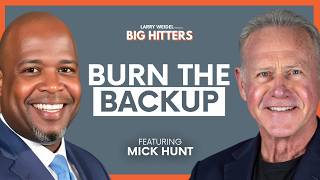
In this episode of the Big Hitters podcast, host Larry Weidel interviews entrepreneur Mick Hunt about the personal and strategic forces that propelled him from a traumatic childhood to building and exiting multi‑million‑dollar insurance businesses. Hunt explains how a promise to protect his mother at age ten forged early emotional‑intelligence skills that later became the foundation of his "Plan A" mindset – a single‑track focus that rejects backup plans and insists on making the primary plan work. He describes his competitive drive, the decision to gain control through entrepreneurship, and the mentorship that taught him to sell relationships, dominate a niche (restaurant insurance), and scale rapidly (building a $16‑17 M agency in three years, then growing a $50 M acquisition to $70 M in four years). Hunt shares concrete frameworks: decision‑tree visualisation, back‑casting milestones, and daily handwritten reflection on wins and lessons. He discusses his book, How to Be a Good Leader When You Never Had One, which codifies leadership principles for people lacking role models, and the role of high‑level mentors (Daymond John, Les Brown, Robert Irvine, Chris Voss). The conversation ends with actionable advice – invest in yourself, clarify your "why", visualize wins, and stay relentlessly prepared – aimed at listeners who want to move from small‑scale effort to high‑impact leadership.
Chapters
All my eggs were in plan A. Plan B was make sure plan A works. Plan C is, Mick, get off your butt and make sure plan A works. Plan D was, you can't do anything but plan A, so go make sure plan A happens. So I'm always wired since birth to the main thing is the main thing. And I might learn lessons. I'm not gonna say I fail. I might learn lessons But Plan A is always gonna be my, my MO. I'm always focused on Plan A. I don't give myself outs. I don't give myself, hey, if this doesn't work, you can go do this over here. I don't think that way. I don't prepare that way. And honestly, I, I'm never going to.
Welcome to Big Hitters. I'm Larry Weidel, and this show is for people who are done playing small. Each week we break down what it actually takes to win at a high level. The decisions, the discipline, the adjustments that separate those who almost do it from those who do it. No theory, no fluff, just straight talk from someone who spent 50 years building winners. If you're serious about momentum, you're in the right place. Let's get into it. Hello everybody. We're talking with Mick Hunt today. Get ready to, uh, Here's some great insight. And so, Mick, congratulations on what you've been doing and your book, your podcast, and all of the outreach you have in so many areas. So great to have you on.
Larry, I'm honored to have you on, and it's great to be in your presence again, man.
Well, you're too kind. So talk about now, You had a chance. You said— I'm seeing in here, hopefully they'll edit my stumbling out of here, Joe. But I saw a thing about a childhood promise that, that kind of got you triggered off. I don't— that kind of threw me because it's like, wait a minute, I don't remember ever hearing of a childhood promise early on. So what, what was that? How did that trigger, you know, the kind of life you've had?
Man, Larry, and I can almost replay this day in my, my head every single day. Imagine being 10 years old, Christmas time, actually Christmas Eve, and waking up to tears streaming down your face, except the tears aren't yours. They're your mom. They're the tears of your mother. And I knew exactly what those tears represented. Um, Larry, for the first 10 years of my life, It was not uncommon for me to visually witness my mom being physically abused, to see her being emotionally and financially abused, and sometimes even sexually abused by my father who lived in the same household, who was her husband. At 10 years old, I couldn't make that norm, but this day, hearing the wailing of my mom, I knew that I was going to have to do something. I hadn't seen my mom smile in a long time. I hadn't seen her laugh in a long time. I didn't see joy in her eyes anymore. And I said, at that point, I was gonna do something to change her life. At 10 years old, could I physically do something to my father? No, I'm not naive, right? But what I learned at an early age is what today we would call emotional intelligence. I learned the triggers that my father had. I got to understand what a bad day was going to look like. And so when I could sense those things, instead of him lashing out on my mom, I would just make him lash out on me. So I purposely would get in trouble, but what I was doing was saving my mom's life and saving my sister's life. And so that was the promise that I made at 10. At that day forward, I said, I'm gonna do my part to make sure this doesn't happen to you again. And so, I made a promise, and every day I live that promise to make sure that my mom can have the life that she deserves, and so can my sister and brother. Wow.
And this has turned into a global mission that has transformed companies, careers, and cultures across multiple industries. It might have something to do with the fact of your title of your book, even, How to Be a Good Leader When You Never Had One. So the thread kind of runs all the way through. Talk about what you were interested in. I mean, how much did it dominate your thinking, the trying to maintain peace in the home versus you're a young man growing up and want to get out and experience the world? And how did You know, how did that work out? You know, how much were you pursuing things you were interested in versus, you know, having the problem at home? I know my, my wife had an alcoholic husband, I mean, father. And, you know, she was the one who maintained order and kind of kept the veneer up. So, you know, everybody else in the community thought he was a great, wonderful guy and didn't know the monster he turned into when he was home drunk. And so, you know, I don't know why, I don't know how she balanced those things. How did you balance those things and still get yourself launched out into the world?
Because I knew the only way I was gonna change my mom's life was to be one of a few things, right? At 10 years old, when you watch TV, you saw athletes. So I was either gonna have to be the best athlete, I was gonna have to be an entertainer, Or I was gonna have to be a lawyer or a doctor, because to me, that's what success represented, one of those four things. And so I, I made sure I was the best athlete on all the teams I played on. I made sure that I was the best student in school because in order for me to do what I wanted to do, I was gonna have to go become something. What that something was, I don't know, but I was gonna have to be successful. So how did I balance it? I grew up really fast, Larry. Like I, I wasn't the kid that liked to play games. Everything I did was always with purpose, always with intention. And I always had to win, man. Like, you call it competitive spirit if you want to, but for me it was, if someone else is better than me, that's gonna limit my opportunity to be someone. Because as you know, right, best always wins. So when you put best or greatest, when you put EST at the end of a word, That's what wins. And that's what people see. So I had to make sure that that was always me. And so growing up, man, like I was highly competitive. I probably was a kid that other kids didn't want to be around because I didn't want to do the things that they were doing. Right. Like I made everything competitive. I made everything a win because that's the only way that I knew that I was going to be able to get my mom, my sister, and later my brother out of that household. And so It led me to understand that entrepreneurship was the way. You have control of your life when you take control of your finances. And so I knew that if I could learn and understand business, that that was going to help me. And in order to be a great entrepreneur, you've got to build a great team. And that's where leadership came into play, too.
Let's bookmark that statement there, folks, that you take control— say it the way you say you take control of your life when you take control of your finances.
Yeah, the only, the only way that I was going to be able to take control of my life was to take control of my finances because I can control that aspect of what I do.
Yeah. And the thing is that it's— and that goes beyond just making money and everything is taking control of the financing. You know, we've been in— I've been in the financial services business where you do financial planning for middle-income people all over the country. What happens, we start out in life You know, the first section of life is hopefully we're taken care of by our parents and we have a little bit of a, you know, shelter over our head and food coming in, a little place to sleep and all that. You know, we're taken care of. But then eventually we got to get out there and do it ourselves. And so you go out, you know, you launch your career and the vision we all have is I'm going to go out and work hard and, boop, you know, I'm going to go up and man, I'm going to keep doing that until I reach this peak. Where I can retire, retirement, then I'm going to do whatever I want, go travel, this, that, the other. And then what happens is 10 years in, you catch— you check in with these same people and they're down here. They did not go up, they go down. They did not take charge of their, uh, finances. Where— and in defense of, uh, everyone out there that does that, there's not a lot of education on that, that side earlier, and usually you don't have the extra motivation that you had to cause you to be more mentally organized, to get the insight and to get on a different track. And so how did you— you know, how far along were you before you realized the entrepreneurial track was the most promising?
Man. So when I graduated college, I was working for a Nationwide insurance agent who's one of my mentors to this day. Um, and, and he brought me on as a sales manager. And Larry, I could barely spell insurance, let alone understand what the coverages meant and, and how to do it. But he hired me and he said, Mick, I want to be the biggest, baddest Nationwide agent in the state of North Carolina. And I said, great, how are we going to do that? And he said, that's why I hired you. You better go figure it out. And 6 years later, not only were we the biggest nationwide agent in North Carolina, we were the biggest nationwide agency in the country. And I learned so much from him on how to say yes and then just go figure it out, how to build business plans and, and, and stay to them. But what I realized was I was helping build his dream and his vision. And I said, hey, I've got a vision too. I wanna make sure I could do this. So at 27, 28, I started my own insurance agency, um, not knowing anyone, uh, definitely not buying or acquiring, but 3 years later I sold that business for over $16, $17 million. And I realized entrepreneurship is the way. And so my mission since then has been building and scaling, showing other people how to build and scale as well.
And where in North Carolina were you?
Chapel Hill.
Chapel Hill. Oh, I was over in Greensboro. So.
Okay.
Yeah. And so anyway, right there at the hub there of, you know, the triangle type area.
The triangle in Raleigh. Right there. Yeah.
And so great location. The raw material of that kind of business is people. Gotta have a lot of people around you. At least we had to back then. We were seeing 'em all. Face to face most of the time. So now, how did you get a— how did you build a business up? How long did it take you to build it to where you, you, you, you exited with $60 million?
3 years is all that it took. But I, I literally built it with the same foundations that I learned from my mentor, Martin Vitale, which was understand people and relationships. When you have— when you're selling anything, but especially insurance, where it's something that everyone has to have, right? You gotta have car insurance, you gotta have home insurance, you should have life insurance, and you should have financial protection. When you're selling something that everyone has to have, it's a little bit different. You've gotta be able to build relationship and trust. It's not like you're selling phones or t-shirts or whatever. You're competing with a whole lot of folks in a space. So I got to really understand people And more importantly, Larry, why people buy, right? Like what makes Larry buy? What are the triggers that Larry has? And because of what I went through growing up at 10, I knew how to read people really well. So if we're face to face, if we're on the phone, I know how to ask questions to see where your emotional interest starts to increase. And so how did I grow? I built a team. —of salespeople that really understood that. And we were really involved in our niche market. So like my personal niche was restaurants. I love selling to restaurant owners. And so I was a part of their business. Like I got to understand what influenced not just their insurance decisions, but what influenced their business decisions. Who were the vendors that they needed to work with and partner with? I wanted to know all of them. So I got to intimately know my ideal client, and then sell to pain points, not trying to sell a product or service.
Yeah. Now you sell your business and what do you do? Did you move away? Did you move to a place in the mountains or the beach? You know, to— you know, did you go buy a big farm somewhere?
What did you do? What I did was I took a year off because my contract of sale said I had to. Um, but then I went to go head up another insurance brokerage and that brokerage, I inherited $50 million of revenue and in 4 years grew that to $70 million of revenue. Um, what most people don't understand is I inherited $50 and I immediately got rid of $15 million that didn't fit our portfolio and our workflows and processes. So essentially I went from $35 million to $70 million in 4 years. Yeah. Fantastic. Yeah. And, and so that's what I did. And then after that, I realized again, people make growing, scaling, and leading harder than it needs to be. So I started, I, I don't like calling it consulting, but I started an advisory firm that helps businesses and entrepreneurs understand those things. How do you start an advisory?
Now at this time, are you still in, uh, still around Chapel Hill, still in the Carolinas?
No, I had actually, when I started my company, I moved to Florida. So I spent 10 years in Florida and then I moved back to North Carolina to start the advisory company.
Is that where you are now or where are you now?
I'm in my hometown of Greenville, South Carolina. So just a couple of years ago, I moved back home.
You and MrBeast are the biggest things in town.
Yes, sir.
Folks, you're— you go to Greenville, East Carolina University, MrBeast. And Mick Hunt.
There you go.
You'll see that right on the city limits sign there. So congratulations on that kind of success that came from an insight you were picking up that you, as I I'm big on getting people to write things down, Mix. I have a hidden agenda in asking this question, but to me, I always was, you know, I always felt like what works for other people don't necessarily work for me. And you know, and I think that you grew up with an amazing insight, you know, the ability, like you're talking about at 10 years old to look out, watch television. Most people are watching television and shifting from channel to channel and saying, what do I like? I've seen that before. You're out there and you're observing and you're doing your data collection. At 10 years old, you're like, okay, in the future, if I'm going to provide for my family, I've got to become elite in something that's worthwhile, probably athletics or doctor, lawyer, Indian chief, or an entertainer or something like that. And so you're evaluating. So obviously you have a different lens than most people, and everybody's got their own list of priorities. And you know what that did? That colored your experience and interpretation of situations for the rest of your life. And also when you thought about your future, because priorities were set. You know, God gave you, you know, that was a nasty situation, but from that you got a divine imprint of a direction for your life, which had to be up, you know? And I remember when I went to North Carolina, we moved from, I started an expansion operation. I was one of the original people to pioneer leaving Atlanta and opening up offices around the country for our company. And, you know, I was right from the beginning, I was going after $1 million in income because the reason why was not because I was money motivated, I had just got myself in that deep of a hole. So if I was gonna come out, I needed to explode like an oil well out of the ground and so I could get in front of this thing. And you had a little bit of that fever inside you. And so as you came up with this drive, how do you think it impacted you when you got out in the world, in the insurance world? What gave this guy the idea that he could dump all this thing, national expansion, do it big on my first day on the job? Mick comes in here. He— this guy must be very intuitive to see that.
And you, man, I'll tell you this, Larry. I think a lot of times people and business leaders, entrepreneurs always make sure that they have an out. What made me different? All my eggs were in plan A. Plan B was make sure plan A works. Plan C is, Mick, get off your butt and make sure plan A works. Plan D was, you can't do anything but plan A, so go make sure plan A happens. So I'm always wired since birth to the main thing is the main thing. And I might learn lessons. I'm not gonna say I fail. I might learn lessons But Plan A is always gonna be my, my MO. I'm always focused on Plan A. I don't give myself outs. I don't give myself, hey, if this doesn't work, you can go do this over here. I, I don't think that way. I don't prepare that way. And honestly, I, I'm never going to, like, Plan A is always Plan A.
So let's talk, a lot of people would say that though, Mick, but obviously you operate that way. So let's dig down into that for a minute. How does that play? How, how would you describe if I, I put you on the spot, put you on stage in front of people like you've been so much of your life and said, okay, how does that play out? You know, I wanna learn. How does that play out having that type of no parachute, basically no parachute approach to life, you know? By the way, if you're still listening right now, you're different. You don't just consume content, you're actively looking for an edge. And that's who I built the Big Hitter Community for, not people chasing motivation. —people chasing momentum, not theory. Proximity. Proximity to operators who are actually in the arena making real decisions and winning at a high level. Inside Big Hitter, you get conversations we don't have on the podcast, direct access to people who build what you're trying to build in a room that holds you to a higher standard every single week. This isn't a hype group. It's not networking for the sake of networking. It's where serious people go to sharpen their thinking and compress their timeline. If you're done just listening and you're ready to be in the room where it actually happens, head to joinbighitters.com or click the link in the show notes. The right room changes everything. I'll see you inside.
Yeah, the first thing is, and, you know, I make people write this down too, is be overly prepared. You've got to You've gotta prepare and know more than you think you know. You've gotta be able to see the decision tree, as I like to call it. If this doesn't happen, I do this. If that doesn't happen, I do this. But then most importantly, you've gotta see the win. So that's part 2. Number 1, you've gotta be overly prepared. And number 2, you've gotta visualize winning. And if you can't visualize winning and whatever a win looks like for you, no matter how small or how big, If you can't see that, then plan A is never gonna happen. Like, plan A should result in wins, right? Like, that should be the deciding factor. So make sure you're prepared, make sure you see the win, and then back into what are the milestones that need to happen to make this win happen. So if a win means, hey, I need to do $1 million of new revenue this year to the company, then okay. Let's back out into that. What, what, what's the last thing that needs to happen for us to have $1 million? What needs to happen to make that last thing happen? What do I need to do in the first 90 days? Like what has to happen? What is critical mass in the first 90 days? And then what's the first thing I need to do today? And that's literally every time I take on a project, every time I help Fortune 500 companies, That's our method. And then that's gonna help you prepare for everything.
Well, let's talk more about that because that really helps. Without that clear picture, you know, I've always had the phrase, I probably talked with you before about it, but you gotta be specific to be dynamic. And this falls into that category. Now, I just heard on a podcast this morning, or that this nanoscientist, genius guy, but he's dealing with— it's amazing what he's doing. I mean, they've come up with things where they're going to be replacing concrete with, you know, fiber carbon thing. And he's talking about dealing with these elements where you could put— he had one where they actually designed molecules that have their This is happening in our world, Mick. They're designing molecules, have designed molecules that have four wheels, have a chassis, have a steering wheel, have a motor. As soon as the sun comes on, the motor activates, the motor rotates at like 50 million things per second, some kind of thing. And they can line up these things like 40 or 50 million of them side by side and fit on the top of a hair off your head. I mean, specific, you know. So when we're talking about specific, folks, you really don't have to be that specific. But, you know, in every area of life, it's the people who get specific that get results. Amen. You know, amen. Get specific. Now, the first thing is like, like Mick was saying, you know, he, he visualizes the goal. You know, it's like, and visualize options, you know, like the tree, you know, the whole idea of a decision tree. And some people say the decision tree of the pros and cons of doing something, you take that to another level of decision tree on how we're gonna get it done. Okay. We're past, we're past, you know, the decisions, you know, the pros and the cons of doing it. No, now we're rolling. And now we got a decision tree of how we're gonna get there because there is no plan B. We're going to get it done and we are going to run into obstacles. So what are we going to do? And so you're thinking those things. But I love what you said. You not just like going forward from here, but it's like as we get to the top of the mountain, we get close. Like, what's the step before that? And then what's the step before that? And so that's a unique— I think that empowers you by putting those pictures and those ideas and to get yourself mentally, you know, we talk about getting mentally organized for success. They call it all the darn time. But this is what we're talking about. When you get yourself mentally organized for success, you get the grid laid out in your mind to where, where the success is not an option. It's going to happen. It's just if it happened this way or that way, you know. So talk about that, how you, how you grid that out in your mind in terms of, of that kind of thinking, how that empowers you.
Yeah. So I'll give a sports analogy because this is kind of how I, I'm a sports guy. So this is how I, I wire my brain. 32 teams in the NFL. They all wanna play. They all wanna win the Super Bowl. Right. So if we say the ultimate win is to win the Super Bowl, right. Well, what do you have to do in order to win the Super Bowl? You gotta play in it, right? You can't win the Super Bowl if you don't play in the Super Bowl. So the last step of winning the Super Bowl is to play in the Super Bowl. And in order to play in the Super Bowl, you gotta make the playoffs, right? So now we've got those two steps that are back and now it's okay. The best way to play in the playoffs is to win my division. So in order to win my division, I've gotta beat these three teams. More than they beat me. Right. And so now, now I'm gonna take it to the business world, to the entrepreneur world. When you know the win, what do you have to do to win? And then that decision tree for me is a bunch of if-then scenarios, because again, I wanna be overly prepared. If I hire this person, what's the best thing that could happen? What's the worst thing that could happen? Right. If I don't hit this quarter's target, What's the worst thing that could happen? What's the best thing that could happen? And then I go into, again, trying to be overly prepared because here's a tip for everybody, Larry. They talk about rising to the occasion. You actually never rise to the occasion. You rise to your level of preparation, right? And so I'm going to not only visualize things, I'm gonna role play. I'm going to put myself in that game situation. You just don't show up on Sunday and play football. There's a lot of practice that goes in that week before. There's a lot of studying that goes in before you play the game. And so I'm literally that same way. I'm gonna role play. I'm going to test my systems. I'm gonna test my workflows. I am literally gonna test everything that I can before I press play on any movement that ever happens. So for me, that decision making is a lot of if-thens. If this happens, then I do this. If this doesn't happen, okay, I can go over here. And then I know why things don't go the way that they're not supposed to go. Like, I never have to guess. And I'm not saying I'm perfect. I'm not saying I don't have quarters where we don't hit our target, but I know why we didn't hit them. And sometimes I can project, hey, we're not gonna hit our target and it's okay because we, we identified this problem over here that is more important to fix. Than making half a million dollars is cool, right? Like, we need to fix this. So I think, again, being overly prepared is a skill. It's a habit. It's not even a skill, it's just a habit. It's a dedication. It's a decision that you have to make that you're going to be fundamentally more prepared than underprepared.
And I'm gonna ask you, I'm gonna follow up on that. It's like, you know, the thing is there's the thinking and the doing. And Annika Stornstam, who was one of the Hall of Fame lady golfers. She had a thing I referred to this story in my book, Serial Winner, is that she said on every hole, golf hole, you know, every tee box, there's two boxes that the thinking box and the hitting box. You know, she said actually on every, every shot you've got the thinking box and the thinking box is where you stand behind the ball and you look where it's supposed to go and you do your thinking. You visualize them and how my swing is going to work. This and the other. How my breathing is going to work. You remind yourself all of those thoughts, you know, those swing thoughts and this, that, the other. And, you know, the path, this, that, the other. And you take a couple of, you know, little practices. Then you walk up from the thinking box and you don't let anything interrupt you. You go to the hitting box. That's where you're set up behind the ball. You do a couple of waggles and you hit and you don't think at this point. No thinking. There's only doing. Because you've already done your thinking back here. Now, in how I did— I think all of us that are successful do that to one degree or another. The toughest— and this is what I want to ask you about— the toughest is when we're getting started in these new things and it's just us. You know, you're, you know, you're the whole posse. You're the whole company of 10,000 people.
Just you, the salespeople, the account executives, and the janitor at the end of the day.
This is before you have the crackerjack admin assistant. You know, you could you can bail yourself out. You gotta, you know, clean the toilets yourself, you know, at this point. And the thing is, like, when I went up to North Carolina, here's how I did it. First of all, I established the priority, and that was I knew I had to do a lot of prospecting, you know, recruiting. You know, I had to build an army. I had to do a lot of prospecting for recruits. I didn't— I said, I don't know how much I got to do, but I said, I'm going to do a lot. So I picked this number, 500. I said, I'm going to do 500 appointments. And interview 500 people and then see where I stand. You know, just— I don't even want to think about it. That was my plan. Don't even think about it. Don't evaluate. Just do 500 appointments. And then if that doesn't get you rolling, you know, I knew I had— this was like a poker game. I had to ante up. I had to ante up with activity. And this is pretty much true of any kind of thing where you launch a business. You've got to ante up behind the scenes. Nobody knows you're doing it, but you got to bust your rear with some kind of Herculean amount of, you know, activity. Most of it will fail, but you got to keep going through those 80, 90% failures to get that 10% that, that you'll run with, you know, at the end. And so you got to ante up. It's a game. This is just no, no way. You got to ante up with activity. So that was my main goal. But I had it in my mind. I knew that I wouldn't always feel like doing that. And so what I made up my mind, Mick, was I said, here's my attitude. I know I got to do— that's the main— that's the number one priority, you know, making and keeping appointments. However, I also need to do some paperwork. I need to do some— you know, they're going to send forms from it. You know, you were in financial services. I was in financial services. All kind of regulations coming in all the time. You got to keep up with in the business that you've sold. You know, you got to push that through and check, get it from the home office and make sure it doesn't get lost. Okay. And then there's always tapes you got to listen to. You know, back then we were listening to cassette tapes, you know, to stay current on things. That was like listening to podcasts now. And so there was all kind of crap that I had to do necessary, but only paid off if I actually did the, the main things, which is the making, keeping appointments. So what I would do, here's my attitude. I wake up in the morning, I would not debate it, but my— here's my game plan. I get in the car, I'm always there early, and it's like I did whatever I could get myself to do, Mick. If I wanted to do the number one thing, but if I couldn't do it, I'm not going to sit there and feel sorry for myself or beat myself up. What, you know, how lazy can you be? No. If I'm not going to go this way, I'm going to go that way, you know, because there's always something I could get myself to do and clean the clean this shelf out, clean this drawer out. And then by the time I did that, I might be okay, I'm ready to talk to some people on the phone. But the main thing was I wasn't gonna waste time. I was gonna be doing something. If I, you know, it was kind of like if I can't run, I can walk. If I can't walk, I'm gonna crawl. If I can't crawl, I'm gonna, you know, pull, either stick my thumb up, thumb up and hitchhike, you know. But the deal was I was gonna keep myself moving forward one way or the other. And, you know, that paid off big time. So how do you— how do you go about motivating yourself when you're right from the beginning, when you're in that thing where there's nobody else around and it's easy? Nobody's watching you, you know, nobody's watching you, only you. And so how do you motivate yourself during those times?
I remember the intent of why I'm doing what I'm doing. And it sounds— it sounds cliché a little bit, but that's the truth, you know. For those, if you've ever read my book, you've heard me speak anywhere, I talk about this thing called your because, right? Simon Sinek wrote a book that says start with why. It's great. Larry, I could probably guess your why, but if I were to say, why is that your why? You're usually gonna start that sentence with, well, because X, Y, and Z. And you know, 'cause we did this on my podcast, right? Like whatever your because is, whatever that purpose is, Make sure it stays in front of you every day because nothing is gonna work as you plan it. If, if business plans work, if projections and forecasting work, everybody on planet Earth would be billionaires. Trust me. The reason that it's not is exactly what Larry was talking about. Most people give up. So you've gotta make sure that your because is real and that that's gonna be your driving motivation and the accountability to keep you keep going. Because that's what it's all about. Like, uh, and I tell people, write it down. Um, some things that I do every day, I ask myself, or I write down, was this a good day or bad day? What made it successful? What was a win that I had today? And what's something I can improve on tomorrow to make sure that I don't have that same mistake or that same challenge, or I have to learn that lesson? And so for anyone that's starting out, It's just that. Make sure your because is important and then make sure you're quantifying what a good day looks like. Right? Like it's lonely out there when you first start. It's lonely, but write it down, quantify it, have good days and stack them up. Yeah.
And I think the thing, first of all, starts with like, I'm going to make today count one way or the other. I'm not going to waste today. And I don't care what my feelings are. I don't care what, you know, the aptitude, you know, the way the wind's growing, blowing, if it's raining or whatever, I'm— it's going to be, it's going to be a positive day. But then to be, when it's over, Mick, you made a very special, very good comment, which is at the end of that day, that day, you know, it's like the Bible says, sufficient unto the day is the evil thereof. You know, as you go out there and work in a day, you know, there's battles all day long, little battles, medium battles, sometimes monster battles. But the deal is that's the day to write your lessons down from that day. When the day— before you go to sleep and that, you know, you reboot the computer for a fresh start, before you go out, think to yourself, ask those questions Mick said, like, you know, was it a good day? How good of a day? What made it good? Or if it didn't work, it was disappointing, you know, I could have been more. Where was the turning point in there? What could I have done different? And what What made it good? What could have made it better? Because the thing is, like, things can always be better. And so that's why I say, you know, I've got, I say this in my book, when you go through the finish line of finishing something, that's when you should be thinking about improving. Because everything can always be better. And as you're going through that finish line, everything is, you know, right force there is like, you know, the diet, you know, the, you know, I should have gotten, you know, should have called the coach in earlier on this, that, and the other. I should have better, you know, lighter shoes or something like that. You know, if I'm running, you know, better equipment. And so right when that stuff is freshest in your mind, if you capture it, that's kind of like a moment, like in the middle of the night when the ideas come to us and we don't write those things down, they just disappear. And so a very How long have you been— have you always been doing that?
I, I got it from a mentor. So Daymond John, everybody knows Daymond John from Shark Tank. He's, he's been my mentor. So I say for the last 5 years, 6 years, I do it every day. I religiously handwrite every day and I handwrite it because I'll remember it if I handwrite it versus voice say it or scribble. So, but that's just me.
No, ab— absolutely. The thing is, it's like it, it becomes your DNA with a I found two things. If you write it down, the idea is to take truth, to take good ideas. Good ideas don't care who use them. And, uh, the idea is that if you take a great idea and you write it down, number, number one, and then number two, you tell somebody about it or you pass it on to somebody else. Now it's— those are the two greatest things you can do to make that part of your DNA where you automatically will go to that idea when you're in that situation because you've kind of logged it into your, you know, mixed it into the way you think and your reactions and everything. And that's the whole way of you can upgrade yourself. You know, you go through and, you know, you start off the idea, Mick, is to go through your day in a way where tomorrow you're going to wake up an upgraded version of yourself. Amen. You see what I'm saying? It's like, you know, I don't want— you know, it's kind of like when I was running a business, you know, like I made, you know, I made my first paycheck when I got promoted up to running my own operation and everything up in North Carolina was just mind-blowing. And the first thing that I said, what most people say is, I'm going to go buy the new car, buy the new house, this and the other. My thing was, I never want to get paid this little amount of money the rest of my life. You know what I'm saying? It's like, because if I've got an opportunity here to grow and compound, And so I went 18 years without uninterrupted growth in income because that was the mentality. Like, I don't want to, you know, it's a stewardship thing. You know, it's not like I want to be rich, but like, I've got the opportunity here. I don't want to be the idiot who fumbles it away as much as anything else. And so as you've gone up there, you have mushroomed your success. You've taken that thing and mushroomed it into where bestselling author, podcast, international speaker. You've got your, uh, you're on the Forbes Business Council and the Forbes Coaches Council. I don't even know what these things are, uh, but why don't we just talk about that for a minute? What does that mean to be, uh, on the Forbes, uh, Business Council and Forbes Coaches, uh, Council?
It means that Forbes has recognized you as an influencer or leader in, in that category. So Forbes says that my— on the business council side, that my business strategy can influence and help others. On the coaching side, it can influence and help others. And so that's really what that recommendation or that, that accomplishment means, that Forbes has recognized me as someone who is astute in business strategy. And also from a coaching and development standpoint is someone whose principles and frameworks can help guide you to that next level of whatever that is.
And you put, crystallized a lot of those things when you wrote the book, How to Be a Good Leader When You Never Had One. And how, where along the journey did that book come?
3 years ago, Larry, I have, I have 3 children. They're, they're adults. One is just in grad school, but the other 2 are working real jobs, so they're off daddy's payroll. And I asked them, I said, without saying your dad, each of you give me 3 leaders that you think are really good today. And they paused and all they could think of were social media influencers. And I said, okay, when I was growing up, right? Like in schools, we read books on really good people that were really good leaders. We saw leadership every— we had encyclopedias. That, that talked about people. Now, social media, and I'm not saying it's a bad thing, but visibility has trumped leadership. And so we are gonna have a generation of people that have never really seen good leadership, and it's not their fault. And so I started writing just a little manuscript for my chick, for my kids. And my youngest son came and said, dad, you should just turn this into a real book because there's a lot of people like me that need this. Like we haven't grown up, like we're self-taught in most things that we do. When we have a question, we go to YouTube for the answer, right? And so I started writing out the framework of this book and then, you know, my mentors, the people that I care the most about, so a Daymond John, a Robert Irvine, a Les Brown, a Chris Voss, they all saw the manuscript and said, Mick, that book is needed. That book is the leadership book. And so I literally finished it. And that's it. Like I wanted to give modern leaders the blueprint of how to lead. And that means emotional intelligence. That means how to speak and communicate like a leader. That means how to read people. Um, it, it really is the blueprint of if you've never had a good leader, and I want everybody that's watching or listening to, to think about it, never had a good leader, then you need a blueprint of what that should be.
And so that's what the book is. Well, also, if you've had a good leader, you might not recognize what makes them a good leader. So they're a good leader. And having the book as a reference point allows you to realize what made them that kind of made them outstanding and where you can duplicate it yourself, because the idea is to recognize it so you can imprint those characteristics in there. And the, the how does one go about getting to the point where you've got mentors like, you know, those 5 that you— I think it was 5 you rattled off there with Damon James, our Johns, Damon Johns, and all the way to Chris Voss. These are some pretty high-level people. You didn't have Mr. Beast in there yet, but hopefully he's a little young. He's a little young to be a mentor for you.
But no, I've had the pleasure all of my adult career. I I either go to conferences, networking events, or I'm speaking at them. So, you know, 20 years I've been doing that. I had the fortunate or unfortunate pleasure one time of speaking right before Les Brown. And he literally, as I'm coming off stage, he's coming on stage, he grabs me and says, hey, hang out in the green room. I wanna talk to you. And I was shook. I was like, wow, Les Brown wants to talk to me. Same thing happened with Daymond. I had the unfortunate pleasure of speaking right before Daymond John at an event. And he was like, hey, you said some things that captivated me. I wanna talk to you off stage. But I've always been authentically myself. And, and I would say what all of my friends, 'cause they're mentors, but they're also my friends. What they said that I did that most people don't do is I didn't grab my phone and wanna take a selfie and, and prove to people Hey, I was just with Daymond John, or I was just with Robert Irvine. I asked them really good questions, questions that I actually wanted answers to, not fluff questions, not generic questions that I personally needed in my career. They were able to provide insight for. And so it started by asking good questions, authentically being myself. And most, most people that you look up to have some type of coaching program or access program. And I wanted to be a part of those. And then it became, don't pay me anymore. Like, let's, let's have a mentor type relationship. But that's how it started. I believe in mentorship. I believe in paying. I invest in myself. I believe in having multiple coaches that can help me in various aspects of my life and my business, because that's how you grow. And so, Sometimes, you know, you and I talked about this because you, you actually helped me with this as well too. Mentorship to me means sometimes I wanna press the button on the elevator to get to the top. I don't wanna have to take all the stairs if I don't have to. If, if a, if a Larry Weidel can come to me and say, hey Mick, instead of doing this, just do it this way. And I don't have to go through the journey because Larry did. I'm still on my journey. But I get to skip this section because Larry's already done it and he can help me get to that door that I'm trying to open.
Yeah, there's no shortcuts, but there are straight lines, you know. And you know, you know, you don't have to be— it's no more complicated than the movie Spinal Tap. They have this thing where they're at a venue, they're trying to find— they're going from the dressing room to the stage and they're wandering, wandering around for 15, 20 minutes backstage trying to find how do you get to the stage. And someone comes along and takes them up there. You know, they could It was like 10 steps. But if you don't know, you're wandering around in circles. So it's not like the person who tells you those things is a genius. They've just been there before. They just know, you know, it's just like if, if I go to Greenville without a GPS and I'm looking for an address, you know, somebody along this highway and I just ask them for Main Street or something like that. How do you get there? They'll all know because they've grown up there. You know, they may—
And they'll tell you what GPS won't tell you. Right? Like, oh yeah, you can go that way, but then you're not going to be able to park. There's a free parking deck over here, and you just take 10 steps and you're where you want to be, right? Like, GPS isn't going to tell you that.
Absolutely. And so anyway, congratulations on, uh, all of your incredible success. We're going to have to wrap up the, uh, the public part of the broadcast, and I want to, uh, ask you— I think people are going to be really, are really buzzing now with what they've, uh, they've heard from the comments you've made and what would you send them off with? What would you want them to walk away from this, listening to this, and then maybe get excited enough to where they want to start plugging into your podcast on a regular basis where you go into that, you're asking that same question to everybody. What's your why? What's your because? And things like that. And so really opens up interesting line of, of conversation when you do that. And so I think you, you, you, you found a really good niche for the podcasting arena. So what would you, what would you want people that have, you know, to, to read your book, to come to the podcast, to take, plug into what you've got going on? What would you like them to have as a takeaway?
Yeah, I'd say the biggest takeaway is that you can invest in yourself. Investment doesn't mean financial all the time, but you've gotta truly invest in yourself, today's version of yourself, to get to the version that you ultimately want to get to, whether that's tomorrow, next week, next year. You've gotta make the investment today. And there's people, this isn't about me, If you're listening to this podcast, if you are a client or in the community of Larry Weidel, the things that he says and does are the same things that I say and do because it just works, right? Like, we didn't, we didn't invent this stuff. We invested in ourselves and we know that it works.
Yeah. And these ideas are available for all of y'all who really want to move up and as quickly as you can, get clear on what they are and get busy and you know, integrate them into your life. And so anyway, we're looking forward to hopefully meeting those that are listening on here. Feel free to leave a comment. You know, you can subscribe, like, do all of those kind of things, but mainly leave a comment because when you're writing things down, you know, you're signifying, you're making yourself work a little bit. And rather than, you know, you're taking that from— the thing is like, take Don't let this be an entertainment, you know, an interesting thing here that, you know, heard some nice things like, what did you learn? You know, why did you learn? How can it make tomorrow better for you? That's what this is all about, folks. And it's not entertainment. And the world needs more big hitters. The world needs more people doing it big because they're the ones who offer hope and inspiration for all of those out there that are looking for someone to lead and follow. And you can be that great leader. That Mick talks about. Thanks so much, Mick. Larry, thanks for having me, brother.
I appreciate you.
That's it for this episode. If this resonated with you, do me a favor, share it with someone who's ready to level up. Winners find winners, and the right conversation at the right time can change everything. Want to go deeper? Join us inside the Big Hitter community at joinbighitters.com. That's where the real Work happens. And if you haven't already, subscribe so you don't miss the next one. Remember that you're either growing or dying, and there's no standing still. Keep winning, and I'll see you next week.
More from Larry









Rick Jordan on Self-Engineered Proximity, Cyber Security Moats, and Truth-Based Leadership

Fire Fast or Fail Slow: Kevin Brittingham Reveals the One Rule That Built a $100M Empire
