Why Your Next Corporate Gift Will Be Brilliant
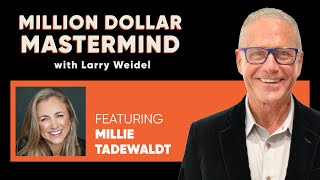
Millie Tad Walt built Brilliant, a corporate gifting company, from a self-taught coder background through Harvard law and BCG. She bootstrapped it to $50k in the first month, hit zero revenue in April 2020, and pivoted hard by June 15 to survive. Now she runs 110 people across the US and Canada, turning what companies call swag into what people actually want.
Questions this video answers
2015
About $50,000
About 110 people
A 32,000 square foot warehouse outside of Chicago
26 U.S. states and 4 Canadian provinces
Foreign.
Welcome to this edition of the Million Dollar Mastermind podcast. This is where we pick the brains of high achievers from all walks of life and get their hard earned real world insights on winning. I'm your host, Larry Wydell.
I'm here talking with Millie, Tad Walt. Hello, Millie.
Hey, Larry, how's it going?
Where in the world are you today?
I am in beautiful Santa Barbara, California.
Barbara?
Yeah.
My brother lives about hour north of there and actually I hope to be driving through there in the next month or so. Beautiful part of the country. How long have you been there?
Is. We moved here almost two years ago. We were in Chicago before that and have lived in San Francisco and Boston and just been enjoying seeing all the great places in America.
Of course you're not going to be able to enjoy all the great weather in Santa Barbara that you have in Chicago, but.
That's right.
Maybe you can put up with it.
Yeah. Well, teaches you to appreciate even the foggy days here when everyone freaks out and wears their down coats unnecessarily.
Yeah. And so talk about why are you in Santa Barbara? What brought you to Santa Barbara?
We looked at all kinds of places, all over and we decided that it was an ideal place to live. Great weather, close to major cities. My mom lives here. Seemed like a great place to raise our little kids. And my company, Brilliant has been all remote since I founded it in 2015 so we could really live anywhere.
Yeah. Plus you're close to Harry and Megan, so.
That's right.
You know, you've got dinner guests for Friday night, you know, so we're working.
On getting them over here.
Yeah. Well, let's talk about Brilliant. You know, how did you get that idea for Brilliant? What is it? And how big is this, this thing gotten?
Yeah, for sure. So in my, in my varied career previous to starting Brilliant, I had had a few opportunities to buy swag branded merch in those roles. So company T shirts, pens, gifts. And what struck me when I bought that stuff was how bad that experience was. I was in my mid-20s in my first role where I bought some company T shirts and I was an expert e commerce shopper, as many mid-20s women were then and probably still are today. And the way you had to buy company T shirts at my company was you had to call up this guy and he would make an appointment and he'd come out to the office with a rolling suitcase of samples and there was a lot of like paperwork and forms and he wouldn't let me keep the samples to try them on. And I just had to trust that it was going to work out okay. And it felt really bad. So that was one bad experience. And then a few years later, I had a really good experience giving a couple gifts at work. And what I found was giving the right gift to someone in the right moment really transformed that relationship. So those two experiences stuck with me when I found myself kind of ready to start a company. And that was the inspiration.
Well, talk about how big a business merchandise is and gifting per se, you know, it's huge.
It is actually sort of hard to measure because so much of retail is gifting and yet you can't really segment that out. In the US they talk about the promotional products industry, which is like literally kind of swag tchotchkes, that type of stuff being about a 25 to $30 billion industry that's in the US alone. So that's a pretty big industry. But then when you sort of take a step back, you can look at the industry globally. You can look at, you know, all merchandise, materials, marketing, all those different categories in addition to retail when it is purchased in a business context. And that ends up being an even bigger market. Kind of, kind of hard to estimate.
Our company, financial company, we're getting ready to have a convention this summer and there will be awards by the tractor trailer load that be about 60,000 people there. And it seems like the whole thing is passing out awards and recognition. But how do you get into, how do you go in that business and build something significant other than, you know, you're going to open up a local trophy and embroidery and T shirt shop on the downtown or something? How do, how do you go into it from a.
Like you did well, Larry, I didn't mean to stumble into the swag industry. What I set out to create when I started brilliant in 2015 was your corporate gifting assistant in a way. So the idea was our customers would come along and they would say what kind of gift they wanted to give, in what context. I want to give a gift to my client and he's about 45 years old and he's into I don't know if this is cliche golf and barbecue. And also he loves playing the ukulele and he lives in Seattle. And I want to spend about $100. And the idea was that the platform would recommend three gift ideas. You would be like, yay, I love these. And I'm picking this one. And that would make that gift giving experience really simple, yet feel personal. So that was the concept I started with.
How do you make money doing that? I mean, how much, you know, profit can you make on a $100 gift where you. Three options and then you have to deliver. You know, you have to order it and have someone deliver. Well, I guess they drop ship it or something like that.
Yeah, the thought in 2015 was you could drop ship it or you could come up with a matrix of all the possible options and you could eventually develop stock of the most popular ones, and then you could control things like packaging and the card. But. But, yeah, great question. I wasn't sure I was playing around in the space. And so I went out and found some people in my network and asked them to try this thing I had built that did that, and it really didn't do much. You would fill out that form. I made the form really pretty, and then it would say, standby, you'll get some recommendations in one hour. And so I would get the email and I would go scrambling at my desk trying to come up with three gift opt four people within an hour, because that was the time frame we'd given. And I did that a few times and it seemed like it was working. But yeah, your question was. Was always there looming large in my mind. But what happened on about gift number four was people started asking to put their logos on the gift. What I realized then was, well, this would really solve the inventory problem because no one would expect me to be stocking their logos on the gift. And, oh, look, it looks like whenever you order logos on things, you have to buy like, 200 of them. So I stumbled my way into the promotional products industry. I found myself in early 2016 at a trade show in Las Vegas. It's the industry trade show. About 10,000 people descend on Mandalay Bay, and there are aisles and aisles of swag, and a lot of it is really bad or poorly merchandised or sort of, like, presented in a way that is uninspiring.
And tell me what Bad. Let's elaborate on bad.
Yeah, bad. So many flavors of bad in this space, right? You're giving someone something that they didn't ask for, and it. It has a. You have an ulterior motive, right? You're trying to get them to do something for your business. You're trying to make money in some kind of way because you're at work here. You're not just doing this for the love. So you're giving them something that they didn't ask for. And if they don't actually love that thing, what are the odds they're going to Keep it. So to me, bad is a piece of junk that goes straight in the trash. Plastic garbage. A bad pen, a tchotchke, a scratchy T shirt that doesn't fit right, a sweatshirt with your logo printed on it poorly. Basically anything. We say, we'd rather sell you no swag than sell you bad swag. But what we're really aiming to do is give people their new favorite thing. So maybe you didn't realize you needed a new water bottle, but this company gave you a water bottle and all of a sudden it is your favorite water bottle. And now you have an upgraded opinion of their brand. You have positive emotions. Whatever they're trying to get you to do, you're some percent more likely to do it. And you're going to be looking at their logo for the next X days while you enjoy that water bottle and have good thoughts about them. The alternative is I gave you some weird stuffed animal with my logo on it and you don't want a stuffed animal. And maybe you give it to your kids or maybe you chuck it in the thrift store bin. We call that bad brand karma. That doesn't, that doesn't do anything good for anybody and bad for the planet too.
How did you get in there and approach this from a unique standpoint.
So my, my background since not quite childhood, but when I was a teenager I, I learned to code. I grew up in a small town and I stumbled on the Internet and taught myself how to code. So I was a self taught software engineer from the age of 13.
You are a young female nerd.
I know. I still am a young female nerd. Right?
Good Lord. 13 years old, small town and teaching herself code.
Racked up some weird dial up bills, all kinds of hijinks, nerdy hijinks. So I always had this lens of what can technology do to make everyday things better. And so I walked around with that lens from when I was 13 on and I still do. And there's always a way I like to layer technology onto every problem I encounter because I'm still a young female nerd. Slightly, yes. Less young, maybe more nerdy.
Oh yeah, you're still young.
Thank you. Yeah, go on, go on.
You're still young.
So I went off to college and I was a design major in college and that ended up being a pretty fun combination of caring about aesthetics and caring about how things look and incorporating technology with that to make experiences better.
How does that filter or that framework, that perspective influence? Give me an idea of how that would influence you as you went you know, as you go through life and you, you encounter situations.
Yeah. So I went on to be a management consultant at the Boston Consulting Group after I went to law school and.
Why did you go to law school?
Oh, it's a great question. I got into Harvard. I had to go.
You got into Harvard and you had to go to law school?
Yeah, it seemed, it seemed like it would be a good adventure and it was.
Was Alan Dershowitz one of your professors?
He was. He actually took us on a trip to Israel.
Really?
Yeah.
You're such an educated young lady. Good lord.
Yeah, sorta.
Yeah.
Yeah.
But you did, unlike most people from Harvard that I know, you actually are doing something with it. So.
Oh my, my friends are all pretty accomplished too. It's been a network. The network there has been incredible.
I kid the Harvard students, the Harvard graduates. So anyway, anyway, talk about, you know, this gave you a platform. What that. Let's just talk about that. Coming through that. Why, what in the world were you doing at Harvard? From this small town, little coding, 13 year old winds up at Harvard.
Yeah.
You just wanted more challenge, I guess.
What I mean, I had never thought I would go to grad school. I went to college and graduated quickly and started a freelance web application development firm. I couldn't find a job that paid very well, but I had a few freelance clients and I turned that into a business and I started building web applications for them and that was a pretty good living. It also gave me some free time. And one day in my free time I stumbled upon a page on the Internet. Still, still a nerd. That was a practice LSAT test. So I took it and I plugged it into this page that said, you know, with this GPA and this LSAT test, here's what school you could go to. And it said Harvard. So I, I thought that sounded like a good idea. So I took 24 full length practice LSAT tests to ensure that I would get a very good score and got a near perfect score and near perfect score.
Wealth did you have, in addition to being this young wonder kid, did you have wealthy parents who would not gag at the idea of you going to Harvard or did you get a scholarship?
I paid, paid my way and got a scholarship. What my parents were have given me lots of wealth in other ways, but certainly not paying for my grad school tuition.
So you paid your way through with your.
I saved, I saved up from my, from my business after college and also got a lot of loans. I think I graduated with about $180,000.
In student loans, there's a secret right there.
There you go. I don't know, you got to do the math on that.
Well, that's, that's a motivation. Is it, Is it motivation or is it depressing? What does it do, that mentality?
It never really bothered me. The interest rate was about 3% and it would stay 3% for the entire duration of the loan. And at the time I paid it off, it probably wasn't the like objectively rational choice to pay it off because 3% interest rate loan is a pretty good deal. But it felt shockingly good to have that just go away one day. So. So I don't know, there's always some emotion wrapped up in the sort of economically rational actor mindset that we try to hold in our brains as business people.
Well, I mean, you know, just the release of the pressure and yeah, while you're just such a young girl too, to have that paid off, it's just incredible.
Yeah, I think I was, I was in my late 20s when I paid it off, so that was, that was exciting.
Yeah. And so did you pay that off from your. What business paid that off, would you say?
Well, so after, after law school I went to bcg and one of the things that lured me to law school initially was you would look at sort of what's the average first year lawyer salary and looked pretty good. I figured that would be the worst case scenario. And if, if I had to do that, that would be an upgrade. And if I thought of something better, that would be cool too. It's sort of a risk, a calculated risk. In going to law school, I wasn't sure I wanted to be a lawyer. And when I got there, I learned about management consulting and I realized I didn't want to be a lawyer. And management consulting seemed like it would be a really good way to kind of transform my law degree into an MBA and go get involved in the business world and be treated like somebody who'd gotten an mba yet. I also had the, I think the legal education that I got at Harvard and that you get at any top law school is incredible. Like, I would highly recommend it. The blend of kind of logic and history and policy and politics, that whole combination is just like an incredible education. And I also cross registered at Harvard Business School and MIT Sloan when I was there. So I got to see a lot of that business education too. But I would just highly recommend it if you're a nerd and you want to go learn a bunch of cool stuff in one place. Law school is a great place for that.
What about the business world had an appeal to you?
Well, I guess I'll start with what didn't appeal to me about being a lawyer. Because the flip side is what was appealing in the business world. So being a lawyer, it felt like you'd always be someone's agent. So you'd be making recommendations and you'd be helping guide them. But at the end of the day, it wouldn't be your choice and it wouldn't be your bet. And for me, I realized I liked some risk and I liked making bets and I liked winning. To go back to your point earlier that this is about winning, um, I like winning. I'm competitive by nature. I can't suppress that aspect of my personality. It's a sickness in some ways, but I like winning. And it feels like when you're someone's agent, it's not really your win. So I, I started to understand that it would take a long time if I took a path as a lawyer to move from agent to principal. And I knew I wanted to be principal sooner than that. Um, so I didn't think I'd be principal at Boston Consulting Group, because of course you're definitely an ultimate agent as a management consultant. But I think that would give me a lot of good exposure to the business world. And again, things I hadn't seen. I grew up in a small town. Law school was super eye opening. Just the kinds of different kinds of people I got to see. And you know, I went to Israel with Alan Dershowitz. That was nothing that had ever been on my radar in my childhood. So I loved seeing all the different sites. And I knew going on to kind of top three management consulting world would give me a similarly new vantage point on the world.
Yeah, your independent streak kind of doomed you from the beginning that you weren't going to last long in the management consultant world that you, you were not going to put up with dumbbells. Not paying attention to your advice for long.
Well, the whole, the whole premise of it is a little tough, especially in your first couple years. You, you know, I, I rolled into BCG. My first day of work was September 15, 2008. I don't know if you remember what happened on, but that was the day Lehman Brothers went under. And all the case interviews in the world didn't prepare me for how my job was going to change. So instead of doing cool competitive pricing exercises and exploring new markets for my clients, I was doing a lot of what they call delayering. You heard of that?
Yeah.
Means layoffs and firing people and figuring out how to cut costs, because that was the beginning of our, or, I don't know, the sort of public beginning of our most recent recession. Getting in there. It ended up being a pretty different experience than what I'd been expecting, but again, got to see a ton of stuff, you know, traveled all over to the clients of the world's largest milk solids producer and interviewed them about what's the experience like working with your sales rep from this milk solids company. And another project that was incredible was I got to work for Chicago Public Schools trying to identify the kids most likely to be involved in a violent incident in high school, in public high school, and from there, trying to figure out an intervention plan to prevent that, which was morbid task on a lot of levels, but also pretty inspiring because when you think about it, you talk about like a 10% improvement in the business world. It's like, whoop dee doo, I saved you 10% on your logistics costs. But a 10% improvement in kids getting shot in high school is like, hey, we stopped 20 kids from getting shot. So. So 10% actually becomes really meaningful. So a whole array of different things I got to see in that role, and that was incredible.
Okay, so you start you bootstrap, which is always fun because you're not accumulating that $180,000 debt like you did get leaving college and university and from your garage. Talk about that.
Yeah, well, I mean, the garage was involved. I feel like that's the, like, gritty glamour shot of the garage. There was also an office, a home office where I had a desk. So I wasn't just, like, sweating it up in the garage the whole time. And I. I also have been thinking a lot about the whole garage storyline. Everyone starting a business from their garage. I always knew it would be bigger. It wasn't like I was, you know, unintentionally starting an enterprise in my garage. It just made sense to start in my garage because I didn't want to spend a bunch of money on a space if we didn't need it yet.
So, you know, Jeff Bezos started in a garage.
Yeah. And I think he had a big vision from the beginning too. Right.
Yeah, I might. I might. He might have.
Yeah.
Steve Job. Steve Jobs and Wozniak started in a garage.
That's right. Many famous garage stories. I don't know that I'll be that famous or that rich anytime soon, but I did start in a garage. I bootstrapped. Brilliant. I had after bcg, I'D gone on to work for a startup incubator in Chicago and got familiar with the venture capital space and ultimately raised a venture round for a company. I started there and kind of got to see those dynamics and witness what was good about that and what I. What I didn't like so much about that firsthand. And then I went on to a startup.
What did you see? What did you learn about that? I mean, what did you. What insights do you even retain today from that experience?
Oh, so many. It's not for every business model, and it might not be for you in the time in your career that you consider it, but it's so loud. There's so much noise around. At least when you get into tech, the sort of noise you hear, the signal that comes out of it all, is raise venture capital and you're a hero. And I mean, maybe it was naive of me to sort of follow that noise, but those seem like the big success stories you hear. It's like that. And acquisitions, there's no like, hey, so and so bootstrapped this business, and now they are in charge of their own livelihood and get to make their own choices and they don't have a boss. So I think that's the glitz and the glamour to me. Or it was at the time where it was like, this is the path. If you want to start a tech company, you got to raise venture capital. But the flip side of that, I think, is typically when, when it makes sense to raise venture capital, it's because your business model can't be profitable out of the gate. So. So you have to raise money. And the thinking is, once you get this thing really big, it's going to be really profitable, but there's going to be this period where it's not. And that's why you need so much money. That ends up being a big. A big shot to take the binary outcome issue where, you know, whatever percent of these companies that raise venture capital money just completely fail and a much smaller percent of them continue to survive and thrive and ultimately get acquired. And that ends up being a pretty interesting bargain that I think a lot of founders don't consider because, I don't know, we're optimists. And you go, take that round and you're sure you're going to be on top of the world and you're going to be the next Steve Jobs. And most of them aren't. And so you go, you know, it relates, it relates.
Maybe you can tell me I'm wrong on this, but to me, it relates to when you start out in anything, you don't know what you don't know. And that's why, you know, the re the rationale behind doing this podcast the way I do it, which is kind of bass ackwards and convoluted, is I don't know what people don't know that are listening. You don't know. But I do know that if we talk about a variety of things, maybe we'll stumble across something and they'll hear something, it'll say, oh yeah, I never thought about that one before.
Yeah.
And it's a way of, it's a place of life. Yeah. But you know, the same thing. It started on any business. I used to tell our managers, you know, because you know, we in financial services and we're opening up offices and training managers like McDonald's except you know, they get a financial services Office instead of McDonald's. And I said, I just can't wait for you to accelerate through the system, get a team in place so we can promote you out, you can get your own office and you can begin to find out how stupid you really are. Because then, then when you come back into my full timer meeting, you're going to pay attention, you know, and right now you're sitting in my office and looking at me like what a dummy I am, making all these decisions, but you have no idea, you know the context. And so I'm looking forward to you getting up to where you can realize what you don't know. But the trouble with raising money that you see time and time again, especially in the software space, is that people spend the money on the wrong things. They haven't been in it long enough to know where to spend the money and then the money's gone, you know.
Yep, yep. And you, and you have to sort of plan on raising that next round and that next round after that. You're not taking that round and using it to get to profitable because you have to. You've also made this bargain that you're going to try to get so big when you take these rounds. You're trying to, you know, 5, 10x your investors money and you're trying to do it in a compressed period of time. So you've got to, you gotta take a big shot. And again I think, I think that can be great. I just don't think that's for everyone and it's not for everyone at any particular time in their career. Like maybe you don't want to have a binary outcome after five years in your 30s or whatever point in time you have chosen to make this kind of decision to take venture capital.
Yeah. Maybe you haven't been in it long enough to know the cause and effect thing of the decisions you make and the things you're doing, what kind of returns you can expect. And maybe you need to get a little further down the road before you can narrow that in and maybe not run up so much debt before you get that kind of experience and that knowledge and the track record. And so you started your. What. Why did you come up with the name Brilliant? That's awfully audacious for a small girl who's a coder from a small town. Brilliant.
You know, I had started a few other companies before Brilliant, and I had spent so much time, like, trying to come up with the perfect name. And I'd created a prototype of what Brilliant, the original Brilliant, might look like as a sketch. And I just threw the name on there and it stuck. And it's been, I think, a fun name and a fun brand. It conveys positivity and sparkles and happiness. And this is a positive business to be in. Like, you're dealing with fun stuff. You're bringing people's brands to life, and you're creating emotional moments, magical moments for your clients and their clients. And I think spreading happiness to some degree in a world of work, which I think needs a little happiness.
Well, I think it's. I think you made a great choice there, because that's the whole idea of the gifting enterprise, is to put the extra sparkle in there. And so I don't know. I don't know that you could have done a better job on.
The only time I regret it is when we make a mistake. In the earliest days, it was me who had made mistakes. And I would have to call someone up and I would say, hello, this is Millie from Brilliant. We've made a mistake. Can you please help me? And the sort of lack of humility there felt always kind of awkward when trying to recover from an error, you.
Know, I'm sure those were few and far between, you know, so.
Yeah. Anyway.
What. What did you do right from the beginning?
What did I do right? Oh, man.
What did you do right?
It's a great question. I think I. I found a great segment to focus on. I found this segment of the market that was unloved, I would say old and unloved and archaic on a lot of levels. And I came in and I had the blinders on. I had no idea who the good competitors were. So I didn't look at that. But what I did look at were all the bad old experiences and I believed that I could do better and just sort of went for it.
For those of you who are sick and tired of fooling around and are dead serious about wanting to move up fast, I've got something especially for you. I've combined the best insights from over 40 years in business and making $70 million in income and compressed them into a free webinar. That's right, it's a free resource. If you want to find out exactly what the concepts are that I use in coaching million earners, Register now@widelonwinning.com you'll discover the five part framework used by so many to reach their financial, personal and professional goals. You can find that link in this episode's show.
Notes how much testing did you do or research due diligence more or less did you do to reach that conclusion where you said this is a go?
Not that much. I had a couple concepts I was looking at. One was in the parenting space for young parents. I had a six month old baby at the time and so of course I was in it and was thinking about all the things that had been hard and challenging about that experience. So I had a concept in that space that I was playing with and I had been offered an entrepreneur in residence role at a venture capital firm to go start that startup idea with them. So that was one idea I'd been playing with, but I struggled to see how I could get it to the scale where it could be profitable and be a standalone business. And I'd already had this kind of bad experience raising venture capital where I'd come up with a good company and done everything right but been unable to raise that next round and sort of had to shut down what felt like a good business due to its lack of profitability or theoretically good business. So I had this one option on the table and I had this other idea for this gifting company and I was working in a job I really wasn't very happy with at the time. And my husband had started a company two years prior and his company was finally getting some legs under it and so he had a salary again. So I kind of looked around and I said, well, what's the risk of picking one of these things and doing it versus the risk of not? And the risk was limited to my salary and my lack of misery at this job that I was really unhappy at. So the risk seemed to be pretty minimal. We could go without my salary for A bit. And I could, I could shoot this shot. And so I, I tried to do it in as lightweight a way as possible. So I didn't want to spend too much time to get to a place where I could start to assess whether the idea had traction. So after testing that initial kind of gifting robot idea, which is poor branding, but you get the idea, the sort of pick one and three and shifting into the we're going to sell you bulk swag and bulk gifts. I built out that landing page. I had that design and coding background so I could just do that. I didn't have to go find somebody. It didn't have to take months, it could take days. And so I built that out and I went and shopped it and I started to get orders. And my first month in, when you.
Said you went and you shopped it, explain that process.
Yeah, well, so I had my own network in San Francisco from my, you know, previous four years working in, in, in the city in the tech industry.
Network meaning network, meaning friends who had.
Businesses, people I had encountered who had businesses or were business adjacent or worked in companies. So basically I sent emails to the mall and described what I was working on. And you know the old saying, if you, if you want advice, ask for money and if you want money, ask for advice. Yeah, I asked for advice. Cause I wanted money, but also advice. I would have taken advice. And I got, I got both. So in my first month in business, I did about $50,000 in revenue. I got enough orders to kind of blow my mind.
What was your first orders like? There was.
My first order was I had an angel investor named Cyan Banister. Cyan, shout out if you ever hear this, who did a big order of holiday gifts for her network of founders. And she, I, I think she spent about $30,000 on something like, I want to say 300 gift boxes of really cool bespoke stuff. There was like a roll up leather tech cord organizer and a water bottle and a treat from like a custom maker, like a San Francisco chocolatier. And I packaged them all up myself in my garage with crinkle paper. And my hands were all cut up, I probably should have worn gloves, I didn't know. And made them beautiful. And I have all these pictures of it. And it was, you know, the very beginning where I began to believe that this was an idea that didn't totally exist. And the way I was presenting it was compelling to people who knew things. And I don't think, I mean, I think she was doing me a Favor, perhaps by taking a chance on me, but also I think I did a good job. And so it went from there, and I expanded out beyond my network pretty fast, because, as you know, your friends will do nice things and do favors for you, but strangers are a lot less likely. So I started cold emailing, and I just went on LinkedIn and I came up with the job titles of the types of people who I thought would be good clients for us. And I wrote them emails describing what I did and definitely overstating our capabilities, which has been a theme in my entire career. Always try to. Always try to get a job that's just slightly out of reach and grow your way into it as quickly as possible with your feet to the fire. And, you know, I got responses from CMOs and VPs of marketing and VPs of people. And honestly, my mind was blown because here I was just this person with a landing page and a garage, which is actually a pretty good thing to have if you're in San Francisco. A landing page and a garage and an idea in an email. And I'm getting these meetings in San Francisco with tech companies who think what I'm selling sounds pretty good. It just went from there. And I think one thing I did right was probably not realizing what a. What a big space I was playing in at first, until I got enough traction to begin to feel like I had some confidence. Cause I think it would be very easy to. To talk yourself out of shooting your shot if you realized what you were up against.
Now explain that.
I mean, now I look around at our competitors in the space and I see a ton that I admire. And I see some where I'm like, oh, we should do that. Or they have this great feature, or they do this amazing thing, or, damn, what a good campaign. I wish that had been ours. And at the time, I think I was able to somehow see the world such that there was a very obvious place for me, nobody in it to come, and just try to do things a little bit better. And my idea was to reduce decision fatigue by making it easier for buyers of gifts and promo products to make their choices. So I don't know if you've ever shopped for a promotional pen for your business, but a lot of times the experience is I'm going to look at nine web pages of a hundred pens each, and I that I'm going to start to see stars because they all look kind of equally bad. And which one of these pens is actually going to be awesome. But actually there is, like, one really awesome pen. Well, there's, you know, five to 10, I think. And so for most clients, we can point them to the best pen and we can reduce that decision fatigue. And that was always the heart and soul of the business, which was a trusted sidekick, we call them, our creative partner, who will know your brand, know your goals, and really just make your life as easy as possible when you're ordering gifts and dealing with all the logistics and then that we would have the tech platform and the fulfillment capabilities to back that up.
Right from the beginning. How big did you want this to be? I mean, you like winning and as we know in life, you know, you grow or you die. You know, you can't. That's the trouble, you know, it is.
The trouble, isn't it?
Yeah. You start this thing and then you can't, like, okay, I'm going to get it. You hear people say, I'm going to get it up to a certain point and then I'll be happy. Yeah, yeah. Like that. Yeah.
No, that's true. That is so true. I had a friend at the time who was a partner at Google Ventures in San Francisco and she was super smart, Yale grad, won't hold it against her. And we were talking about what we wanted to do next. This was before I started Brilliant and she wanted to go raise venture capital and start a tech startup. And I was telling her all about how I didn't want that. And I remember at the time saying, you know, as big as I'd want it to be would be about a hundred people. She said, you know, I'd like to have a thousand person company. We were sort of talking about scale and so we're at 100 people. We're a bit over 100 now. We're about 110 people at Brilliant. Eight years in. And you're totally right, I definitely want to keep growing. And that is a huge part of winning.
This is the sickness that you have.
That's right. That is the sickness. And I.
The thing is, is a good sickness. It's the sickness that's drives the world.
I don't know why. I like, if you get too contemplative, you sort of are like, why do I feel this way? This makes no sense. But yet.
Oh, it's because of your intelligence. You know that. Here's what you know. You know that if you keep doing the same thing, you're going to get bored.
Yeah.
Your mind is going to want to start something else and then you're going to get sidetracked and then things you know, the first thing's going to go down, then you'll have to fix it.
I think you're like describing ADD also, but.
Yes, but you're smart enough to realize that growth is the answer. It doesn't have to be astronomical growth every year.
That's right.
Growth is fun. That's the other.
That's the challenge. I also want to keep growing because I think our team wants that. We've hired this incredible bunch of people, and if we don't keep growing, they're not going to have opportunities to grow them.
How can you give them pay raises? How can you let them have more staffing? How can you give them promotions of the company's not growing? You know?
Yep. You know, that's a. It's kind of a tricky situation to be in because regardless of whether I'm happy at 100 people, no, no one else is going to be happy.
All right, so I'm going to give you advice. I'm going to give you advice because I advise million dollar earners.
Okay, great.
What you've got to do is work on your core and offload. What you do is you progress. It's a fun way to do it because what you do is you progressively offload the least favorite things that you don't, you know, the things you don't like doing, and you just. And you keep the things that you enjoy doing and you're the best doing for yourself. And that's just your way of life. You know, you're looking.
I'm doing it wrong, Larry. I keep picking things in this company that need an expert, and I go hire someone great to run that thing. And I'm just so jealous that they get to focus on, hey, you get to be the VP of sales here. That's all you have to focus on. How incredible that must be. So I've actually, starting in 2020, I hired an old colleague and kind of then and still very close friend to be my COO, and over the next three years, hired out a management team of about 10. So I actually have a ton of great people around me. And that's an important part of growth, too, is having smart people who want to box with you and pound the table and have a fight about it and get to a better answer and grow together.
What you want to do is work yourself out of the position where you have any one thing you've got to do.
Yeah.
You know that you got people to do it, and that way you can keep your eye on the people that are doing those Things you can be like Walt Disney. And that's what Walt Disney do. He had all these departments and he would go in and visit and take ideas from one department to the other. And then if there was one thing or another, he, like, you know, he got into the theme parks, well, he'd spend a lot more energy over there because that's where his excitement was. But that keeps, that keeps you fresh.
Well, this intensity has to go somewhere. So.
Yeah. And your intensity and your enjoyment of the business is what really fuels everything, you know, because there's a funny thing about people who work for you. If you show up in, if you're not feeling great, they think you don't like them. You know, that you, you know, you do your best in the world to hide it from them, but they're going to pick up something's not right. She's mad at me.
It's true. They all take what I say way too seriously.
Yeah. Even if you're trying to joke with them or something, it's like, oh, what did that mean? You know?
Also found that people think I know the answer. Like, I'll ask a question like, so, like, where should we go do this marketing campaign? And they'll have a look on their face and they'll think and they'll say, okay, well, where? I'm like, no, I don't know. I'm asking, like, let's figure it out. Like, it's almost like they think I'm being Socratic or something.
Well, you actually put your finger on one of the most fun things about getting big and having a great team around you. You move, transition. What I found, anyway, you transition from the point where you had to come up with all the great ideas to. To where all your, your main job is to come up with the right questions. What are we going to do about this? You know, if we keep doing what we're doing, we're going to get down here, we're going to stall out. What can we do so we don't stall out on that area or something? Like, what do you think?
It's an ever evolving role. From the first day when I was writing code and packing boxes and making sales calls, like, that was one crazy job that I bet not many people have had, though Jeff Bezos could, could probably appreciate that. And then, you know, at about 20 people kind of figuring out, how do we scale this thing and having some management structure in place and 50 people hiring HR, developing like a real R and D structure for our tech team, and, you know, now 100 people. We've got middle management, we've got functional leaders. How do we, how do we scale all that? How do we make sure the right people are in place? How do we make sure they're talking to each other? That's all really challenging too. And like you said, asking the right questions and sort of putting the right people in those conversations to get to the, to get to the truth or the best version of the truth we can find. Yeah.
And you find out if you don't offload, you don't have time to think about those things. Like those thoughts don't have. Like, I had something happen in our office in the last, last week. I woke up at like 3:30 in the morning. Like, wait a minute, what are we doing about such. And so I haven't heard anybody mention anything about that for five weeks. And we're like two weeks past the deadline that we were supposed to have that done. And I found out they'd forgotten about it too.
But you know, the big problem though is all these people have job descriptions. So when I get some fun new idea that I want to try, there's no one whose job it is to do that. So those are the tasks I still end up taking on. I have little skunk work side projects that often, often turn into something big. One of our biggest tech products was, was one of those. Originally in fall 2019, I made a little marketing stunt form where gift recipients could, you know, select their T shirt size and provide their address in order to get their T shirt delivered directly to them instead of us having to send it to some address and not knowing if that's right and of course not knowing their T shirt size. And so what do you know? When Covid rolled around, all of a sudden everyone in the world wanted to figure out how to send a T shirt to somebody or whatever the gift was, because we were starved for physical connection. And sending a gift was a really great way to connect physically. So that was a weird side project that I had sort of cooked up in my free time and turned into a huge leg of our technology stool here. So I, I don't want to, I don't want to lose that stuff. But you're totally right. Having having tasks like that end up being kind of the wrong thing to be doing.
Not necessarily because a growing company is always going to have new beachheads. You're always going to have new things, and who better to think of something? You know, you got more experience than the rest of them in what works and what doesn't. Work in this space with this company.
And you got to say the 30,000 foot view of what's going on here.
And you got your finger on the pulse, you know what I'm saying? It's like nobody's got the finger in the pulse like the top person. And so you're more, you're more like, you're probably, you know, you could be wrong. But I mean, the thing is you're more likely to be right. Your instincts, that's fair and you should, that's how you make money off your instincts. You know, you think of stuff as like, what if we did this? And, and so I think that's a great use of your time because once you figure it, figure it out, you can find somebody to do it, you know.
Yeah, that's true. The gut feeling is definitely underrated in business.
Yeah. One thing I wanted to ask you where as you were coming up and you know, you've done such a good job in maximizing your experience really from the time you're 13, you started coding, you had you developed approach somewhere along the way that has served you well in school, in your decision making, in your, you know, getting out in the real world, starting your own business. You, you, you've got some, you know, I don't know how much you've thought about it because I don't know if you're at the point where you're getting ready to write your book or not.
Or if they're, but fair enough, if.
They'Re pulling you back to Harvard to speak yet, that's when you start wondering about things like this.
But maybe they'll learn about me on this podcast. And they.
Yeah, but it's like you start thinking like, what are those principles? I, you know, what did, what was I told? You know, there's one reason I do this podcast and I wrote my book. It's, it's like, wait a minute, there's about four or five people. If I had not known them in my 20s and I had not been told certain things from them, concepts, principles, or, you know, an idea I might have gotten out of a book or something like that. Not just all from people, but it's like, you know, there were some, there were some critical pieces that I wouldn't be here today if I hadn't had that piece of information, you know, to operate off of. And so how, how would you describe, you know, some of the operating type principles that have served you well over the years?
I love that question. The first one that comes to mind I think is Being authentic and being yourself and making real genuine connection with people. What, what that's led to for me is a bunch of really smart people around me who I actually like being with, who make, make life and work way better.
Show me the other side of that story, you know, like you.
Yeah, the other side of the story is some people aren't gonna like it. Yeah, there's gonna be people that don't like your flavor, but at least you have a flavor. So the people that do like it, like those are your people. So find your people and, and you're gonna enjoy them a hell of a lot more than if you fake it and you're, you know, overly. It's, it's good to be polite but like, you don't need to kiss up. Like go be yourself and you, you'll find your tribe. And I've definitely found people around me who I really enjoy and who I also feel like I can have like a direct, true conversation with and cut out the crap. And I think that's also like not only delightful, but efficient. You sort of get to better answers faster with a bunch of people you trust and enjoy around you. So.
Correct. That's one thing. But let me ask you, dig into it a little bit. Do you think that could be a female thing of just trying to fit in and be accommodating and go along and put up with crap that you don't want to put up with or something? Or is that just, just you?
The good question. I think that is a very female description of how that might manifest. But I think maybe a male description of that might be sort of not being vulnerable or like emotionally available. I see a lot of men out in the world who like don't put themselves out there and don't say the weird thing and, and like don't make, make a risky joke. And I don't mean like a risque joke. I mean like be goofy, be weird. Embrace that you're a nerd. Like fly your freak flag. So I don't know, just sort of like being down to be weird and letting people see that and letting people find you and really connect with who you are. And yeah, you know, there's, there's not always a time or a place for that. Sometimes I go meet with a client and I read the room and I can tell they don't really want to see that side of me. So I'm not going to like blow up a business relationship. But over time I've developed a lot of long term relationships with colleagues and Friends and people that were once friends and now colleagues and people that were once colleagues and now friends. And all of that comes from being kind of emotionally available and authentic and just being willing to be yourself and take that risk. So I would, I would give a strong plus one to just being yourself and leaning into that and making what.
You can out of that now and beyond that. Now what were some, you know, you're growing up, you start noticing how people act and behave and approach things. What are things that, you know, you said, you know, I want to be that way. I don't want to be that way.
Yeah, bureaucracy. Hate it, hate it so much. Hate paperwork and process for process sake. And that'll tie into another thing I think is important and is an operating principle which is caring about details, but caring about them thoughtfully and not for the sake of them, and sort of figuring out how to click into that detailed level of abstraction and then step back and see the big picture. And sometimes what I find is bureaucracy seems to be a product of some detail went astray sometime way back when. And so we made a policy and a form and a process. And now there are so many layers of that that it gets in the way of effective action. And I also think it is super demoralizing for everyone who has to be part of that. So kind of questioning rules, questioning process and using your brain at all times and, you know, thinking, thinking that stuff through, that wasn't very coherent, but that, that's been important here. And I think my team, if they hadn't realized it, if they heard that, that would make a lot of sense to them because there's rules, there's guidelines, there's also like five other ways to do it and there's exceptions to every rule. And yeah, we have a price for this one product. And if an amazing client comes in and they're offended by that, you know what, we could just change that. It doesn't have to be anything. Yeah.
Now, what is the roughest situation, the most, you know, the, the thing where things just went all wrong? I mean, it just, um.
Well, this is going to be a cliche answer probably, but the year was 2020 and I was eight months pregnant with my third kid and we had just taken the brilliant team of 11 people to Malibu for our annual off site and we were flying high. We had visions for the year 2020 about what we were going to do and how we were going to accomplish it and how we were going to grow. And then the world shut down and I was locked in my House in Chicago. And I watched the email volume die and I watched the revenue die. And we went from our best month ever to fully zero a goose egg in April 2020, no revenue.
Wow. Yeah, it was zero.
It was rough. And, and we're bootstrapped. So it's not like I've got $5 million in the bank that are going to like back us up so we can ride through the storm. So. And I'm eight months pregnant, which I don't know if you've been just kidding.
It's been so long since I've been eight months pregnant.
I tell you, it certainly adds a layer of anxiety to the whole situation. And then my other two kids, who were 2 and 5 at the time, wow, Home from school all of a sudden and lucky I have a good husband who also helped and could help because I know some people's jobs didn't allow them to help or have a husband who could help. So we're homeschooling the kids, super duper pregnant, trying to save the ship from sinking, and had to start putting. And I had actually just hired my coo, Lindsey Cohen, who had been my close friend and before that colleague at Sandbox in Chicago.
So she just hired another high, high level staff.
I had, and she had, she was quitting her job to come join us. We had agreed on Valentine's Day that she'd come and she was going to join on March 30th. And I called her up when the world shut down and I said, hey, did you give your notice yet? And she's like, yeah, why? And I was like, oh, no reason, don't worry about it. See, on the 30th, so.
So, well, the thing was to point out to people, not only was it zero in April, you didn't know what it was going to be in May, June, July, August.
Exactly. And I had to start making. For me, the way to sort of resolve or at least stave off anxiety is to make a plan. And so whatever is eating away at me, I, I break it down and I figure out what I can change and I go make those changes or at least put some steps in place that I can sort of see, see through the end of that. And so for me, I, I had to say, okay, well, at what point are you going to start thinking about laying people off? Because there's a certain point where this thing runs out of money and it'll probably come back at some point. But like, you can dip into your savings, you could take a loan or you can lay People off. And, you know, I don't know if you remember, but like the headlines at the time were all these companies laying people off and people their jobs and total chaos and we're washing our groceries. And so I put a. Put a stake in the ground and I said June 15th, I said this in mid April. If by June 15th this thing doesn't feel like it's coming back, I'm going to start firing people. And I also started telling everyone to take time off and shifts. We have unlimited vacation. So that wasn't saving me any money. But basically everyone was feeling it. They were sitting around their computers all day feeling anxious because of the state of the world and also because of the state of the business and their jobs. And they could see it. We're a transparent company. You can go online any day on our business intelligence platform and see the month to date, revenue and the year to date and what our goal is. So anyone at the company could have checked and seen that things were looking pretty grim. And so I put a stake in the ground and we went heads down and we came up with all kinds of content and a big sales and marketing push around gifting from home and basically leaning into what our clients must be feeling, because we were feeling it too. And we knew what they were feeling. They were feeling all kinds of uncertainty and their employees were feeling uncertainty and everyone was stuck at home. And we couldn't reach. You couldn't reach anybody, really. Not in the same way as we used to. Salespeople couldn't reach their prospects. So we built out all this content around how to reach the world when the world's gone remote. And here's our technology tools and here's our suggested gifts, and we put it out there and we started pitching it. And lo and behold, May rolled around and it started to pick back up. And it's like, okay, I can move the stake in the ground from June 15 to July 15. So I moved the stake and I had my baby and I was back in the saddle the next day, which was brutal.
Boy or girl?
A boy. He's a. He's a hellion. Oliver. From. From May onward, it was gangbusters. And we had an insanely big growth year. We were held back only by our ability to handle it all. And 2021 was even crazier. And so that was a very dark, low moment that we turned into and turned into for a lot of people, something really amazing.
Well, I'd like to point out what you did that was so right there and explain it in other terms, come at it from a different standpoint. And that is that when you don't know what to do, your whole world is caved in. You say, like, I don't know what to do next. What I've always told people that's very similar in sales, where people would say, I run out of all my prospects, there's nobody left. I've, I've contacted everybody I know to contact, you know, and I would always tell them, you're lying to yourself. There's one left.
There's always something.
There's all. I said, there's one left. And they would go, every time. This, this is decades of doing this. But they would go like, oh, yeah, there's one left. I said, go talk to that one. You'll think of another one. And there's always, you know, there's all. When, whenever you run into a brick wall, there's always one thing you can do. And what you said there was, you know, to, to get yourself moving, to take those steps. You said, okay, I'm going to make a plan. You know, I'm going to get a plan. What can I. Because a plan forces you to think about what you can do, you know, like, well, I can't do that. But, you know, you can't do a plan off nothing. You got to do a plan off something. So it forces you to think on what your, you know, your, your possibilities are. That was just such a smart move. But it kind of shows how you've innately are equipped to do your job in case you doubt yourself going forward. As you go from a hundred to a thousand employees, it's all the same thing. Because you're dealing with situations like that. It's like, well, we can do something. Let's, you know.
Yep. I think that is, it's like being relentless. I'm a fighter. Like, I, I don't give up. And I think that ties to being optimistic. Like, there's always a way we can spin this to make it better and fix it, which is sort of crazy and has led me to do some really weird things. Also more in my personal life, I made a very ambitious birthday cake for my 3 year old once that turned out horribly. And my husband walks in and I've been like slaving over this birthday cake for eight hours. And he goes, this is the most ambitious thing you've ever done. And it was a complete fail. Like, hilarious. But I don't know, I guess like within the confines of your own kitchen, being willing to take a weird risk and try. That is harmless. And luckily, my business endeavors are less of an unmitigated disaster.
Yeah, we're going to have to. It's been fun talking with you and hearing your story. How do you. For people that are wondering, are you. Are you virtual still with 100 employees?
I mean, we've always been all remote. And that was, you know, they talk about in gymnastics, the difficulty factor of a routine. And when I started the company, I chose a higher difficulty factor because I chose to be all remote from the beginning. I didn't. I didn't want to have an office, I didn't want to commute. And I knew if I didn't want to do that, my choice was either to try to hire the whole company in the suburb of San Francisco that I lived in or figure out how to do it remote. So I did it all remote from the beginning. And that was actually one nice thing about COVID for us was we weren't adjusting to. To the sort of work from home world, and we were kind of in our normal environs. And so, yeah, we're all remote. We are in 26 states and four Canadian provinces now. So we've got a lot of coverage in the US and we also have a 32,000 square foot warehouse outside of Chicago.
Huh. Well, congratulations. That's planning that background. That experience of getting remote to this size probably equips you pretty well to continue to scale your future expansion.
It does. It was definitely a little harder to start the engine and figure out kind of the block and tackle for. How do you. How do you interview someone for this company that doesn't like. What is the culture of this place? What is this place? There's no place. So getting that started was weird and different and that was the difficulty factor. And now it pays dividends because we can hire anyone anywhere. And not just from the suburbs of San Francisco, where people need to make a lot more money, but from anywhere in the country, in Canada and maybe all over the world and give people jobs that are above market where they live and give them that flexibility that I really valued, too.
So how do you, you know, you hear companies talking about their mission statements and their core values and things like that. How big are you on that to unify your team?
I mean, I think you. I think you live it. We actually just had our company off site in Scottsdale. We bring everyone together once a year, try to take them somewhere nice and show them a good time. And we talked about a few of our company values, but it was sort of the first time we ever really declared them officially. And as you might imagine, they're kind of casual. One of them is one of the. One of my favorites is down to clown, which means you're down to. You're just going to try stuff. Like, you're going to try it, see if it works. You're not going to follow the rules, you're going to break them if you need to, and you're going to figure out the best answer for the client and for us. And so that those are the types of company values we have. And I think just because we're not tattooing those on our corporate wall doesn't mean we don't have values. But I think the culture here is. Is a strong element of. Of this company and. And why people like working here.
Yeah, I think the. We live them our values is the best answer because rather than having on a paper and we repeat them at every meeting and stuff, you wonder how far that goes.
You know, it's like sometimes I have to repeat myself 10 times before people really understand what I'm trying to say. And I've heard that from other CEOs, too. It's just you're talking to so many audiences. You just have to keep beating the drum. So I do understand that, but I think I model our values pretty well. I think this company is still largely a reflection of what I believe in and how I work and my style. And I think we've always tried to be really upfront about all that. And because like I said earlier when I was talking about authenticity, it's not.
There you go. But when you're not trying to be something, you. You are something.
Yeah, that's right. And come to us, if you are our people. We will all love each other and we will have a great time together. And if not, we wish you well and we hope you find your people.
Okay, well, this has really been a lot of fun, and I've kept you too long, but I like to let the guests have the final word. For people who have listened, followed us all the way through, and for people who are inspired by your story and would love to follow in your. Your footsteps, is there any last thing you'd like to leave them with?
I mean, I think. I don't want to say follow your passion. That's. That's cliche. But be contemplative about yourself and what makes you tick and find a path that fits with that and feels like home. And that's. That's what's worked really well for me. I feel like what I'm working on and the style in which I'm working on, it really just is right for me. And that allows me to keep going in a way that I think I really. At bcg, for example, I struggled. Like, that just wasn't. That wasn't my style. And it was a great experience, but it wasn't a place where I could be for 10 years, nose to the grindstone, really, like, enjoying the challenge. So I think you can, if you can figure out a way to work that aligns with your own style and your own values and what you're good at and what you like, that's going to make a hell of a lot of difference in terms of your ability to be successful.
Well, thanks so much for your time. This has been flown by and looking forward to getting you back on when you're up over a thousand employees.
That sounds great and slightly terrifying, but thanks, Larry. I appreciate it.
It won't necessarily have to be next month, but.
Okay, great. I hope not.
All right, thanks so much.
Thanks a lot. Take care.
Thank you for listening to this episode.
Of the Million Dollar Mastermind podcast.
Commit to your personal and professional evolution with our free training video. It's designed not just as an educational session, but as a transformative journey for those bold enough to aim for the stars. This isn't just any webinar. It's a roadmap to achieving the extraordinary. It's tailored for those who dare to dream big. And yes, it is completely free. Join us in a network of ambitious professionals ready to take their careers to a new heights. Secure your spot now@whitelownwinning.com and let's unlock your potential together. Thanks for being part of this community.
More from Larry









Rick Jordan on Self-Engineered Proximity, Cyber Security Moats, and Truth-Based Leadership

Fire Fast or Fail Slow: Kevin Brittingham Reveals the One Rule That Built a $100M Empire
