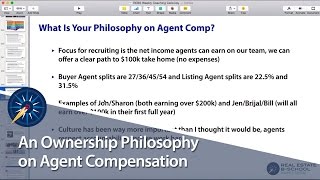
Brett outlines a compensation model where productive agents pay nothing out of pocket. He walks through desk fees, per-agent charges, a 5% broker split, and a 5% team admin fee, showing how production covers costs at ReMax and Keller Williams before going independent.
Let's see, Brit asked a question. If you're not independent, how does broker split to franchise fit into the agent split? So let me tell you, it's a good question. So when I was with ReMax, when I was an agent with another ReMax, I paid like 750amonth for me as like a desk fee or whatever they called it. And I paid 439 for each of my agents and then it was 95,500. So a broker would take 5% and team would keep 95%. And then on top of that I did a 5% team admin fee. So it was actually 10% off the top. And then we did the 30, 40, 50, 60 splits for my agents at the time. If they sold so in May, if they did 400,000 of volume in the month prior, I would cover their broker fee for that month. So it gets a little bit more convoluted if you guys are doing half caps or quarter caps with kw. But I want to have a team where there's no sort of out of pocket expenses for my agents. Like all their expenses are baked into the splits. If they're productive, it doesn't matter. Like there's enough money to pay for it. My conversations around buyer agent splits are like, how much money have you earned in the world of, you know, the free market for services, any services that you can provide, any industry as an employee or as an independent contractor. Like if I'm talking to a real estate agent recruit, it's that conversation. So Brett, tell me, what did you make last year and what did you do? You know, I actually started going to the Keller Williams way of doing a resume review. Highs, lows and compensation. So for everyone that joins our team now I know exactly what they did in each one of their positions and what they made doing it. So if your best year was 62,000, we have an agent joining our team now who, who made 62,000. She's going to crush it in our team and so she's going to be able to double her income. So we just have conversations around net income. So the splits for us now, total tangent there, but we basically when we went from ReMax the team to ReMax, where I owned the ReMax, we kept the 5% and 5%. So it was still 10% off the top, but we gave 1% to ReMax. So my former broker was keeping four giving one. Now I was keeping nine giving one. When we went independent, which was December this last year, I kept the 10%. Now we just combine a 10% broker admin fee. So we still do the 10% off the top. So on the buy side is 30, 40, 50, 60. So it ends up being 27, 36, 45, 54. The agents pay nothing. Listing splits are 22 and a half, 31.5, which is actually 25 and 35. So the model is the whole. It's the 45, 25 payout, buy side and sell side, which averages out on 35. If you have a balanced 5050 business, which you need to have really, to have a healthy real estate team, is a 50, 50 buyer seller business. I think if your agents are producing, you should, I think, step up and be willing to cover some of the broker fees. And here's the thing, though. If you're paying too much money to your broker, at the end of the day, a lot of Keller Williams agents say, well, I only pay 23,000 to my broker. You know, I had someone tell me that, and he had eight agents on his team that were each paying 8,000. And I'm like, okay, but it's eight times eight, plus 2364 plus 2387,000 you're paying to the broker. So somebody's paying it. You know, is that is a half cap or a quarter cap? Because being put to good use inside a KW franchise, I'd argue that it isn't. I like Keller Williams, but I'd argue that it's not being used. So you got to figure out how to do that, Brett, in your specific situation. But I would have it based on production. Like, if they're hitting their numbers looking back one month, you'd agree to cover it.