Damon Gautier walks through building a franchise prototype for your business: systems designed so the model works without you. The shift from working in the business to working on it means empowering teams, cutting your dependency, and using staff turnover as a chance to redesign how things actually work.
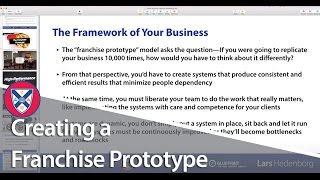
When we talk about framework of your business, this, this concept of franchise prototype, it really, really rings true with me. And I've thought of it. When you start to think of replicating your business 10,000 times, obviously if you replicate anything 10,000 times, you couldn't possibly be involved in any of them. So you could have no direct responsibility in any of those 10,000 businesses that you're building off of your one franchise prototype. That's the mindset you have to apply when building a sustainable business. So the question is, if you're going to replicate your business 10,000 times, how would you have to think about it differently and just asking that question repeatedly? Maybe you write that question out and you put it on a piece of paper on your wall or on a board in your office or something. You know, if, if I'm going to build, you know, 10,000 Damon Gautier and associates around the country, how would I have to think about it differently? It's a really, really, really good question, right? So from that perspective, you've had to, you, you'd have to create systems that would produce without you being involved in iota. Maybe you can hire, maybe you can find the lead, the regional lead for those 10,000 and hire 10 people to run a thousand each of these franchises. But the systems would have to be dialed in and produce consistent and efficient results that minimize people dependency, even most importantly, dependency on you. So it's just a critical way to shift your thinking around the work we're doing. And I've always had that perspective because I really e myth was the one guiding force along the way. I've always been been separating out the working on versus working in. When I was working on, I wasn't tinkering and changing things for the sake of changing things or looking at websites. I was working on the business with an eye toward building out something that could live on its own. So at the same time, you must liberate your team to do the work that really matters, like implementing the systems with care and competence for your clients. So depending on your default leadership theme, you know, we went through, the default leadership styles were dysfunctional. They call them two different things in e myth. But I think the dysfunctional themes, dysfunctional business themes. It may be tough for you to give up and empower your team in the right way and you hire the right team members and they can help you build the systems. So systems are dynamic. You don't simply put a system in place, sit back and let it run forever. Systems must be continuously improved or they'll become bottlenecks in roadblocks. And that's kind of the cool thing about when we have changes in our business. So when, like, a Keith, one of my listing partners, or Keely leaves my business, you know, it really is an opportunity to open things back up and realize, you know, what. What happened here? What did we tweak to fit people versus how we really want this system to run now that we have a blank slate again. So you look at those opportunities differently when you have an eye toward really building something that's truly sustainable.