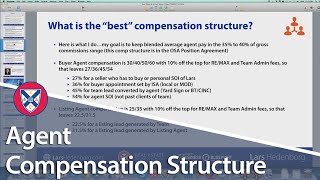
How to structure agent commission splits to hit 60% gross margin on buyer deals and 75% on listings. The speaker explains tiered splits based on who generates the lead, why you need an off-the-top team fee, and how to communicate changes without losing agents when you're ready to scale or sell.
Questions this video answers
10% off the top.
1% of that 10% goes to ReMax.
Approximately 60% gross margin to the team (paying out ~40%).
Approximately 75% gross margin to the team.
$4,500 commission check on a $150,000 sale (example).
So you have to be able to wrap your head around why if your team isn't set up this way right now and you've got a small team. I know it's, it's. How do I want to say it? It's pretty scary to think of, you know, what's going to happen when I kind of rip the band aid off and just put this in place. And there's definitely a way to finesse your way through, but you've got to be able to. And part of it is how much you're providing agents, right. So you should be working toward taking as much of that lower dollar productive activity off of your agents plates as possible. So I have, I have clients that, you know, they don't have any admin. So it's them doing deals and a few agents doing deals and they don't have an admin. If you're gonna go from that, you know, and you're paying them, you know, maybe 60% of their deals, if you're gonna, if you're gonna change it on them, you've gotta be able to show value without having sort of a mutiny situation on your hands. But this is how we Pay, we do 10% off the top 1% of that 10% does go to ReMax. And so that's kind of the way we have it set up. So it's 20, it's 30, 40, 50, 60, it's 27. So it's the 30 is for a seller who has to buy or a personal soi, it's a gimme. The 40 is the next tier. On the buyer side, it's a someone other than the agent set up the appointment or the showing appointment or the new buyer consult for the agent to go on. So the agent still has to meet with the client, they still have to build rapport, they still have to lock down the relationship. The assumption in the lowest split is that the relationship is locked down. One step up is that the opportunity to meet somebody was set up by someone different than them. But the relationship isn't locked down. So they need to lock down the relationship in the next tier, which is 50% or 45%. After 10% off the top, they've got to generate the appointment and they've got to lock down the relationship. And then the highest pay for them is that they've locked down the relationship. So when you explain it that way, it's really easy to understand. It's not, especially when you put numbers behind it and say, listen, I know this is easy to just pick on this lowest split. But I can make an argument even at $150,000 transaction, which is a $4,500 commission check, let's take 30% of it is what, 1350. So it's a little less than that. So maybe 12. Let's call it 1250 on $150,000 sale. At the lowest split, they're getting paid 1250, but it's someone that's gonna buy a home. So even at 20 hours in the deal, it's still 60 plus bucks per hour, but it's likely less than that. It's still about 100 bucks an hour, 120 bucks an hour. They're getting paid on a lower price price point. In my. In my market, if some of you are in the 100, 110,000. I've got clients in lower price points. Even on those, you know, they're making, it's a $3,000 commission check, and they're only earning $800 of it, it's still good money. 800 bucks for 20 hours is 40 bucks an hour. And it's probably more than that. It's probably about $60 an hour, probably about 15 hours they'll have in the deal. So you have to be able to talk, because that's how regular industries talk. Like, what value do you bring to the table? In my market, getting paid 100 grand to do the job of a buyer agent on my team, it's good pay. You know, you're working more. You know, you're not behind a desk. You're not working a corporate job. You've got flexibility, you know, in your schedule to a certain extent, you know, but you could do that working 40 hours a week on my team. And if my agents make 100, I make 150 on the buy side. So most teams, if the agents are making 100, the team's making 60 to 75, which is. Which is not good. On the listing side, we just have two splits. One is team and one is them. Bringing the business 10% off the top. It runs out of 22.5 and 31.5. So the whole point of having this conversation and your job, even if you're still in the business, you're still producing, is for you to know your margins on each side of the business. You may not have the same split structure. You may have something different, but as long as you can get to close to a 60% gross margin on the buy side, so you're paying out 40%. And on the listing side, it should be as close to a 75% gross margin to you. That's going to give you the type of margins you need. Having that structure in place, especially before you exit the listing side of it and getting this thing dialed in. This is one of the bigger hurdles you'll have to jump over to get this structure, the foundation right moving forward.