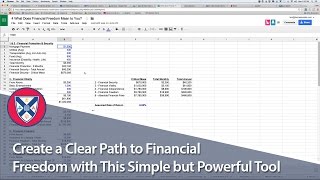
A spreadsheet tool breaks financial freedom into four tiers: emergency savings, basic expenses covered by returns, higher lifestyle spending, and unlimited spending. Enter your numbers, track quarterly, and see how much you need at a 6% return rate to reach each level.
I think I showed the net worth calculator. But let me show it in the context of the financial freedom. So if you go to Google Drive financial freedom, this one for what does financial freedom mean to you? And you pull it up and this, this is this document, you have to make it your own. So I think everyone only has view access to any of the, the sheets and stuff. So you go file, make a copy and you want to plug your own numbers into here. So basically what this is helping you figure out is it's helping you plan against the levels of financial security. Knowing I went through this at wealth Mastery in Fiji probably three or four years ago and I've just had a few numbers. I think these are my numbers. So 2200, we pay. Transportation is probably like 400. Our food is probably more like 1200. We eat a lot. This has actually changed a little bit because I do some wealth stuff. But this says basically that if our monthly bare necessity just to live expenses were about $5,000 a month, you, you want to have your first level of financial freedom is financial protection. So having an account with X months put away, so having $30,000 in account, and then you want to figure out what's the critical mass. So what amount of money could I have in a savings account earning a rate of return of 6% or whatever percentage you put on it, what number would that be? So if, if, let's just say I use 6% here, that number would be $1,040,000. That if it threw off 6%, it would throw off enough money for me to be financially secure and pay for all of these expenses. The next level is all the basic living expenses plus entertainment, just like bare necessity entertainment, savings for college education, any kind of luxury items that you might have if, if shit hit the fan. I could live my life as it is right now at a basic level for about 75. And we put our kids into Christian private school. So that would change this to. So let's call it $8,700. That's annual 10, 104, 400. And if I divide 104, 400 by 0.06, you, you get the critical mass. So if I had 1.7 million in an account earning 6%, it would throw off enough for me to handle the 8,700 without depleting that amount. So without eating away at the 174, I could have $8,700 at 6%. And then you go financial independence, you know, let's call it $5,000 a month more. That would be 2.7, then 13,7 on top of that, maybe that's an additional, you know, 5,000amonth on top of that. So if I had, if I had 18,000, you know, let's, let's make this 20,000. So 6,300. 6,300. So if I had 20,000 after tax to spend, that'd be pretty, pretty much any lifestyle I can imagine. Like spending $20,000 a month, knowing that I could live on 8,700, spending an additional 11,300. That would be 4 million in the bank for me, earning 6% for me to be able to take out $240,000 per year without depleting the 4 million. And then absolute financial freedom is 20,000 on top of a ridiculous amount of money. And so this is me having to spend $40,000 a month. That number for me is 8 million. That is my number. This is the number that I keep in my mind as the number that I'm looking to hit to be able to have the choice to unplug, if that makes sense. All right, and then what goes along with this? And we covered this before, this four net worth calculator plus one year planner. This is just a process going through your. And calculating your net worth on a consistent basis is very, very important. So go through this, put in the current date, all of these blue numbers, and print this out every quarter. Put a recurring appointment in your calendar for the first day of the quarter. On January 1st, on April 1st, on July 1st, on October 1st. And you're just going to print these out and go through all of your accounts, the value of your residence, the mortgage on your residence, your credit cards, your checking, your savings, any investment accounts, any other debt, credit card or personal loans. This is just a snapshot in time that you're printing out. And I always suggest printing them out. And even if it's negative, you've got to deal with it. I covered this in the other call, but I just felt the need to cover it again. That's it.