How Dan Beer Hit $215 Million Sales While Leveling Up His Team | Real Estate B-School
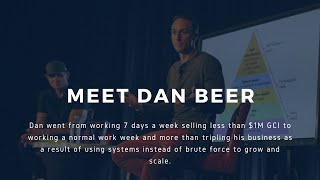
Interview (July 2019) with Dan Beer of the Beer Home Team (eXp Realty, San Diego). Dan describes scaling from a small team in 2014 to a ~30-person, fully leveraged team and closing 303 homes ($215M) in 2018. Key themes: tracking ROI and precise lead-source attribution, adopting direct-response marketing (influenced by Dan Kennedy), building operations and compensation aligned to activities, delegating time-consuming work by valuing one’s hourly rate (target ~$250/hr → $500/hr), and the role of coaching (2014–2016) and peer networks in accelerating growth. Practical tactics: unique phone numbers per campaign, direct-response ads that drive immediate response, rigorous tracking of conversion by source, and elevating marketing quality to achieve outsized returns.
Questions this video answers
303 homes (closed out 2018).
$215 million of business (2018).
About 30 people ("30ish person company").
May 31, 2014.
Approximately $700,000 average price point (he cites 715k).
All right, everyone, I'm super excited today. I've got Daniel Beer out of San Diego county with us and I got the pleasure to hang out with Dan and work with him. This is going back to the early days of real estate B school and I thought it'd be fun to get Dan back on here just to share his. He has grown in massive ways since those early days. And Dan, why don't you give like 60 seconds, like just introduce yourself where the team is today.
Also, yeah, Dan Beer. I run the Beer home team at EXP Realty in San Diego, California. So if there's anything you need in San Diego, by all means, a little shameless plug. We are a 30ish person company today. Ours, which is different from when we met. I think we were about three or so back then. But we'll get into that in a minute. So. So yeah, we're about 30 or so people, plus or minus one or so, depending on the day and what's happening within the business. We just closed out 2018 with 303 homes sold and $215 million of business. The team is structured with virtually any position that at least popular position or well known position out there, meaning everything from showing agents to ISAs to fully built out operations team. Operations director. We have a really cool new role which is our agent and client experiences manager. She does a lot of awesome stuff, but just trying to give you a sense of the fact that we have all of the different positions. They're here. I call it a fully built, fully leveraged team. We have general agents, not buyer agents, and listing agents, we used to have that. We now have agents that are simply agents, though we still do maintain a company listing agent position which is kind of its own little separate thing. But all of our core agents can do both sides.
Awesome. And Dan, when we met back in 2000, like early 2014, what did you want to achieve when we first got together?
Yeah, you know, it's. I don't think it's that deep beyond. I wanted to grow. I wanted to. I wanted to grow. And I, I know that growth doesn't just happen by showing up to the office and necessarily like pounding the phone harder. Don't get me wrong, that's not to say, you know, that's not to say that you don't have to go and do that, make your calls and do your, you have to do all of that. But if you're only doing that in a vacuum, outside of actually expanding your mind, your circle of influence, then it's not it's only going to go so far, right? Because then it's just based on you and how smart you are. And so I knew I needed to go get. Surround myself with other smart, smarter people. And that was the goal was really just stimulate ideas, stimulate my mind. And from a practical standpoint, I knew I needed to get just better systems in place, which I hate to even say that because it's such a generic thing to say, but I was at that stage in my. In my growth where sales had accelerated well beyond any kind of business platform that I had built. I hadn't built any business platform. I was just going as fast as I could go. So I needed to really build out the foundation of what could look, you know, what could actually what could eventually become a business. You were the master at that, right? I mean, that's what you were known for. So I reached out to you, actually, you know, who you have to thank, by the way, just to pause for a minute. You have Buddy Blake to thank. To thank. Because Buddy, I was chatting with him, and I'm like, man, I've heard of this Lars thing. Heddenberger, trying to pronounce your name, Lars. I couldn't do it. And I said, oh, Lars. You know, long story short, because I won't lose time here. It was pricier than, like, traditional coaching that I had been exposed to. And I don't know, I think you might have different tiers and models now, but back then, at least it was for me. But thank God, Buddy got me out of the mindset of just being focused on what you're paying versus what you're making. And he told me, dan, you have to do it. It's worth it. And he was right. So, Buddy Blake, awesome.
Go back to that time in 2014. Fifteen, like, personally. And as the business sort of fed into all the areas of your life, what were the problems you were facing?
14 and 15. So, first off, my son was born. My first son, my oldest son was born on May 31, 2014. So that was going on. I was working at a pace where literally, it was just based on. Yes, we were. I was growing, but it was really just based on, can I work another hour? Definitely. Life back then looked like there was no dinner party or date with my wife or really anything that was sacred to, you know, and protected from having to grab the phone and runoff and break plans and. And so, yeah, you know, I could start. Could feel the stress starting on my personal relationships, particularly my wife, and particularly understanding that I had my son coming. So That's, I guess that's the mindset or the, you know, personal side of what I was living with and struggling with. I also just knew whether, you know, I'm not sure if I ever, like, necessarily articulated it, but at a subconscious level, for sure, I understood that there was only so long I could work at that pace, and there was only. So. There's just a lot. So long I could do it and so much I could grow because it was all just based off of me. So I was in search of, like I said earlier, building a real business foundation. And you definitely, you know, you went through the same thing I went through Lars, but you were simply a few years ahead of me, your evolution. Right. You were maybe, what would you say, maybe three, four, five years ahead of me in your evolution? Maybe five or so. And so. And that became a model for me.
Yeah. That's awesome. What would you say that, like, the three big focus areas that we spent time on back. Back in 14, 15, I think we, I think we ended working together formally in 2016. But what, what. And I'm going to ask it this way, so what focus areas did we work on? Like, let's pick three that are still part of your world today. Like, man, I still remember that Lars impressed this upon me. Or like, what are the lasting effects of our. Because it's easy to just say, okay, well, Dan Beer, I work with them. He sells a gazillion homes, like you should too, you know. But what are the things that are really lasting in your business that have really made an impact for your team members, for you that are, that are still part of the world?
I'll go through the ones I can think of without getting obsessed on making sure I come up with three, because that's just. My brain will work better that way. So number one is the finances in the business. As simple as this might sound, though, most agents watching this, if they're honest with themselves, they don't know what their ROI is on virtually anything they're doing in their business. And so we nailed in that business tracker that you had, and that was a really important tool for me. So it's. Ever since then, I've become hyper obsessed with what is the source of everything. I just had a meeting today with the team where I reminded them, guys, you're sourcing a bunch of deals. Seller side deals. The San Diego Home Finder, that's our website. I said that's rarely the source on seller deal. Almost never. It happens from time to time, but almost never. The real Source is they heard us on radio and then they googled us and went to our website. That's how they got there. But the source was radio or the source wasn't website. It's that they got our postcards for three years and then they googled us, ended up on our website and then inquired on a form there. But just because they filled out a form on the website doesn't make the source a website. The source was farm, the source was radio. Source was typically something else on a seller deed, seller deal. So anyway, I got really obsessive about the source of a deal because that allows you to actually track numbers. That allows you to invest more into what's working, it allows you to pull back from what's not. And sometimes you have something that is or should be working but stops working quite as well. And then you get to analyze is the source no longer as good or do we have to actually run a different conversion cycle on it or do we have to communicate through different mediums as the world has the world changed? Do we now have to add a messenger touch in addition to the phone call? I definitely got very obsessive about return on every lead source, tracking it, tracking phone calls to every source. So there's another one. If you look at my marketing now bars, I actually teach what I call direct response forming that direct response world. Everything that has to do with direct response, just my exposure to it. It started with you. So everything, basically everything Dan Kennedy right.
On down give like a 60 second lesson on direct response. So what's wrong with like 99% of what agents do and what is right about direct response?
Yeah, it's, it's. Most agents are, you know, we're all small business people, right. And not, not all of us went and got some big mba. And if we had gotten the mba, maybe that even damages further because what we were watch looking at it that you know when we're getting this MBA is we're studying companies like Budweiser or like Nike who can afford to put marketing out there that just simply. It's like three croaking frogs and that's supposed to win business for us or Nike who could just have a guy run through a field and then put their logo up and there you go. Well that works potentially when you have a multi hundred million dollar a year marketing budget. But for the most of us we don't have that. We have money that has to be deployed and it has to create response today. So if you want to think about what a direct response marketing Ad would look like. If you remember the company Proactive, the Acme company, they are a direct response company. They did a phenomenal job of using all direct response laws, so to speak, in their marketing. So you'll notice that they used infomercials as their medium, but every one of their dollars ever spent on marketing was created so that as soon as that played, someone would call and that's what they were tracking from every one of their ads would lead to response to sale. So our marketing as agents has to lead to response. We can't just afford to put postcards out that tell the neighborhood that we're the neighborhood specialists, you know, and call one day if you'd like. Or they, or that, you know, hey, I'm a neighbor so you know, you can trust me. And all of those kind of generic, light, fluffy, all that generic marketing, you know, just brand exposure. If you have a massive, way bigger than my budget, not many do, maybe you could go for it. But the rest of us, we have to get response now. Once we have response, we put them into our, into our CRM and into our marketing program. Right. Internally. And now we start brand building with the people that have actually responded to us. So there's a 30 second version, but you could go, you know, there's unlimited amounts of books. I'd start with Dan Kennedy if you're interested in it. But what I can tell you, if you're watching this, Lars, the core of his marketing programs, because I've seen them for years, they're based in direct response. If you go, pull up the top 150 or so in Wall Street Journal and you look at the teams that are ranked there, they are based mostly in direct response, especially the ones that are doing a lot of units. Maybe not the few that are, you know, selling 10, 20 homes on the beach and they're all $30 million houses, but the rest of us, direct response. So something you might want to study.
Yeah. Awesome. Any other areas? Anything in the backstage that operations or anything?
Yeah, well, I'm sure there is, Lars, for sure. The way we still run Dialogue Tech, right. Like a unique phone number on all of our marketing. Again, that's a direct response element. Getting very close to the numbers. You know, I'm not going to be successful at putting it into very specific words because at this point, and so much learning that I've done with you since you and from all kinds of different places, but I know that it's all been congruent with what I learned with you, which just even the way that you structure employee compensation, the way that you hire people and actually align their compensation to the activities that you're looking for them to deliver. Right. And there's something that a lot of us mess up, especially with early hires. Empowering employees, having a proper organizational structure where, you know, if you've hired somebody to do a job, you actually give them a space to do it. Those things truly do go a long way. And that's in our business. Absolutely. Today. And like I said, I can't necessarily articulate it beyond the fact that I know that it's all been congruent, rooting back to the days we spent 2014-16.
Yeah, awesome. What? Talk about the results. So you talked about, you know, in 2000, when we first met, it was, you know, you were hard charging. There was no. The only way you can earn more money was by putting an additional unit of time in. Talk about time, money and stress and the evolution of that in terms of the results you achieved. At what point did you make the shift delink time for money and just know that there's higher and better uses for you in the business. Talk about that in terms of the results.
That's actually a book you recommended to me. It was Dan Kennedy's, no bs Time Management for Entrepreneurs, which is just a phenomenal book. There was something about it that made a difference where we all know, either at a conscious or subconscious level, we all know, and we all agree with the fact that if you want $100 an hour, you can't do $20 an hour work. Very simple concept. Everyone says it, everyone agrees with it, but very few actually live it. Like really, really few live that. And so something happened to me in reading that book that if you've ever tried to either start working out and you've gone through sometimes even years, potentially of starting to work out, to where all of a sudden there's just something that clicks inside of you. And now you just wake up every day and you work out and. Or you've ever tried to start eating healthy or quit smoking. There's that moment where you knew it for years, but there's this moment of decision where your chemistry changes and now you just take on that new behavior. That book did it for me. So something clicked and my chemistry changed and I became incapable of doing anything that was outside of my perceived hourly rate that I wanted for myself. To the point, Lars, where if I'm stuck somewhere outside and I need to get a ride to whatever place. Cause I need to be somewhere. Let's Say I don't even need to be somewhere. Let's say it's actually, it's not even an appointment. I just, I want to go somewhere. And a friend calls and says, oh, I'm on my way there, I'll be there in 20 minutes versus how much will the Uber cost? I mean I start calculating this, I'm like 20 minutes free ride, $20 for a ride, it's gonna save me 20 minutes of my life. I'm in Uber. So like that's how much it affected me.
Yeah. And I think it's such a good point. I don't think a lot of people live it. My first number, I want to actually ask you what your number was. Mine was 250 and that made $250 an hour. I wanted to make, I wanted to, you know, pre tax 500 grand and I wanted to work a 40 hour workweek. It's simple math. And then it just made everything so clear to me. I'm like, wow, there's like no job I need to do my company, you know, I could basically hire out every piece of everything except vision, you know, culture, leadership, those sorts of things. So what, what was that math for you when you, when you did that, that exercise?
Yeah, I wanted to also like you, I wanted to net 500,000, which is roughly a 250. Right. So $250 an hour. It went from there to wanting it to be $500 an hour. The truth is I haven't really moved it since then and I'm not even sure if it's necessarily important to like, would I actually do something different if I moved it to 600 versus 500? It's gets the point where.
It'S important to recognize it.
I'm thinking about it on a consistent basis. Right. Like literally anything I do, if I'm going to take a flight and it's 300 more dollars for the direct flight, but it's going to save me four hours of time and I'm like, cool, I'm making money and I get the direct flight. So that translates back to when you're at the office. It actually, it ties back to something I said earlier, which is how do you actually empower employees to do what they're hired to do? And it's because you have a really strong connection to this concept where not only would you be doing the wrong thing on a human level, on a, you know, giving them the right working environment level, it's not only is it the wrong thing for the culture of your Company, but it's also a wrong thing in this. In this dollars per hour analysis that you're now committed to. So it makes it easier to give people the space to work. Yeah.
Awesome. So when we first started chatting, what in your mind, you know, because it definitely is not the cheapest option and it's not traditional coaching. What were some of the objections you had when we first got started? Like, I almost didn't join because, you know, what comes to mind?
Well, two things come to mind. So one, one's money. One's money. Because again, I don't know what tiers or whatnot you have now, and I think you might have a few options. Am I wrong? Do you have a few options now?
We only have three levels now. Undergrad, grad, and boardroom.
I know you have that now. At the time, it was one level and it was basically all the grad level. And, you know, so it was, you know, at least it was just more than I was accustomed to. And the only real reason that was the problem is because of what I had was accustomed to. I was. I had been exposed to a couple of other coaching programs and they were just nowhere near what I was wanting them to be. Right? So then it says, so then the idea was, okay, let me pay more. Even though I've had a bad experience in the past. And the reason I had a bad experience in the past is because I just didn't know a lot of what I didn't know. I didn't realize when I joined certain organizations that they were really just built for the absolute masses. They were very. They were built to be at a certain level. I just. And you know what, even having said that, not to tear them down, I won't name them. But reality is too, is I didn't even have the discipline to at least implement what I was learning there, because had I, it would have still been profitable. But so, yeah, when you combine the fact that I had this like very fluff filled previous experience and now it's going to be more expensive. I don't even like that word. It's gonna be a bigger investment then that was the hesitation. Buddy Blake and I had a call, you know, at that stage in my career, and it's something I've definitely continued until now. The one thing that it was, it was Buddy happened to be the guy. But the reason he was the guy is that I had taken steps to continuously put myself into certain rooms and make sure that I was in relationship with certain people, certain agents, and when. And those people all have a mindset that doesn't allow you to think small. Right. Like, every move I make, everything we do, the current mastermind that I've built, everything, it's all based on the concept that I need to be surrounded by people that are going to push one another and that are production focused, that are going to want to grow. So those were the two objections, Lars. But Buddy got me through it. I made the investment and it was different. It was very different. It was like we were actually building little components of the business that when you stack them all one on the next, created a platform for you to be able to scale. To be able to scale your operation.
Yeah. Let me ask you, what were the favorite parts of the time we had together? When you look back.
I always think about the first. The first intensive that we had, you know, and that was just awesome, man. It was 30 or so of us. How many, how many, how many at your intensives now? Which, by the way, I intend to go to one. I can't go to the one that's upcoming right now, but I'm gonna go to the next one as a.
It's only like, it's always 13 people in that first room.
It's. That was a lot of fun, man. And the quality of who was there still. I have at least three or four, five, six relationships from that room. That was a. That was a lot of fun. What else stands out is, you know, the other thing that just kind of spins in my head is you would tell me that I was gonna do 200 deals one year, and you were telling me that, though, when I was at about 60 deals and that seemed just so far out there. It seemed, it seemed on the border of what wasn't possible. But I think you, whether intentionally or not, you intelligently pick the very smart number, because that was about the biggest number I would sort of kind of believe, like if you'd said 300, I would have thrown it out the window. Now forget it. Lars is crazy. It was like right on the border of what I was willing to believe. So I think about that. And of course we did not 200 deals this past year, but 300 deals this past year. And that's at a $700,000 average price point, right? 715.
You know, I was just going to say for people that don't realize sometimes, I mean, doing what I do in my market is easy compared to the crazy hyper competitive market that San Diego. It's like when we're, you know, you guys are like five agents, five Six agents to a single listing. Yeah, it's like it is so lopsided the amount of people that have licenses in your market. And because everyone's just really, they're kind of doing something else and they're just chasing five commission checks in a year would totally make their year. So it's not.
Well, that's what happens in these high price point markets. And really it's a mistake. Seriously, if I could impart any kind of wisdom, something that's been a big impact on my business has been that I've said to myself, let's take a look at how someone has to work in a Charlotte or in a Phoenix and, you know, Omaha. How do they have to work, at what rate, what systems do they have to have to be able to carry that much business so that they can hit the numbers that I, you know, that I want to hit, but they have to do it with, you know, five, six times more bit more transactions. So let me study what they do now. People in my market, they say to themselves, oh, that wouldn't work here. We're too fancy, we're too educated, we're too sophisticated, we're too coastal, we're too whatever. Right? That's what they think here. I said, no, I'm going to learn how they work. I'm going to bring that here. And I think that math will be pretty interesting. If I work that way at our price point, I think I'm going to like that. Well, you might be looking at things that you might be dismissing. What an agent? Forget me. And 300 homes in San Diego you might be dismissing. With people in San Diego doing 30, 40, 50 homes a year and someone doing 50 years, a home in San Diego is a God. Okay, like that's a, that's a huge agent. And you might dismiss them though, as, oh, look at their price point. Oh, they could just get away with that. Oh, it's just so easy. You realize, Lars, everyone thinks my market, like every homes over a million bucks. It's not our average. Our median is 580. Yes, that's higher than most, but it's not like totally insane. Right? So you might want to study what we have to do with our competition level, with the level of quality that is demanded, the level of strategy that's demanded. The questions were asked by our clients, like how particular they are. You might want to study how we have to work. And then what if you brought that quality standard to your market and kept working at the pace you work at now you might have a real Edge on your competition, who doesn't think they have to deliver that. That level of. That standard of quality, that is a way for you to pull away from your marketplace and differentiate yourself.
That's awesome. And you mentioned there was like probably three of you on your team. It was. It was you. What was it? An admin and a buyer agent. What was the complexion of the team when back in 14, man.
I want to say it was. Gosh, I want to say that it was one agent, one isa, which I have no clue why I had an ISA at that size. That's like, doesn't make any sense. And then one admin.
Yeah. That's awesome. Yeah. So, I mean, this has been awesome. Your journey, I remember clearly you telling us that, and we've done that in parts of our team, is bring the luxury to the non luxury. And you can take, you know what's working to sell a thousand homes in Omaha, you know, you can take to San Diego to sell, you know, 215 million freaking. It's brilliant.
It's only marginally more expensive. Right. I mean, to get to not print on some flimsy piece of paper and instead print on something proper or to have twilight photography instead of daytime photography, just to make these small differentiating factors in your marketing and your look and your brand standard. It really isn't that much more expensive. And I can't exactly measure it, but let's just say for the sake of the example that it becomes three times more effective for like a 15% cost bump. Right. You're typically going to be winning.
Yeah. That's awesome. Yeah. So my only, you know, if you're listening or watching this, you know, and you're kind of at that point where like Dan was saying, you know, you can only kind of advance your income by grabbing one more unit at a time and you're struggling, you know, to make that math work, just go to realestatebschool.com there's only one way to enter a conversation with us, just through a strategy session. And Dan, I appreciate you and your time and just the advice that you've given here. I think it's been really cool. Thank you.
Yeah, brother, it's always good to spend time with you.
Yeah. We'll talk to you soon. See you guys.









