How Real Estate B School Got Started
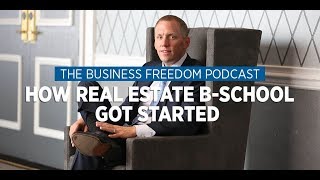
Lars Hedinborg left aerospace to become a top real estate agent, then started Real Estate B School to teach other agents how to build sustainable businesses. He built the company around authentic conversations and practical advice for team leaders, not hype.
Welcome back to the Business Freedom Podcast. Lars Hedinborg here, founder of Real Estate B School and co founder, High Performance Real Estate Advisors. We are out of Charlotte, North Carolina. Today on the podcast I wanted to take a stroll down memory lane. And I get asked a lot of times by folks that are kind of either new entering our program or just out and about when I'm masterminding with agents across the country. You know, why the heck did you start real estate B school or what? What was it about, you know, your situation or the industry in general? What motivated and inspired you to start Real Estate B school? And you know, I think it was like this when I got into real estate, where I didn't quite know what I was getting into. And you know, when I got into real estate, this was back in 2007. I got licensed in 2006. I got into real estate in 2007. And it was March 5, 2007 was my last day at my corporate job. It was a multiple six figure job I had with a company called Curtis Wright, Gastonia, N.C. actually started with their corporate headquarters in New Jersey. And I was transferred to Charlotte, North Carolina to assume a position in strategic planning and acquisitions. And it was an aerospace company. This was my dream job. I worked on Wall street as a financial analyst, a grunt analyst, not like a high paid analyst that's just analyzing stocks. I was just running spreadsheets and creating presentations for pitches for an investment bank called Bear Stearns. And so when I left that world, my perfect job was literally to work in corporate development for an aerospace company. Corporate development is acquisitions and strategic planning. So I had achieved like my perfect job. And here I was not being fully committed to it because I didn't see a path to time and money freedom. And I was sort of working for the man. And you know, I never really saw myself as an entrepreneur necessarily, or a business builder until I remember it distinctly. The guy that was running this division in North Carolina, he was the one that recruited me from our corporate headquarters. And pretty quickly or pretty soon after I moved down and I assumed this new position for the division, the aerospace division of this company in Charlotte, North Carolina. He got diagnosed with pancreatic cancer. And he was like mid, maybe early 60s, and he, I think he only lived like four or five months. So here's a guy with a 33, 34 year history with this company and he had just gotten to the point where he was promoted to run this division and he was having a good time. He sort of had arrived at a position Financially and, you know, position in the business where he had some influence and he was just having a great time. And he sort of relocated lots of times to lots of different divisions and assumed different positions in his journey in climbing the corporate ladder. Ladder with Curtis Wright. And here he was. I think it was less than a year after he bought his retirement home in Hilton Head, South Carolina, that he got diagnosed with pancreatic cancer and he passed away. His name was George. And this was a pinnacle moment for me where I realized that I cannot do that. I cannot work 30 plus years and just hope that there's this sort of light at the end of the tunnel. And that sort of motivated me. At the time I had relocated from New Jersey and I sold some investment properties up there when I realized that I wasn't going to move back. And I started investing in real estate. And I got to know a local broker, helped me buy probably eight or nine different properties. I sold at the exact right minute in New Jersey where literally in like less than three years, I think I made like 404, no, even more like $500,000 of increase in value in the properties that I had in New Jersey. And so I just got to know this broker, his name was T.J. larson. And he just kind of asked me, like, you know, why don't you, Would you ever consider a career in real estate? And so I hadn't, and I did. And, you know, it was probably less than a year after he planted the seed that I was doing real estate. And so the point of that story is that when I got into real estate, I didn't quite know what I was in for. I didn't know what the actual job of a real estate agent was. In real estate school, you're not taught that. You're taught to stay out of real estate jail. And so my journey, you know, I was married in 2006. We had our first child in 2007. A couple miscarriages my wife Julie had. And then we had Kendall, our daughter in 2010. And that's when I was building my real estate business. The first year I was doing it solo. Then I hired an assistant part time, and two weeks later she went full time. That was early 2008, 2009. I hired my first buyer agent. In fourth quarter 2010, I hired three or four more buyer agents. We went from 58 to 118 to 178. And I was just committed to building it like it had a life outside of me. And so I didn't really have the idea to eventually teach others how to do what I did. The journey, and this is the number one reason I started real estate B school is the journey for me from new agent to very quickly top producing real estate agent. I sold 45 homes. Yeah, 45 homes. 44 homes in my first full year in real estate. And that was top producer in my office out of, I mean I was in a big REMAX office at the time and people were like, what, how, like how are you doing that? And then we went to 58 sides and then 118 sides and the journey was really hard. I did have real estate coaches, although they hadn't done the thing that I was looking to do. I was looking to build a sustainable, systems driven, profitable business. And most folks that I had come into contact with, they really didn't have a real business because they still had to sell a lot of real estate. And then they had some agents around them and it was like this loose collection of stuff. It wasn't necessarily consumer facing. They had their client base and it was just weird. It struck me as very odd. And the good thing is I didn't bring a lot of baggage into real estate. Like someone who's been in real estate forever for 20 years, like it's always been the way it's been and it's all about splits and you know, you're not really building anything that, that, that sort of blows away the clients that you're working with. And so the first reason I started real estate B school is that the journey was really hard for me. You know, I went from 118 in that third year, I guess the first full year that I had a team, we did 118, then I did 178 and then 248. In that 178 to 248 transition, that's when I was sort of going from seven days to five days to three days a week. And then we did like three, 10 and 400 plus. And that's when I really sort of laid on leverage and systems and tracking and learning how to lead and manage people and hold expenses accountable and people accountable. And it was just a complete crap show for the most part of the early years. And then it really started to settle in, into a cadence and a system and things were happening really, 99.9% of me being hands off of all of it. And so I spent a lot of money on coaches. I got a little bit from everybody, although nobody really had like the true path, like a real roadmap. To building this thing, to to be independent of me. And that was really what I wanted. I saw myself as a business owner versus a guy that was kind of doing the thing, you know, E. Myth. If you read Michael Berger's Berger, Michael Gerber's book, E. Myth Revisited, it's technician, manager and entrepreneur. I really saw myself as an entrepreneur and I wanted to build something that had a life outside of me. And I was focused on returning versus doing the work of a real estate agent. So that was number one. The journey was really, really hard. And then I touched on it. There was a lack of knowledge and understanding around all of the elements that have to go into place for a real estate team to be a real true business and the team leader to be more of the team owner versus a sales leader. A lot of the real estate teams at the time that I saw they had made the shift from real estate agent or top producing real estate agent into sales leader. And so all they were really doing was they were just leading a sales team. They hadn't made the shift to, you know, manager to leader to business owner. There's like kind of like five steps that you need to go through. Top producer, you need to be a top producer before you bring people into your world. Then you're like a sales leader where everyone's shoulder to shoulder and you're just kind of showing them what you figured out. Then there's manager. A manager builds systems and hires people and they hold people accountable to the systems they built. And then there's a leader that maybe there's one or two other people in your business that have stepped up, they've taken on some management responsibilities and now you're able to lead more so. And typically there's a backstage manager and a front stage manager, one for operations, one for sales. And then ultimately, really and truly, I want it to be a business owner. The business owner has leaders in place and managers in place and they're sort of running the business from afar and running it based on numbers, leading and lagging indicators in the business. So I didn't see a whole lot of knowledge or understanding around that journey. The full on like 5 step journey to business ownership. And most of what was being taught out there was to make the shift from top producing agent to sales leader and that's it. It ended there. It didn't give you the training or tools and systems or implementation support to become a manager and build out systems and get people to run those systems. Because the people that were teaching me different things didn't actually know how to build the systems. And so I was able to struggle through all that and really make that shift from sales leader to manager to leader of everyone, a leader of managers to ultimately business owner. So that was the second thing that motivated me. Lack of knowledge and understanding around what the full on journey was to business ownership. And then the third thing that motivated me, and this is the number one thing that motivates me. Every freaking day I get up and not saying that I figured everything out because I certainly haven't figured everything out and I'm still failing lots and lots and lots. In both businesses, the real estate team and real estate B school, the coaching, training, implementation company. The third thing here is I see a lack of authenticity and I think it's just in general, in our culture, people aren't really leading with, you know, what their life is actually like. They're more inclined to show parts of their lives that are really sugar coated. And it's kind of like you've heard it before, you know, everyone on Instagram or Facebook or even in face to face conversations. For the most part, what I find is that they're giving their highlight reel the best of their business, the best of their personal life and they're not coming to those conversations with, here's where I'm struggling, here's where I'm really, I feel like I'm getting kicked in the teeth right now. And here's where I'm really, I've got shame, I've got, you know, things I need to work on. That's the conversation that I want to have with somebody so that we can move from where you are now into a better place in the future. And so I found that it's that it's the authentic conversations that I'm most attracted to now. You know, realized that I was stepping back into production again in another business. There are people on. Stacy Peterson was my first client ever. She's full time real estate B school. And we've sort of grown this team to 11, I think 11 or so, folks. Now we've got four business coaches that have all done the thing that we teach. They went from top producing agents to sales leader to manager to sort of team leader to business owner. And so I'm sitting from a different perspective now and I'm still involved in aspects of this business that aren't quite leveraged. And I really love them because it's on that last point about having authentic conversations about where you are now in your real estate business. And that brings me to my very Last point, The only thing I have to offer you, conversation about where you are now, an authentic conversation about where you're struggling. You know, what's not working also what's working, what are you doing really well? What opportunities do you see for the future? Then we'll have a conversation about what that future looks like for you three short years from now. What's possible with your real estate business? Time, money, stress. That's the equation. I want time and money freedom and no stress. That's my goal in my business, how my business serves my life rather than enslaves me like most real estate team leaders. And so if that's you, if you just need to have an authentic conversation about where you are in your business and you've already gone down the path of building a real estate team, you know, I like to say that sort of the folks that I have great conversation with, it's up to 5,6 million GCI. Really, it's that 500 to a million GCI where you've got a key administrator, a couple three buyer agents, and you're sort of struggling to launch this thing. You're still heavy in production, you don't know where your expenses are, or you've set up the wrong model where it's more like a brokerage than a real estate team. And you're still sort of spinning your wheels because time and money freedom are not even a thing in your world and you're super stressed all the time. So if that's you where you don't have any time, you don't have any money and you're stressed, or you have no time, you have a lot of money and you're super stressed. Either way, we want to figure out the equation that is the right equation for you that's sustainable for the long term. Go to realestatebschool.com that's all I've got for you. Book in a business growth strategy session. We'll get on the phone for 45 minutes and we'll talk exactly where you are now, where you want to go and what's holding you back. Realsdaypeacechool.com we'll see you guys there. Sam.









