How to Establish a Business Cadence That Drives Growth
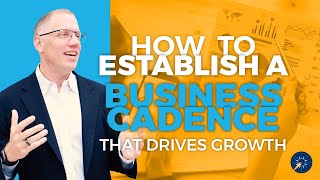
Speaker (real-estate team leader) explains how establishing structured routines and a consistent business cadence enabled the shift from solo agent to scalable business owner. He outlines a five-part approach: (1) a planning process (3-year vision → 1-year plan → 90-day goals → weekly commitments → daily cadence), (2) tracking meaningful KPIs (emphasizing "listings activated" as a leading metric), (3) regular meeting cadences (weekly sales, operations, full-team, and 1:1 coaching), (4) rigorous activity tracking (dials, conversations, appointments, follow-ups, signings), and (5) personal routines/structure that create freedom. The talk includes personal metrics (2008: 70-hour weeks, 44 transactions; later: 248 transactions with minimal personal closings) and a CTA to a free 15-minute training at predictablerealestatesuccess.com.
Have you ever noticed that any huge accomplishment, you know, in your life or in your business has come with a different set of routines or establishing like a different pattern in your everyday? And the same applies to, you know, going from real estate agent to business owner. It requires a little bit of different thinking and new routines and a cadence to allow you to make that shift. And so in today's video, I want to take you through what that looked like for me and the things that you can do to, to go from maybe you're even running a small team or you're just struggling as an individual agent and you want to make the shift to business owner. What is the cadence you need to put in place to be able to make that happen? You know, when I look at my real estate business and I think about like the pain I suffered in those early days and working seven days a week and just the grind that is traditional real estate, you know, I look back fondly and I wouldn't want to relive those days. And so this cadence for me was life or death. It allowed me to step up and be a better dad, to be a better husband, you know, to be a better man of God and just have a bigger impact in the community. And I want the same for you. Make sure you stay tuned to the end of the training we have. It's a free 15 minute training. It's on how to go from where you are now, predictably, to a spot where you have way more money freedom and time freedom. If you like the video, give me the thumbs up. Subscribe as well and make sure you turn your notifications on and also leave comments so we can go back and forth on some of this content and I can add value that pertains to you. So let's dig in. Let's talk about cadence and specific, specifically what that means as it relates to growing your real estate business. So I was able to go from, you know, let's say 2008 was my first full year of real estate. I was working 70 hours a week. It was seven days. As much as I'd like to say, I took Sundays off. I worked every Sunday, even if it was just on email or text or just doing stuff in the business, responding to deals or whatnot. Went from 44 transactions, you know, where there wasn't much of a cadence at all, to, you know, let's say three, four years later, I did 248 transactions where I only did one of those transactions myself. So the process of getting in there and the cadence that I followed and that my team members followed. And then they did it without me. Like it's this journey of I do it, we do it. So you're going to come alongside me, we're going to do it together. This cadence. And they do it and it's the same cadence throughout. And it starts with just figuring out what it looks like for you, where you are right now, and getting really clear on what the cadence in your business looks like. There's five things I want to go through and I want to slow down here so you really understand what I say when I talk about cadence. So this begins with a plan planning process. In real estate B school, we have a very specific process that I've been using for over a dozen years. I've consistently knocked down goals that I've set for myself. It's this three year vision, one year plan, 90 days, and then we chunk it down into weekly commitments and then our daily cadence. And so as you look at just where you are in your business, do you have a vision of where you're going? Have you broken that down into an annual plan? And are you living in a 90 day world? Are you making weekly commitments on what's important, what has to happen? And then do you have any daily cadence with a top three, a gratitude practice, you know, intention for the day, affirmations, you know, what does your daily cadence look like? So it starts with that. And this is if you're a solo agent or you have a team, if you're in production or out of production, if you show up to your office or you don't show up to your office, you have to lead in this area because your team members are going to follow you in suit in terms of having a planning process. This applies in business and also personally. So our team members have a 31990-you- know, and they break it down into weekly and daily. And it's for their business and their personal life. So you've got to get this straight for yourself before you can roll out to your team. The next thing is looking at meaningful metrics in your business. We call these KPIs key performance indicators or measurables. You know, what has to happen this month and then ultimately this week in your business for you to achieve your goals. You know, back in 2008, 2009, I started, you know, tracking, you know, in a goal setting type fashion. By month. I would have to meet this many listings or sellers. I would have to sign, you know, X percent of them and I would have to sell X percent of Those set, met, signed. So I would have to set enough appointments to meet enough sellers to ultimately list and sell the number of homes I wanted to sell. And if you don't have that process in place, if you don't have a goal setting process, specifically as it relates to what I consider to be the number one critical metric in your business, are listings activated? And if you don't have a plan, this doesn't get into the marketing part of it. More the cadence around like, yeah, I need to set this many listing appointments this week, I need to meet this number of listings, you know, and I need to sign and then ultimately get activated on the market and then, you know, go under contract. That is the leadingest indicator in your business. So you have to make sure you have this monthly critical metric which for us it's listings activated. And what is it for you? Stop and think for a minute. What metric are you willing to just live and die by in the business? So that forever and always, obviously I recommend that it's activated listings. Everything comes good from listings. But where you're at in your business, what's the most important metric you can start not only tracking, but also forecasting and setting goals around? Next, we have to consider, once people are in our world, what's the meeting cadence we're going to have with team members? You know, on our team we have a sales meeting, an operations meeting and a big team meeting. So everyone comes together once a week. And then front stage, which is sales, comes together to solve problems once a week. And then our backstage operations come together once a week. Even if it's just you, an administrator and a buyer agent, what is your meeting cadence? How are you meeting? Probably all three of you could meet in one meeting a week just to commit to moving the business forward. And then if you have team members that need to be developed, which every team member needs to be developed, what's your cadence? Meeting with them one on one and coaching them. You know, this meaningful interactions with your team members to move the business forward on the one hand, but also to move their career forward. You know, they're placing their trust in you by joining your vision to grow this business. And you need to make sure that you're providing a Runway for them to be able to succeed. They can't see this like no Runway ahead of them and a cliff at the end of it. That's what it feels like to be on some of these real estate teams where there is no development plan, there is no meeting cadence. You're not really providing much Value because you're not coaching them and giving them a cadence and a structure where they can see the vision and they figure out or they realize how they fit into that vision. So ask yourself, if you have an administrator or a sales team, what is your meeting cadence? And if you don't have those individuals right now and you aspire to start holding a weekly meeting with yourself, we call it a clarity break. You know, you're going to meet with yourself and talk about what's working and what's not working in the different areas of my business. Right. With respect to attracting new business, converting new business, diversity, delivering to buyers and sellers. You're planning your metrics, knowing your numbers, your growth plan for your team, what's working and what's not working in the business, your personal routines, your habits, were you doing really well and where are you struggling? You have to be willing to look at those things as well. And the last thing that is super important as you look to build a business that has a life of its own is just being honest around, you know, what's actually happening every day. And this is where you need to lead in tracking. This is one of the most painful things you'll do because numbers do not lie. When I was a solo agent, even before I hired my assistant, I was tracking, you know, how many dials I made, how many people I talked to, how many appointments I set, how many followers follow ups I put into the database, how many people I met that day, how many I signed. I was really intentional around tracking. And it wasn't a complicated tracking system. You know, a business can't scale if it doesn't have a cadence, a tempo, a commitment to tracking. And you're fooling yourself if you think you're going to scale out of being a solo real estate agent to building a team. If you're not sort of keeping track of your own efforts, you need to be able to lead folks, agents that join your team with you know that for every 32 contacts on this lead source, I set an appointment. 80% of those appointments I meet and I sign 82% of them. You set the bar with tracking your own efforts. And if you don't commit to doing that early in your journey, the chances that you put a cadence in place, that has a life of its own, it's really hard to envision that because you're not doing the work in the early stages to set up those systems. So my question for you, as you look at where you are in the process, where are you struggling with cadence where are you resisting to putting routines in place? You know, where are you just not willing to be honest with yourself that cadence and structure will lead to freedom? It's this like oxymoron, right? I don't want to be held back by a calendar or time blocks. I don't want to track. I don't want anyone to know my numbers, right? Structure and cadence leads to freedom. The reason I can take 10 to 12 weeks vacation, I can work 3 days a week consistently, I can make the kind of money I want to make is because I have submitted to cadence, routine and structure. So the question is, are you willing to do the same? If you want to know sort of more in more detail what the steps look like, you know, I talk about drivers and accelerators and I talk about this predictable path to Success, go to predictablerealestatesuccess.com I give you a free 15 minute training, which is a deep dive into, into the tools and systems that you'll need to go from where you are today, which if you're watching this, it's likely overworked and underpaid to building a business that gives you time and money freedom and also freedom from stress, which is just the craziness that we endure in this industry is just unbelievable. So go to predictablerealestatesuccess.com or click on the link below. If you like the video, please hit the like button. Make sure you subscribe and also turn notifications on. And as always, please leave me comments. I enjoy doing these and challenging you and I love to hear from you. So until next time. We'll talk soon.









