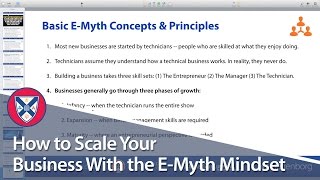
A business owner explains the E-Myth framework: the technician does the work, the manager organizes it, and the entrepreneur builds the system. Most founders get stuck as technicians and never scale because they don't shift their mindset to work on the business instead of in it.
Foreign. Let's get into one of my favorite books. So it's one of those books, sorry for jumping away that I I keep real close to my desk. Super cool read. If you haven't Reddit, you're crazy. It's the E Myth revisited. So this is the whole on versus in. If you haven't read the book, you know when people talk about working in your business versus on your business, that where that's where this comes from. And I'm just going to read some of the main points and I'm going to try to kind of talk about, you know, how I adopted really this is a mindset deal as far as a way to think about your business, especially as you begin to build it out and scale it. So I'm going to read these main points here. So the E Myth, or the entrepreneurial myth says that most new businesses are not started by entrepreneurs who set out to build a strong business, but by technicians who enjoy the hands on work themselves. So for us that's the the doing the deal, working with buyers and sellers. Because of that natural bias, most business owners focus working in their business when really they should be working on their business. There is however, a simple and effective way to offset the E Myth tendency. So that tendency is working in versus on instead of looking at the business as a one off operation. So the only one of its kind, the owner should consider the business to be a prototype for a large number of franchises that will be added at a later stage. Even if you have no, and I have no desire to recreate, I've been asked plenty of times by plenty of people can, can you just. We'll just be partners and we can do the large group in, in my market I have no desire to do that. But I built out a prototype, a franchise prototype and that's what I offer here in business school and in my consulting is I'm going to give you the franchise prototype. But you have to think about your business in a way where you're building out a prototype for a large number of franchises. By adopting that mindset, the business owner will not only participate in the business as a technician, so you'll still might be working with buyers or sellers, but, but you will also act as a manager, you know, putting systems in place and controls in place and as an entrepreneur having the vision of how the business can create sustainable added value for all key stakeholders. Stakeholders being your employees, your clients, and hopefully you won't have any investors or any equity holders. I do not recommend partnerships in real estate companies A business that is built and managed by someone who combines the approach of the technician, the manager and the entrepreneur. So the technician is doing the work, the manager is putting systems in place, and the entrepreneur is casting that vision of building a business with sustainable added value. So the business that is built and managed by someone who combines the approach of the technician, the manager and the entrepreneur will have a far greater chance of future success than one guided by someone thinking like a technician alone. You could think of dozens of different industries that have technician based businesses. There are accounting firms that have, you know, one office where the guy does all the tax returns and his name is the company name versus, you know, accounting firms where the guy is doing no accounting work and he has 12 junior accountants working for them. There's H vac company in my market, that's a huge, huge company where the owners don't go out on any, you know, cooler. My air conditioner is broken down. And then you have guys that are literally going on every service call. And so to think like, to adopt this different mindset is super critical if you're gonna come with me along this path of building a sustainable business here in B school. So let's kind of dig a little bit deeper here in the basic E myth, concepts and principles. Obviously, I recommend you read this book, but if you don't read the book, I need to make sure you get these basic principles because these simple thoughts will shift your entire thinking about your business and why you're doing what you're doing. So most new businesses are started by technicians, people who are skilled at what they enjoy doing. So this is, you know, an agent who gets into the business. They're selling 25, 30, 35, 40 homes. There's bursting at the seams. They hire an assistant, they give them no guidance, no systems. They hire a buyer agent because their wife is pissed at them or whatnot. I mean that's. Most businesses are started that way. Technicians assume they understand how a technical business works. In reality, they never do. So they're not business people. You have to make a conscious decision to be a business owner. It doesn't happen just because you're good at doing the technical work. Building a business takes three skill sets. We talked about them on the last slide. The entrepreneur, the visionary building a business that adds value systematically and sustainably. The manager, the person that puts in the systems and controls, and the technician, the person that does the art. The person that is really good at working with buyers and serving buyers, and the person that's really good at getting sellers to make good decisions on price and to seeing the value that you provide versus other agents in your market. See, those three independent skill sets must exist for you to build a business. Businesses generally go through three phases of growth. Infancy. And this is when a technician runs the entire show. So for me, this was 20082009 expansion when better management skills are required. This is 201011 for me. And maturity, where an entrepreneurial perspective is needed. And this is where we are currently. And you know, my business, if I defined it differently, you know, I could argue that we're still in our infancy. But for where I see my business ultimately going the 400 to 450, 500 sides max, we're pretty much where we need to be as far as maturity level goes.