A spreadsheet-based method for tracking your net worth by listing assets, subtracting liabilities, and monitoring progress toward financial goals over time.
Questions this video answers
Over $10 million in liquid net worth by the time he is 50 (excluding the value of his businesses).
He uses approximate cash-flow multiples: about one year's cash flow for the real estate business and about half a year's cash flow for the coastal business.
A low revolving balance of about $10,000.
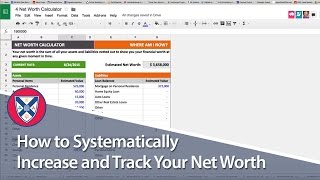
Foreign asks a question, do you use a special type, form or process to track your net worth and what metrics do you use? So let me show you in business blueprint, in your drive under business ownership. I put a net worth calculator in there. So this is very, very simple calculator. So you go in here, you put in the date. It's basically going to estimate your net worth. So the house I live in is probably not even worth that. Probably 525 automobiles. We own two automobiles. They're probably worth 60,000. You know, you just make jewelry, furniture, electronics, any other personal assets that you have, cash or cash equivalents, whatever you have in your checking account and your savings account. I think right now we've got about 425 here. So you know, call this 225 and 200. That's about the cash I have on hand right now. Retirement accounts and individual stocks I just put in, that's about 5:50 and then I just put in some money here. So I think this is just over 925 for your company. You know, I'm conservative on the value of my companies. My coaching company is not fully leveraged. If I wasn't here, it would not stick around for very long. So the value is not a whole lot. My real estate company, I could leave that company in pretty short time and there's some value there. But I'm conservative. You know, I put I think like one year's cash flow for the real estate business and like a half year's cash flow for the coastal business. So you'll have to make some estimate here of the value of those companies. And so that'll give you your total assets. And then this is the side that's interesting. So you really need to lay this out. We carry a mortgage on our house and no other debt. And the goal is to pay off that mortgage. But if you have any other loan balances, you list them all and your goal is to get rid of all of your liabilities. That's the goal for me anyway. And credit cards, I carry some credit card, but only revolving just to get points, you know, and it's not even a bright idea to even do that. But I just pay it off automatically from my bank account. And that's even a low balance. I think it's like 10, 10,000 or so. So you just do your assets less your liabilities and that gives your estimated net worth. And what I would do if I were using this tool is I would just add a column here. Yeah, I Guess you just insert three to the right so you can add a column to this. And when you go in here, you got to do file, make a copy and make it your own own and bring it over into your drive. So you can, you can just, you know, clear all this formatting out and then you can kind of do dates. You can go 8, 24, you know, and then write the number down. 3, 6, 5 8. 3658, boom, boom, boom. And that was my goal. And then just you know, track the numbers here or do it like this. And then you know, every quarter do it. Just give, put yourself a reminder, do it. And then here you want to see it go up. So you want to see it go 3, 8, 5 0, you know, and then you can do like a little plus minus between the two. And so I do have goals for me personally, people don't talk about this stuff like just simple net worth calculations and how important this is and just to do it systematically. So my goal for net worth is by the time I'm 50, I want to have over 10 million net worth and that doesn't include the value of my businesses. So liquid net worth stuff that I can get at pretty easily. So that, that's my goal. So I want to eliminate all my liabilities, that's my near term goal and just continue to, to take cash off the table. If you are scared of what this looks like and we use this tool in the boardroom and we're open about it, we share this with everybody. So everyone in the boardroom knows everyone's net worth. You have to be real with this stuff, even if it's negative, that comes up to a negative number here. That's okay because you got to get after it, you got to attack it. You can't just assume that it's going to get better. You got to consciously make a decision to increase your net worth. It has to be a goal. So I have goals quarterly to save to take money from my different bank accounts and get it off the table as I say.