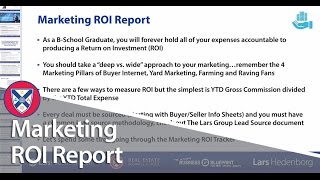
Real estate agents need to track where their marketing dollars actually go. Learn the four pillars of marketing, set up lead-source codes, and use a monthly ROI tracker to measure costs against closings and commissions. The lag between spending and results means you need consistent data entry to see what actually works.
Foreign marketing, ROI report. So as a B school graduate, you heard me talk about this many times. You will forever hold all of your expenses accountable to producing a return on investment. And that's where the term ROI comes from. You have to take a deep versus wide approach to your marketing. So remember the four marketing pillars. So it's buyer Internet leads, it's yard marketing, it's farming. And farming is, I consider farming expired FSBO and geographic and raving fans. And that's helping your agents get referrals and you getting referrals from past clients and your sphere. Those are four marketing pillars that you can go, you can easily do 200 transactions, if not 400, on just those, on just those pillars. And of course it takes time, right? So if you're like two years in the business, you know, when I was two years in the business, I didn't have many raving fans and the referrals weren't coming in. But now we're probably, I think we're at like 40%, 35, 40% of our businesses is from that source. There are a few ways to measure roi and I have a little bit more complicated way that I than I do it now than I used to. But the simplest is to look at your year to date gross commission from a specific marketing source divided by that source's year to date total expense. So it's definitely not perfect because you know, you're spending money, you know. So I started a new farming piece and I'm at the point where I can afford to start a farming piece. So it's a 10,000 home area. That's super high price point. And we're doing a newspaper to this geographic farm. So for me to measure the ROI now it's as we're just getting it out there and we're getting inquiries, but we haven't listed properties yet. It's not as meaningful because there's a lag. You know, even the money we spend on our expired mailers, you know, the expired mailers that go out now aren't going to, the checks aren't going to be cashed for two, three, four, six months from now. So but it's the only measure we really have. Every deal must be sourced. So this starts with your info sheets right in the Dropbox, in the different, in the listing packet folder and the buyer packet folder, you have buyer and seller info sheets. On each of those sheets you have a spot to put the lead source. You must have a common lead source methodology. Let me really quickly show you in the Business blueprint. You have this sources of business document here and we've updated this a little bit. We added a couple lead sources, but it has a numbering system for every code, a lead source code. And I recommend if you don't have a better way to do this, that you just adopt this, this, this way of doing it, you know. So our buyer Internet leads are all 100 series. Our yard marketing is 200 series. The radio expired FSBOS raving fan club. Those are our team efforts. And then you have agent efforts to get their SOI or referral business. We've got farming, so I just added that other farm. It's now 702 and, and then referrals to the company. And so this gives you a very easy way to track all of your business. So you must have a lead source document. You have a copy of mine, so you can use that as a guide. All right. Okay, I'm going to go through the marketing ROI tracker. Most of you hopefully have seen this, but I don't want to assume that you know how to use it. So I'm going to spend just a little bit of time here going through this again. All right, so each of these columns represents something that you're spending money on for marketing. The cost structure here, this is just the way that I kept track of kind of like what, what I included there or what I didn't include there. This number is actually lower. Now, we don't have an ISA associated with this, so this expense is actually, and we do less than 1500 pay per click. So I haven't updated this specifically lately, but that's just a description of what your costs are. And then this is just the actual number. So when I have a blue cell, that's where you're expected to change that number for the most part. So that's where you can go in and put your cost for whatever lead source you put up here. When you put the number of months. So you'll run this report monthly. So I've got a way that I do it now for my consulting clients. We have access to this business tracker, really cool tool. And it does it automatically. But for the purposes of this, you'll do this monthly. So now if you did this for June, you'd be at six months and it would take your $3,500 a month expense and it would multiply it by six to calculate the total investment that you had there. So this just hasn't been updated since February anyway. So you'll put in the closed. So the number of leads. This doesn't really do a whole lot, except track your conversion rate and you'll track the number of leads for the entire time period. So if you're a boomtown platform, you'll put in whatever leads you got between January 1, 2014 and June 30, 2014. If you're doing a six month period, you'll do the closed units, the the number of homes you close on this lead source, the total volume and the total gross commission, and it'll calculate the average price. Then you'll do the same for pending. So units or sides that haven't closed yet, the total volume and the total gross commission. The spreadsheet then adds, you can see these are in black. The spreadsheet adds the close and the pending, and it's these numbers that are used to calculate your return.