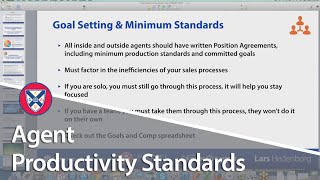
A real estate team leader breaks down minimum productivity standards: buy-side agents need 2 deals a month, listing agents need 3. To hit income targets, you need roughly 100 presentations a year to close 46 buyer transactions at $3,250 net each. The math uses a Goals/Comp spreadsheet to work backward from revenue to required presentations.
So let's kind of get into goal setting and minimum standards. So we went through the position agreement in Module 5 and on my team we have two sets of minimum standards and we, we absolutely hold to these minimum standards. And I encourage you to take a stance here with your team. I've seen teams, you know, with double the amount of agents that I have on my team selling less real estate than my team sells. So we're at, I think we're at about 215 or so sides this year and I have three new agents that have probably about six or seven sides. So if I take those out there, the new agents that are ramping up, we're probably at about 210 sides with seven agents so far. So was that 30 sides per agent and we're at mid year and that includes pending. So there's some, some sort of overlap there. But that's the kind of productivity that you should be striving for. So on our buy side we have a minimum productivity standard of two transactions per month and we look back 90 days. So there's six per quarter. So if you're selling 24 homes on my team, you're probably not doing that great. You know, you're not. We've let an agent go who was just sold over 24 homes and she just wasn't ever going to really kill it for us like we want. And then on the listing side, it's easy for our listing agents because we do so much of the process for them. But technically it's three sides per month or nine per quarter. But our listing agents will sell, you know, 50 plus homes easily. One will get to probably 75 homes or so. And I do believe that as far as far as goal setting, you know, even if you're a solo agent, so there are some of you here in real estate B school and you're listening to this whole team building, you know, these modules, and you're kind of scratching your head. But I've always focused, I mean, I've always forecasted my production and I've always set goals for myself. Without goals, you have nothing to shoot for, you know, so you need to set an annual quarter, monthly and weekly goals for every part of the pipeline. But it's important to take your team through this process. Surprisingly, your team won't do this on your own. So if you give them, and I'm going to go through the goals and comp spreadsheet here, but if you give them this spreadsheet, very few of your team members will actually go through this process, it's just a weird thing. It's part of the reason why you're so successful as team leaders because most of society in general just doesn't give a crap enough to plan out their life. So. But you're not that sort of team. You're a Super bowl caliber team. And your agents need to be dialed in on what needs to happen for them to be successful. All right, so this is in your, in your Dropbox. It's called agent goals Comp and Affirmations. And there's actually a few tools sort of embedded in here. This is a tool I used back in probably like 2008 when I was a solar producer. And I think I at the time I wanted to do 250,000 working X days per week, 10 hours per day, 48 weeks. You know, percentage of time on versus in your business. I would earn an average commission check at the time was probably about $6,000. We're at 7,500 now. So that's 42 transactions. You can do this as a solo agent, I guess is the point. Point I'm trying to make. And you know, so at that time I was probably light on the listing side. So it was 30, 70. So I had to sell 13 listings, 29 buyers and then it actually goes through. You know, of the 13 listings, I know that 75% of my listings sell. So you have to take 17, you have to take more than 13 and you sign up 2/3 of sellers you meet with. So you actually have to go on 25 listing presentations. This is a great exercise for everyone if you're solo, for you to do. But for every one of your agents to go through this exercise to see how these numbers and these conversion rates, agents don't put this stuff together. So if they want to sell, you know, let's put it, let's say you're a purist model like we are. You know, so you have an agent that wants to make, let's call it 150,000. That's a stretch for our buyer agents on our team, but it's doable. We're at about 7,500 average. So call that 3,750. Probably less than that. Call it 3,250 to them. So that's 46 transactions. So they'll net 3,250. There's no other expenses on my team. So call it 46 transactions. And it's all buyer side. So of buyers that sign, so a loyalty agreement actually buy. So we're probably running even less than that, it's probably 50 to 60%. You know, it seems like buyers for the most part are, you know, they'll. They'll say they want to buy, but then they end up not buying. And we sign about 90% of buyers we meet with. But for the purposes of this example here. So if you want to sell 46 buyer sides with the inefficiencies of signing someone to a loyalty agreement and then buying and your ability to actually get someone to sign, you need to make basically 100 presentations a year or two presentations per week. So that's kind of the way we boil it down to our agents, using those exact numbers pretty much where if you, you know, we'll probably give you an opportunity to sit down with a new buyer once a week. You know, team, team generated appointment or showing appointment, and. And then on your own, you need to come up with two to three legitimate new buyer consults or showing appointments. You need to be giving presentations, two to three presentations every week, to be able to sell 46 buyer sides at 3,250 per commission check to earn $150,000. So those are the numbers. If you've never gone through an exercise like this, those are the kinds of numbers that, that you should be well versed in and you should be able to walk your agents through. And this is part of the value that you add as team leader. So that's the first tab you can see down here, the first tab called Goal Volume Breakdown.