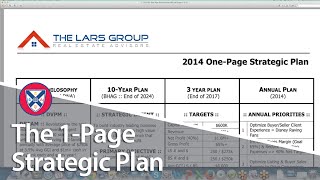
A narrated walkthrough of a one-page strategic plan framework (inspired by Verne Harnish’s Rockefeller Habits) tailored for real-estate teams. The speaker explains using a single-page document to align team vision (Dream/Vision/Purpose/Mission), a 10-year BHAG, 3-year and 1-year targets, quarterly goals, KPIs/critical numbers, departmental tactics, and SMART action items—emphasizing tracking, conversion, profitability (gross margins), and agent net income targets.
This really is your roadmap to success and it gets your team on the same page. So it's a common sort of way to let your team know what you're working at and what you're focused on and to let them know what you're focusing on in your business. So another really, really good book and a good website to jump on. The website is gazelles.com It's G-A Z E L L E S.com It's Verne Harnish and the book is Mastering the Rockefeller Habits. I know I have it on cd, I don't know if it's on Audible, but that is absolutely a book worth getting and reading. And it's almost like a one of those books that you kind of constantly go back to. It gives you and your team the one page strategic plan, gives you and your team a very easy way to develop and communicate the strategic focus areas of your business and have everyone on the same page. I'm going to bring up my 2014 plan here in a second. And in Dropbox you have the word version of what I'm about to show you. So it goes all the way from a 10 year, they call it BHAG, big hairy, audacious goal, all the way down to three, three year, one year and quarterly, which is pretty cool. So you cast out your 2024 goal for your company and then you break IT down into three, one and quarterly goals. It goes through KPIs or key performance indicators, critical numbers, things that you're focused on constantly, things that matter most in your business. And then the quarterly goals have action plans with responsible team members. So this doesn't have to be all your responsibility if you're a solo agent or you have a small team. I still really recommend looking at your business in this way because it'll give you the framework on how you're going to achieve your 10, three and one year goals. And then ultimately it's just merely updated. Quarterly versus you know, I love when I hear agents saying, you know, oh, I'm reinventing myself, you know, now it's like, I don't even understand what that means. Like, what do you mean you're reinventing yourself? Like, what does that mean to reinvent yourself? Like, real estate's a simple business. You have like buyer leads and seller leads and you help them buy a home or you sell their home and you know, and you just do it in a way where they're going to refer business back to you. Like, there's no reinventing going on. So anyway, so this is a really cool way to lay out your business. No matter where you are in the process, you have the word version of this exact plan. But in the beginning when I had no other better mission or vision. Sometimes just copying something gives you a start. So I'm not telling you to copy what I have here, but as a start, take this document and use it. Use the framework of it and leave blanks if you don't have stuff. But it's a good framework to start from. So it starts with dvpm which is Dream Vision, Purpose and Mission. It also goes into core values which a lot of the core values were taken from. What's that book? The Traveler's Gift, 7 Ways to Live youe Life or 7 Promises. I forget what the exact words words are. It goes through your 10 year plan. This is the BHAG the end of 2024. The strategic intent the primary objective we say serving 600 families. I've kind of since sort of tweaked this. I don't know really if I want to have a real estate team that sells 600 homes per year when I think 400 is probably more our sweet spot. I believe past four four fifty we're probably going to have an additional layer of people possibly but we'll, we'll sort of see if growth is makes sense. We call key strategies to achieving the BHAG our brand promise some of our USPs. Then we get into our three year targets for capital reserves, for revenue, for net profit, for gross profit Number of listing sides, buyer sides average price point average GCI listing and buying listing Appointment to listing taken listing taken to listing sold NPS scores. I mean it really gets into some pretty cool detail on critical numbers and KPIs that we track in our business. Key thrusts over the three year period Increase cash flow through expense control Know your numbers Tracking marketing effectiveness focus on conversion leads to closing lead appointment taken and sold lats lats increased gross profit which is the number one problem I see with real estate teams. It's horrible. Some of the gross profits coming out of these real estate teams are you know in the 40 to 50% range when they should be, you know in the 60 to 70% range. Execute our proven marketing to increase repeat referral and new client business. And then we have some of the KPIs we have number of MBAs and listing appointments per week Listing appointments to listing taken listing taken to listing sold ratios Average company revenue for listing side greater than 8,000 buyer side greater than 4,000. So that's gross margin on the listing side and the buyer side productivity sides per agent. That's a huge, it's only one bullet point on this entire thing. But most teams have to get give away more commission than they need to because they don't have systems in place to keep their agents super productive. So my highest paid agents are making a lot of money because they're selling a lot of real estate. So one of my agents, I think he is closed and pending for the half year. He's at 51 transactions. I think he may have just put two under contract. No, he put three under contract while he was on vacation this last weekend. So he's at 54 closed and pending. And we're first week I guess first week or second week in July. So we're just seven days into July and he's at 54 closed pending so far. And then we look at agent net income, what the agents are taking home. My goal is 100,000 take home per agents. I know in my market here in greater Charlotte that that a very small percentage of agents I would say less than 10%, maybe less than 5% net more than 100,000. So pre tax. So the only thing, the only thing left you have to pay is taxes that they net more than 100,000. And so that's my goal for agents is for them to net 100,000 or more. And most of my agents will do that. Dollars, marketing, dollar total cost, raving fan scores, listing lead conversion, buyer lead conversion. Those are the critical numbers that I track. My gross profit margin greater than 65% monthly operating expense expense and then marketing ROI goal opportunities to exceed plan threats to making plan. You can kind of read through those buy side, you know we still have huge opportunity in terms of lead handling and conversion agent training, listing side, higher commission rate. We ask for more than the market average and we ask for transaction fees and to improve our conversions of listing appointments to listing taken. We sell through most of the listings we take but I think we're too, we're too hard on, we should be listing more properties that we go out on. Appointments, FSBOS referrals, calling past clients, asking for referrals. Possibly I was looking at hiring a person to head up our raving fan club to drive referrals. Then we go by department. We talk about year end goals. We have the quarterly plan tops tactical operating priorities. And then you can see some of the numbers that we have for monthly and quarterly for, for this year, for the first quarter of this year and then we have smarts, which are, you know, just a. Everyone's heard of smart goals. Specific, measurable, action, attainable, time based. And what's the R relevant? You can kind of see that there. So this is a real easy way to organize the strategic focus areas of your business on a big sort of 50,000 foot core philosophy. The foundational DNA coming down to a 10 year plan, the BHAG, a three year plan, an annual plan, all the key numbers that are important in your business, and then bringing it down to the year end goals in the quarterly plan, and then you're merely updating this document. So it's not a monumental effort to get a document like this together because you're just tweaking it versus recreating the wheel or reinventing the wheel every time.