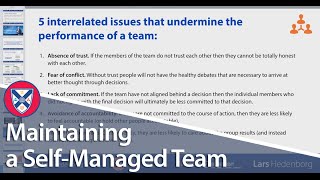
This video excerpt reviews Patrick Lencioni's "Five Dysfunctions of a Team" framework and applies it to building and maintaining self-managed real estate teams. The speaker lists the five interrelated dysfunctions—absence of trust; fear of conflict; lack of commitment; avoidance of accountability; and inattention to results—and contrasts each with the behaviors of cohesive teams (trust, healthy conflict, commitment, mutual accountability, and focus on collective results). The segment also notes that avoidance of accountability is a major problem observed in real estate teams and serves as a bridge into later modules.
So let's jump into our last section here that here in module four where it's another sort of book review where we talk about the five dysfunctions of a team, how to build and maintain a self managed team. This is going to give us a little bit of a running start into module five and module six. The five dysfunctions are really five interrelated issues that undermine the performance of a team. Most of these relate pretty pretty well to real estate in a real estate business. So number one, dysfunction is absence of trust. If the members of the team do not trust each other, then they cannot be totally honest with each other. Number two, dysfunction is fear of conflict. Without trust, people will not have healthy debates that are necessary to arrive at better thought through decisions. Number third, or the third dysfunction is lack of commitment. If the team have not aligned behind a decision, then the individual members who did not agree with the final decision will ultimately be less committed to that decision. Number four is the avoidance of accountability. If they are not committed to the course of action, then they are less likely to feel accountable or to hold other people accountable. And that's huge. That's probably the biggest, the avoidance of accountability is probably the biggest thing we struggle with on our real estate teams and we do it in a way where other people hold underperforming agents accountable, which is pretty cool. Number five. The fifth dysfunction is inattention to result. Consequently, they are less likely to care about the group results and instead focus on achieving their own goals. So another way to look at this model is to imagine how members of a truly cohesive team, how they behave. Number one, they trust one another. Two, they engage in unfiltered constructive conflict around ideas. Number three, they commit to decisions and plans of actions even if they don't agree with them. Number four, they hold one another accountable for delivering against those plans. Number five, they focus on the achievement of collective results.