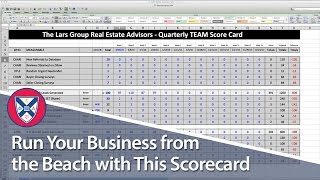
A walkthrough of a Google Sheets scorecard that tracks real-estate team metrics: leads, appointments, signed deals, and closed transactions. Enter data weekly, set conversion assumptions, and watch your funnel. Keep it current and you can manage the whole business from anywhere.
Questions this video answers
About 7 homes per week closed.
650 transactions per year (325 on each side).
About three minutes per week.
About 50% (speaker also cites ~54% from example numbers 90 and 60).
Around 20 buyer appointments set per week and 10 listing appointments set per week.
I promise you, this is so far from anything that you've ever been to. And now I want to just do the team scorecard real quick. I know there's some of you that aren't running the business tracker for whatever reason, so I'm not going to judge it, but I basically took the team scorecard out of the business tracker and I'm going to upload it as a Google Sheets into the drive. So I'm going to take this and upload it into the Google Sheets as a standalone document. So there's nothing complicated here. I just set the dates. So all you have to do is change this date and then everything is data entry. So as you're entering one week and it's a new week, you want to copy the data over so you're not overriding it. That's the only big difference. But this is something you must do, no matter how big or small your team is. You've got to be able to manage your business through data. You've got to be able to manage your business through data. So this is looking at buyer leads generated, appointments, set, met, signed, written, closed on the buyer side, then the seller side. Seller leads generate, set, met, signed, written, closed, and then anything you want to track up here and who's responsible for delivering that number. We toyed with new referrals to database reviews obtained on Zillow, our Compassion Impact program. Buyer closing surveys, seller closing surveys. You could easily just delete this up here. This is not the critical part. Down here is the scorecard. I don't care if you're a solo producer or if you have a team of 15, 20 producing agents, you've got to have weekly targets for how many buyer appointments and listing appointments you're setting every week. We just work these numbers backwards. These are actual conversion rates from set to met, met to signed, signed to written, and written to close on the buyer side, and then assumptions on the listing side. And basically our goal is to sell, on average, close to seven homes per week closed. So it's less in the leaner months and it's more in the peak months. But if we're going to hit our 325 on each side, which is our goal, 650 transactions this year. That's the pace that we need to produce at. So you can have whatever you need here. So if it's 12, you know, and 12, and your goal is to, you know, we're not even. See, your goal is, I guess, 10 here, you know, four listings and two buyers a week, or say it's four and four. So your goal is 100 transactions. 50. 50. You have to get to somewhere close to 20 buyer appointments set in a week and 10 listing appointments set in a week. We tend to meet with most of the listing appointments we set. And so from set to written, we're at about 50, just over 50%. So 90 and 60 gets that. That's 54%. That's about where we are. Yeah. If you're using the business tracker, most of this stuff is going to auto populate. This is for folks that aren't using the business tracker. So there are people that aren't using the business tracker. This is not necessary if you are using the business tracker, as this will auto populate. So this is going to be more manual, obviously. But all you're doing is going back in your calendar and said, did I set any appointments? Did I meet anybody? Did I sign any loyalty agreements, Did I write any buyer contracts? And you're just entering, Yeah, I set three appointments. I met with two of them. I only signed one. I wrote one buyer contract and I sold one. And same thing on the, on the listing side. And then when it comes time to shift this, so next week when it's the 15th, you're putting 215 here and you are now, you know, copying this data over one, and then you're putting in new 97 leads in a week, 21101. So, yes, definitely manual process. But it's not going to take you more than three minutes to update this on a weekly basis. You've got to run this scorecard no matter how big you are. If you're not running the BIS tracker. All right, I would recommend running the biz tracker. If you have a more sizable team. You've got to get that biz tracker up and running. That's. So Sandy asked the question, do you recommend separate ones for each buyer specialist rather than grouped all together? You could do that and then sum them all up, but that's going to be a very. You might as well at that point be running the business tracker. The business tracker has a setup where each agent has their own scorecard and all you do is change the agent name and it takes all the data that you already put into it. So the business tracker is the way to go. I just want to make sure everyone is still writing, still using a team scorecard. The concept of a team scorecard is from the book Traction. And it really doesn't have much to do with the business tracker except that it provides an automatic way to update it. They're just really important data points in your business that you could run your business from a beach somewhere in. If you had this scorecard on a weekly basis, you would know where your business is. If you had this.