Running a Business Takes A Lot of Hard Work, But YOU Don't Need to Be The One Who Does It All
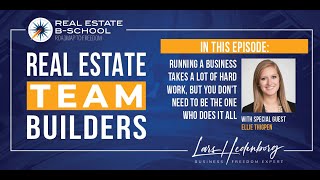
Lars Hedenborg and Ellie Thigpen discuss how real estate teams can delegate administrative work through ERS, which handles listing tasks, MLS updates, and drip campaigns. The system tracks lead response times, conversion rates, and appointment follow-ups with daily scorecards to hold teams accountable and improve ROI on paid leads.
Questions this video answers
ellie@expertrealtorservices.com
509-979-0850
Welcome back to Real Estate Team Builders. This is Lars Hedinborg, the founder of Real Estate B School. This is going to be exciting. So I have Ellie Thigpen on with us today. She has been. How long you been with dft?
Almost seven years. It'll be seven years.
Seven years with a real estate team that probably was like 150 transactions when you joined or something, if that. Maybe 100 transactions last year you guys did 330 transactions for almost 120 million of volume. And out of that business was this entirely new business that was launched, which is. I'm going to botch like what you guys do, but we're going to unpack a lot of it. A company called ers. Expert Realist, Realtor Solutions, Realtor Solutions Services. I totally bashed it. It's ers. Um, but the genesis of this business was like all this stuff that team builders need to do but never have the time to do or they keep tasks internal to their real estate team which really aren't the front stage. Sort of the things that drive the business from a, from a top line are everything else you guys have sort of taken on and are now doing for some of the top teams in the country. And so the conversation I want to have is like around that. What have you seen with some of these top teams that are able to like once they shed these like non dollar productive and super essential. So it's not like the things you do aren't important, they're just not like driving the company from a top line perspective. So all that said, I'm already into the topic but Ellie, introduce yourself in like a two minutes or less. Kind of give like the, the backstory with DFT and how ERS was born and then we'll get into some of the teaching that we're going to do today.
Cool. Yeah. So I'm Ellie. I have been in, in the real estate realm since my junior year of college. Kind of my first major job. Started out as a transaction coordinator. Kind of have run the gambit throughout my real estate career of everything. Started out as a coordinator. Got into sales my senior year of college, well, junior into senior year. And mostly I remember I had a great time, but I remember absolutely saying a prayer that my closing clients would not ask me out for a beer afterwards to celebrate because I was not 21 yet. So that's kind of how I started. After college, I grew up in Washington State, moved to Charleston. Best decision I ever made. Met Dave pretty much right away and started out again in a more like Admin closing coordinator role and again with Dave moved into more of an ISA role and then was an agent for about a year. My personality type is not. I could do it. I did very well. Sold 20 something houses in like eight months. It was great. But I was exhausted and it just did not feed my happiness. So kind of talked today as we were growing and was able to move into the director of operations role which was again another great thing that happened to me. So really started working, managing our closing coordination team, bringing on more coordinators, understanding the back end of the business, how we ran our CRM, how we ran a bunch of our marketing, just understanding everything that was going on in the background as I was an agent. So a little bit into that we had VAs working for us that Dave had brought on who were doing a lot of tracking and scorecards for us and that kind of built this second business which we'll get into here in a minute. But now my time is really spent kind of split between them, which is really fun and exciting. I work with people all over the. All over the US and then all over the world with ers, which has been an awesome experience and just getting. Making a lot of connections and friends and have loved doing that. So personally, I actually live pretty close to you, Lars. I'm in Waxhaw, North Carolina. I'm married. I have a. What is she, 14 and a half month old, named Reagan. Two dogs live a pretty normal, happy life.
Awesome. And yeah, the warning before we hit record is that we've got dogs, we've got a baby monitor. It's like it can all hit the fan at any moment and we're just going to ignore the dogs and the baby if it does.
And daylight savings time just happened. So I was re fixing Reagan's schedule so that I was ready for this.
And so here, here's the crazy thing is so you know, working with so DFT is Dave Friedman team. So that's. Ellie's been a part of that business now splits her time between that business and ers, which is the. Essentially it's more than a VA service. So that, that is really minimizing what it is. It's. It's outsourcing all of the critical admin tasks, tracking accountability lead. I mean, I mean really we're going to get into some of it. But once I saw what you guys were doing with it, I was like, I remember I physically visited Dave in your office and just the way you run the office and do a lot of transactions out of a very small Footprint. I'm like, where are the admins? Like, no, admins don't come to the office. They all work from wherever they are, which is really, really cool. But I'm like, man, can you do that for us? So it was your team doing it for DFT and then it was doing it for HPREA and then sort of ERS was born, which I think is pretty, pretty cool. Let's break it down. You know, when you guys were sort of launching it for yourselves and then doing it for others, what are the critical components from accountability or administrative tasks? The things that aren't really making the team leader money or they're not doing those things. And so they don't have clarity into the accountability on lead sourcing or agents break down the key buckets of what you guys focus on. That helps team builders.
Yes. So, so kind of like you said, two main kind of aspects and services that we work with are delegation, which is administrative tasks, and then accountability, which is, I mean, really what it sounds like, accountability. You have no idea how many people I talk to that have no idea what they. One, what their agents are really doing.
Right.
They're spending a lot of money on leads. They don't know what happens with them. They're spending a lot of money on a CRM and they have no idea how their agents are handling it. They, you know, are. There's so much that they set up into their. There's a lot of a trust put in agents, which is great. You need to trust your agents and you know, trust but verify sort of thing. So understanding that what you're providing to your agents is actually happening. And that's. I mean, that can be silly. Things like, hey, you have all these leads. They're nurture. Great, okay, not ABC player right now or not ab nurture them, but are you actually nurturing them? Is anything happening with that person? Or how are you managing your top, top 100 in your CRM? So a lot of accountability addresses a lot of that. How is the CRM managed? What are, what are your agent set MET sign numbers and where are the gaps?
Right.
You see, you know, Susie, an agent on your team who you can look at her set MET sign numbers for the last couple weeks and see that she has a major gap, right, from appointments she set for herself and appointments that she's actually meeting. So there's a training opportunity right there, right. Is we need to talk about what type of appointments you're setting because you're setting a lot of crap appointments apparently, right? So that kind of visibility is what accountability like works to do. Where again, agents just don't really have any idea or team leaders just aren't. They don't have the time, and they shouldn't be taking the time.
Right.
To dive into that and know all of those specifics yet. They need to know.
Right?
So. And then delegation, you know, there's a lot of stuff, you know, I've been on the admin side of it. I've been now on the operational side of it for a long time, where I know, like, putting a listing in the MLS takes forever, right? Looking at the past listing, looking at tax records, looking at the listing intake that the agent brings back, building an opportunity calendar for every month. You know, you likely have a, you know, expensive employee on your team doing that every month when you really don't need that person doing that. And they could be spending time on more higher producing activities. There's so many examples that I'm sure we'll get into of. Of repetitive, consistent tasks that happen every day, happen every week, happen every month that somebody's doing that can be delegated for that person to help with, you know, calling your client, calling your raving fan club in person with doing. Doing more personal or higher producing activities than those kind of repetitive tasks.
Yeah, I want. I want to get a little bit more into. What do you guys call it, the set of rules that each agent needs to abide to. I know Dave called it something, and I think you guys carried that name. It's kind of like the lead management policy, but you called it something different. Do you remember what that name was?
So we track it in the weekly scorecard, and it's like the weekly law, like the pipeline. Weekly pipeline. And laws for that pipeline is probably what you're referring to.
Yes, it's like, you know, as an agent on this team, you're committing to like these six or seven things, and then you have. Your team goes in and checks on those six or seven things and, you know, there are consequences, you know, and so you'll get an email from the VA who's like, really a team member. I mean, we got to know our va and then you'd be like, okay, you. You didn't do what you committed to do. And so you're getting no leads for the next week. And it's like, you know, and it really takes the onus off the team leader. Accountability for a team leader is often the hardest part of this job because they generally have an. A high I personality, which they have a desire to be Liked. And that is typically against what accountability is. So when you delegate, you create the system, everyone agrees in the system. And you delegate that to someone that's a team member that's running that system. Now they can't do their job if you're not doing your job. And now everyone sort of knows the, knows the rules of engagement. So talk a little bit about that. It's humbling when agents on our team would get an email from, you know, one, one of our BAs who's we consider a team member saying, hey, listen, you didn't do your job, you know, and part of your ego gets like, you want to just say like, who are you to turn off my leads? It's like, well, I'm the person on the team that's protecting these leads and making sure that as many of them close as possible. So talk a little bit about that dynamic.
Yeah, and so that's the weekly scorecard. When, when we set it up with a team, we have kind of some baseline items on there that are really common practices and like laws, like we said that we see dft, hpa, like all a lot of these big teams kind of all over the country, like the main chunk of laws. And then that's all. It's also like we call it personalized, right? Where as a team lead, your operations manager, your sales manager can add really on there, whatever you want and we can track it all. So with that, again, it's set up. It's a black and white scorecard. An example, like a perfect example. And a lot of what is already on there is CRM management. So in your boomtown, your firepoint, your sync, your whatever, do you, do you have more than 100 leads in there, right? It's a very straightforward answer, right? Like you either do or you don't. Do you have them all labeled as ABC players or tagged correctly? Everyone has different systems for how they do it. But do you have all of that done correctly? If you have set a follow up call, did you make that follow up call or do you have overdue calls? Within your CRM is another follow up call then scheduled after you create, after you complete that call. Very black and white items that are very important, right. To running an effective CRM. And I know so many team leaders and just teams in general are really trying to hammer down that CRM management because it's, it is, it's your client, it's your agent's business, right? It's all of their future income for the next year. So we try to essentially just Take all that information, which is, I'll say it again, black and white.
Right.
Your agents know, and if they forgot to update something like it's very clear still where we got that information, if that makes sense. So there's not really any like argument to it. Not that your agent should be arguing it, but by looking at that scorecard, you can see exactly what needs to be done. What's missing? Are they too busy? Are they getting too many appointments so they can't handle their CRM?
Right.
We have a lot of people that completely run their one on one meetings with agents like sales managers who run their one on one based on that weekly scorecard.
Right.
Are you doing what you need to do to generate enough business for the next 90 days of income for your to hit your goals? So. And again, it takes the kind of pressure off of a lot of agents and managers who don't want to have to say, sorry, you're off of leads for the next week because you didn't do X, Y and Z. Because it's all just right there. There's really not much argument to it. So we do have a lot of people that really like that about this worker.
Yeah. And, and you know what I've seen you guys do really well is that. Did you ever read the book Checklist Manifesto or have you heard of it?
I've heard of it. I haven't read it.
I don't even know if it's worth reading. So the punch. The only thing I remember is like the reason why more people don't die in hospitals and more planes don't fall out of the sky is essentially checklists built over time where if something went wrong, it sort of went back in the checklist. And there's always this constant feedback loop. And you know, when I, when I look at the stuff you guys do for teams, it's sort of along those lines. And I want you to talk about a little, you know, you even go as far as we all know that a new lead needs to be treated a certain way. Especially like these days if you're paying for any home search leads or there's no way you can monetize those leads at the level you need to in order to continue spending the money on the front end. Unless you're doing the right things in the first 24 hours or 7 days or 14 days or whatnot to. But then also on appointments. So talk a little bit about your, I think you call it lead audit and appointment audit where it's just like, hey, a perfect you Know, treating a lead perfectly in the first, you know, 14 days looks like this. And your guys go in and sort of make sure that that actually happened. Then also on appointments, make sure that a bomb bomb video is sent. So talk about like auditing and the value of auditing leads and appointments.
So, so I'll cut that back a little bit. A lot of that daily lead audit is like the first five minutes. So when a new lead comes into the system, like, does it sit there for an hour, does it sit there for a day before it's called? So, you know, just taking it back like the daily lead audit is, is what it kind of sounds like, right? It's every day, every lead that's incoming into your CRM and, or any other, you know, coming into agent reputation, anything like that, we can track those leads and how quickly they're called, how quickly a text is sent, an email is sent, are they set up on an E alert? Are they, do they have a follow up call scheduled and are they tagged in the CRM?
Right.
And again, those are kind of our baseline. Here's what we would recommend that you use. You can add anything onto that that you want, right? Maybe it's a handwritten cart, maybe it's, you know, adding them to a bomb, bomb drip. Maybe it's, you know, anything for a brand new lead. Um, we track it in that daily lead audit. Because that's exactly what you said, right? Right now people are spending like an astonishing amount of money on say a seller lead, for instance, right now. And you get a seller lead into your system and that it sits there for five hours, it's, it's, it's probably gone, right? So we're trying to make sure that that lead is called within those first five minutes. And every team's a little bit different. Some teams have an ISA team that's looking to, you know, that's on it immediately. Sometimes it maybe goes round robin to agents or goes out to all agents. And really just helps to understand for a lot of people who are trying to figure that out too. Like, hey, do we need to change how our technology is set up to do this? Or is, is this working? Are we getting people called enough? Why aren't we getting called fast enough? You know, and kind of you can go down that rabbit hole of, of knowing what needs to be fixed in order to hit that five minute mark. If, if that's your goal, right? It might be an hour, it might be a couple hours, it might just be, hey, make sure they're called within 24 hours. Again, every team is different, but that's what we mostly see with the daily audit. Your second question might actually go a little bit into again, you talked about checklists, you talked about tasks need to be done for every set appointment. For many of our teams, this kind of jumps over into more of an administrative task. But when an appointment is set, generally our VA team will send a bombbomb. We'll schedule them on a drip, right? For an automation, will add them to a certain tracker. We'll set them up in CTE or C suite X, Y and Z for everything done as soon as an appointment is set. And then same thing when a price change happens, when it goes active on the MLS or when the listing goes active, when it has a price drop, when it goes under contract, when it closes. There's all these different tasks that happen at every one of those steps. So from that aspect, delegation wise, that's exactly what we do. Really. I mean, that's a huge part of delegation. But accountability wise, I think you're probably talking about the sales scorecard and tracking every appointment that's set. Kind of like you mentioned, like the set, met, signed, and then kind of going through that whole process. And this is in addition, you know, a lot of teams work with CTE and CC to track dollars.
Right.
Throughout the entire process. This is specifically like when an appointment is set, what happens to it?
Right.
Like kind of moving away. I feel like a lot of teams again, that I talk to set appointments and then they're a no show. And so it goes somewhere right in the system. And hopefully you talk to them again. Hopefully the agent's following up or, you know, you talk to them and they have, they, they're working on their credit. They'll be ready in a couple months. So immediately, you know, they're down the list, like all of that. This is to keep track of it all, to see every metric. And we can show anyone, you know, there's like seven tabs to the sales scorecard of different breakdowns by agent, by department, by quarter, by month, by everything. With our data entry sheet. And it kind of spits into a lot of more easy to read sheets to see what those numbers look like. And like I said, train on the gaps that you notice based on that scorecard.
Yeah. And it is surprising you mentioned CTE and CCU that there is this like massive gap with, with those tools and the most important part of a sales organization. And even when you say set, met, signed, I bet there are half the team builders, team leaders, out there that aren't even like obsessing over, like just those three things, like all day long. Like your only job as a team leader is to it's set, met, sign every day, day in, day out. Like, who do you, what, what appointments did you set, what appointments did you meet and did you sign them? Right. And then you've got to get them under contract. And all of that talk about, like, without naming names, talk about like folks that you've onboarded that like you would think they would have that something figured out, but it was totally off base. Like you were blown away that a team doing a hundred million doesn't even track set, med signed or like, how bad? Because I know, because I have real estate B school and I get into people's businesses. So I know it's a crap show. But are you seeing the same thing from your side of things that like, it's pretty much a crap show. And every team that we come into, 50 million, 100 million, 200 million, it's all the same. Give a little bit of like color.
Around what you've seen a lot of. Well, so a couple of things a lot of people have like CTE and SISU as a start and don't use them.
Right.
They're very time consuming to update because you need to update when a price point changes, when a commission change splits or split changes, when a closing date changes, when it pushes out of the month. I mean, there's so much to update. In order to have any of those be accurate at all, you need to be in there probably multiple times a day. So a lot, again, a lot of people using CT using one of those tracking systems and none of the information is accurate because it's not up to date. A lot of people, I mean, like, I mean, yeah, a lot of people, like you said, who don't track, set, met sign, who don't really know. And then one that stands out too is I was, I'm surprised how many teams I see that have a CRM and their agents have, are using the CRM and one agent has like 800 contacts on the, in their name. And like not even in a fishing pond, not in any sort of team account that like ISAs are dialing through. Not like one agent is hoarding like 800 leads or contacts in there and that, I mean, those are like, they're not calling those people. So those people are just sitting there and nobody's reaching out to them. No one's touching base. Like drips aren't even set up like they're just sitting under Joe Schmo's account and. And they're just. They're just wasted, you know, because there's no way that person can handle that many leads. I mean, my opinion is the agents can't even handle 100. I think it's like 50 to 75.
Right.
Is the max that a busy agent can actually. Actually keep up with and have communication with. So I'm always surprised by how many agents have to, like, completely cut down again from like 5 to 800 contacts to get down to 75 and then get back there. You know, all of those other leads are going into some sort of fishing pond, some sort of team account where new agents, agents who are ready and need more business, who have their CRM perfect, who need more business for an ISA team, for anyone to kind of dial through and start up that business, as opposed to it just sitting there in their own CRM and doing nothing.
And last. Last thing, the tool, I think it's the. It may be the lead audit tool that allows a team leader to know whether or not their agent team are properly servicing the leads that are being generated. I know Dave was showing me, like, prospecting scorecard. Yeah, the prospecting scorecard. So that's another thing that's like, how do you know? And how can you actually show your agents that, hey, guys, either you step up and you start handling these leads the way they're supposed to be handled, or we have to bring in, you know, another buyer, agent or two. So talk about that dynamic and that specifically.
So the prospecting scorecard was kind of built because we saw a lot of agents and ISA teams who had a fishing pond, some sort of account, or different lead sources with different accounts, whatever that. And agents or ISAs would immediately kind of go to the team leader, hey, we're out of leads. There's. There's nothing else to call. You know, you need to buy more leads. You need to get more leads for us, because there's nothing here for me to call. There's no way I'm going to do business. Yada, yada, yada, right? So the. The concept and the tracking of that prospecting scorecard is, okay, based on lead source, how many leads have been added to our system, and how many times have they actually been called? Generally, a team leader or a. Or a manager, director will have certain expectations for an ISA or an agent team to call, for instance, five times on the first day and then do a 30 days of gain, 30 days pain, however you want to call it.
Right.
Like the next 15 days, dial once every other day. And at that point you've called the lead.
Right.
You've given it all you've got.
Right.
And I guess another answer to your last question too. You'd be surprised how many agents and ISA teams and people just call once, get a voicemail and never call them again. So that's the concept of that prospecting scorecard is. All right, let's see how many times something has actually been called. And nine times out of 10, when an agent says, oh, I'm out of leads, I need. Go buy, go buy more leads. Right? Go spend more money. They've called once or twice. So this prospecting scorecard then shows, hey, for here, for, for Google paid ads alone.
Right?
You have, you've called them on average once, right? Something like that.
Right.
That kind of breaks down so that you can go back to your agents and show them whether you're using Mojo, Zoho, RingCentral, whatever it is that you're using as a dialer or caller. That's. That concept is to know, okay, actually, before I go and buy more leads, let's make sure that we're getting absolutely everything we can out of these lead sources that I'm already paying for.
Yeah, and what you just said there, I think is. I don't think. I know. It's brilliant. Most team leaders will sort of take like their agents telling them like, you know, like, yeah, we call these leads, you know, they're whatever. Right. But the best practice is like, I think like what, 15 times in 14 days or something. And that includes like 10 texts, like 10 emails, you know, like this haul. That's the only way to win the game of paid leads. And like you said, most agents are maybe, maybe one call, but no E alert, no text, no video message, let alone 20 contacts in, you know, in seven days or whatever the lead management policy requires.
Talk about making the most of the money that you're spending. Is that.
Yeah. And the byproduct are like super low profit teams where the team leader has to stay in production because they're not monetizing, they're getting like two or three times return on a paid lead source when they could be getting, you know, 10 to 12 times return if they actually run these systems. So I know this has been a lot. If you're listening to this and you're like, I don't know half of what Ellie was talking about and you're running a team, I promise you that you have to be considering these things like this is the. I know everyone hates when I say this, but I'm going to say it anyway. This is the not so sexy part of running a real estate team is that all of these things that were talked about have to happen if you're going to run a team that has even a chance of providing you with a really good return without you, the team leader being heavy in production. You know, Dave Friedman Team DFT runs a high level business without the owner grinding out transaction because the owner, Dave Friedman has different gifts that don't include that.
Right.
And so what's one? And I want to give your contact information, but what's one parting word of advice that you would give for a team leader that is like they're like eyeballs deep in production because they have none of these things in place and they need some sort of, you know, some sort of words of encouragement. What would you tell them?
I would say to like take a minute to take a step back. I think we talk to a lot of people who are like, oh, I know I need that, but I'm way too busy. You know, let's, let's talk in the new year or let's talk after the summer rush or you know, take it, take a day, if even that, right. To step back, take a couple hours. I mean from our side, we try to make this as seamless as possible, as easy of an onboarding process as possible. We just need to know a couple specifics about what you want, right. And when people are too busy to even do that, they're just going to keep going on this, on this rat race, right. Of trying to keep up, trying to keep up. It never slows down. It never slows down, right. And as soon as it slows down, you're trying to figure out how to spend more money to make more money. Right? So take a step back, like shoot. You literally shoot us video. So we make it very easy to start. You can do it on a Saturday morning before you go to your kids soccer game, send like get us set up in a couple hours and then use the data.
Right.
Obviously you need to, you need to use the data, train your sales manager, train your people on how to actively use it in one on ones. But I guess my advice would be to take a step back and do it, otherwise you're never going to do it. And again, you know, like you said, like it's something that you just need in place in order to run a profitable business, you know, in a year, right. And three years and to continue using it And a lot of our. I mean, there are plenty of successful teams out there, but a lot of our clients that have been just consistently successful have been with us for, like four or five years.
Right.
That just use this data every time they bring on a new agent, every time they need anything. Right. We've been updating CTE forum for five years.
Right.
That they use this data consistently. And it works. So just take the time to do it. It doesn't take very much time, but.
And that's a real, real good way. You said it. So you become a. Like, the CFO in a company is not the person data entering, like, you know, or the CFO is not wondering, like, hey, is that data accurate? Or is somebody updating that data so I can actually use it? So this puts you in the CFO seat of your business and not like, wondering if the scorecards are ever going to be accurate, even if you're running scorecards. So I really love the way you ended that. And I had one other thought, but I think I forgot it. Yeah. So here's the final thought. If you've been listening to the podcast for any extended period of time, you know that I guard you against any solicitation whatsoever. Like, never in a million years would I have someone come on here that has something to sell unless I know that it's something you must take action on and use in your business, which is the case with ers. So there's a lot of really good information here, which it's going to be, like, really hard to implement any of it on your own. And so, Ellie, what's the best way? And I mean that if you're listening to this, I mean that you know that I don't use this as a way to, like, I don't benefit financially. When, you know, someone comes to ers, there's no affiliate relationship whatsoever. But, Ellie, what's the best way that someone can get in touch with you?
So, my email is pretty straightforward. It's just L, E, L, l, I, e expert realtorservices.com um, and. Or my cell phone is still from Washington state, but I live in the Carolinas. Is the 509-979-0850 are my two contacts and that's phone, text, email, whatever.
Awesome. Awesome. Well, I appreciate you coming on. This has been valuable.
Appreciate you having me.
It is the part of business that matters the most, making sure your systems are tight and that all your expenses and people are accountable. So much love, Ellie. Keep crushing it and we'll talk to you soon.
Well, thank you.









