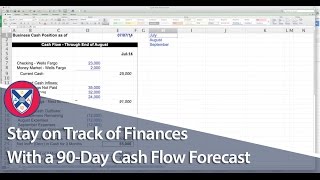
A YouTube presentation urging business owners to track cash using a 90-day cash flow forecast. The speaker recounts a personal shock—liquid cash dropping from about $305,000 to $27,000 over roughly four months—which motivated weekly forecasting. He explains a simple spreadsheet with fields for current cash, projected net inflows (exclude payouts like agent commissions), and operating expenses; the tool projects cash position for the current month and the next two months. Regular weekly reviews (suggested: Thursdays at 9am) are emphasized.
Foreign 90 day cash flow forecast. So I want to give you an example here. And this is just most trainers or coaches or whatever you, you want to call me, won't really reveal some of their mistakes. And I don't know that this was a mistake as much as just something that happened that I want to have all of you learn from. You have to know what cash you have coming in and going out from your business. It's critically important. I mean, it's. I say meter, it's a matter of life and death. So I had a situation where it was like October, you know, maybe September, October, where I looked at my Wells Fargo account and you know how it like just sums up all your, all of your accounts. And I know the number was like 305,000. So my business accounts and my personal accounts, my liquid cash added to over 300,000 and then it was like four months later. So I think it was January or February. And I remember that number being 27,000. And so I don't have a real documentation of what happened in between. I know obviously business was slow and it was kind of that time of year. I didn't have a separate business sort of buffer account or anything like that. But I just remember that being a weird feeling. Like, not weird like, oh, that's weird. But weird like, holy shit. Like, I don't know what happened to $280,000. I really don't know what happened to $280,000. It was a good bad thing, right? Because we were growing and I was investing in different things and I was honestly trying a bunch of things and seeing what would stick. That's part of the benefit. When I talk about the marketing pillars and these are the four things you need to do, I mean it, like, don't do anything else because I've tried it and I've wasted money on it. This 90 day cash flow forecast, I don't want you to over complicate this, but I've got a simple spreadsheet that you can use and I want you to make an appointment with yourself every Thursday at 9am that's what I started doing once I had this moment of clarity, like the holy shit moment where I've lost $280,000. Every Thursday at 9am I make an appointment to do a cash flow forecast with myself. The tool that I use now does it automatically that my consulting clients use as well. But you have to do this on a regular basis. Let me show you the tool, if I can pull it up here real quick. It is in business ownership, financial analysis, cash flow forecast. Cool. So business cash position as of a certain date, these are the three months that you're looking at. So for now, we would put, you know, seven, seven in here. And we would be looking at July, August and September. So it's always the current month that you're looking at. And then month plus one and month plus two. You look at whatever accounts. You can change these here, they're not in blue, but you can. Maybe you have a different bank or, you know, I had two sources that I kept. Business cash. So you'll put those two numbers in here. It'll add up your current cash position, your projected cash inflows. Here's where you will. You'll do the best you can to just all of the closings that are already on the books. You'll want to calculate the cash you have coming in from those closings. So you may be paying agents on those closings where you'll want to take the agent payments out of this analysis. So this is cash to you. So in July, if you have 100,000 gross, but you're paying out 50,000, the number you put in here is 50,000. Same thing with August and September. So it'll take your net cash inflow. On top of the 25,000, it'll add 91,000. And then these are your operating expenses. So in the month that you're in, you'll estimate, say, you operate at 12,000 per month, but we're already a week in. Maybe you'll put negative 9,000. These are always negative numbers. And so it takes the 25 plus the 91, minus the 33. And it says at the end of three months, you'll have 83,000 in cash. So you know the cash coming in, the ability to support the cash going out. So anyway, so it's a. It takes your current cash. So you're actually, in one month, you're going from 25,000 to 51,000, a net increase of 26,000, because you're, you're taking your 35 inflow and you're taking away the 9,000 in expenses remaining in July. So it's a 26,000 positive on top of the 25,000. So once you get this set up once, it's not going to take you a lot of time to do. You get the hang of it. But you'll always have a, a, it'll, it'll be ingrained in you that you need to look at your cash flow on 90, 90 days out all the time.