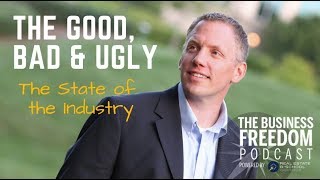
A real estate veteran argues the industry will split into three segments in 3-5 years: tech-driven DIY, discount brokerages, and premium teams. Agents must choose to join high-performance teams or risk being marginalized. The speaker pushes for organized delegation, lifetime client value, and what he calls decisive, inspired execution.
Questions this video answers
September 2018
From about 5,000 to 12,000 agents over the last five years.
About seven homes per agent.
Over 3,000 homes in just over a decade (per speaker).
Around 2007–2008.
Welcome back to another edition of the Business Freedom Podcast. And this is the Good Bad Ugly edition. So this is either something I'm doing really well in my real estate business or something that I failed at in the past and I don't want you to do. It's the good, the bad and the ugly. And I think a lot of times in our industry, there's not a lot of openness around the failures of building a business worth owning. So today I want to chat about really the state of our real estate industry. You know, I don't really worry about a lot of things when it comes to, you know, I don't really get caught up in social media. I don't really do news at all. I watch a couple shows on tv. I basically disconnect from all of that. But one thing I'm truly passionate about is, is our industry. You know, the consumer landscape is completely changing, right? Buyers think they know everything. You know, in the market we're in right now, sellers really do think they're, they're just as good as a real estate agent. And the truth is, with most of our industry pretty much sucking at real estate, a good 90% of real estate agents, maybe 80, if we're being honest, aren't really well equipped to do the job of real estate agent. You know, less than two, three years experience in my market, we've gone from 5,000 to 12,000 agents in the last five years. And the average agent in my, I'm in the number one kw market center in the world. The average closings this year will be about seven homes per agent in the market. And so we've just got a bunch of marginal agents running around the city looking to swing homes and do deals. And the net result is that the public, the consumer, buyers and sellers get shortchanged because they're not getting a great service. So it is definitely changing. And if you think that what got you here is going to get you there, I think you're going to be disappointed at the very least and out of business most likely if you don't shift the way you think about real estate. So I'm like a little over a decade in the business at this point, and I've really focused my early, early part of my journey. I'll go through it on another, another podcast. But early part of my journey was, was tough, like 2007, 2008, that's when I got into real estate. I sold 71 homes or so. By the end of my first full year, it was about like 20. What was it 20, 21 months or so. I made every mistake you could possibly make in this business in those early years and it was eight days a week, 25 hours a day. So I've definitely been there and I feel all of your pain and I do believe. So this is something I'm betting everything on the fact that you're either going to be building what I call a high performance real estate team, an hpret, or, or you're going to be working for one. So the industry is going to split in three ways. This is just my guess, and I'm not the smartest guy by any means. I have sold over 3,000 homes in just over a decade and did most of it leverage, super profitable, build a substantial net worth. That's as much ego as I'll give you on this podcast. The way I see the industry splitting is that, you know, five years from now you're gonna be able to go to a website as a seller and say, yeah, I'm gonna click on this package. I'm gonna click, I do want professional photos. And you're gonna pay $24.95 for package C. And off you go. And then a photographer comes out and you do your own showings. They put a lockbox on or an iPad or a retina scan, whatever is going to be around five years from now. That's, that's one part. Then there's gonna be a middle part which I think is gonna be discount brokers. So limited, there's more people involved, you get sort of limited advice. This is analogous to, you know, calling up Ameritrade. Right? And you can get a live person on the phone, but they're really leaning into their technology as the main thing for a financial advisor service. And then there's going to be, you know, just like financial advisors, just like attorneys, there's going to be premium advisors, the top notch advisors. So that's the path that I'm heading down. To be clear, we are going down the path of becoming a high performance real estate team running on true business principles. And so I don't think the top producers are going to be as prevalent. And the pitch, I guess it's not even a pitch, it's just me explaining the difference between a high, you know, high performance real estate team and a top producer. You know, it's leveraging yourself through organization and delegation. That's the key. And it's really three features, right? Versus even a traditional brokerage for sure. And also traditional team model team maintains clients lifetime value. That's key. And delivery of value proposition is done by the team. So we as a high performance real estate team, we're providing the consumer experience, not just hoping that our agents do a good job providing that experience to buyers and sellers. And more of the workflow is done by our admin staff. So yes, we have listing agents, they go out, we set appointments for them. You know, we send a pre list packet that we do, we have a runner go out, that's scripted, the listing agent gets there, they have a conversation, they present our services, they get them to commit to us. And then a staff member, our operations department takes over. I think more of it's going to go that way. And then agents are transition from high splits traditionally to way lower splits. You know, you, you, if you're in the middle, you're running a team and you're in that middle and your gross margins after you pay your agents, you only have like 40, 50% left. It's going to be challenging in the future, you know, so you've got to think about some sort of value based commission structure. Write this down, the acronym DIE Decisive inspired execution. You must be willing to die. You know, we're 10 years into the current real estate cycle. Some markets are shifting already and it's coming, right? We can't avoid it. There are major financial players that are placing huge bets in our industry. And so these are some of the factors that will impact us three to five years from now. And then there are some players that are trying to change the game altogether. You know, the guys that are coming in, they'll charge you 10% commission to buy your house while you buy another house and make them the move seamless, assume all the risk and all that stuff. And shifts are good, right? I mentioned 5,000 agents in my market up to 12,000. We need to get rid of a good 6,000 agents in our market. So I welcome a shift and you must be ready for it. And then if you are ready for it for it, you'll be able to take advantage of it. And I mentioned decisive, inspired execution this year. Right now you need to be making moves ahead of the shift. You know, getting your lead gen in order, you're tracking around marketing, make sure your ROI is there. So it's as much of a rant as I have for you right now. The industry is shifting dramatically and you have to look for ways to tighten up your business. And you know, most, most folks in our industry really aren't doing what they need to do to really capitalize on what's going to happen in the industry and really think about those three scenarios that I painted, right? It's the, the first scenario is it's all technology. If you're not in the technology game and you're not building that out, that's not an option for you. The middle is limited service and maybe marginalized real estate agents. Right? If you can't, if you can't compete with someone that's playing this game at the highest, highest level like I'm shifting to, if you can't compete with that, you're going to be marginalized or you're going to be in a discount broker model. You work for Redfin. Redfin, their top agent in our market makes $100,000. Their top, top agent and their consumer experience is not great from what I've heard, other brokerages have secret shopped Redfin and it's not a great experience for consumers. So we are going to go to the Nordstrom side, we're going to go to the BMW Mercedes side, we're going to go to that premium attorney, we're going to go to that premium financial advisor and build a business based on delivering this amazing Ritz Carlton experience. So that is what I'm asking of you, just to make a decision on which side you're going to end up. Alright, so we will talk to you on another on a future edition of the podcast. As always, much love, much respect and you know, there's always the good, the bad and the ugly of building a real estate team. And it is my promise to you that I will always share things that are working and things that are not working and things that you want to avoid in your real estate business. We'll talk to you soon.