The Good, Bad & Ugly: Why Am I Doing This? Why? Why? Why?
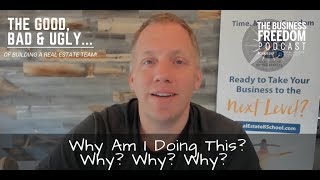
Lars Hedenborg, founder of Real Estate B School, traces his drive to build a business back to childhood trauma and a need for control. He walks through a 7-why exercise to uncover your real motivation, then argues psychology, not tactics, stops agents from scaling teams.
Hey there. Welcome back to another edition of Business Freedom Podcast. This is the Good, the Bad and the Ugly. Really a chance that I get to talk about my business growth journey and share some of the things that maybe I'm not so proud of that will help you along your business growth journey. And this is Lars Hedinborg. I'm the founder of Real Estate B School and co founder of High Performance Real Estate Advisors in Charlotte, North Carolina. Today I want to chat about something that has really impacted me lately and it's a constant checking in with myself around, why am I doing this? What is the point of building a business? And I mean like the emotional reason, the thing that's driving us to get up every day, do things that maybe challenge us, that force us to grow in ways that we don't want to. You know, I'm willing to, you know, take out the trash or get on stage. Neither of those things are in my true sort of comfort zone. You know, we're willing to do the things. If you're really grounded in a deep, meaningful why. And I'm going to go through a process here to help you find out what yours might be. Unless you're grounded in that and you're rooted in, you know, why you're doing the thing you're doing, it's going to be tough to do this at a high level. And so for me, in my real estate business growth journey, I got into the business in 2007. That was a part year for me. I left a corporate job and that's a key part of the story. I was on a amazing trajectory in a corporate job. I did acquisitions and strategy for an aerospace company. Super cool job. It's the job I wanted. After I left, I worked for an investment bank for a couple years in their corporate acquisitions department. And I worked a gazillion hours in that. For me, as I look at all these experiences and why they weren't satisfying to me, it helped me figure out the reason why I'm going about building businesses on my own versus working for somebody and even outside of the the industry dynamics. So as an industry, three to five years from now, if you don't build a high performing real estate team, we call it HPrets, right? If you don't build a high performing real estate team, it's likely you'll need to work for one. And it's not a good, bad or indifferent thing. It's just a statement about where our industry is going, is that consumers are freaking savvy and they're not Going to put up with most of what goes on in our industry where an agent can get paid $20,000 for like 12 to 15 hours worth of work. Right. If you're not providing a world class whatever you define your service, we're going for like a Ritz Carlton experience for, you know, when we help buyers and sellers. If you're not building that, you're going to be working for someone that has that and they can justify getting paid what they get paid outside of that driver for doing what we're doing. There's got to be something gut level emotional that's driving you. So for me, when I first got into real estate, it was, I left a corporate job and that was a key aspect of the story. It's the fact that I didn't want to be my success. I didn't want it hinged on someone else like the corporate ladder or politicking my way. It didn't really matter if I worked 60 hours a week or if I half weighed my, you know, if I just half assed a week at work. And so that's one indication when I go back. So I didn't want to be out of control. I want to be in control of my success. And so ask yourself a series of questions to find out the real motivation. So, Lars, and it's helpful if you do this with someone. This is the exercise. It's helpful if you have someone. So, Lars, why was it important that you start a real estate team? So why did you do this? Well, I wanted to be in control of my future and I wanted to control my success. I couldn't do that in corporate America. So why do you want to control your success? Why is that important to you? Well, you know, I'm going to skip a couple in the middle for me, but keep digging with this. It takes about seven questions. So it's important to me because I know I'm smart enough to be able to do this well. Why? Why is that important to you? And for me, it comes down to the fact that as a child, my upbringing, my parents divorced when I was 4. My dad was an active alcoholic until I was 15. I didn't have a lot of structure and I had a lot of chaos. My mom worked six days a week and we would get out of school and we would let ourselves in. After they got divorced, we would be those latchkey kids. And so not a lot of structure, not a feeling of security. Very chaotic. And my big why is that? I ultimately want to be in control. I want to provide an environment for my family that was totally opposite what I had. And I want to be in control of my future now as a Christian, as a man of God, ultimately, I understand. And I spend time every day, really spending time with God to figure out what his plan is for my life and what his will is, and to make sure that I'm constantly connecting and having that ongoing conversation with God. At my root, though, the fact that my earthly father, you know, made decisions or had addictions that affected me in such a way that I was. The feeling of being out of control is unacceptable to me. So I couldn't work for someone else. I had jobs out of college. I had an engineering job. I worked for that investment bank. I worked for a consulting company after that, and then I worked for the aerospace company. So I had four or five corporate jobs. And I did really, really well. And my income, you know, did really well. But ultimately, it wasn't going to satisfy me at the level that I'm satisfied now. And I still have huge challenges in my businesses that I keep showing up for. And I keep recommitting myself to deal with those challenges rather than run away from those challenges. So a lot of real estate agents will go down this path of building a real estate business, building a real estate team, and they will backtrack when they realize it's hard or it's not as easy as they thought, or, you know, they just. They don't have the patience to be able to, you know, hire people or train people or onboard an assistant to offload the 30 freaking hours a week that they do, you know, $15 an hour work. And they're losing money. And so if you ground. If you do this exercise, right, and you get. Ask someone, like, why is it important that you build a real estate team? Okay. Why is it important? Because I want to have more opportunity. I want time and money, freedom. Why is it important that you have time and money freedom? Well, I want to be able to spend time with my kids and my wife. Okay, why is. Or I want to be able to travel. Why is it important that you. That you're able to do that? Well, I didn't really have that as a kid, so I want to make sure that I'm the best dad. And why is it important that you. You're the best dad and. Well, you know, my dad was, you know, an alcoholic, and it was chaotic as a kid. And so I want to be able to, you know, go deep with this, because when things get tough and they will, you need to be able to align yourself with this motivation, this level of motivation, this driving, you can't stop me level of motivation. And that's all you need to be able to do this. To scale a real estate business to 2, 300 sides where you're able to take 10 to 12 weeks off the grid. Vacation money's not an issue, time's not an issue. Your stress levels are, you know, a fraction of that what they probably are. You know, selling 12 homes, you could sell 250 homes and have less stress. So than selling 12 homes, you don't have to be worried about your finances. So the whole goal is to ground you in a place where no matter what, you're going to figure out what the next step is and there's no capability that you can't develop. Tony Robbins has a quote and I'll botched a little bit. Basically he says, you know, 80% of business is psychology. So when it comes to mastering this is the whole quote. But I'm just, I'm paraphrasing it. So when it comes to mastering marketing, sales, operations, your finances people, when it comes to mastering all of that stuff, it starts with your psychology. In real estate B school, we have all of the capabilities, all the tools and systems and the coaching anyone would need to go sort of go down this path. If your psychology is off, you won't be able to do it. We met as a leadership team a little while ago for our two day annual planning session and we talked about what are the requirements for coming into real estate B school. We found that we have all the tool systems and strategies, real world, swipeable, installable tools and systems and the coaching to support it. We have all of that. We have the 20%. The 80% is psychology. We struggle mostly with folks that haven't made the mental shift that they really want to own a business versus be involved in every detail of their clients of a transaction. And that's a real thing. And so there's something going on there with a member. A deep level. If you think you're the only one that can service a buyer, you think you're the only one that can service a listing, or you think you're the only one that can touch files and make calls to inspectors, you know, all the lower level tasks of a real estate business and we can't break you from that. It's just not going to work. You know, we have, we do lots of mindsets, we do lots of mindset training. So that's not to say that in real estate B school we don't have a significant aspect of what we do that's constantly training you on mindset. You need to come in at least with the mindset of a business is a better way than a solo agent. And that's the only real requirement. And that's not a pitch for real estate B school as much as it is to say that your mindset is everything. And so hopefully this was helpful to shed a little bit of light on the real driver with. If you look at any industry and you look at guys or girls that have created something out of nothing and they have stuck with something long enough to build it into a real business, a business that serves them, that gives them time, money, freedom without all of the stress. If you look at what it took, it's typically someone that's grounded in this, even if they don't know it, it's grounded in this why that you couldn't possibly compete with. And we need to get you there. So keep asking yourself the question. Why is it important that you scale your real estate business? Well, I want more time and money. Why do you want more time and money? I want to be with my family. Why do you want to be with your family? Because my dad, you know, my, my situation, you know, wasn't good. You know, why, why, why get to the root cause so you can go back there when times are tough. You will have tough times. You need to get back to that real deep level and in the gut, in your soul why you're doing this. And like I said, ultimately for me now it's to be a bright light in a dark world. In our coaching, there's a lot of darkness in the world and especially real estate. You know, folks think this is an easy path and it's not. And they find out that it's freaking tough. And they're spending more than they're making and they're working more hours than any human should, their relationships, their health, both physical and spiritual, suffer. And to ground yourself in the why, to get the tools and systems so that you can scale this thing. And if you really want to be the one that is sort of running a business versus working for someone, you need to make this decision, make this mental shift and ground yourself in this why so you can work through the challenges. As I always say, much love and respect. This is not the easy path by any means. If you have any, any challenges or you want to jump on a coaching session, it's rebs strategy session. There is no obligation whatsoever. That offer is always going to be there when the time is right for you. So it's rebstrategysession. Com, and we'll talk to you soon.









