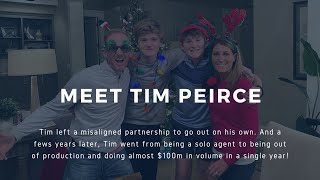
Tim Pierce left a high-producing real estate team to build his own business, starting with just a lead generation platform. After adopting mindset practices, clarifying values, and implementing Profit First accounting, he grew to nearly 100 sides a year while cutting weekend work and stress.
Welcome back to another case study. This one's going to be awesome. I have known Tim Pierce for probably four years, maybe three to four years somewhere in there. He started with real estate B school three years ago, and his journey is just an awesome one and the leap of faith he took to build what he has today. And he's in it, right? He's in it. Nothing's perfect about any of our businesses. So through the case study and Tim, I'll let you chime in here in a second about your journey. Just this is the good, bad, ugly of building a real estate team. And you're out of Hilton Head, South Carolina. So any referrals to that area, send them right there to Tim Pierce. He's easy to find on the web and his name, his last name always messes me up. It's not spelled like you spell Pierce. It's spelled P E, I, R, C E. Right.
It's I before E except for me.
Yeah. So there is no other Tim Pierce that spells his name P E, I, R, C, E in Hilton Head that does real estate. So he's easy to find. So, Tim, give us like, not too much, like a minute or two on like what it was like when you got into real estate B school. The business, the business partner, your vision for what you wanted was a little bit like, kind of unpack that a little bit because I think that'll kind of set the stage for, you know, you did almost 100 transactions last year with a small team. So that's kind of the hook for all of this. If you want to go from leaving something comfortable to building a team and getting to 100 sides, which, Tim, I'll say it's harder to get to 100 sides than it is to 200 sides.
Yeah, I remember you telling me that. I hope so. I hope so.
Give us the backstory here.
Okay, so the sort of thumbnail sketch of this is. I've been in the business for 17 years. I was a successful agent, solo agent. In 2007, I did 21 million in volume without an assistant. And just, you know, I was grinding and I enjoyed it for a period of time. And then I, when the market crashed, I moved to a company and I joined that company and we did very, very well there as well. But I sort of lost my identity as an agent. Was sort of, sort of on a team, essentially. But we did a lot of high end business. But it was a really difficult time, really stressful. I got very, very sick. I got hospitalized. It was a pretty rough time. For me, I came close to potentially the end. And I wasn't totally transparent to me. But through that process I started to evaluate my life a little bit because I was a seven day a week guy just grinding away. And my attitude was you just get it done. You go to work and you get it done. And things sort of evolved at that company and a guy that I got along with was a business minded guy. We decided to partner up and move on to a different brokerage and form a team, quote unquote a team. You know, it wasn't really a team, it was a, hey, let's, let's put our numbers together, let's help each other out, let's share some marketing expense and. And then as I continued to try and search for better ways to do things, I almost continued to just make things worse. So you know, we would bring agents on, we got a sync platform. We, you know, we're spending a bunch of money on generating leads that we had, you know, zero accountability and we didn't, we didn't run a single P and L. We didn't know, you know, our numbers, any of those things. So anyways, fast forward real quick. You know, I sought out a number of different coaches, went through some bad coaches, identified, you know, real estate, B school and just sort of, it was relatable to me. So I reached out to him, I went to my business partner at the time, I said we think we should hire these guys. He really didn't want to, he wasn't really interested, but he sort of just appeased me. And so through, throughout that process I learned that I wanted to build a business and he wanted to continue to be a salesperson and wasn't interested in taking that leap of faith. And I did with Lars encouragement. Honestly I don't think I would have made that jump without Lars talking to me and talking me through it because it was terrifying. Our team was doing, you know, 150 transactions, about 55 million. I mean I was making plenty of money but I was still doing 20 million of the business and my business partner was doing 20 million of the business. So Lars encouraged me to, you know, take a step out and I definitely took several steps back. I was like, you know, I was like standing with the fishbowl, you know, like who's coming with me? And nobody came with me and it's just me. Like I'm totally by myself. I took the sync platform because my old business partner didn't want it. I had all these leads coming in, I had no admin anymore. I had no salespeople. Like, I thought I was gonna die. It was. It was brutal. I go over to a company I didn't know. I mean. And just. And that was it. And so that was kind of the beginning of. That was the beginning of the journey.
Awesome. So it's kind of that Jerry Maguire moment. But you didn't even get the one person.
I didn't even get the one person, man. I was like, who's coming with me? Who's coming with me? No one did.
You touched on it. I remember the realization was, is that this thing that we have, it's never going to be my vision for what I want for my life and my business. Like, it was a glorified team in that you still had to lay down some production for that business arrangement to work. Like, it was just convoluted. Right.
It was. It was stupid, to be honest with you. I mean, it made no sense because we were the production. We were the team. And even the production that we had running up from the agents was not profitable.
Yeah.
So that was, you know, that was an awakening. I mean, I knew that was the case, and I was kind of like, why are we doing this? I mean, I may as well just be a solo agent and hire an admin and do that as opposed to, you know, complicate my life with people to manage and, you know, expensive marketing and, I mean, like, what was the point?
Yeah. And I know guys that will do hundreds of transactions, several hundreds of transactions on a foundationally flawed model, and they'll never have a business because they don't make money unless they sell homes, personally. So you guys were doing 55 million. I know guys that are doing 200 million that have set it up the wrong way. And it's never going to be. It's never going to be sustainable. What did you have riding on this shift personally? Wife, kids. What's the. What's the backdrop here? What's the real motivation for being able to figure this out?
Yeah. Sole breadwinner in the house, two kids. You know, my wife is a school teacher, but, you know, kids in private school. And that was pretty much a net zero situation. Conservative, but nice lifestyle. Right. And so I had a lot to prop up through the business, so it was really, really scary for me. I did not want to have to go backwards, but I also was willing to kind of go for broke because I was at a point where I was like, I just, I'm done. I don't want to do this anymore. Like, I can Remember having to put people in my car, people that I liked, and I was like, I can't. I can't fake my way through this anymore. Like, I just. I have no passion for it. What I did enjoy was helping other people get started and seeing success through other people. And so I had to kind of reinvent my, like, what. What is going to get me out of bed? What is going to motivate me? Because it's not this anymore. I got to figure it out. And beyond that, I was like, I don't know, maybe I'll just go get a sales job someplace or something. I mean, I came out of the software sales business before I got into real estate, and I was like, you know, maybe I'll do that. But I knew that wouldn't get, you know, provide me with happiness either. So, yeah, yeah, I had a lot to. Lot to support. There was a lot riding on it. Absolutely.
Yeah. So let's break down a little bit. Like, when you look back over the three years with real estate, B school, and we can even just talk through it, what are the two or three things? It could be mindset. It could be like an actual system or a strategy or a cadence, or like, let's just unpack two or three, like, really solid things that you, you know, so essentially you left this team with only a lead gen platform and your own. Your own body. And just mentally, I remember just the conversations we would have over Voxer. You know, that first 12 months, it was like the ledge was right there every day.
It was bad. I remember one. I think there's one vox I'll never forget. And so to answer your question, several things were really critical. The, the most important of which was mindset. And you told me that from the very beginning. And I'll never forget it, because you were like, that's going to be absolutely, at its core, what you are going to need to get through this. And so when I reflect on that a little bit, I think about, like, you know, getting into eos, for example, and I'm like, oh, my God. I got like, you know, all these things I got to do and all these rocks and so on and so forth. And it was just a simple vox between the two of us. And. And you said, you know, you need to boil this down. Like, you need to. You need to take a breath. You need to boil it down to two, maybe three rocks and focus on those. You've got way too much going on and, you know, your family doesn't want you to be stressed. You know, you're going to get through this. And that was sort of the attitude. And I remember Stacy, Stacy was really funny. She, she, I was melting down at the very beginning and, and she said, you know, your brain is in fight or flight. And she said, you need to, you need to take, like, you need to count down from 10, and when you count down from 10, you're just gonna take action. And that really helped actually too. So mindset was huge. And it's funny because that wasn't even going to be one of the things I was going to share with you, but that is absolutely crucial.
Yeah. So here's a guy, 17 years in the business where, you know, at some point you sort of fall out of love with a thing that you've mastered. And, you know, so part of it is that you want to move on and build something different. But then also, you just couldn't, you couldn't do the seven days. You can't. Nobody should work seven days a week. And real estate, traditional success in real estate sucks because it is seven days a week, 100% of the time. And unless you make that shift to business ownership, you can't do it. Like, you can't, you can't do it. So.
And one other thing about mindset too, was the belief that you can build it, you can attract talent. Because I made some mistakes early on, and I'll never forget this. Like, I hired completely the wrong guy as a buyer's agent. And I remember I forwarded the email to you and Stacy and you just very quickly responded and you were like, this guy doesn't get it. He's not the right core value fit. And I'm like, how do you know? You just read his email and you were so right, actually. And it was miserable. It was a disaster. And so, and I still make those mistakes. I'm learning as I go through this process, and I think anybody that goes through this process realizes that hiring and recruiting and finding and determining what you're. So that's number two. So, so, like what you stand for, what your core values are, what your mission is. And I used to sort of dismiss that as like managerial hocus pocus, you know, like, like I was always like, don't waste my time with that stuff. Just go sell real estate. Right. And it's so important, it's so crucial because after we did it, we did an off site meeting. We, we established our core values, which I think will evolve a little bit. They'll change. We've determined, like, hey, maybe that's not A core value. But this is so, like something that's not on there right now is initiative. And it's become clear to us that initiative is really important on our team. And so we'll revise them. And so now when I interview people and I talk to people, I'm like, are they a core value fit? When you used to say stuff like that, it just didn't really totally resonate with me. Again, it's. It was just sort of like it's from, you know, like, it just seems like a waste of time. Right. But it's not. It's so crucial. That's really critical.
You mentioned one other thing in there that I. Maybe we're going to talk about, but I want to make sure you touch on it is, you know, there are a lot of folks that have like X number of years in real estate. They're top producers, maybe they have an administrator, yet they don't make this shift to a team and business ownership. Like, what value do I have? You know, so team value proposition. Is that something that you could speak to that might be helpful for somebody?
Maybe that's understanding and identifying the fact that, like, I have something of value to offer. What is it? So I remember Andy. Andy talked to me about that one time. He's like, dude, think about what you offer compared to anybody else starting in the business. Like, here's, you know, here's a desk and a phone and have at it. Like, good luck. Right? And, you know, I just had an interview right before we jumped on this. And, you know, this. This agent is coming from another company and she's like, you know, they said they'd provide leads to me, and they do a little bit, but they're kind of junk and so on and so forth. And I said, well, you know, it's not so much about the leads being junk, it's about what to expect and also understanding how to handle the leads. So if you're gonna. If you're gonna work a PPC lead, you know, you're gonna get three out of a hundred of those, and you need to be skilled to do it. And the problem is you're at a company right now that's just like, here's some leads, good luck, call them once, and, you know, hopefully you'll convert one and get lucky. That doesn't work. And so if you want to be in an environment where you can step into our back office and you can, you know, being immersed in this sales environment where everybody's, you know, supporting one another, everybody's Making each other better. And you're converting at a much, much higher level. And yeah, we send you a lot of leads. With those leads come expectations and accountability, which help you to be successful. So, like, you can go someplace and you can get 100% of your commission. But last time I checked, 100% of zero, still zero. So, you know, it depends on what you want. If you want to do the average six to eight deals a year, you can certainly do that. I mean, it's, it's not for everybody. And then I got to that point where I was just like, okay, that's. We're kind of honing in on who we want and who we add value to, because that was the biggest thing, like, I didn't want to, you know, I mean, yes, it's a sales job bringing somebody onto the team, but I don't want to have to sell you hard on it. I want you to identify with the value. I mean, if you don't get it, then it's not gonna work.
Yeah. So any other areas that really, you look back on the three years and this thing from real estate B school really helped me. What's another area that folks can learn from or something that you messed up that you don't want other people to mess up?
Doing profit first was life changing for me. I hired SBS because I hate dealing with QuickBooks. Just want to hire somebody and do that, and they do that, and they do such an amazing job understanding my P and L inside and out and tracking that. And really, you know, man, Lars, there's, there's so, so much. I mean, you know, Keller Williams has been good for me because I've tapped into career visioning and some other things like that too. But I don't even know where I'd be if I hadn't, you know, stuck with, with B school in terms of all these things and all the tools that we've gotten.
So, but so, so financial clarity. So a lot of, A lot of really good real estate agents became a good real estate agent because they're good, they've got a good network, they're good with people, they can generate referrals. But a lot of agents, especially when you make the shift to it to become a business owner, you don't have that. Those skills because nobody's really taught you and you've never needed them. So generating books on a monthly basis, knowing how to read the financials, having a system in place to move money around, so you have 100% clarity on all the effort you're Putting in and what it means to you financially. Right. So that SBS and profit first, that is just financial clarity. So scale of 1 to 10 before you put those things in place to after, what was the spread there?
Scale of 1 to 10 in terms of.
Yeah, like you weren't doing any of those things before and now, you know, you've got it all together.
Oh, yeah, yeah. No, I mean, you know, so I know, I know right now that I spend too much money on lead gen. I've known it for months. You know, I'm okay with it because my margin is really, really high right now. But I also know I'm not spending enough in payroll and I need to hire somebody because my admin is totally overwhelmed. And so that's what the P and L is going to communicate to you every, every single time you look at it. And you can make decisions and you can be less stressed. You know, I mean, remember Stacy said at one point that, you know, stress is a. Is often a source of lack of clarity. And that's so true. I mean, having a clear lens into your financial world and your business and everything is so huge and being really strategic in terms of profit first so that at the end of the year, you're not freaking out about the tax bill. I used to live like that all the time and it was just really stressful. So, yeah, man, it's a 10 for me. It's huge.
Yeah. So let's talk a little bit about. You touched on it. You know, you've heard me talk about time, money and stress and business. You know, we trade money, unfortunately, we all do. We put time. We trade hours. We put time into things that will get us a return. And in our business, it's a financial return. And hopefully we're not freaking stressed to the point where we have physical breakdowns or we want to, you know, not. Not continue. So where was your time? Money, stress, balance three years ago, before real estate, B, school, maybe talk a little bit about it, you know, hours and then where is it now? What does it look like? Time, money and stress now maybe contrast those two.
So my situation was a little bit different just because, you know, I. I did have a team. And although I gave a lot of that business away, you know, like showings and things like that, I still gave that away. You know, I still put more hours in back then. You know, I was still working weekends and things like that, but not as much as typical solo agent out there now. I mean, I really ever. I never work a weekend. I pretty much will Take a Friday afternoon off. And now one thing that's a little different for me is I was perfectly okay with really handing my business off to the team. Like I wanted out of production. And I know that a lot of agents kind of, you know, struggle to move out of that and some really enjoy it and stay in it. But so, you know, for me it's, for the most part it's Monday through Thursday is kind of the work week for me. The biggest thing I struggle with and the thing I'm working on now is recruitment and you know, time blocking. I've always been a terrible, you know, time blocker.
Yeah.
So those are the things I'm working on. But yeah, no, I mean from a lifestyle standpoint, it's been hugely a huge improvement and the profitability is considerable.
Yeah. And how have you seen that translate into your personal life in terms of the stress you bring home more time to do. How you, how you getting the personal benefits from, from the business today?
Oh, it's huge. I would, I guess, you know, although maybe I wasn't putting in, you know, the seven days a week when I had the previous team, my phone would never stop. And so if I was with my kids, I've taken so much of that off my plate now particularly with implementing call routing service. You know, just the. I have the ability to be present with my kids and my wife and I'll. And I'll never forget us having that conversation. It's just being present is so critical. No matter what it is that you're doing, just be present. And I struggled with that. I mean, I was terrible at it. Like I'd be anywhere. And I mean, I remember at one point when I was a solo agent, I left my kids birthday party to go show real estate. That was a last minute lead. I mean, and makes me sick to my stomach to say that. And I didn't even close that deal.
Yeah, we all have those stories. I've got. I live in a neighborhood now where, where I ruined a family vacation working on a deal that never closed. Now I get to run by that house like when I go running. So I'm constantly reminded of what our clients go through. I don't do any production anymore. But what our clients go through is that they're ruining their lives with this stupid business of real estate. So let me ask you as we wrap up here, who would you recommend real estate B school to and why?
So I'm a big believer that this is not for everybody that, you know, if you've made a decision that you want to build a business that you know for whatever motivating factor is in there for doing that, if you know that you want to do that. I have not discovered any other coaching system that actually coaches you how to build the business and has put all the effort into it and made it a very, very simple process. So I would say, number one, the person that has made that decision to build a business, number two, an agent that is reasonably productive and willing to invest a little bit of money to get the business off the ground. Because we are in a very low cost entry business and low barrier to entry. And you know, when you're building a business, you typically have to invest some kind of money. And that was a stressful period for me, but it was needed. So you got to have a willingness to do that too. And you got to understand that it's, you know, it's, it's possible, it's hard, but it's, it's possible. And, and you got to kind of embrace, embrace the struggle a little bit, you know, enjoy the, enjoy the grind of it. And we're, we're into our third year now and I really feel like, I feel strongly that we're going to continue to ascend and do very well. I mean we definitely. A lot of the people that thought, you know, that told me this would never work here in this market, that you're going to fail, you know, my business part, my old business partner, who I love to death and still friends with them, but we've turned a lot of heads with our growth and it's been fast growth in a two year period.
Yeah, that's phenomenal. Yeah. And such a humble guy. Um, you know, I just appreciate you hanging in there, you know. So from our perspective, some of these things aren't easy. Like it's, it's, you know, what's a good. And I can't think of a great analogy, but telling somebody like helping someone get the confidence to do a thing that you see very clearly. Like, I'm just hoping that I'm not so attached to like, you know, if you have a hammer, you're going to look for nails. You know, like when we're giving like life changing either way, good or bad life changing advice to people. You know, we have a hammer. Our hammer is to teach people to build businesses that don't rely on them. And I just, I'm praying that Tim Pierce was a nail and it turned out he in fact was a nail. So like you said, it's not for everybody, not Everybody's a nail. Our hammer is to teach you how to go from. You said it. Top producing agent, hopefully with an administrator. Ours was a different starting point. You know, we coach a business owner and their main operator. You know, we need them to have that little bit of leverage. So I just appreciate you hanging in there and taking, taking our advice and, you know, just being open with us in the process and telling us your fears. A lot of people, when they have a fear, they, they tend to puff up a little bit and not be as vulnerable as you were. So that's just an awareness I had about you. The fact that you were vulnerable and you were able to tell us where you were at, allowed us to come alongside you and really serve you. So there are folks out there that are grinning and bearing it and their life is a living hell. And I just know that those top agents that are working seven days a week and they're 12, 15 years in, you know, we can help those folks if they just let down their barrier and let us in. So we can actually just trust that this process works. And so if that's you, I'll ask you for a final thought here in a second, Tim, if that's you, if you're at the point where the business, maybe you've fallen completely out of love with it and you're doing 15, 20, 25 million in production or, you know, you've got to a thing running and it just gives you no freedom, you know, where you have to sell all the homes or most of the homes to make even a little bit of margin. You have no financial tracking or cadence or accountability or any of that. You know, those are the folks you want to talk to. There's no hard sell into real estate B school. Just go to realestatebschool.com and there's buttons to apply now and you'll kind of read the criteria. People that we do really, really well with, the nails that we help we really well. Tim, final thoughts. If somebody's listening, you know, that kind of fits the. Fits the image of who we see for real estate B school. What advice would you give them?
Well, I can just tell you for me, one thing that caused a lot of stress for me was feeling like I didn't measure up and comparing myself to others all the time and it just doesn't matter. We play in this game of like, I'm number one or I did this in GCI or whatever, and you got it. You got to block that stuff out and you got to just put your Head down and do the work. And. And you'll be amazed at the people that can come into your life to help you build it. And so. But there's a lot of different stories in B school, and I think the big thing is don't get caught up with I'm not here and I'm here and how, you know, like, you got to just kind of put your head down, get the work done, and you'll be amazed at the accomplishments you'll achieve.
Yeah. A business coach of mine outside of real estate, he showed a visual of, you know, why those horses have blinders on? Like, it's so they don't get to. They're running their own race. A horse, in order to win, the horse has to run their own race. If they didn't have those blinders on, they wouldn't even be able to run straight. They'd be so distracted and spooked. And the analogy is so good, and I'm glad you brought it up. And it's pervasive in our society. Like, hey, how come, you know, their kids are better looking than my kids? Or their kids look like they're behaving that picture. I just beat my kid this morning. I kicked my dog. Like, their dog is not, you know, their dog looks fine. Like, it's this craziness. And we do it in business and our, the industry. We talk about all the wrong things. Like, we glorify those that are selling a lot of homes and no one's asking them about their relationship with God or the relationship with their spouse or their children or their physical body or their emotional well being. Like, we're missing the mark all over it. Do you have a final comment on the holistic side of real estate? Peaceful.
Yeah, actually, I do. I think, I think the one thing you also helped me with dramatically was as much as I was in this sort of. I would describe it as a miserable place, I wasn't, I wasn't super happy. And. And I still struggle with that. I think, I think a lot of people do. Right. And so for me, what was, what was really like a big turning point for me was understanding how to express gratitude. You know, every. Like, maybe I'm not as diligent or disciplined about it every day, but I do it when I need to. And I've tried to pass that through to my kids too. And it really changes your perspective dramatically. And so, yeah, man, that's an invaluable piece of B school that is really hard to describe. And at the risk of sounding a little hokey. I mean, it was pretty life changing for me, actually. I mean, there are a lot of things that changed my life throughout this process. Like whenever you go on a exciting journey like I did, but that was big. I mean, I needed to really go through a really big wholesale change in everything.
Yeah.
That's awesome.
Well, I appreciate you and your time. And like I said, if you're. If you can relate to the story at all and you just don't have a way out or a path forward, we'll never sell anyone into this program. It's just a conversation. It's really all we have to offer you. So just go to real estatebeautyschool.com we'll see you over there. Thanks again, Tim. Appreciate you.
Thanks, buddy.









