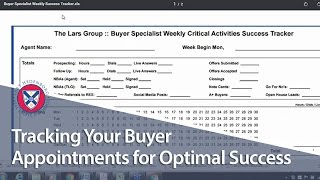
A sales team tracks buyer appointments on yellow information sheets, then logs them into a CRM and calendar. They aim to set 3 appointments per week, meet 2 of them, and sign loyalty agreements from roughly 90% of those meetings. Results go on a public scoreboard.
I promise you, this is so far from anything that you've ever been to. And now this is our kind of our updated buyer appointment tracking process. And again, I don't want to get too bogged down here. I don't want this to become confusing or anything for anybody. But in the simplest, clearest terms, I want everybody to know that, that when a buyer agent on our team sets an appointment, that's a monumental deal. That's a big deal. That's like getting a listing right appointment. It's the same kind of celebration that goes around that we got somebody to say yes, somebody's going to listen to our buyer presentation, somebody's going to sit with us. And so we celebrate that in a big way. And we want to, of course, track that. Everybody knows how important it is around tracking. So the way we're tracking it is they're filling out a sheet, we call them the yellow sheets. And it's either they're doing it interactive electronically, or they're doing it handwritten. So they've got people doing it both ways. And they're taking that buyer information sheet, they are emailing it to that address. Everybody in our leadership group knows now that this monumental, this super positive event has happened. We've got a listing appointment. We've got not a listing, but now on the buy side, we've got. We've got a buyer appointment. They're filling out this buyer information sheet. This needs to be, again, a big deal within all our organizations. This is a big deal within our company. This is our buyer information sheet. You guys, again, have access to all of this. But the buyer information sheet gets filled out, and then from a process standpoint, it's getting emailed over. At that point, it's going into our appointment tracker, which we have a sales admin do that. They're entering that information into the sales tracker. It also gets out there on a buyer calendar as well. Salesperson is entering in. It's on a tracker, it's in the buyer calendar, and we're making sure that it's in our CRM system. Those are the three checkboxes, if you will, on this defining moment of, hey, we've set an appointment as a company, or we want to make sure it's in our tracker, we want to make sure it's on the calendar, and we want to make sure that our CRM has captured it. Now it's all about our buyer agent going out and presenting the VIP buyer presentation and winning loyalty. Right? And so what we're doing is once that Meeting either happens or doesn't happen. We are asking for an outcome of that meeting. Number six I'm looking at there is, hey, report back to the company. What is the outcome of that meeting? Hopefully, right, it was a signed loyalty agreement, but we're tracking the outcome. The outcome is the meeting canceled, it never happened, or it postponed or it happened. And I got it. I got loyalty. And then we're tracking those loyalty agreements. And that's where the real, of course, celebration is in those loyalty agreements. Of course, preceding the written contract is the ultimate celebration with the close. So this year we have created a cadence around set, met and signed. Set, met and signed. Set, met and signed is the cadence that we have created this year. We are communicating that as consistently as we can, whether that be in sales meetings, whether that be in emails. But that's the mantra on the buyer side of our business right now is how many are we setting, how many are we meeting with, and how many are we signing in terms of specific numbers? The target from a set standpoint is three a week that they're getting three people of the leads that they're pursuing. Three people are saying, yes, I will meet with you, and they're giving a confirmed location and a time and a date. So that's the target on the set side. On the Met side, as far as it relates to completed meeting like this actually happened is two. So for every three we set, the expectation is two would happen. And then from a sign standpoint, we're looking for, we're running about 90%. I would say that we're getting signs. So basically, we're looking for two. In a perfect math world, right, it's of kind going to be about 90%. But that's what we're really shooting for, is that everybody on the team would be able to come back to the basecamp and say, hey, I've got two signed loyalty agreements. I've got two signed listing agreements, if you will. And we've even went out and got a little basket and put it on our conference room table. We call it our loyalty basket. And in the loyalty basket is our loyalty agreements. Right there, Hard Copy is where we celebrate on a weekly basis how many loyalty agreements we did get signed or didn't get signed. That may be a more challenging meeting as well. Hey, our target was whatever times the number of people, it would be two times the number of people you have. And maybe you've only got half the loyalty agreements that you should have. Well, we can have a conversation around that, right? And how can we make sure we don't show up next week five short or ten short or one short or whatever it is? So it cuts on both sides. It's a celebration of who won, who got loyalty, how many did we get, and for who doesn't have loyalty or where we're short. We want to make sure that that's public and that they can see that that's out there and that's reflected on the scoreboard, if you will.