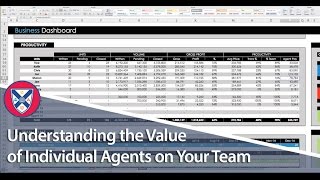
Speaker argues that to scale a real estate team into a true business you must understand the value each agent brings. Provides market benchmarks: typical agent sells 6–8 homes/year (with ~50% selling 1–2), serious full-time agents sell ~10–12; average commission check ≈ $6,500. Using 10 sales as an example gives ~$65k gross before expenses; after blended deductions (≈12% brokerage, 12% marketing, 4–5% other) the example net is about $40k before taxes. Top performers sell 15–20 homes producing higher net ($60–70k). The speaker contrasts these market averages with his team, where multiple agents project much higher take-homes (examples: 113, 83, 78, 67, 68 — units implied thousands), and notes a 67% gross profit on his top producer (bringing in 365 with 244 profit and 113 take-home). Emphasizes discussing net take-home (not just splits) when recruiting and targeting ~67% gross margin for the business.
Foreign. So this is something that if you're, if you're going to scale your build out systems, build a true business and scale that business, you have to get this part right. Fundamentally, if you don't wrap your head around the value that an agent brings to your team, your business is never going to be a true business. So I find a lot of teams overpay their agents because their agents aren't productive. So we're going to cover buyer lead management policy and we're going to cover all the tools that agents use in module six in terms of accountability and reporting to help your agents be productive. But you have to go back and think of fundamentally, this is a question that I answered a long time ago and there's two parts of it. You know, when you're talking to people that are looking to join your team, you know, you need to sort of figure out first of all, what does a typical agent make in your market, in the real estate market. So, so that may be more or less than that person you're talking to can make in another job market. So we all know that, or I know that there really is no easy way to go out and make money if you're, you know, you haven't been successful in other jobs or you've been a $40,000 person or a $50,000 person or a $60,000 person, you know, doesn't mean you can't come into real estate and totally crush it. But for the most part, you kind of have a relative idea. When we put our folks, through our applicants, through the process of applying for a position, we ask them what they've made in other positions, we ask them what their ideal compensation is. So for someone that made 40,000 and they want to make 200,000 in real estate, they may not be someone that can make 200,000. So kind of keep that in mind. But let me run through this here. It'll give you a good perspective, a good idea of what I think about when, or what I thought about when I was involved in recruiting and what I know to be true. So in my market, the Average agent sells six to eight homes per year. If you take out, there's probably 50% of agents in my market that sell one or two homes per year. If you take out those agents that are really part time agents, you know, you probably have about 10 to 12 sales per agent that is taking the business seriously that they have to make income from real estate. So our average commission check is roughly about $6,500. So take 10 sales that's a gross, a top line of about $65,000 before expenses. You know, if you take out, take a blended 12% for brokerage fees, another 12% for advertising, marketing, maybe 4 or 5% for other expenses like websites, leads or whatnot, you're left with about $40,000 before taxes. So that's probably not even an average agent. If you look at some of the top performers on the market are selling 15 to 20 homes. So that number may be 60,000 net or 70,000 net. But there are a lot of agents making less than that as well. So you may be in a market where you have a higher average price point. And in those markets I've seen agents will typically earn what they need versus earn what they can, what they can. Ultimately the maximum they can earn. So $40,000 in my market, maybe 50 net before taxes. So I know that on my team we're in a different, different ballgame. So you may not be able to see the screen here, but it's. If I pull up productivity for my team and you look at pay. So this is closed and pending for the year. I've got one agent at 113, one agent at 83, one at 78, one at 67, one at 68. So we have probably about one or two agents will be 110, 120. One guy's got a shot at getting 175, 180. And another have couple have a shot at getting to 130, 140. But keep in mind the gross profit on those agents. So I have a 67% gross profit on my top producing agent. So he's pretty busy. He's working hard and he'll have a shot at 175 to 180 take home. But that's 67% profit to me. So he's bringing in 365 and I'm profiting 244 on him and he's taking home 113. So the model works. A lot of times I see teams that they need to pay their agents more because they're not productive. And that's really a bad position to be in. So our agents are selling real estate, a lot of real estate, in order to get compensated for their efforts and the value they bring to the teams. So agents on my team all take home more than double what the average net in my market. Even if I call the 40, 50, you know, average it out or round it up to 50,000 net before taxes. My agents have legitimate, not even a hard road or hard path to get to 100, but they can make 100,000 on my team. So you need to know these numbers and be comfortable talking about them. And not as a put down kind of way when you're talking to people, but you need to be comfortable with the fact that you're talking net take home versus top line because agents want to go right to splits. And that's the conversation. You know, it's a tough conversation to have when you really need to shoot for 67% gross margin in your business. And I'll get into all of this. I'm throwing a lot of numbers at you guys, but I want to make sure you understand the importance of knowing what's going on in your market.