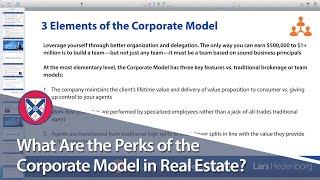
The speaker outlines the advantages of a corporate model in real estate teams, arguing that scaling to $500k–$1M in earnings requires building a team structured on sound business principles. Three core features are highlighted: (1) the company (large group) maintains client lifetime value and consistent consumer experience; (2) workflow is split into specialized roles (buyer/listing specialists, inside sales, client care) rather than relying on jack-of-all-trades agents; (3) agents move from traditional high splits to lower splits aligned with the value they provide. The speaker gives market and performance figures (average market price point ~$240–$250k; five staff projected to close ~400 transactions; owner gross margin ~64–65% vs. traditional ~40%).
Questions this video answers
Approximately $240,000–$250,000.
Five staff; projected to close 400 transactions this year.
Their operation: ~64–65% gross margin; traditional team's best case: ~40% gross margin.
Foreign. So let's get into the corporate model. And this is kind of what we're, we're talking about here. Leveraging yourself through better organization and delegation. And the only way you can earn, you know, half a million to a million. And this is market dependent. You know, our market is kind of middle of the road. We're 240, 250, average price point. But the only way that you can earn 500,000 to a million is to build a team. Not just any team. It must be based on sound business principles. So at the most elementary level, the corporate model has three key features versus a traditional brokerage for sure, or a traditional team model, the company. So in my case, the large group maintains the client's lifetime value and delivery of value proposition to the consumer versus giving up control to your agents. So in that other agent that I was talking about, once my client handed a buyer sign call to that other agent, the consumer experience was based on that other agent's ability to deliver whatever experience they wanted. Plus they close each of their agents close their own files. So there's no consistency in the contract to closing portion in that experience. And there's no consistent follow up from the team as far as the team is delivering the services. And the team cares about how your experience was. And here's a survey. The team wants to know how we did. Here's an annual event that the team wants you to come to. Here's a box of chocolates that the team wants you to pick up. You know, Lars asked me to give you a call. So the maintaining of a client's lifetime value is super, super important here in the corporate model. Number two workflow processes are performed by specialized employees rather than a jack of all trades traditional agent. So we have broken down and I'll go through my org chart here, but we have buyer specialists, we have listing specialists, we have inside salespeople, we have listing client care people, we have buyer client care people. I make it sound like we have a ton of people. We only have five staff that'll close 400 transactions this year. But I'll go through the org chart here in a second. But definitely specialized versus jack of all trades. And number three element of a corporate model here, agents are transitioned from traditional high splits to much lower splits in line with the value they provide in the transaction. And that's when you look at the compensation models that we'll talk about. And the ones that I use in my business, they're radically different from anything you've seen traditionally. Traditional team model is 50, 50 split and higher split to the agent for their sphere. So the. And there's not a whole lot of value provided by the team. And so, you know, the owner's best case on gross margin is probably 40% gross margin. And we're operating at 64, 65% gross margin. So I see a minimum 20% gap in my team in terms of gross margins. So our gross commission income minus our agent Pay, I'm retaining 65% of that to pay expenses and to pay myself profit and put cash in the bank. So it's because we have, we provide most of the value. We bring 80%, 85% of the business to our agents versus relying on our agents to bring a lot of business to the team.